
Multi cable transit fire rating claims look solid until a surveyor asks for the certificate. I have seen E-house jobs stall there, so our factory leads with test documents.
Verify multi cable transit fire rating by matching the Type Approval Certificate scope—A-0 or A-60, bulkhead orientation, plate material, frame size, cable diameter range and fill percentage—against the E-house as-built drawing, then confirm any A-60 insulation detail and installation instructions before sign-off.
That sentence is the whole method. The rest of this article breaks it into four checks you can run during supplier qualification, design review and site inspection. I will also show you what we send from our side so you can run those checks on our parts.
How can I confirm that MCT fire rating test documents actually cover A-0/A-60 bulkhead requirements before I approve a supplier?
A sourcing engineer in Rotterdam once emailed me a competitor brochure stamped A-60 and asked one question: which page proves it? That question shaped how our factory assembles document packs.
Confirm coverage by reading the certificate scope, not the cover page: it must name A-0 and A-60 bulkhead divisions, list the tested steel plate thickness and orientation, reference IMO 2010 FTP Code Part 3, and state the frame sizes, cable diameters and fill limits the approval applies to.
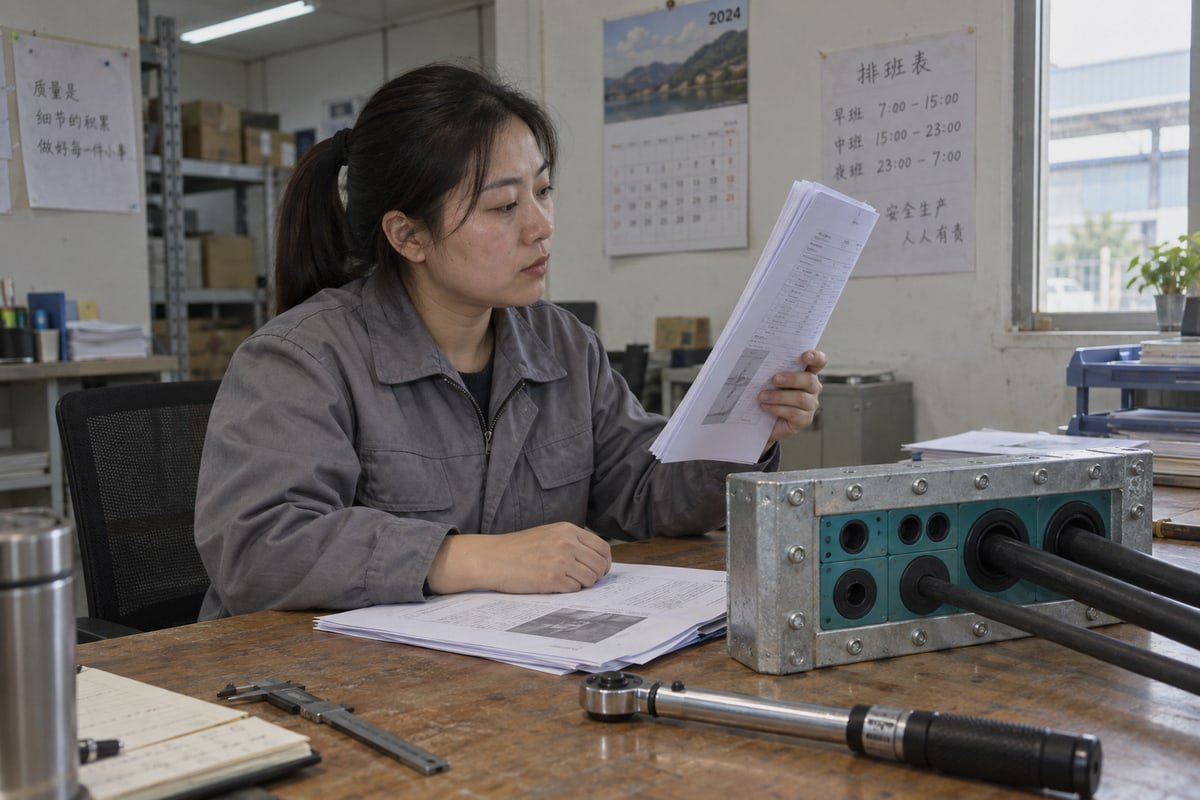
The word "approved" is cheap. The scope table is where the value sits. So I start every review there, and I recommend you do the same.
What A-0 and A-60 mean for an E-house wall
Both ratings are A-class divisions under SOLAS Regulations 1. Both are built from steel or an equivalent material. Both must hold fire integrity for 60 minutes against the cellulosic fire curve defined in IMO FTP Code Part 3 2. That curve reaches roughly 945°C at the one-hour mark. The difference between the two ratings is insulation on the unexposed side.
| Rating | Fire integrity | Insulation criterion on unexposed face | Typical E-house boundary |
|---|---|---|---|
| A-0 | 60 minutes, no flame or hot gas passage | None required | Wall facing an open deck or a low-risk area |
| A-60 | 60 minutes, no flame or hot gas passage | Average temperature rise limited to 140°C for 60 minutes | Wall facing machinery, accommodation or a high-risk process area |
For an A-0 wall, the penetration only needs to stop flame and hot gas. For an A-60 wall, the transit must also slow heat transfer. That is why A-60 approvals often carry an insulation detail around the frame. If the certificate for an A-60 rating does not mention insulation, ask why.
The four documents I ask for
- The Type Approval Certificate. It should list A-0 through A-60, bulkhead and deck, and the division material.
- The fire test report behind it. It should show the tested plate thickness, orientation, frame size, module mix and cable loading.
- The installation manual referenced in the certificate. This is the drawing the approval is tied to.
- Your own as-built drawing of the E-house wall. The first three are useless if they do not match this one.
Same product family is not the same configuration
Buyers often tell me, "The family is approved, so this frame is approved." That is a real objection, and it is half right. A transit family can hold several approvals. But each approval names specific frame sizes, module combinations, cable diameter ranges and a maximum fill percentage. A larger frame, a different stay plate count or a new module size may sit outside that scope. On our own A-0/A-60 test documents we list the exact TSC module set and frame that went through the furnace. I send that page first, before any brochure, because it is the only page a surveyor will read.
What dimensional and installation details do I need to check so my MCT modules seal correctly against the E-House bulkhead cutout?
On our Shandong line we measure every welded frame opening before it leaves, because a two-millimetre error in the E-house cutout turns a certified penetration seal into an unsealed gap.
Check the cutout against the frame's outer dimensions and tolerance, the bulkhead plate thickness and material, welded versus bolted fixing, module stack height with stay plates, cable diameter per module, fill percentage, compression unit torque, and any A-60 insulation overlap around the frame.
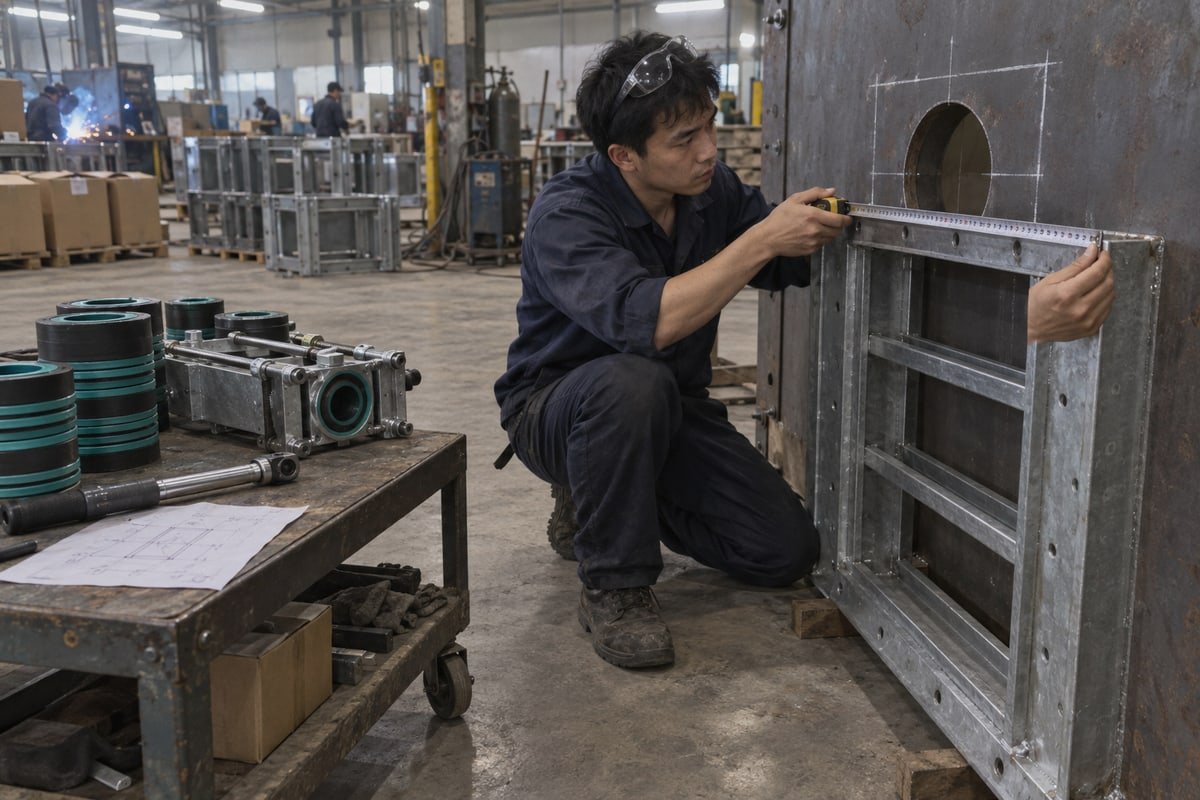
A certificate proves the assembly worked in a furnace. The details below prove your assembly is the same one. I walk through them in the order they appear on a job.
Step by step from cutout to compression
- Confirm the cutout size and squareness. Our frames are dimensionally compatible with common 120-frame standards, so they fit an existing cutout as a second source. Still, measure the opening on the fabricated wall, not on the CAD model.
- Confirm the plate. Note thickness and material. An approval for a steel bulkhead does not transfer to an aluminium or sandwich panel.
- Match the fixing method. If the fire test used a welded frame, transit frame installation on your E-house should also be welded. A bolted frame with a gasket is a different assembly and needs its own approval.
- Build the module stack from the drawing. Each row of TSC square modules or TSR round seals sits between stay plates. The stay plate count and row height must match the tested layout.
- Check cable diameter against each module. Our step-core EPDM modules cover a range of diameters within one size, but that range has limits. A cable below the range leaves an air gap. A cable above it will not compress.
- Check fill percentage. Empty positions must carry blank modules. Overfilling is the most common site fault I see.
- Compress to the specified torque with the compression unit and record it.
The one-page site comparison table
| Item | Certificate or manual value | As-built value | Match? |
|---|---|---|---|
| Bulkhead rating | A-0 or A-60 | From fire plan | |
| Plate material and thickness | e.g. steel, tested thickness | Measured | |
| Frame outer size and cutout | Listed size and tolerance | Measured | |
| Fixing method | Welded or bolted | Observed | |
| Stay plates and rows | Listed count | Counted | |
| Cable diameter range per module | Listed range | Measured per cable | |
| Fill percentage | Listed maximum | Calculated | |
| Compression unit torque | Listed value | Recorded | |
| A-60 insulation overlap | Listed detail | Observed |
Insulation and the thermal bridge
An A-60 wall usually carries mineral wool 3 on one side. The transit frame is bare steel and acts as a thermal bridge through that wool. So the test report will show how far the insulation overlaps the frame, and on which side. Run a simple thermal bridge check for your plate thickness and copy the overlap from the report. Do not guess it.
After transport
E-houses travel by road and sea before they are commissioned. Vibration can relax the compression unit. I ask site teams to re-check torque on every frame after transport and before energising. It takes minutes and it protects the rating you paid for.
Which certifications and third-party approvals should I request to validate MCT fire and gas-tight performance for my project?
Every third-party certificate costs us test time and money, so I weigh each one against what a European purchasing engineer will actually ask for during supplier qualification.
Request a classification-society Type Approval Certificate (DNV, ABS, Lloyd's Register or Bureau Veritas) covering A-0/A-60 bulkheads, the underlying fire test report to IMO FTP Code Part 3, MED Wheelmark where SOLAS applies, plus separate IP68 and gas-tightness test reports, since those are not fire evidence.
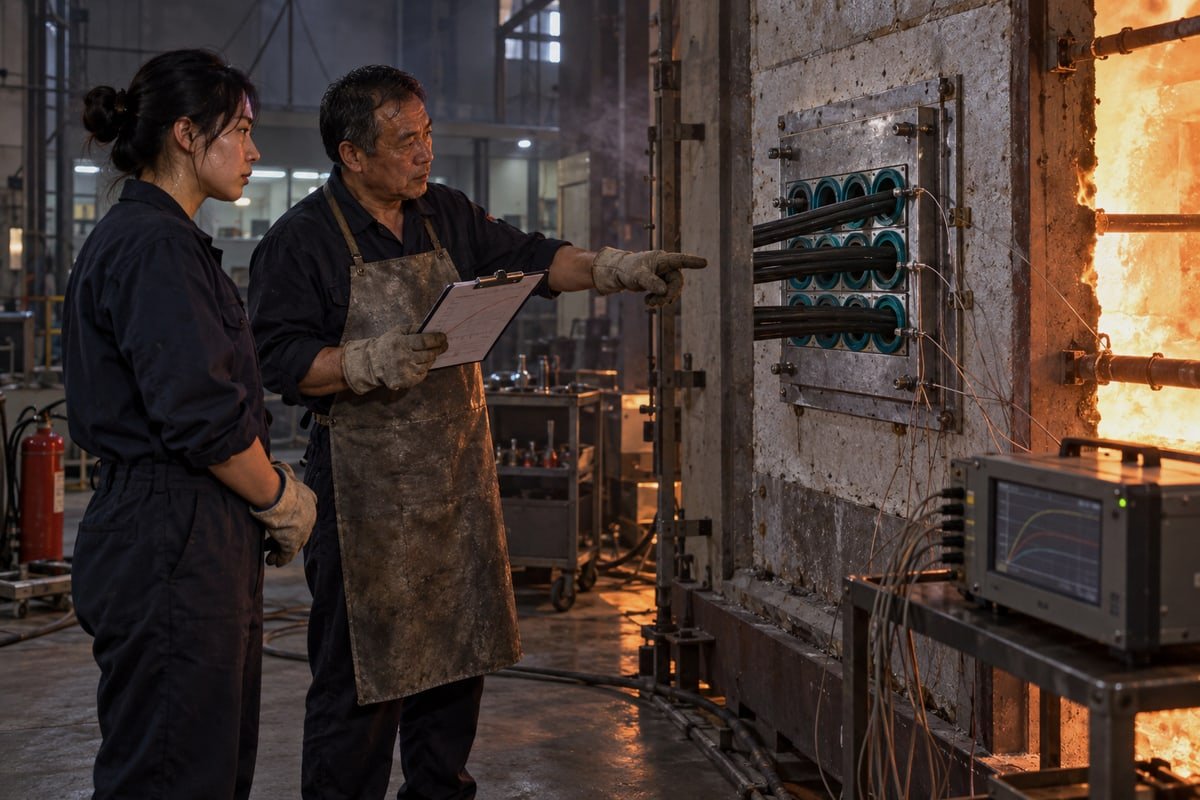
Fire, water and gas are three different tests. A supplier who blurs them is either careless or hiding a gap. Here is how I separate them when I build a document pack for a buyer.
What each document actually proves
| Document | What it proves | What it does not prove |
|---|---|---|
| Type Approval Certificate from a class society (DNV GL certification, ABS class approval, LR, BV) | The tested assembly meets A-0/A-60 for the listed divisions and configurations | That your untested frame size is covered |
| Fire test report to IMO FTP Code Part 3 | Integrity and insulation results against the cellulosic fire curve | Water or gas performance |
| MED Wheelmark | Compliance with EU marine equipment rules for SOLAS vessels | Anything on a land-based E-house outside SOLAS |
| IP68 test report | Ingress protection against dust and immersion | Fire performance |
| Gas tightness test report | Pressure holding, in our case 0.01–0.4 MPa watertight and gas-tight | Fire performance |
| ISO 9001 4 / IATF 16949 5 | The factory runs a controlled quality system | Product performance on its own |
Our factory is BV-approved and runs ISO 9001 and IATF 16949 systems. Our A-0/A-60, IP68 and gas-tight test documents are available on request, and I send them as separate files so nobody has to hunt for the fire page inside a water report. If your project sits under SOLAS, ask for the Wheelmark as well. If it is a land-based BESS container or a modular data centre, the class certificate and test report usually carry more weight than the Wheelmark, and your insurer may name the body they accept.
A-0 or A-60: do not over-specify by habit
I see A-60 written into specifications for walls that face an open deck or a benign yard. That is an objection worth raising with your fire engineer. A-60 adds insulation overlap, more site work and higher cost. A-0 may be the correct rating for that boundary under the structural fire protection plan. Choose the rating from the fire plan, then buy the matching approval. Do not buy A-60 as a comfort blanket.
Two details that matter after the fire
Ask for halogen-free, low-smoke module material. Our step-core modules are halogen-free EPDM. In a fire, halogenated rubber releases corrosive gas that damages switchgear contacts and control boards long after the flames are out. Also ask how each frame will be tracked. A nameplate with a QR code or an RFID tag on every frame lets your maintenance team log torque checks and module changes across the E-house lifecycle. That record is what a surveyor wants to see in year five.
Can I get free validation samples and test reports to verify A-0/A-60 compliance before committing to a bulk MCT order?
One lesson from our early export years: a free sample that arrives without its test report only creates a second question. Now every validation pack ships with paperwork attached.
Yes. DewinMCT supplies free validation samples of TSC square modules, TSR round seals and matching 120-frame-compatible frames, together with A-0/A-60 test documents, IP68 and gas-tight reports, a model cross-reference table and STEP files, so your team can verify fit and compliance before a bulk order.
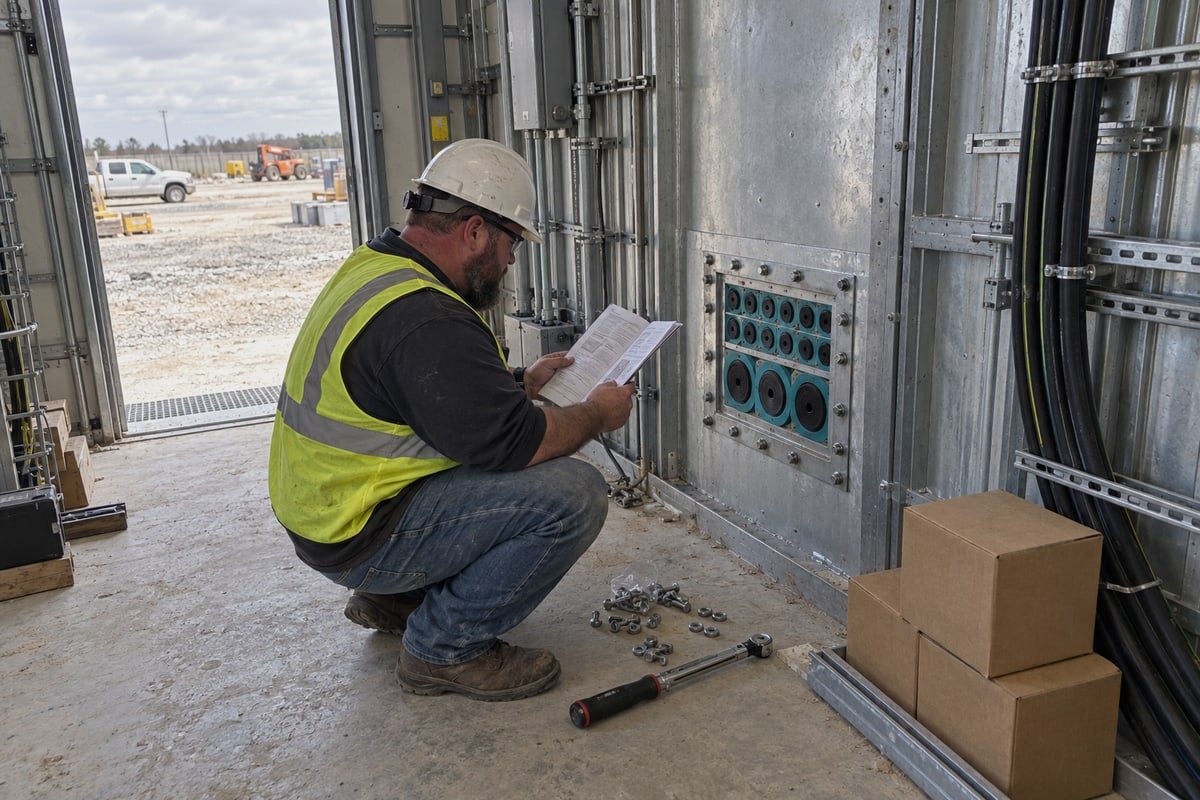
A sample is not a gift. It is a test piece. I want you to put it on your own bench, in your own cutout, and try to make it fail. Here is how that usually runs.
How a validation round works
- You send us your current frame model and cable schedule. We return a cross-reference from your existing model to the matching DEWIN model.
- We ship the sample frame, modules, stay plates and a compression unit. The A-0/A-60 test documents, IP68 report and gas-tightness report go in the same shipment, plus CAD or STEP files.
- Your engineer checks the drop-in fit in an existing cutout and compares the modular seal dimensions to the incumbent part.
- Your QA team compares our certificate scope against your bulkhead rating, plate and fill, using the table from the second section of this article.
- If everything matches, you qualify us as a second source at 40–60% lower component cost. If something does not match, you tell us and we adjust, because our mold shop is in-house.
What is in the pack
| Item | Purpose in your verification |
|---|---|
| TSC square modules, step-core halogen-free EPDM | Check cable diameter range and compression behaviour |
| TSR round seal assembly | Check fit for single-cable or pipe penetrations |
| Transit frame compatible with 120-frame standards | Confirm drop-in fit in the existing cutout |
| Stay plates and compression unit | Rebuild the tested stack and torque sequence |
| A-0/A-60 fire test documents | Match scope to bulkhead rating and orientation |
| IP68 and gas-tight (0.01–0.4 MPa) reports | Separate evidence for water and gas performance |
| Model cross-reference table and STEP files | Update drawings and BOM without redesign |
Factory-fitted or field-fitted?
Some buyers prefer penetration packages fitted at the E-house fabricator, because one team owns the installation record. Others prefer field-fitted modular seals, because cable schedules change late in commissioning. I do not see this as a conflict. A modular transit supports both. What decides the rating is not where the frame was fitted. It is whether the final stack matches the certificate and whether someone recorded it. We handle export documentation for either route, and we hold spare sealing modules for fast delivery when a late cable change needs a different diameter.
Conclusion
Specification alone will not pass a surveyor. Match certificate scope to the as-built bulkhead, keep records traceable, and request our samples and test documents before you buy.
Footnotes
1. Background on the SOLAS convention that defines A-class fire division requirements mentioned. ↩︎
2. International Maritime Organization is the authority behind the FTP Code fire-test standard cited. ↩︎
3. Explains the insulation material used on A-60 walls to limit heat transfer, as described. ↩︎
4. ISO’s own page explains the ISO 9001 quality management standard referenced for factory certification. ↩︎
5. Official body overseeing IATF 16949 automotive/manufacturing quality standard cited by the factory. ↩︎



 English
  Español de México
  Deutsch
  Français
  العربية
  Русский