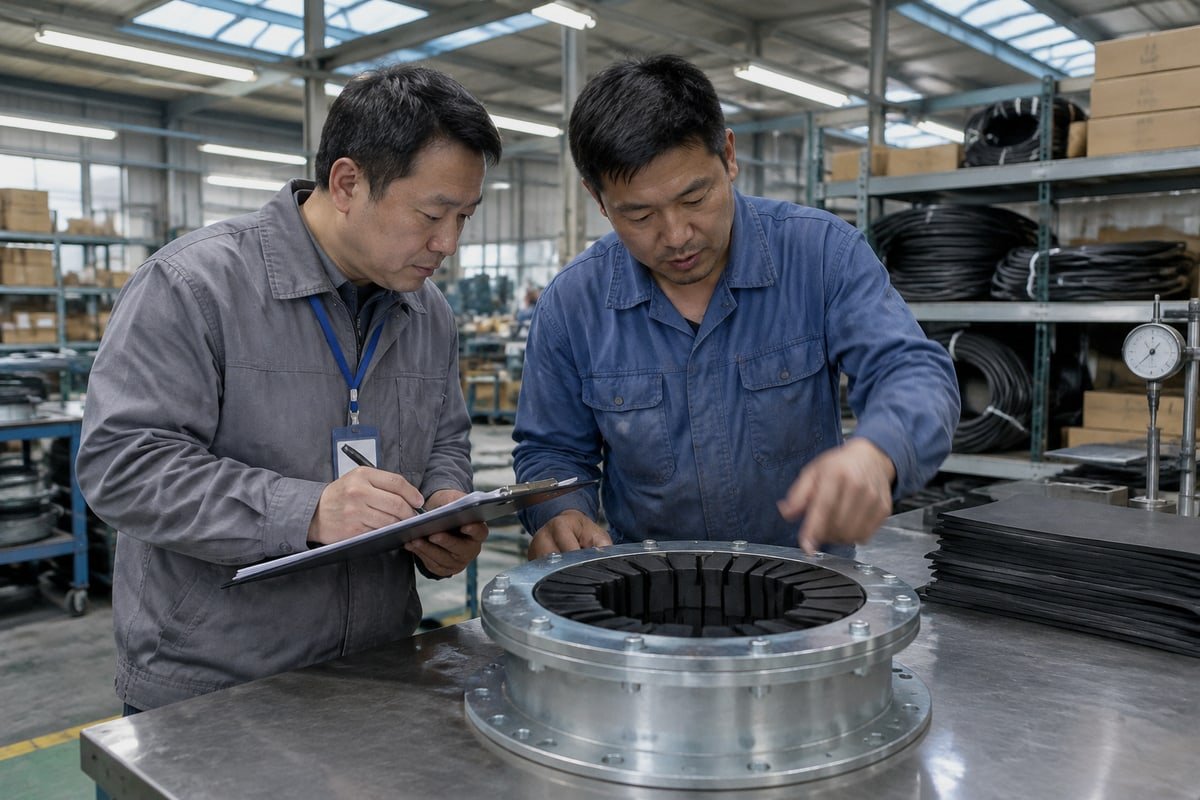
Buyers ask our factory whether to hire a third-party auditor or send staff to inspect a multi cable transit factory 1. Pick wrong, and a bad module fails in service.
Hire a third-party auditor first to verify the factory’s Quality Management System, ISO 9001 and IATF 16949 records, and capacity; then send your own engineers only for product-specific checks such as sealing tests, mold tooling, and traceability. For safety-critical MCT orders, a hybrid model is the most defensible choice.
This is not just a cost question. It is a question about risk, expertise, and evidence. Below, I break down the costs, the checklist, the limits of [remote audits](https://dewinmct.com/?p=599), and the red flags that matter for cable transit suppliers.
How much does a third-party MCT factory audit typically cost compared to sending my own staff?
I weigh the same trade-off with every European buyer planning a visit to our Shaanxi plant: an auditor's fee against flights, hotels, and a lost engineering week.
A third-party MCT factory audit is priced as a fixed day rate for one or two auditor-days, which usually costs less than sending two engineers to China for a week once flights, hotels, visas, and lost project time are counted. Staff visits cost more but go deeper technically.

The cost gap is real. But the shape of the cost matters more than the headline figure. An auditor's fee is visible and fixed. The cost of your own staff is spread across salary, travel, and project delay, so it is easy to underestimate.
Where the money actually goes
| Cost element | Third-party auditor | Your own staff |
|---|---|---|
| Professional fee | Fixed day rate for one or two auditor-days | Salary continues, often with overtime |
| Travel | Local or regional auditor, short trip | Long-haul flights, hotels, visas, insurance |
| Time away from projects | None for your team | Usually a full working week per engineer |
| Report format | Standardized, dated, signed | Internal notes, variable structure |
| Repeatability | Same checklist across every vendor assessment | Limited by headcount and calendar |
| Acceptance by insurers and customers | High, because of independent third-party verification | Lower, because it is your own opinion |
The hidden cost: lost engineering time
Most purchasing teams do not budget for the week their senior engineer is not designing, not reviewing drawings, and not answering site questions. Yet that week is often the biggest line item. Outsourcing the systems audit keeps your technical staff on core project work. It also delivers early detection of process problems before the first order ships. That avoids the far larger cost of returning non-compliant components from a container site or a switchgear line.
When the staff cost is worth paying
Sending staff makes sense in three cases. First, the supplier is new and unproven. Second, the product is safety-critical, such as a fire-rated bulkhead seal. Third, you have real technical expertise in cable transits and want to check details a generic auditor will not. In our experience, we lower this cost for buyers in a practical way. We publish model cross-reference tables from existing 120-frame models to our TSR and TSC modules, and we ship free validation samples before any visit. That means a buyer can confirm dimensional compatibility on their bench first, then use the site visit only for the questions that need a physical presence.
| Situation | Recommended approach |
|---|---|
| Proven supplier, standard modules, repeat order | Document review, no visit |
| New supplier, standard modules | Third-party audit as pre-order gate |
| New supplier, custom frame or fire-rated application | Third-party audit plus staff visit |
| Any supplier, first project for a regulated end customer | Third-party audit for the impartial record |
Supply chain risk mitigation is the real budget line here, not travel. Spend where the risk is.
What should I include in an audit checklist to verify ISO 9001 and IATF 16949 compliance on-site?
Last year an auditor from a German switchgear builder spent his first hour at our Shaanxi plant on one thing: the nonconformance log, not the production line.
Your checklist should cover the certificate's scope and validity, document control, calibration records, incoming EPDM material inspection, batch traceability from raw compound to finished module, corrective-action logs, and IATF 16949 items such as PPAP files, control plans, PFMEA, and measurement system analysis. Verify each item against live records, not presentations.
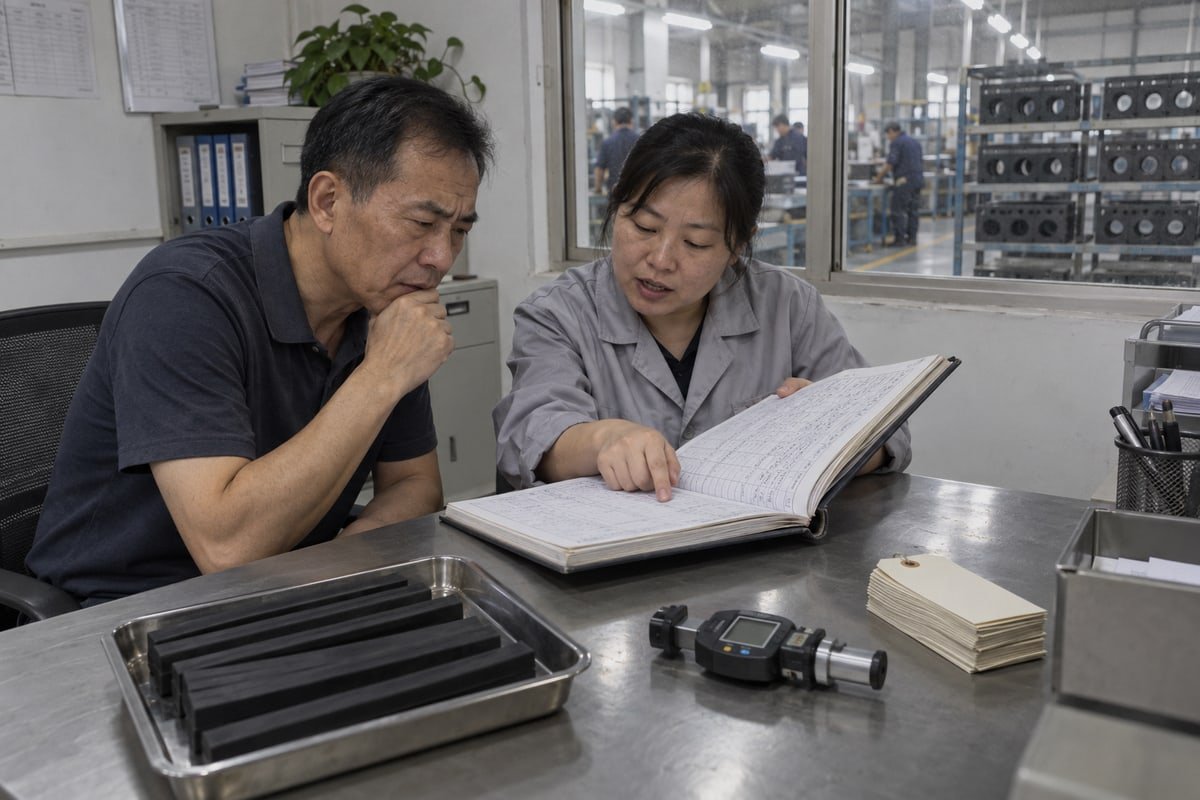
A certificate on the wall proves that an audit happened once. It does not prove that the system runs every day. Your checklist should force the factory to open live records in front of you. I have found that the good factories enjoy this. The weak ones stall.
Start with the certificate, not the brochure
Read the scope line on the ISO 9001 certificate. It should name the design and manufacture of cable and pipe penetration sealing systems, not a vague product family. Check the certification body 2 and the expiry date. Then ask whether any product or factory approval sits on top of the QMS. In our case, buyers ask to see the BV factory approval 3 alongside the ISO 9001 and IATF 16949 certificates. That layer matters for regulatory compliance in marine and energy projects, because type approval and QMS certification answer different questions.
The checklist
| Checklist item | What to ask for | Pass signal |
|---|---|---|
| Certificate scope and validity | Original certificate, scope line, expiry | Scope names cable transit products; not expired |
| Document control | Latest revision of a module drawing on the shop floor | Revision matches the engineering master |
| Calibration | Records for pressure gauges, calipers, durometers | In-date, traceable to a standard |
| Incoming inspection | EPDM compound test records, halogen-free declaration | Every batch tested before molding |
| Batch traceability | Follow one module from compound lot to shipment | Unbroken record, ideally a per-component QR code |
| Nonconformance and corrective action | Open and closed NCR list for the last twelve months | Root causes recorded, actions closed |
| Test evidence | Fire A-0/A-60, IP68, pressure 0.01–0.4 MPa reports | Reports match the exact module size quoted |
| Factory Acceptance Test (FAT) | Witnessed compression and leak test on a frame | Procedure written, results recorded |
What IATF 16949 adds on top of ISO 9001
IATF 16949 grew out of the automotive sector, but its tools translate well to sealing modules. Ask for the PPAP file 4 for the module you plan to buy. Ask for the control plan that shows which dimensions are checked at which station. Ask for the PFMEA that lists how a step-core module could fail and what prevents it. Ask for measurement system analysis 5 on the gauges used for critical tolerances. These documents show whether ISO 9001 compliance is a living process or a paper exercise.
Test the digital thread
One check I recommend is to pick a finished module at random and ask the factory to trace it backward. A mature multi cable transit factory can link that block to its raw material batch and to the vulcanization press record. If the answer needs a phone call and a spreadsheet hunt, the traceability claim is weaker than the brochure says.
Can I trust remote video audits and documentation reviews instead of an in-person factory inspection?
A Dutch BESS integrator once asked me to point a phone camera at our vulcanization press for forty minutes before he would even request samples.
Remote video audits and document reviews are reliable for confirming that a factory exists, owns its equipment, and holds valid certificates, but they cannot verify sealing pressure tests, compound quality, or hidden process gaps. Use them as a screening step, and reserve in-person or hybrid inspection for safety-critical MCT orders.

I support remote audits. We host them regularly for buyers in Europe and the Middle East. But I am honest about their limits. A camera shows what the person holding it chooses to show. That is a conflict of interest built into the format, even when the factory is honest.
What a camera can and cannot show
| Verification item | Remote video | Document review | In-person |
|---|---|---|---|
| Factory is real, not a trading office | Good | Weak | Good |
| Equipment exists and runs | Good | Weak | Good |
| Certificate validity and scope | Weak | Good | Good |
| Mold shop and tooling condition | Fair | None | Good |
| Compound quality and hardness | None | Fair, via test reports | Good, with a durometer in hand |
| Pressure and leak test performed correctly | Fair | Fair | Good |
| Workshop cleanliness and material segregation | Fair | None | Good |
| Unplanned questions to operators | Weak | None | Good |
The pattern is clear. Remote methods verify existence and paperwork. They do not verify performance. For a cable transit module, performance means watertight and gas-tight sealing across the rated pressure range, and fire boundary integrity. Those are physical properties. Someone with technical expertise needs to touch the product or watch the test with control of the camera.
The hybrid model with smart glasses
The most useful development I have seen is the hybrid model. A local third-party inspector wears smart glasses or carries a stabilized camera. Your engineer directs the inspector live from Europe during the Factory Acceptance Test (FAT). Your engineer says where to look, which gauge to read, and which module to pull from the rack. The inspector holds the camera, so the factory does not choose the view. This removes most of the conflict of interest. It also gives your engineer on-site quality control without a flight. We have run this format for compression tests on TSC frames, and the questions asked were as sharp as any in-person visit.
When remote is enough
For a repeat order of standard TSR modules from a supplier you have already audited, a document review and a short video call is proportionate. For a first order, or for a custom fire-rated frame, it is not.
What red flags should I watch for when evaluating a cable transit manufacturer's production capabilities?
The lesson we learned early, after opening in 2013, was simple: a shiny showroom tells you nothing; the mold shop and the scrap bin tell you everything.
Watch for no in-house mold making, EPDM compound bought without incoming inspection, fire and IP68 test reports for a different module size, no batch traceability, no accelerated ageing protocol, and a certificate scope that does not name cable transit products. Any one signals a trading company or a weak process.

Red flags are rarely dramatic. They are small gaps that add up. The table below lists the ones I would check first, and what each gap tends to mean in practice.
The red flag table
| Red flag | What it usually means | What to ask |
|---|---|---|
| No mold shop on site | Modules are sourced, not made; custom sizes will be slow | Show me a mold being cut or repaired |
| No incoming inspection of EPDM | Compound substitution risk; halogen-free claim unverified | Show me last month's incoming test records |
| Test report size does not match quoted module | Rating is borrowed from another product | Show me the report for this exact part number |
| No batch traceability | Recalls cannot be scoped; failures cannot be root-caused | Trace this module backward for me now |
| No accelerated ageing protocol | Long-term seal performance is unknown | Show me the ageing test method and samples |
| Certificate scope excludes cable transits | QMS was certified for something else | Read me the scope line |
| Cannot provide CAD or STEP files | No engineering department behind the sales team | Send me the STEP file for this frame today |
| Sales staff cannot name the rubber hardness | No technical depth in the customer-facing team | What is the Shore A of this module? |
Custom frame geometry and fire-stop integrity
Many BESS and modular data center projects push cable density beyond what a standard frame layout expects. That is where passive fire protection 6 can quietly break. A factory that only assembles standard frames will say yes to a custom cutout and then improvise. Ask to see the R&D process behind custom frame geometry. Ask how the factory confirms that the fire rating still holds when the cable fill changes. At our plant, custom frame sizes start in the in-house mold shop, and the engineering team reviews cable fill against the tested configuration before a drawing is released. Our 38-plus granted patents came out of exactly this kind of problem solving, not from marketing.
Ask for the accelerated ageing protocol
Elastomeric modules must hold their rated pressure for decades, sometimes in high-salinity air. Ask the factory how it ages its EPDM samples and what it measures afterward. Hardness change, compression set, and leak performance after ageing are the useful data. If the answer is only a datasheet from the compound supplier, the factory is trusting a vendor rather than testing its own product.
The trading company test
One question ends most doubts about a multi cable transit factory. Ask to walk from the raw compound store to the press to the finished goods rack without a break. If any part of that path is off site, you are talking to a trader. Our Shaanxi headquarters and our Shandong and Hunan sites all pass that walk, and I encourage every auditor to take it.
Conclusion
A wrong supplier choice puts fire and water boundaries at risk. Qualify systems with a third-party auditor, validate the product with your engineers, and demand evidence, not brochures.
Footnotes
1. Wikipedia provides a technical overview of multi-cable transit systems and their industrial applications. ↩︎
2. Official ISO site providing standards for certification bodies and quality management system requirements. ↩︎
3. Bureau Veritas is a leading authority for marine and industrial factory approvals mentioned in the text. ↩︎
4. Official IATF site for automotive quality standards, including Production Part Approval Process (PPAP) requirements. ↩︎
5. NIST provides the foundational standards for measurement system analysis and industrial calibration accuracy. ↩︎
6. The IMO sets international safety standards for passive fire protection in marine environments. ↩︎


 English
  Español de México
  Deutsch
  Français
  العربية
  Русский