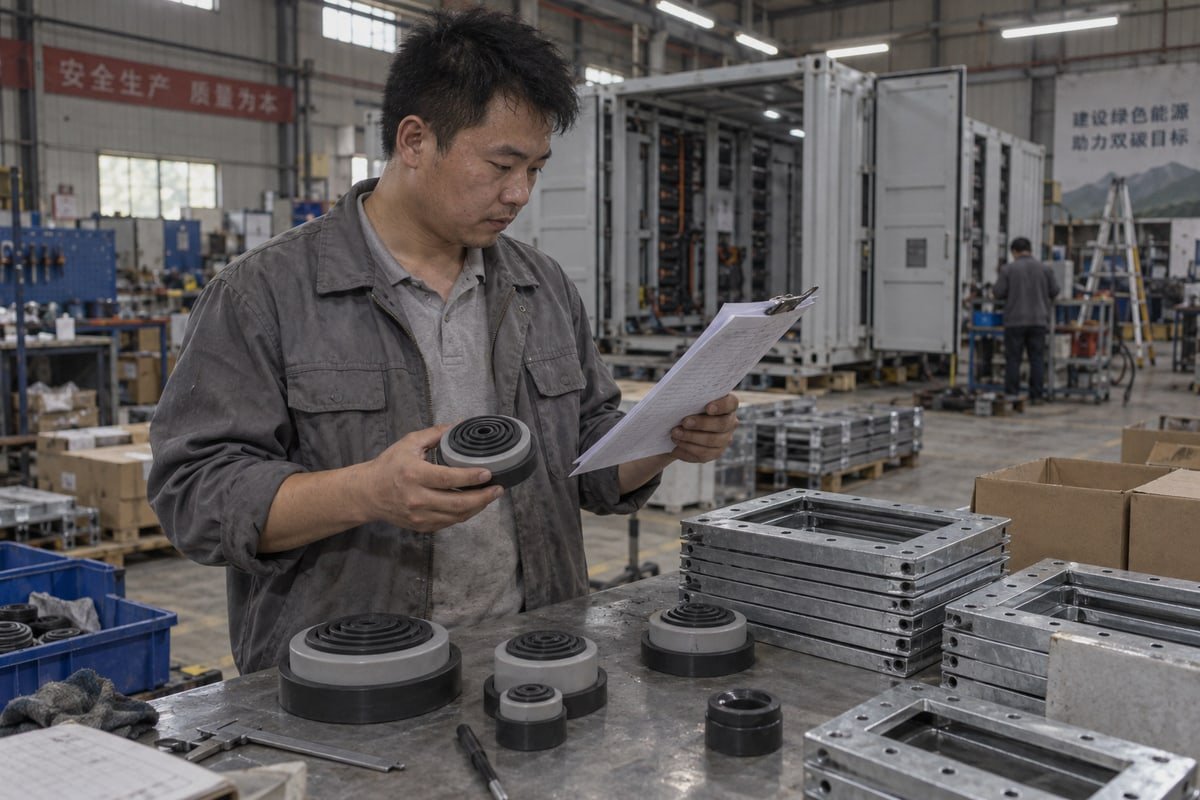
A single BESS container 1 can carry dozens of cable diameters. On our production line, I still see RFQs for multi cable transit inserts that list none of them.
To get multi cable transit insert solutions for various diameters from a China supplier, send a diameter-by-diameter cable schedule, state your frame standard and sealing level, request the supplier’s sizing chart and test documents, then confirm fit with free validation samples before placing an order.
The rest of this guide walks through each of those steps. I will show you what to ask, what to send, and how to read the answers you get back.
How can I confirm a Chinese MCT supplier's step-core inserts truly cover my full cable diameter range?
Every batch of step-core sealing modules leaving our Shaanxi plant gets a peel check. We strip layers on random samples and measure the bore against the labeled diameter range.
Confirm coverage by sending the supplier your full cable schedule with each outer diameter, then asking for a written sizing chart that maps every cable to a specific step-core module size, including the min–max range per peel layer, and verifying it on free validation samples.

The word "covers" hides a lot. A supplier can say a product line covers cables from 3.5 mm to 100 mm. That is a true statement about the line. It says nothing about whether the specific module in your quote fits the 27.4 mm cable on your drawing. So the first job is to move from a range claim to a cable-by-cable match.
Start with a diameter-by-diameter cable schedule
I ask every buyer for the same document before I quote. It is a plain table. One row per cable type. You already have this data in your harness drawings, so it costs little to share.
| Cable ID | Outer diameter (mm) | Quantity | Pre-terminated? | Notes |
|---|---|---|---|---|
| DC-01 | 27.4 | 8 | No | Power, EPDM jacket |
| DC-02 | 42.0 | 4 | Yes, lug fitted | Needs split insert |
| CTRL-01 | 9.8 | 24 | Yes, M12 connector | Bundle in one row |
| ETH-01 | 6.2 | 12 | Yes, RJ45 | Bundle in one row |
| Spare | — | — | — | 20% blind modules |
With this in hand, the supplier can return a sizing chart. That chart should name the exact module for each row. It should also show the peel range of that module. If a supplier only replies with a catalog PDF, push back. You want the mapping in writing.
Understand how step-core layers work
A step-core insert is a solid rubber block with concentric peelable layers. You remove layers until the bore is slightly smaller than the cable. Compression then closes the gap. Our TSC series uses halogen-free EPDM 2 for these layers. Each module size covers a defined cable diameter range, not a single value. That is why a handful of module sizes can handle a long cable list.
Many suppliers organize sizes into classes. One common modular product line uses module widths of 15, 20, 30, 40, 60, 90, and 120. Other systems cover roughly 4 to 54 mm across several insert sizes, while some cable entry plates span 1 to 35 mm or 1 to 65 mm. Custom manufacturing can push the top end toward 200 mm. Ask which class system the supplier follows. Then ask for the peel range per class in millimeters. Vague words like "fits most cables" are the failure signal.
Pre-terminated cables change the answer
If a cable already has a connector, it cannot pass through a solid bore. You need a split insert. Some engineers resist split designs because they worry about the long-term seal along the split line. That concern is fair. My answer is to test it, not argue it. Our modules are two-piece by design, and the compression wedge kit closes them into one sealed mass. A watertight test on the sample settles the question. Market data supports the split approach too: several transit systems are rated for pre-terminated cables up to 65 mm and bare cables up to 75 mm.
Finally, request free validation samples for the two or three hardest rows in your schedule. The largest cable, the smallest cable, and the one with a connector. If those three fit, the rest usually follow.
What certification and test documents should I request before qualifying a multi cable transit supplier in China?
A sourcing manager in Germany once answered our quote with one line: send the test reports first. That is the right order for a fire-rated seal.
Request the quality system certificates (ISO 9001, IATF 16949), a classification-society factory approval such as BV, DNV, ABS, or Lloyd's Register, fire test reports for A-0/A-60, IP68 ingress test reports, watertight and gas-tight pressure results, and material certificates for the halogen-free EPDM.

Documents fall into three groups. Some prove the factory runs a controlled process. Some prove the product survived a defined test. Some prove the material is what the datasheet says. A serious multi cable transit supplier should be able to produce all three without a long delay. Here is how I would sort the request.
| Document | What it actually proves | What to check |
|---|---|---|
| ISO 9001 / IATF 16949 | The factory has a controlled quality system | Certificate scope names MCT products, not just "rubber parts" |
| Classification-society factory approval (BV, DNV, ABS, LR) | An independent body audited the plant and product | Approval is current and lists the module series you are buying |
| Fire test report, A-0 / A-60 | The assembly held back fire for the rated time | Tested assembly matches your frame, module, and compression unit |
| IP68 test report | Sealed against dust and sustained immersion | Depth and duration are stated; IP66 or IP67 is not the same |
| Pressure test, watertight and gas-tight | Seal holds at a stated pressure | Range covers your case; our modules are tested at 0.01–0.4 MPa |
| Material certificate | Rubber compound is halogen-free EPDM | Hardness, temperature range, and flame class such as UL94-V0 |
| Chemical compatibility matrix | Rubber resists your oils or solvents | Your specific fluids appear in the matrix |
| Hardware material certificate | Bolts and compression parts resist corrosion | 316L stainless for high-salinity or offshore sites |
Match the certificate to the application
Not every project needs the full list. A control panel inside a dry building may only need an IP rating and a UL94-V0 flame class. A BESS container on a coastal site needs the IP68 waterproof rating, corrosion-resistant hardware 3, and often an A60 fire rating 4 at the container wall. Marine and offshore applications add the classification-society layer. Buyers in that segment usually ask for DNV GL certification 5 or an equivalent approval from ABS or Lloyd's Register. Ask what the supplier holds today. Our own factory carries BV approval, and I would rather show that document than promise a certificate we do not have yet.
North American projects sometimes specify NEMA 4X instead of IP codes. Make sure the supplier understands both systems. A wrong mapping here can fail an inspection later.
The low-price objection
Some buyers tell me they only want a cheap rubber insert. I understand the budget pressure. But an uncertified insert in a fire-rated bulkhead is not a saving. It is a liability that moves from the supplier to you. The better framing is this: a qualified second source should cut cost and still hand you the same test evidence as your primary supplier. That is the whole point of dual sourcing. If a supplier cannot produce test reports for a modular sealing system, the low unit price is not comparable to a certified one. You are comparing two different products.
One more practical point. Ask for the reports in English, with the test lab and the tested configuration named. A report that covers a different frame depth or a different module compound does not protect you.
How do I verify dimensional compatibility with my existing 120-frame system before ordering samples?
Early on, we learned a module can match the catalog number yet still fight the frame. Tiny frame-depth differences decided whether the compression wedge kit closed cleanly.
Verify compatibility by requesting the supplier's model cross-reference table, 2D CAD or STEP drawings of the module, frame, stay plates, and compression unit, then comparing the 120-frame packing depth, module footprint, and bolt spacing against your existing frame drawings before samples ship.

Drop-in replacement is the promise that makes a second source worth the effort. It only works if the geometry lines up. I approach this as a paper check first and a physical check second. The paper check costs nothing and catches most problems.
Ask for a model cross-reference table
A cross-reference table lists your existing module or frame model in one column and the supplier's equivalent in the next. We keep one for our TSR and TSC series against common 120-frame standards. It saves both sides a lot of back-and-forth. When you read it, look for the footnotes. A good table marks which items are true drop-in parts and which need a spacer or a different stay plate. If a supplier claims 100% compatibility with no exceptions, ask how they verified it.
Compare the drawings, dimension by dimension
Request 2D CAD drawings and 3D STEP models for every part that touches your frame. Then check the items below against your own frame drawings.
| Checkpoint | Why it matters | What to compare |
|---|---|---|
| Module packing depth | Must match the 120-frame depth or the seal will not compress evenly | Module depth vs. frame internal depth |
| Module width classes | Rows must fill the frame width with no gap | Sum of widths per row vs. frame internal width |
| Stay plate thickness | Sets row spacing and load transfer | Plate thickness and profile vs. existing plates |
| Compression unit stroke | Must reach full compression inside the frame | Wedge travel vs. remaining free height |
| Frame cutout and bolt pattern | Frame must bolt or weld into the existing opening | Outer dimensions and hole spacing |
| Peel-layer bore range | Module must reach your cable OD after peeling | Min and max bore vs. cable schedule |
Our engineers send these files as a package with the quote. If you work in a BIM environment 6, ask whether the supplier can provide BIM objects or digital-twin data as well. Modular data center builders increasingly want the transit in the model, not just on a drawing.
Plan spare capacity and mixed rows
While you have the drawings open, lay out the frame. Mix module sizes so each row is full. Then reserve a share of blind modules for future cables. Many EPC teams ask for a spare capacity layout with a fixed percentage of blind modules. That way a new cable later needs a peel, not a new cutout.
Stay plates and frames deserve attention too. A frame from a different supplier may use a slightly different weld flange. That is fine for a new build. For a retrofit, you keep the old frame and only swap modules, stay plates, and the compression unit. State clearly which case you are in.
Then order validation samples
Only after the paper check passes do I suggest samples. Ask for the installation manual and the list of tools with the sample kit. Install the sample in a spare frame or a test fixture. Torque the compression bolts to the stated value. If the wedge closes and the module faces sit flush, you have real evidence. That is worth more than any compatibility claim in an email.
What information should I include in my RFQ to get accurate pricing and lead times from Chinese MCT manufacturers?
Whenever we quote a mixed-diameter kit, I weigh two paths: pull standard TSC modules from stock, or open a mold in-house for an odd size. The RFQ decides which.
Include the full cable schedule with outer diameters and quantities, frame standard and cutout dimensions, required fire and IP ratings, target certifications, environment and chemical exposure, split or solid insert preference, spare capacity percentage, annual volume, packaging or private-label needs, and your delivery schedule.
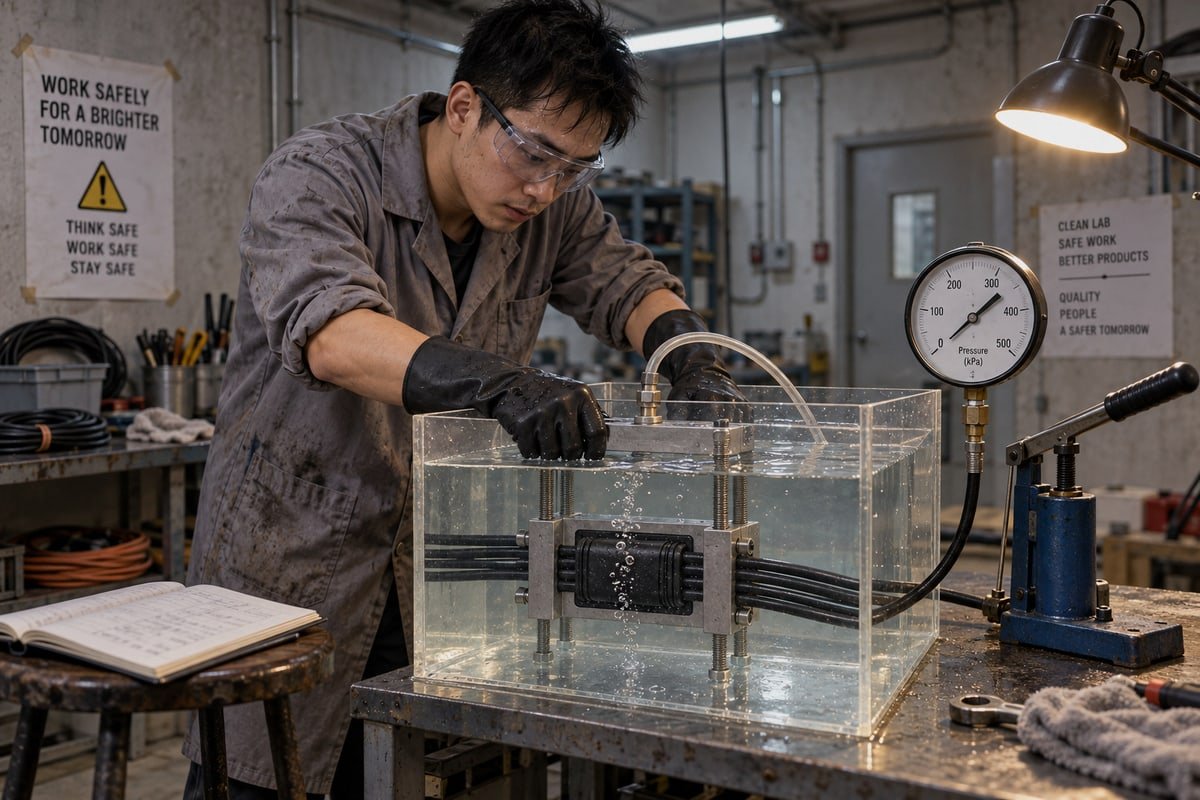
A vague RFQ gets a vague quote. A complete RFQ gets a firm price and a real lead time. Below is the order I would follow. It mirrors the questions our sales engineers ask when a request arrives half empty.
- Cable schedule. Every outer diameter, its quantity, and whether it is pre-terminated. This single table drives module selection.
- Frame standard and opening. State that you use a 120-frame system. Give cutout dimensions and wall or panel thickness. Say whether you keep your existing frame.
- Sealing performance. Name the fire class (A-0 or A-60), the ingress rating (IP66, IP67, or IP68), and the pressure you need the seal to hold.
- Certifications. List required bodies. BV, DNV, ABS, Lloyd's Register, or a UL94-V0 flame class. Ask which documents ship with the goods.
- Environment. Temperature range, UV exposure, salt spray, and any oils or solvents. Request 316L compression hardware if the site is coastal.
- Insert type. Split for retrofit and connectorized cables. Solid where the cable is bare and the engineer prefers a fully molded block.
- Spare capacity. Give the percentage of blind modules you want in each frame.
- Volume and cadence. Sample quantity, first order, and yearly forecast. Lead time depends on this more than anything else.
- Branding and packaging. Private label, color coding, kit trays, or bulk cartons.
- Delivery terms. Incoterm, port, and the documents your customs broker needs.
Standard or custom: the tradeoff behind the price
The RFQ also decides how much tooling sits behind your price. Here is the comparison I walk buyers through.
| Factor | Standard step-core modules | Customized cable entry seals |
|---|---|---|
| Unit cost | Lowest; built from existing molds | Higher; tooling amortized over the order |
| MOQ | Low; often from stock | Higher; tied to mold cost |
| Lead time | Shortest; sampling in days | Longer; mold design and trial shots first |
| Fit for mixed diameters | Good, via peel layers | Best, for sizes outside standard classes |
| Replacement later | Easy; any batch matches | Depends on supplier keeping the mold |
| Branding | Generic or simple marking | Full private label possible |
Most projects land on standard sealing modules for the bulk of the schedule. Custom work makes sense for a large-diameter pipe, an unusual oval cable, or a private-label kit. Because we cut molds in-house, the custom path is faster for us than for a trading company that must subcontract it. But it is never free. Tell me the odd size early. Then I can check whether an existing mold can be modified before anyone pays for a new one.
Why the numbers matter for the cost case
Purchasing engineers come to us for one main reason. A qualified second source for multi cable transit inserts typically lands 40–60% below the incumbent's price when it drops into the same 120-frame. That saving only survives if the quote is accurate. Missing diameters, a forgotten fire class, or an unstated salt-spray environment all add cost after the PO. A full RFQ protects the saving you came for.
Fazit
Vague inquiries buy the wrong inserts. Send a diameter-by-diameter schedule, demand test documents and drawings, validate free samples, and you will secure a certified second source at real savings.
Fußnoten
1. Authoritative report on the technical requirements and global deployment of grid-scale battery energy storage systems. ↩︎
2. Technical chemical database providing detailed properties and safety data for EPDM rubber compounds. ↩︎
3. Official resource for infrastructure standards and technical specifications in energy storage environments. ↩︎
4. International standards for fire protection and safety ratings in maritime and industrial environments. ↩︎
5. Official site for global classification and type approval services for industrial and maritime components. ↩︎
6. Comprehensive overview of digital modeling and BIM processes in modern construction and engineering. ↩︎



 English
  Español de México
  Deutsch
  Français
  العربية
  Русский