
A fire-rated multi cable transit can pass a datasheet and still fail your fire inspection. Our export team saw that risk early, so we built verification into every quote.
Verify a fire-rated multi cable transit by matching third-party test reports to your exact wall or floor assembly, cross-checking frame dimensions against your 120-frame cutouts, testing free samples for IP68 and pressure, and confirming CAD/STEP files and English technical support before ordering.
Below, I walk through the four checks in the order our own customers run them. Each one takes days, not months. Skipping any one of them is where projects get expensive.
What certification documents should I request to confirm fire ratings like A-0 or A-60?
Last year a QC engineer on our Shaanxi line rejected a batch because the nameplate did not match the test report configuration. That small mismatch is exactly what auditors catch.
Request the third-party fire test report naming the exact frame, module, and filler configuration, the certificate with A-0 or A-60 classification and test standard, the factory's ISO 9001 or IATF 16949 certificates, and installation instructions showing the tested assembly.

The word "fire-rated" tells you almost nothing on its own. The rating only has meaning when it is tied to a test standard, a substrate, an orientation, and a full assembly. That is the first thing I explain to any purchasing engineer who asks for our A-60 certificate.
What A-0 and A-60 actually mean
A-0 and A-60 are class divisions from the IMO FTP Code 1. They were written for steel bulkheads and decks on ships. A-60 means the penetration keeps flame integrity and limits the temperature rise on the unexposed side for 60 minutes. A-0 keeps integrity but carries no insulation time. Our TSR and TSC modules carry both ratings, and the test documents are available on request. But a marine A-60 report is not automatically your building-code rating. European data centers usually specify EI classes tested to the EN 1366-3 standard and classified under EN 13501-2. North American projects ask for UL 1479 certification 2 or ASTM E814, which report F and T ratings. NFPA-oriented data center guidance commonly calls for at least one-hour separations. So you must ask: does a report exist for my exact substrate, or only for a steel bulkhead?
| Standard | Region or use | What it proves | Applies to |
|---|---|---|---|
| IMO FTP Code (A-0 / A-60) | Marine, offshore, containers | Integrity and insulation on steel divisions | Transit assembly |
| EN 1366-3 + EN 13501-2 | Europe | EI rating on walls and floors | Transit assembly |
| UL 1479 / ASTM E814 | North America | F and T ratings for through-penetration firestop | Transit assembly |
| IEC 60331 3 | Global | Cable circuit integrity in fire | Cable only |
| EN 45545 | Rail | Reaction to fire of vehicle materials | Cable and materials |
Cable fire performance is not transit fire resistance
Many buyers mix these two up. IEC 60331 tests whether a cable keeps carrying current in fire. It says nothing about the seal around the cable. A through-penetration firestop rating belongs to the whole modular sealing system: frame, halogen-free EPDM modules, stay plates, and compression unit together. If only the frame was tested, the report is incomplete. I also recommend confirming that the rubber is LSZH. Corrosive smoke from halogenated rubber can damage server boards long after the fire is out.
The document set to demand
| Document | What to check |
|---|---|
| Third-party test report | Lab accreditation, exact model numbers, substrate, orientation, duration |
| Classification certificate | Product family named, expiry date, issuing body |
| Factory system certificates | ISO 9001 4, IATF 16949, BV factory approval |
| Installation instructions | Same module layout and torque as the tested assembly |
| Material declaration | Halogen-free EPDM, LSZH statement |
If a supplier sends only a certificate with no report behind it, keep asking. The report is the evidence. The certificate is only the summary.
How can I check dimensional compatibility with my existing 120-frame cutouts before ordering?
Every quote forces one trade-off for me: promise perfect drop-in fit, or ask the buyer for one more drawing. I always ask for the drawing.
Check compatibility by measuring your existing cutout width, height, and frame depth, comparing them to the supplier's cross-reference table, confirming module and stay plate stacking heights, and fitting a free sample frame and module set into one spare cutout before placing the order.
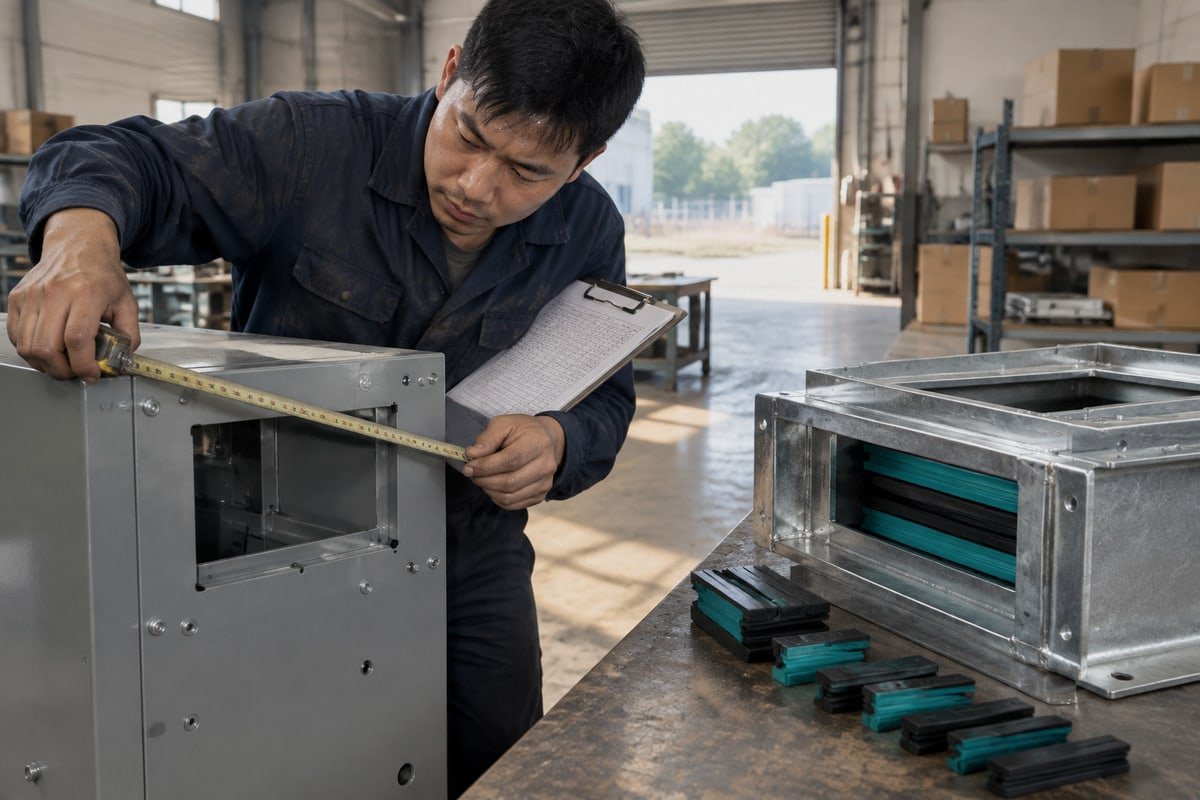
Drop-in second sourcing only works when the numbers line up. Our TSR and TSC modules were designed to be dimensionally compatible with common 120-frame standards, and we publish cross-reference tables that map an existing model number to the matching DEWIN model. Still, I never let a customer order on the table alone. Here is the sequence we ask them to follow.
A five-step compatibility check
- Measure the cutout, not the old frame. Steel panels move during welding. Record the finished opening width, height, and plate thickness.
- Pull the existing frame drawing. Note the internal opening, the flange width, and the bolt pattern if it is a bolted frame.
- Compare against the cross-reference table. Match the frame first, then each module size, then the stay plates and compression unit.
- Add up the stack. Module heights plus stay plates plus compression travel must equal the frame opening. A few millimeters of error means no seal.
- Fit one sample. Insert the free sample set into a spare cutout and torque it. This catches anything the paper missed.
| Dimension | Why it matters | Typical failure if wrong |
|---|---|---|
| Internal opening width | Modules must sit flush with no side gap | Compression cannot build pressure |
| Internal opening height | Full stack must be captured | Compression unit bottoms out early |
| Frame depth | Module depth must match wall thickness | Modules protrude or fire barrier is thin |
| Module step-core range | Each cable must fall within the peeled diameter range | Cable slips or is over-compressed |
Two data center details that the table cannot show
Hot aisles run warm all year. Frame steel and EPDM expand at different rates, so a marginal fit at room temperature can loosen at operating temperature. Our step-core, halogen-free EPDM keeps radial pressure across a range of cable diameters within one module size, which gives some margin here. Second, high-RPM fans create constant micro-vibration. A module stack that was compressed to the wrong height will walk over time. That is why I insist on the physical fit test, even for a customer who has used our cross-reference table before.
Can I get free validation samples to test sealing performance under real IP68 and pressure conditions?
A sourcing manager from the Netherlands once told me he trusted no IP68 claim until his own team dunked the sample. We shipped it free the next week.
Yes. Established MCT factories provide free validation samples of frames and sealing modules so your lab can run immersion, air-pressure, and compression tests. Ask for samples in your exact configuration and request the matching IP68 and 0.01–0.4 MPa test documents to compare against your results.

Sample testing is the fastest way to turn a marketing claim into a measured result. We offer free validation samples because a qualified second source has to earn the position. A buyer who tests our modules and then sees the same numbers in our third-party test reports has a reason to trust the next 500 units.
What your lab should actually test
| Test | Condition to reproduce | What passing looks like |
|---|---|---|
| Water immersion | Sustained submersion per IP68 intent | No ingress on the dry side after the hold |
| Air pressure | Within the 0.01–0.4 MPa range the supplier claims | No measurable pressure drop over the hold |
| Compression check | Install per instructions, then release and re-torque | Modules return to rated compression |
| Vibration seating | Mount near a running fan bank for a set period | No loosening of the compression unit |
| Chemical exposure | Contact with dielectric fluid or cleaning agents used on site | No swelling or hardening of the EPDM |
Gas-tightness is a separate question from IP
IP68 protects against dust and water. It does not prove the seal holds a clean agent during a discharge. Rooms protected by FM-200 5 or Novec 1230 need every penetration to stay gas-tight and water-tight, or the agent concentration falls below the design level. The same tightness supports the static pressure that precision cooling depends on. Our modules are tested gas-tight and watertight in the 0.01–0.4 MPa range, and I always ask buyers to run the pressure test on their own sample rather than take that line on faith.
Where immersion cooling changes the picture
Liquid-immersion racks put dielectric fluids near the penetration. The intumescent filler and the EPDM must both stay stable in contact with that fluid. If your site uses immersion cooling, send us the fluid datasheet before we cut samples. Passive fire protection only works if the material still behaves as tested on the day of the fire.
What CAD or STEP files and technical support should I expect from a Chinese MCT manufacturer?
One lesson cost us a project early on: we sent a PDF drawing when the EPC's BIM team needed native STEP. Now every quote ships with both.
Expect native STEP and 2D DWG or DXF files for frames, modules, stay plates, and compression units, a model cross-reference table, installation instructions, torque values, and English-speaking engineers who answer technical questions promptly and support custom sizes through in-house mold making.

Files and support are where a real factory separates itself from a trading company. A trader forwards whatever the plant gives them. We generate the models ourselves, because our engineers designed the parts and hold the 38 granted patents behind them. That difference shows up every time a consultant asks a hard question.
The deliverable set to expect
| Deliverable | Format | When you should have it |
|---|---|---|
| 3D models of frames and modules | STEP | With the first quote |
| 2D dimensioned drawings | DWG, DXF, PDF | With the first quote |
| Cross-reference table | Spreadsheet or PDF | Before sample release |
| Installation instructions and torque values | With the samples | |
| Third-party test reports | PDF, English | On request, before purchase order |
| Custom size drawings | STEP and 2D | After mold review, before tooling |
Supporting the factory audit process
A European sourcing manager will often ask for an audit before the first container. We welcome that. Our factory is BV-approved and runs ISO 9001 and IATF 16949 systems, so the audit trail already exists. If you prefer an independent body, agencies such as SGS or Intertek can perform the pre-shipment inspection. Ask for batch traceability, production photos, and a check that shipped units match the certified test samples. That is the factory audit process I would want if I were buying.
Questions worth asking your engineer contact
Ask whether EMI/RFI shielding variants exist for penetrations near sensitive equipment. Ask whether the supplier holds any FM Approved listings, and if not, which route they suggest for FM-governed sites. Ask how private-label production is handled, because many integrators want their own name on the nameplate. In our case, in-house mold making means custom sizes and private labels do not add a middleman. Good technical support is not a hotline. It is an engineer who reads your cutout drawing and tells you what will not fit.
Fazit
Unverified transits fail inspections and stall commissioning. Match reports to your assembly, fit a sample, test it, and demand real files. That is how we earn second-source status.
Fußnoten
1. Official International Maritime Organization page explaining the fire protection codes used for marine vessel safety. ↩︎
2. Authoritative source for the North American firestop testing standard mentioned for through-penetration systems. ↩︎
3. Official site for the International Electrotechnical Commission, which defines the cable circuit integrity standard. ↩︎
4. Official ISO landing page for the quality management standard required for factory audits. ↩︎
5. Technical overview of the clean agent fire suppression system commonly used in data center environments. ↩︎



 English
  Español de México
  Deutsch
  Français
  العربية
  Русский