
Sending MCT drawings to quote is how designs get leaked by suppliers. One forwarded email can seed a clone. Our Shaanxi factory reviews incoming RFQs, so I see over-disclosure often.
To protect designs from being leaked by suppliers when sourcing multi cable transits, share performance requirements before geometry, sign an enforceable NNN agreement first, vet the factory’s certifications and document control, release only redacted interface files, and confirm second-source compatibility through cross-reference tables and validation samples, not full drawings.
That answer has four parts. Each one maps to a question I hear from sourcing engineers in Europe. I will take them in order, from contracts to compatibility testing. Along the way I will point out where our own process as a second-source MCT factory fits, and where it does not need your data at all.
What contractual protections should I put in place before sharing my MCT drawings with a supplier?
A German BESS integrator sent us their NDA before a single cable count. Their sourcing engineer explained the order matters. We agreed, and that sequence has shaped our process since.
Before sharing MCT drawings, sign an NNN agreement covering non-disclosure, non-use, and non-circumvention, governed by the supplier's home jurisdiction. Add derivative-work ownership, no subcontracting without approval, audit rights, return-or-destroy duties, survival clauses, and register design patents or utility models where the parts are made.
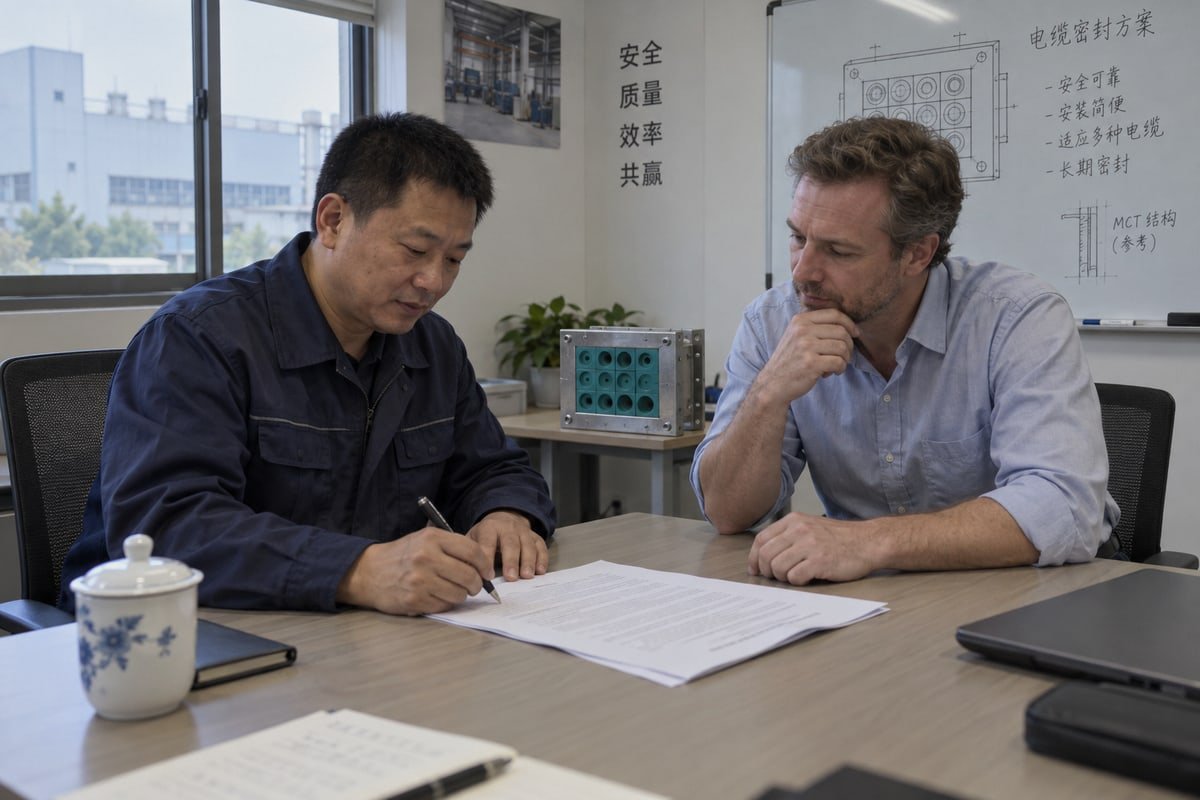
A standard non-disclosure agreement written for a European court has a weak point. It tells the supplier not to talk. It does not clearly tell them not to use. And it is hard to enforce in China. That is why buyers who source from our region should move to an NNN structure instead.
Why a Western NDA is not enough
The three N's each close a different gap. Non-disclosure stops the supplier from sharing your proprietary design specifications 1 with third parties. Non-use stops them from making a similar product for themselves or for another customer. Non-circumvention stops them from going around you to your end client. Then comes the enforcement side. The agreement should name Chinese law as governing law, name a Chinese court or arbitration body, and be written in Chinese with a controlling Chinese version. It should also set a liquidated damages figure. A Chinese court can freeze assets against a clear contract sum. It cannot do much with a vague promise.
The clauses I would not skip
| Clause | What it does | Why it matters for MCT designs |
|---|---|---|
| Non-use | Supplier may only use data for your order | Block geometry and compression logic are the clonable parts |
| Derivative-work ownership | Tooling, tweaks, and suggestions belong to you | Mold adjustments can otherwise become the supplier's know-how |
| No subcontracting without consent | Stops onward sharing to a machine shop | Frames and stay plates are often outsourced |
| Audit rights | Lets you inspect document handling | Supports on-site factory audits later |
| Return-or-destroy | Files and samples come back or are wiped | Covers prototypes, not just PDFs |
| Survival | Duties continue after the project | Leaks often happen after the relationship ends |
Separate three IP buckets
A good manufacturing services agreement should define three things clearly. First, your confidential design. Second, the supplier's pre-existing know-how. Third, any jointly developed modifications. Our factory holds 38-plus granted patents on our own modular sealing systems, so we insist on this split too. It protects both sides. If we suggest a step-core change to help your cable range, the contract should already say who owns that suggestion.
Register rights where the parts are made
Contracts bind one supplier. Intellectual property rights bind everyone. If your MCT design has a distinct frame profile or block arrangement, file a design patent 2 or utility model in China before the RFQ goes out. Local authorities can then act against unauthorized production, and customs can hold infringing goods. A contract alone cannot do that.
One more thing. Some buyers argue for giving full drawings to one trusted supplier and locking in a long-term deal. It does reduce error. But it also removes your leverage and concentrates risk in one factory. The contract should always leave room for a qualified second source.
How can I vet a Chinese MCT manufacturer's reputation and certifications before sending my design files?
Early in our export history, a buyer demanded our BV approval and IATF 16949 certificate numbers 3 before talking price. That request taught me what serious vetting looks like.
Vet a Chinese MCT manufacturer by verifying business registration, checking ISO 9001, IATF 16949, and BV approval certificates with the issuing bodies, requesting fire, IP68, and pressure test reports, auditing document-control systems on site or via a third party, and asking for references and IP-compliance history.

Design files should only go to a factory you have already qualified. The vendor vetting process has two goals. One is to confirm the supplier can make firestop penetration seals 4 to your spec. The other is to confirm they can keep your data inside their walls. Most buyers do the first and skip the second.
Factory or trading company?
This is the first filter. A trading company forwards your files to whichever workshop gives them the best price. You lose control the moment you hit send. So check the business license and the registered capital. Look at whether the company owns production sites or just an office. Our own registration shows RMB 50M capital, a headquarters in Shaanxi, and production plants in Shandong and Hunan. That kind of footprint is verifiable through public Chinese company records. If a supplier cannot show it, the data trail does not stop with them.
Verify certificates, do not just collect them
| What to check | Evidence to request | Red flag |
|---|---|---|
| Quality system | ISO 9001 and IATF 16949 certificate numbers, checked with the certification body | Scanned PDF only, no number |
| Marine or offshore approval | BV factory approval reference | Approval belongs to a different legal entity |
| Fire performance | A-0 / A-60 test reports | Report describes a different module size |
| Ingress and pressure | IP68 and 0.01–0.4 MPa watertight and gas-tight test documents | Claims IP66 or UL Type 4X in marketing but has no report |
| Own IP | Granted patents in the supplier's name | Catalog copied from a Western brand |
| Data handling | Description of document-control and access rules | No revision control, files shared via personal messaging apps |
The last two rows matter more than they look. A factory that owns its own patents has an interest in a clean IP culture. A factory that copies catalogs has already shown you how it treats other people's work.
Audit the document-control system
An on-site factory audit should include a short data-handling review. Ask who receives customer drawings. Ask where they are stored. Ask whether project teams are separated from work for your competitors. A third-party audit firm in China can do this for you at modest cost. Some buyers also keep a local agent who visits unannounced and witnesses the scrapping of defective parts or excess inventory. That step closes a quiet leak path. Reject modules and leftover frames often walk out the back door and into the secondary market.
Here is the objection I hear. Why not skip all of this and buy off-the-shelf systems? That works for simple jobs. It limits you when the project needs a specific fire rating, a tight frame cutout, or private-label branding. A properly vetted second-source factory gives you the same protection with more room to specify.
What technical safeguards can I use when sharing CAD or STEP files to limit how much of my design a supplier sees?
Our mold shop needs real geometry to cut a custom TSC module cavity. Sales needs almost none. We weigh that gap on every private-label job, and buyers should too.
Limit what a supplier sees by exporting STEP files with only interface envelopes, stripping feature trees and internal geometry, redacting tolerances until production, embedding unique watermarks or geometric fingerprints per recipient, sharing through view-only virtual data rooms, time-stamping every revision, and splitting components across unrelated suppliers.

A multi cable transit is three things: a frame, a stack of rubber blocks, and a compression unit. Anyone can see that from the outside. The value hides in the block geometry, the compression behavior, and the material. Reverse engineering prevention means keeping those three inside your company as long as possible, while still getting an accurate quote and a good part.
Build the package in stages
- Start with a functional brief. Cable count, cable outside diameters, spare capacity, environment, fire and IP class, and frame opening size. No CAD yet.
- After the NNN is signed and the vendor is qualified, release a simplified STEP. Export the model as a dumb solid with the feature tree removed. Replace internal detail with a solid envelope so only mating faces and mounting holes remain.
- Release critical tolerances only at the production or first-article stage, and only to the party that machines that feature.
- Keep the master model in-house. Never upload the native assembly to a supplier portal.
Match disclosure to the supplier's role
| Recipient | What they receive | What they never receive |
|---|---|---|
| Sales or quoting team | Requirements brief, quantities, delivery terms | Any geometry |
| Frame or stay-plate fabricator | Cutout dimensions, hole pattern, plate thickness | Block geometry, compression design |
| Sealing module supplier | Module footprint, cable range, performance targets | Frame drawings, end-client name |
| Compression unit supplier | Interface dimensions, load requirement | Sealing concept |
This is fragmented manufacturing in practice. No single vendor holds the full picture. It costs some coordination time. In return, supply chain security improves a lot.
Make every copy traceable
Watermark drawings with the recipient name. Better still, add a tiny geometric fingerprint 5 to each supplier's STEP, such as a slightly different fillet radius on a non-functional edge. If a file appears on a marketplace, you know where it came from. Share files through a virtual data room set to view-only, with download and print disabled and access logs kept. Time-stamp each revision, either with a notary service or a blockchain record, so ownership and transfer dates cannot be disputed later.
Black-box the material
If your design depends on a special compound, do not send the formula. Supply the pre-mixed rubber and let the factory mold it. Our own modules use a halogen-free step-core EPDM that we formulate in-house, so we understand why a buyer would guard that layer. When we protect designs from being leaked by suppliers on our own side, the compound recipe is the first thing we lock down.
How do I confirm dimensional compatibility with a second-source MCT supplier without disclosing my full proprietary design?
On our Shandong line, go/no-go gauges check every TSC module against 120-frame cutout dimensions. That fixture exists because compatibility, not full drawings, is what a second source must prove.
Confirm compatibility by sharing only interface data: frame opening size, module footprint, cable outside diameters, cable count, and spare capacity. Ask the second-source supplier for a model cross-reference table and free validation samples, then test fit, compression, and sealing in your own frame without sending proprietary drawings.
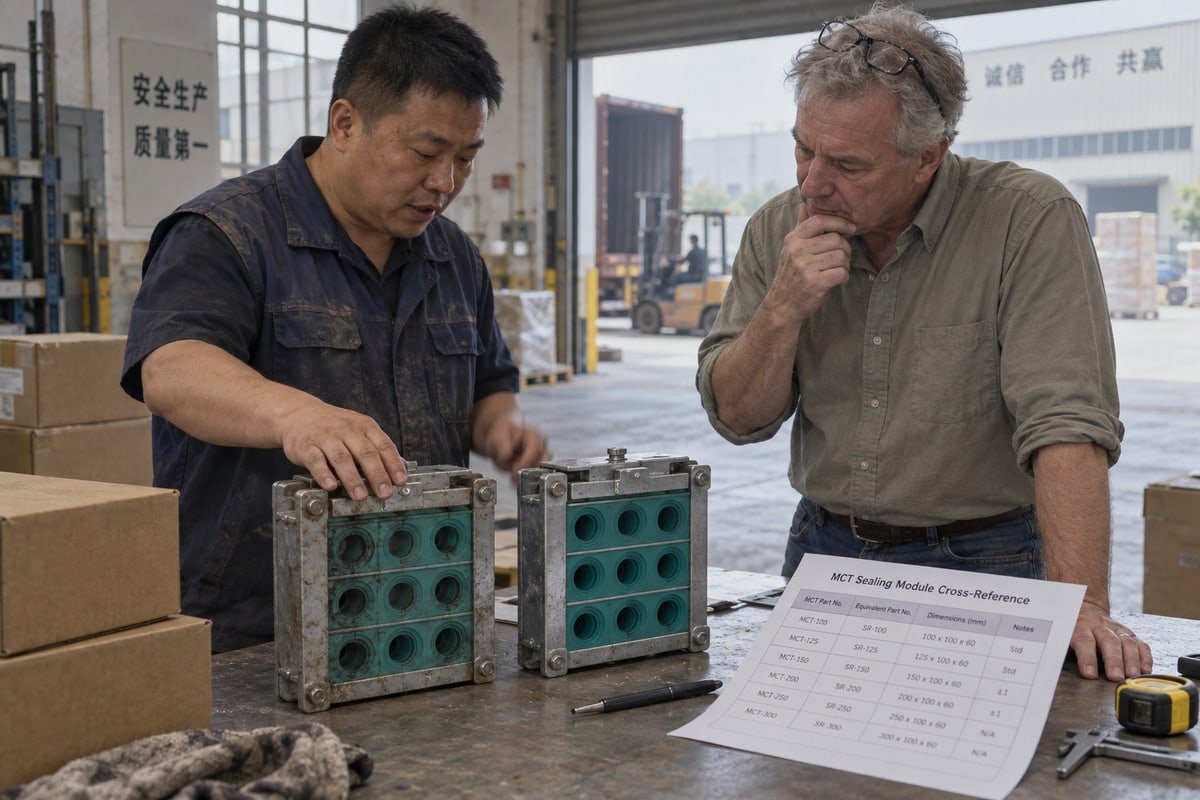
Second sourcing is where most over-disclosure happens. The buyer wants a drop-in part, so they send the whole assembly to prove the fit. They do not need to. The interface between a frame and a sealing module is small and well defined. Everything else stays with you.
What to share and what to hold back
| Share for compatibility | Hold back until first-article approval or forever |
|---|---|
| Frame internal opening (width, height, depth) | Full frame drawing with weld and mounting detail |
| Module footprint and stack arrangement | Internal block geometry and core design |
| Cable outside diameters and cable type | End-client project identity |
| Cable count and spare capacity percentage | Exact compression tolerances |
| Required fire class, IP rating, pressure range | Test data from your original supplier |
Notice the left column is almost entirely what any supplier's sizing sheet already asks for. Cable OD, cable type, and spare capacity are enough to size a modular sealing system for a standard frame. Our step-core EPDM modules adapt across a range of cable diameters within one module size, so the buyer often only needs to state the diameter band, not each individual cable.
Use a cross-reference instead of a drawing
A qualified second source should already know the common 120-frame standard. Ask them for a cross-reference table: your existing module model on the left, their equivalent on the right, with footprint and cable range for each. We maintain exactly this kind of table from existing brand models to DEWIN TSC and TSR models. It lets your engineer confirm the match on paper before anything physical moves, and it puts the disclosure burden on us, not on you.
Validate with samples, judged on outcomes
Then request free validation samples. Fit them in your own frame in your own workshop. Check insertion, compression, and re-entry. Judge the result against a black-box specification: A-0 or A-60 fire performance, IP68 ingress, watertight and gas-tight sealing across 0.01–0.4 MPa, and your cable range. Request the test documents that back those numbers. You are testing what the module does, not asking the supplier how it does it, and you are not telling them how yours does it either.
Red flags during second-source qualification
- The supplier says they cannot quote without your full assembly CAD.
- The supplier asks who your current MCT brand is before offering a cross-reference.
- Samples arrive without a revision-marked drawing of the sample itself.
- The supplier offers to "improve" your frame design unprompted.
Controlled disclosure is not hostile to suppliers. It is normal mature procurement, and a factory that resists it is telling you something.
Fazit
Leaks start with over-sharing, and they end with a cloned product. Share performance first, contract second, geometry last, and qualify second sources through samples and cross-reference tables, not drawings.
Fußnoten
1. Official US government resource for businesses looking to protect their intellectual property in international trade. ↩︎
2. WIPO provides global services for protecting industrial designs through the international design system. ↩︎
3. The official oversight body for the IATF 16949 automotive quality management system standard. ↩︎
4. NIST research division providing technical standards and testing for fire barrier penetration seals. ↩︎
5. International standard for the computer-interpretable representation and exchange of product manufacturing information. ↩︎


 English
  Español de México
  Deutsch
  Français
  العربية
  Русский