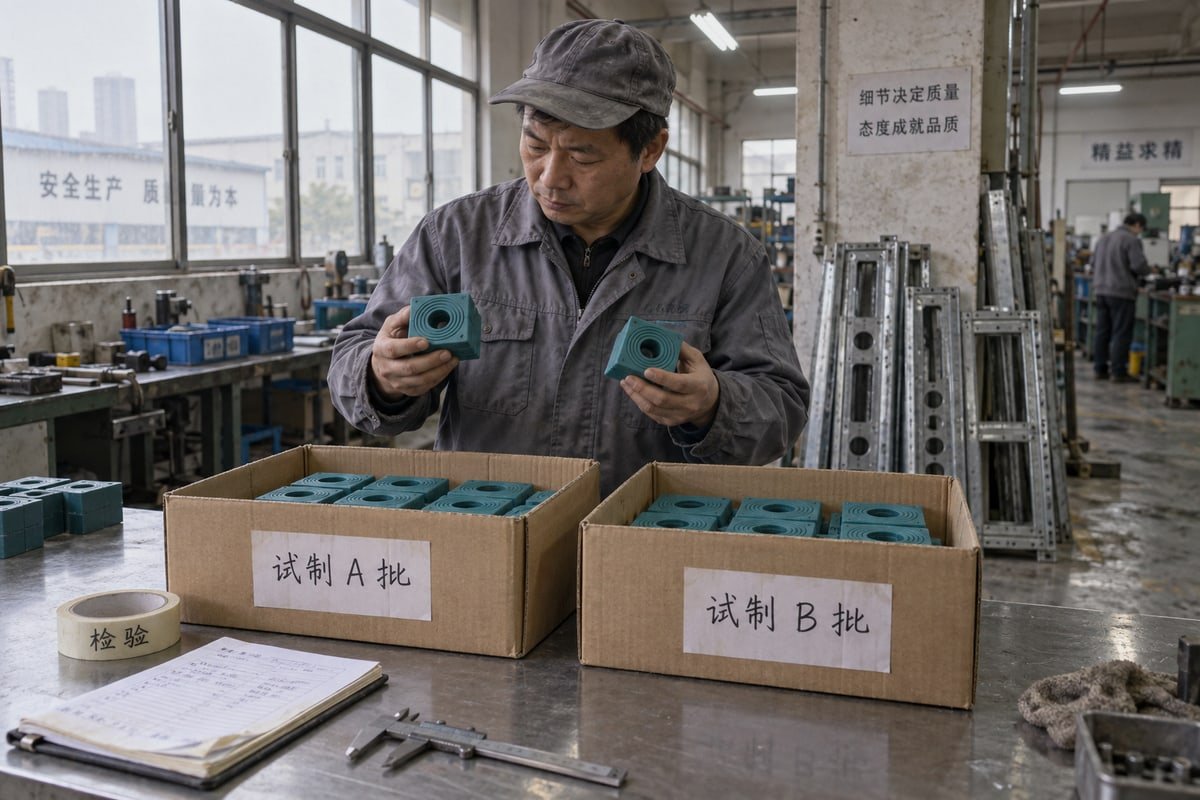
Your first multi cable transit order is a bet. Pick wrong and one failed lot stalls a whole BESS line. Our factory sees buyers hedge this by splitting orders.
Yes, split your first multi cable transit order between two suppliers only if you run it as a controlled qualification trial: same drawing, same acceptance criteria, same inspection method, and a plan to consolidate or dual-source afterward. A casual hedge dilutes learning and adds overhead.
That is the short answer. The long answer depends on four things. How you compare documents. How you check fit. How you use samples. And how you count the real savings. I will take each one in turn.
How do I compare test documentation and certifications when trialing two MCT suppliers side by side?
A purchasing engineer in Germany once emailed me two folders: one from his incumbent, one with our A-60 fire test reports. He asked which one actually proved anything.
Compare test documentation by building one matrix with identical columns for both MCT suppliers: fire rating test report, IP68 ingress test, pressure sealing range, material declarations, ISO 9001 or IATF 16949 certificates, and factory approvals. Judge each on scope, issuing body, date, and match to the exact module ordered.

His two folders were not comparable. One had a thick brochure and a one-page certificate. The other had raw test reports with photos of the tested frame. Neither format is wrong. But you cannot judge them by weight. You need one matrix, and both suppliers must fill the same columns.
Build one documentation matrix, not two folders
Here is the structure I recommend to buyers who run a two-supplier trial. It is also the structure our own export team uses when we send test documents on request.
| Document | What to check | Why it matters in a split trial |
|---|---|---|
| Fire rating test report (A-0 / A-60) | Test standard, tested frame size, tested module sizes, cable fill | Fire-rated penetration seals are only valid in the tested configuration |
| IP68 ingress test report | Test duration, depth, frame and module combination | Proves the seal, not the brochure claim |
| Pressure sealing report | Watertight and gas-tight range, for example 0.01–0.4 MPa | Confirms the module works at your project pressure |
| ISO 9001 / IATF 16949 certificate | Validity date, scope, site address | Proves process control, not product performance |
| Factory approval (for example BV) | Approval scope, site, expiry | Confirms a real production site was audited |
| Material declaration | EPDM compound, halogen-free statement | Needed for marine, rail, and data center specs |
Scope matters more than the logo
A certificate is a scope statement. A type approval certification 1 for one frame and module combination does not automatically cover another combination. So ask both suppliers the same question: which document covers this exact part number? If the answer is vague, that is your first data point. If your project sits in a hazardous area, ask both whether ATEX certified components 2 are required and what they can supply. Do not assume.
Independent inspection beats self-inspection
A growing best practice is to inspect trial parts independently. Do not rely only on the supplier's outgoing report. In our experience exporting to Europe, the buyers who send their own incoming inspection results 3 back to us are the ones who qualify us fastest. Their data and our data meet in the middle. That is a real vendor qualification process. A folder of PDFs is not.
What dimensional and fit risks should I check before splitting my first order across two cable transit manufacturers?
Last year our QC team rejected a batch of our own TSC modules because the step-core rubber sat slightly proud of the frame cutout. Fit problems start small.
Check frame cutout dimensions, module height stacking, compression unit travel, stay plate spacing, and cable diameter range per module before splitting a first order across two cable transit manufacturers. Confirm both suppliers match the same 120-frame standard, and never mix modules from different brands inside one certified frame.
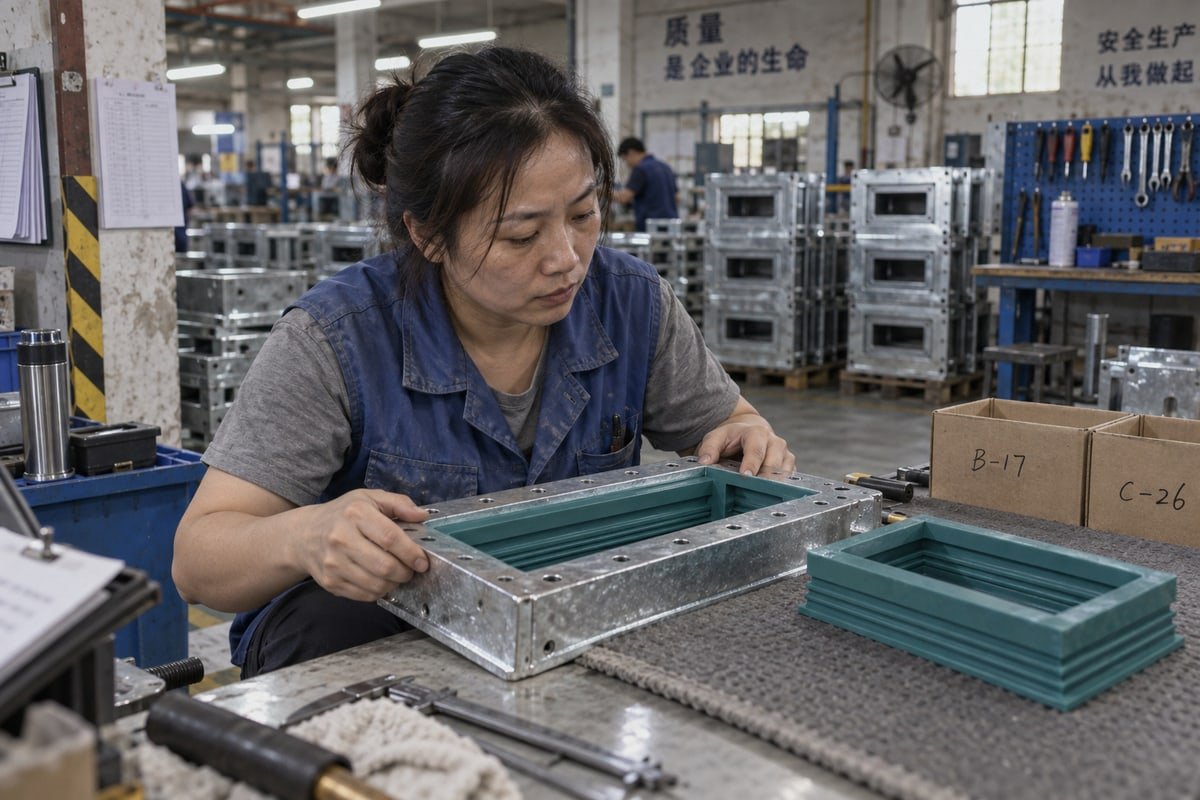
That rejected batch never shipped. But it taught me something. A module can pass a caliper check on the bench and still fail in the frame. So when you split a first order, fit risk is not one item. It is a chain of six.
Six dimensional checks that decide a split trial
| Check item | Method | Risk if skipped in a two-supplier trial |
|---|---|---|
| Frame cutout inner dimensions | Caliper against drawing | Module stack leaves a gap or will not enter |
| Module width and stack height | Dry-stack modules in the frame | Compression unit cannot seat |
| Compression unit travel | Measure remaining travel after tightening | Under-compression leads to leaks |
| Stay plate thickness and count | Compare both BOMs line by line | Wrong total stack height |
| Cable diameter range per module | Peel step-core layers to the real cable | Wrong module size chosen |
| Bolt size and torque spec | Read both nameplates | Over-torque cracks rubber, under-torque leaks |
Run all six on both suppliers' parts. Use the same operator. Use the same frame. Record the results side by side. That is the only way to see real tolerance variations rather than operator variation.
The interoperability trap
One objection I hear often: "If I run two brands, someone will mix them in one frame and void the fire certificate." That risk is real. Sealing system interoperability at the frame level is not the same as certification at the system level. Our modules are dimensionally compatible with common 120-frame standards, so they drop into existing frame cutouts. But we still tell buyers: one frame, one brand of cable sealing modules, logged on the nameplate. Compatibility solves the fit problem. Discipline solves the mixing problem.
Tools, CAD, and the 20-year spares question
Three more objections come up. First, brand-specific compression tools. Because we match the standard frame geometry, the compression hardware and installation method stay the same. Verify this on your sample anyway. Second, duplicate CAD libraries. We provide CAD and STEP files and a model cross-reference table, so your engineers map old model to DEWIN model once, not twice. Third, spares. A facility may need spare modules for 20 to 30 years. Dual sourcing does not force you to stock two sets. It forces you to record which frame uses which supplier. That is a spreadsheet, not a warehouse.
Can free validation samples help me qualify a second MCT supplier without disrupting my production schedule?
I learned early on that a sample nobody installs teaches nothing. Now our free validation samples ship with a fit checklist, so the buyer's team tests them under real conditions.
Yes. Free validation samples let you qualify a second MCT supplier offline: install them in a spare frame or test rig, verify fit against your cross-reference table, and run sealing checks without touching the live production schedule. Then place a small trial order only after the samples pass.

Samples and trial orders are two different tools. Samples answer "does it fit?" A trial order answers "can they repeat it?" Buyers who confuse the two either over-trust a sample or over-invest in a trial that never needed to happen. Here is the sequence that keeps your production line untouched.
A five-step sample-to-trial process
- Cross-reference first. Send your current part numbers. We return the matching DEWIN models from our cross-reference table. This takes a day, not a week.
- Request free validation samples. Ask for 3 to 5 identical parts. That is the common size for a controlled supplier test. It is enough to see part-to-part variation without waiting for a full lot.
- Install offline. Use a spare frame, a test bulkhead, or a scrap panel from a previous project. Run the six dimensional checks from the previous section. Time the installation and log it. Installation efficiency metrics matter later when you compare labor cost.
- Run a sealing check. Water or air, whatever your test rig supports. Compare the result to the supplier's pressure report. If the numbers disagree, stop and ask why before ordering.
- Place a small production-like trial order. Define pass/fail criteria before the order ships. Ask for more than one lot if you can. One good shipment proves less than a controlled trial across two lots.
What the trial decision should look like
Document the result as one of four outcomes: approved, approved with restrictions, provisional, or rejected. Tie any corrective action to a specific defect or documentation gap. In regulated qualification programs, the trial order can pause the qualification clock until inspection is complete. That is fine. A paused clock is cheaper than a stopped line.
Why this protects your schedule
None of these steps touch your running production. The incumbent keeps supplying. The second source is tested in parallel. Only when the trial is approved does the second supplier get a share of real volume. That is supply chain risk management done in the right order.
How much cost savings should I expect if I dual-source my cable transit modules from a factory-direct manufacturer?
Every quote we send to Europe involves the same trade-off: the buyer wants the 40–60% saving, but they also want proof it does not cost them somewhere else.
Expect 40–60% lower unit cost on cable transit modules when you dual-source from a factory-direct manufacturer instead of a branded distributor. Net savings are smaller after qualification, inspection, and admin overhead, so model total cost across the first year, not just the piece price on the quote.
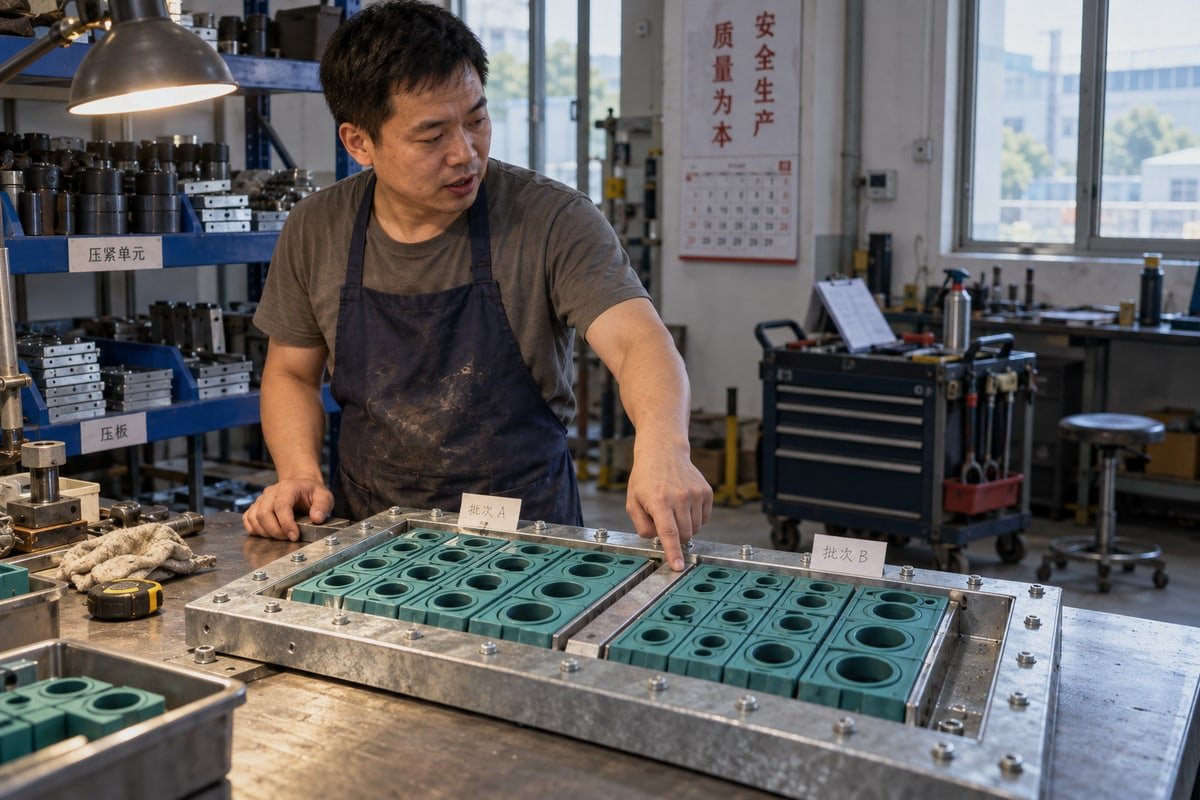
The 40–60% figure is real. It comes from cutting out distributor margin and brand premium, and from making the rubber, the frames, and the molds in-house. But a skeptical sourcing manager should not stop at the unit price. Here is the honest way to model it.
A first-year total cost view
| Cost line | Single-source (incumbent) | Dual-source with factory-direct second supplier |
|---|---|---|
| Module unit price | Baseline | 40–60% lower on the second-source share |
| Qualification effort | None | One-time: samples, trial order, inspection time |
| Admin and logistics | One contract, one schedule | Two contracts, two shipping schedules |
| MOQ and volume discounts | Full volume with one supplier | Volume split; check both MOQs before committing |
| Spare module supply | Dependent on one lead time | Two sources; fast spare delivery from the factory |
| Risk exposure | Single point of failure | Backup source already qualified |
The objections, and where they hold
The anti-split view says two suppliers dilute purchasing power. That is true if your volume is small and both MOQs are high. So ask both suppliers for their MOQ before you split. If the second-source share cannot reach MOQ, run the trial, approve the supplier, and hold them as a qualified backup instead of an active split.
The admin overhead objection is also true. Two vendors mean two communication channels. In our case, export documentation 4 is handled on our side, and English technical support answers within the buyer's working day. That does not remove overhead. It reduces it.
Lead time is part of the cost
Lead time reliability is a cost line most quotes hide. Measure promised lead time against actual delivery 5 for both suppliers during the trial. A cheaper module that arrives late costs more than the saving. Our three production sites in Shaanxi, Shandong, and Hunan exist partly so one site's load does not stall a delivery. Ask your second supplier how they handle the same risk.
When dual sourcing strategy pays back
A dual sourcing strategy pays back fastest for integrators with steady volume: BESS container builders, modular data center builders, switchgear panel makers. For a one-off EPC project with a single launch window, keep the first order with one supplier and qualify the second in parallel. The savings are still there. You just collect them on the next project.
Fazit
A single-source first order feels simple until it fails. Splitting it without controls just doubles confusion. Run one disciplined trial, document the result, then award, dual-source, or reject.
Fußnoten
1. DNV is a leading global authority for type approval certification of industrial and maritime components. ↩︎
2. Official European Commission guidance on the ATEX directive for equipment used in hazardous environments. ↩︎
3. Official ISO page explaining the ISO 9001 standard for quality management systems in manufacturing. ↩︎
4. Official government guide to standard international trade and export documentation requirements. ↩︎
5. International Chamber of Commerce rules defining responsibilities for the actual delivery of goods. ↩︎



 English
  Español de México
  Deutsch
  Français
  العربية
  Русский