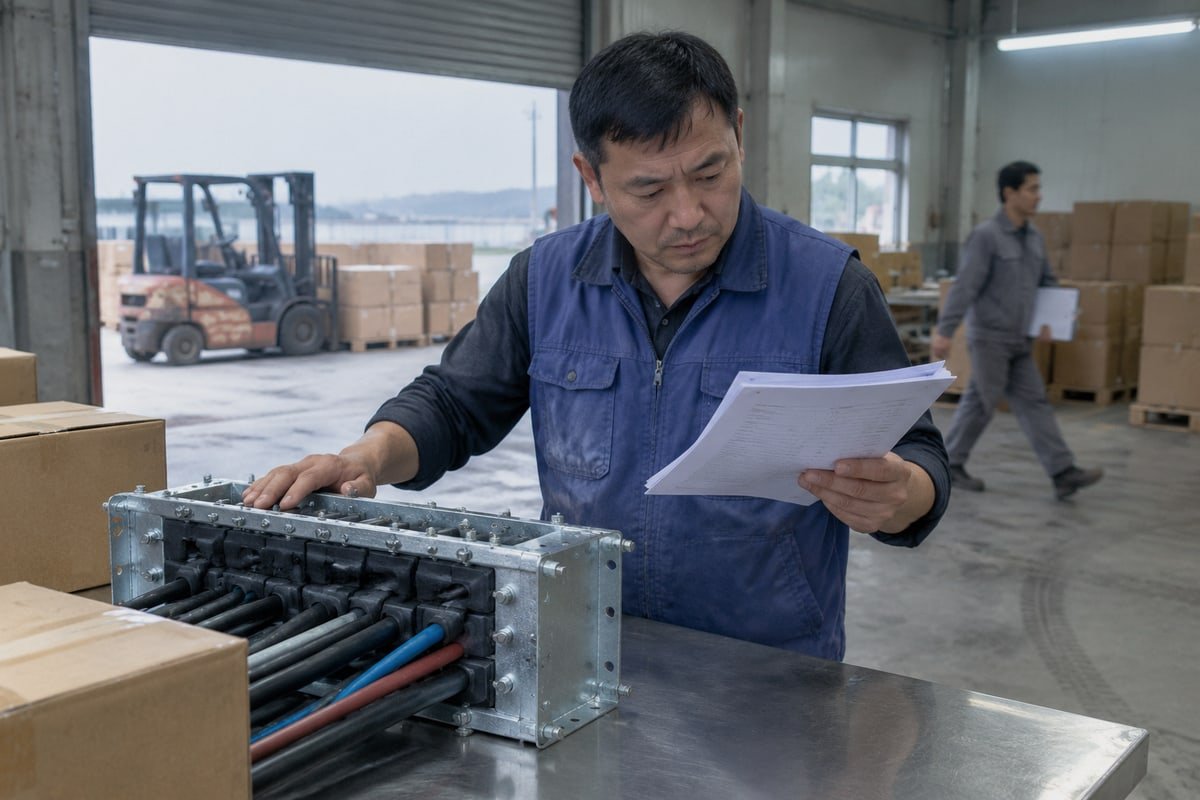
One vague invoice line once held our MCT shipment at Rotterdam for weeks. Verifying customs declaration name and value with suppliers for multi cable transits prevents that.
To verify customs declaration name and value with suppliers for multi cable transits, request the registered legal exporter name, a datasheet-linked product description, the HS code basis, and a commercial invoice whose transaction value matches the purchase order and Incoterms 2020 term. Confirm everything in writing before shipment.
The rest of this article breaks that answer into four practical steps. I will show you what to ask for, how to cross-check it, and where discrepancies usually start. The goal is simple. Treat customs declaration verification as a pre-shipment quality check, not a post-shipment repair.
How do I confirm the correct HS code and customs declaration name for MCT sealing modules before shipment?
A forwarder once typed "cable parts" on a TSC module invoice from our Shaanxi plant. The importer's broker then asked for photos, datasheets, and a reclassification review.
Confirm the HS code by matching the module's construction, halogen-free EPDM blocks or a steel frame, to the tariff heading under the General Rules of Interpretation, then check the declaration name against the supplier's business licence and past export records. The description should mirror the datasheet and type approval wording.

Start with what the module physically is
The Harmonized System uses a 6-digit global base. Countries add more digits for local tariff lines, so an EU TARIC code 1 and a Gulf tariff code will differ after digit six. The first six digits must still rest on the same logic. HS heading 8544 covers insulated wire and cable. An MCT sealing module holds cables, but it contains no conductor. A supplier who writes 8544 on a module invoice is describing the cables that pass through the product, not the product itself. That is the most common HS Code Classification error we see, and it invites reclassification at the border.
Our TSC and TSR modules are halogen-free EPDM blocks with step-cores. Our frames are welded steel, galvanized or stainless. When a buyer orders a complete frame kit, GRI 3b, the essential character rule, decides whether the metal frame or the rubber inserts define the product. We ask the buyer's broker to make that call, record the reasoning, and then we match our description to it. Tariff Classification should follow the actual construction, never the marketing name.
| Component | What it physically is | Weak description | Defensible description |
|---|---|---|---|
| TSC sealing module | Vulcanised halogen-free EPDM block with removable step-core layers | "Rubber block" / "cable parts" | "Halogen-free EPDM cable transit sealing module, 120-frame compatible, size 20/40/60" |
| TSR round seal | EPDM sealing assembly with steel compression plates | "Seal" | "Round cable and pipe transit seal, EPDM with stainless compression plates" |
| Transit frame | Welded galvanized or stainless steel rectangular frame | "Metal frame" | "Steel multi cable transit frame, weld-in type, for bulkhead cable penetration" |
| Compression unit / stay plate | Steel or aluminium hardware | "Accessories" | "Compression wedge unit and stay plates for cable transit frame" |
Tie the description to type approval wording
Product Description Consistency matters most during a physical inspection. If the invoice says "rubber block" but the BV type approval certificate says "cable transit sealing module, A-60", the inspector sees two different products. We copy the certificate wording onto the invoice and packing list, then add material and size. We also map each invoice line to our bill of materials, so the halogen-free and fire-rated material properties are traceable to a document, not a claim.
Verify the declaration name is a legal entity
The declaration name is the registered exporter of record, not a brand. "DewinMCT" is our brand. Our business licence carries a longer registered company name. Ask your supplier for the licence, the customs registration number, and a redacted copy of a previous export declaration. The three names must match character for character. If a trading company appears where you expected a factory, ask why, and get the answer in writing before the goods leave the plant.
What documentation should I request from my supplier to verify declared value matches the actual product cost?
Every quarter we weigh two things: how much cost detail to disclose on export paperwork, and how much a buyer's broker needs to defend the value.
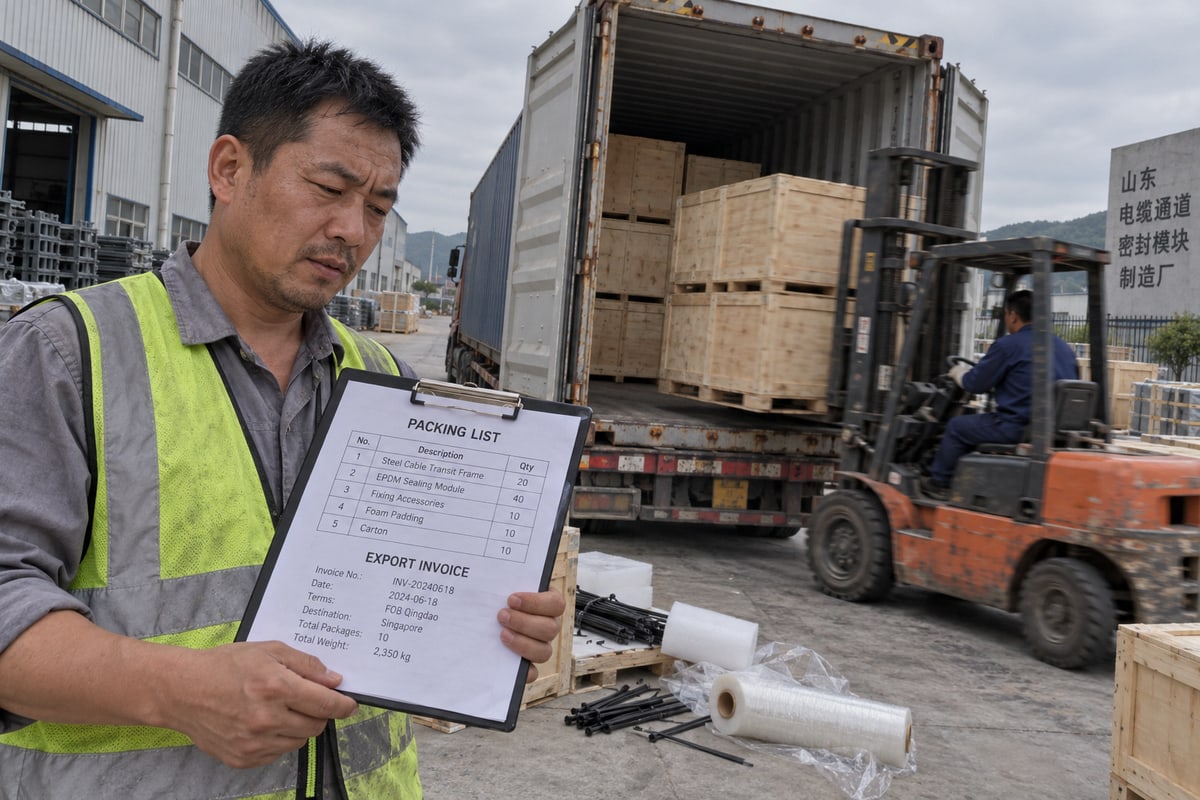
Request the commercial invoice, packing list, signed purchase order, proof of payment, product datasheet, a redacted copy of a recent export declaration, the supplier's business licence, and a Country of Origin Certificate. Compare unit price times quantity, Incoterms 2020 term, and any tooling assists across all documents.

The document set and what each one proves
Customs officers use the declared value and the goods description together to assess duties and taxes. The declared value is only credible when several independent documents point to the same number. Here is the set we prepare for every export order, and what a careful buyer should check in each.
| Document | What to verify | Common mismatch |
|---|---|---|
| Commercial invoice | Unit price × quantity equals total; Incoterms 2020 rule stated; exporter legal name in header | Quote in EXW, invoice silently in FOB |
| Packing list | Quantities and module sizes match invoice lines | Spare modules packed but not invoiced |
| Purchase order / contract | Prices, currency, and payment terms match invoice | Post-negotiation discount not reflected |
| Proof of payment | Amount paid equals invoice total | Split payments across two invoices |
| Product datasheet | Description and material match invoice wording | Datasheet says EPDM, invoice says "plastic" |
| Redacted prior export declaration | Same HS code and similar unit value for the same product | Different code on every shipment |
| Business licence | Registered name equals invoice header and declaration name | Brand name used instead of legal entity |
| Country of Origin Certificate 2 | Origin matches where frames and modules were actually made | Frame and inserts from different regions, one origin claimed |
Watch for assists and free-of-charge items
Two items catch buyers out. First, assists. We do in-house mold making for custom module sizes. If a buyer pays for or supplies that mold, its value is an assist and, under standard valuation rules, must be added to the customs value of the parts it produces. We state the tooling charge on its own invoice line so nobody has to reconstruct it later. Second, free-of-charge goods. Our free validation samples and any no-charge replacement modules still need a fair value marked "Value for Customs Purposes Only". Zero value on a declaration is a red flag, not a saving.
Incoterms 2020 and the value basis
The EU and most Gulf states calculate customs value on a CIF basis. Under EXW or FOB 3, freight and insurance are added at import. Under CIF or CIP, they are already inside the price. If the invoice term and the declaration term disagree, the Import Duty Calculation 4 will be wrong in one direction or the other. Commercial Invoice Accuracy therefore includes the trade term, not only the price.
Some suppliers object that customs documents are confidential. We understand the concern. A redacted copy, with other customers' prices masked but the exporter name, HS code, and product description visible, protects commercial terms while still proving identity and consistency. That is the compromise we offer, and we have not yet met a buyer who needed more.
Can I get a written customs declaration agreement to avoid discrepancies at European or Middle East ports?
A German BESS integrator sent us a one-page declaration annex last year and asked us to sign it before the first TSR order shipped. We did.
Yes. A written customs declaration agreement, usually an annex to the purchase order, fixes the legal exporter name, product description, HS code basis, declared transaction value, Incoterms 2020 rule, and origin statement. Both parties sign it, and the supplier commits to reproduce it exactly on every invoice and declaration.

What the annex should contain
A declaration annex is short. It does not replace the contract. It removes the ambiguity that causes ports to hold cargo. This is the clause set we now attach to repeat orders.
| Clause | Content | Why it matters |
|---|---|---|
| Exporter of record | Full registered legal name, address, customs registration number | Identifies the party responsible for the declaration |
| Product description | Exact wording per line, linked to datasheet and type approval certificate | Prevents "rubber parts" appearing on any document |
| HS code basis | Six-digit code plus the GRI reasoning for kits | Gives the broker a defensible position |
| Transaction Value | Unit prices, currency, tooling assists, sample valuation method | Keeps invoice, payment, and declaration aligned |
| Incoterms 2020 rule | Named rule and named place | Fixes what is inside the price |
| Origin statement | Country of manufacture for frames and for modules | Supports the Country of Origin Certificate |
| Change control | No change to any field without written buyer approval | Stops silent drift between shipments |
European versus Middle East requirements
The annex serves both regions, but the emphasis shifts. For EU entry, the importer's EORI number 5, a consistent TARIC code, and steel content data now matter. Our welded steel frames can fall within the scope of the Carbon Border Adjustment Mechanism 6, so an EU buyer should ask for embedded emissions data on the frame at the same time as the declaration annex, not months after. For Gulf ports, an attested Country of Origin Certificate and a legalized invoice are often requested, and the product description on those attested documents must match the declaration word for word. Any difference between the attested set and the customs entry is treated as a discrepancy, even when the goods are identical.
What the agreement does not do
I want to be direct here. Signing an annex does not transfer the importer's legal responsibility for the entry. Customs authorities hold the declarant and the importer accountable. The annex gives you evidence of good faith, a fixed data set, and a contractual remedy against the supplier. It does not make an incorrect declaration correct. That is why we pair every annex with the document set from the previous section.
How do I make sure my supplier's declared value won't trigger customs delays or extra duties on my BESS or data center project?
The hardest lesson from twelve years of exporting our sealing modules: an undervalued invoice never saves duty. It only moves the cost to a post-clearance audit.
Keep the declared value equal to the real transaction value, consistent across purchase order, invoice, payment, and declaration, and in line with the supplier's shipment history for the same HS code. Declare free samples and spares at fair value, and align frame and module values so the ratio looks normal.
Why value is a consistency problem, not a price problem
Customs Valuation Methods follow a fixed order. Transaction Value, the price actually paid or payable, comes first. Authorities only move to alternative methods when they doubt the declared price or the documents behind it. So the question is never "is the price low?" but "can the price be verified?". Our drop-in modules are often 40–60% below the incumbent brand. A buyer's broker will sometimes flag that gap. The fix is not to raise the invoice. The fix is a stable shipment history at the same HS code, a payment record that matches, and a cross-reference table showing which incumbent model our part replaces. Customs compares your entry against the supplier's own past entries and against category norms. Consistency is what passes that comparison.
Red flags that trigger a Customs Compliance Audit
| Red flag | What customs suspects | How we avoid it |
|---|---|---|
| Same module at different values on consecutive shipments | Price manipulation | One price list per buyer per year, changes documented |
| Kit declared as one line at frame value only | Modules hidden inside the frame | Frame, modules, and compression units on separate lines |
| Zero value on samples or spares | Undervaluation | Fair value marked for customs purposes only |
| Generic HS code reused across unrelated products | No classification basis | Product-specific code with GRI reasoning on file |
| Brand name on declaration, different name on invoice | Identity mismatch | Registered legal name on every document |
Kit versus parts: a component-level valuation audit
A BESS container may carry dozens of transit frames, each packed with modules. Declaring the whole set as one functional unit or as individual parts can change the duty rate and the audit exposure. We recommend a short component-level valuation audit before the first project shipment. List each component, its material, its HS candidate, and its unit value. Then let the broker decide which structure is more accurate and legally defensible for that destination. The answer can differ between an EU data center project and a Gulf substation. What must not differ is the value basis.
The broker's role, and its limits
A freight forwarder or customs broker can validate terminology, declaration format, and country-specific requirements. That help is real. But a broker cannot repair a weak product description or an unsupported value after the goods arrive. Post-clearance audits and data matching are now routine, and they look back at entries long after release. The supplier owns the accuracy of the underlying data. Your job is to verify it before shipment, using the document set and the written annex described above.
Fazit
Vague names and unsupported values stall MCT shipments. Verify the legal exporter, datasheet-linked description, HS basis, and transaction value before shipment, and put it in writing.
Fußnoten
1. Official European Commission database for the integrated Tariff of the European Union. ↩︎
2. WTO technical information on rules of origin and certification requirements for international trade. ↩︎
3. Official ICC rules defining the responsibilities of buyers and sellers in international trade. ↩︎
4. EU guide on how customs duties are calculated based on tariff, origin, and value. ↩︎
5. EU registration and identification system for businesses involved in customs activities. ↩︎
6. Official EU information on carbon pricing for imports of certain goods like steel. ↩︎



 English
  Español de México
  Deutsch
  Français
  العربية
  Русский