
A leaking seal halts a BESS container, and every waiting hour costs money. So our factory measures after-sales response speed for multi cable transits stage by stage.
Evaluate after-sales response speed for multi cable transits by measuring five separate times: acknowledgement, technical triage, first action, on-site arrival, and full restoration. Ask for these targets in a written Service Level Agreement, verify them with documented past cases, and test them with a mock fault report before ordering.
That sounds simple. In practice most buyers only check one thing: how fast the sales contact replies. This article shows the other four times, the paperwork that proves them, and a cheap way to test a supplier before you commit a production order.
How Fast Should I Expect a Technical Response When I Report an MCT Sealing Issue?
A switchgear builder in Germany once emailed us late at night about a compression unit that would not seat. Our engineer sent a torque sequence before their morning shift.
For a critical MCT sealing issue, expect written acknowledgement within one hour, a qualified engineer's diagnosis within four working hours, and a corrective plan or replacement module dispatch within 24 to 48 hours. Routine questions can take one business day. Negotiate anything vaguer into the contract.

Brochures love the phrase "24/7 prompt response". I understand why. But the phrase tells you nothing about who picks up and what that person can actually do. In our years shipping TSC square modules and TSR round assemblies to integrators in Europe and the Middle East, I have learned that a fast phone reply and a fast fix are two different events. The first is a commercial response. The second is a technical response. Only the second one ends your downtime.
Break the response into a chain of times
Service teams in other technical sectors already split acknowledgement, fault identification, and restoration into separate targets. Some publish acknowledgement within 30 minutes and fault identification within 30 minutes to 2 hours. MCT suppliers rarely write anything that concrete. The model still works. Ask for each link in the chain and get a number against it.
| Stage | What it means for an MCT incident | Realistic P1 target to request |
|---|---|---|
| Acknowledgement (MTTA) | Ticket, email, or call confirmed with a case number | Under 1 hour |
| Technical triage | An engineer, not a salesperson, reviews photos and frame data | Under 4 working hours |
| First action | Torque instructions, module swap plan, or spare parts dispatch | Same day |
| On-site or remote support | Field engineer visit or live video session scheduled | 24 to 72 hours, depending on region |
| Restoration (MTTR) | Seal passes leak or pressure check again | Agreed per priority level |
| Update cadence | Progress reports until closure | Every 4 to 8 hours for P1 |
Use a priority matrix
Not every ticket deserves a midnight call. A compromised A-60 fire seal on an operating container is not the same as a question about stay plate spacing. A P1 to P4 matrix sets expectations on both sides and protects the emergency response time for the cases that need it.
| Priority | Example | Expected response |
|---|---|---|
| P1 | Loss of gas-tight or fire seal on a live unit | Immediate, 24/7 including holidays |
| P2 | Module damaged during installation, commissioning blocked | Within the same working day |
| P3 | Fit or cross-reference query, no downtime | One business day |
| P4 | Documentation, maintenance and inspection protocols | Two to three business days |
One objection I hear often: "The supplier is available anytime, so why measure?" Because availability only measures the phone. Response speed measures the fix. Our own engineers handle the first hour of a P1 case themselves, and we log the timestamp. A claim without a timestamp is just marketing.
What Documentation Should I Request to Verify a Supplier's After-Sales Track Record?
Our QC team keeps a closed-ticket log for every TSC module complaint. It began as an internal tool. Now European buyers request it before they request our price list.
Request a written Service Level Agreement, anonymized closed-ticket records showing acknowledgement and resolution dates, spare parts stock lists by region, fire and pressure certifications with issue dates, warranty terms, escalation contact lists, and two or three reference customers who can confirm actual technical support turnaround on real incidents.

Paper does not seal a cable. But paper is the only way to check a track record without waiting for your own failure. I sort the documents into three groups. The first group proves a service system exists. The second group proves it has actually performed. The third group proves the parts and people are where you need them.
The three groups of evidence
| Document | What it proves | What to check |
|---|---|---|
| Service Level Agreement with named times | The system exists | Separate targets for acknowledgement, triage, on-site, restoration |
| Escalation contact list | The system exists | Engineer names and a route past first-line support |
| Product warranty terms | The system exists | Who pays freight and labor on a replacement module |
| Anonymized closed-ticket records | The system performed | Real dates, not averages; look at the worst cases |
| Reference customers | The system performed | Ask them for one incident story with times |
| Spare parts stock list by region | Parts are reachable | Sealing modules and compression wedges held locally or only at the factory |
| Fire and pressure certifications | Product capability | A-0/A-60 fire rating, IP68, watertight and gas-tight test range such as 0.01 to 0.4 MPa, each with issue dates |
| Quality system certificates | Process discipline | ISO 9001, IATF 16949, third-party factory approval such as BV |
Audit the paperwork speed too
Compliance documents are part of after-sales service. A site in the Middle East or an offshore yard working to marine and offshore standards 1 may hold cable installation until a fire-test certificate or an ATEX/IECEx declaration 2 is in hand. So ask a simple question: how long does it take you to send a project-specific certificate pack? We keep our test documents ready to release on request, and I still time the response, because a two-week wait for a PDF is a delay just like a late module.
The global-versus-local objection
Buyers often ask whether a large global brand will always outperform a smaller factory on service. Broad engineering resources help. But a regional stock point and a reachable engineer in your time zone matter more when a seal fails on a Friday. Do not assume either way. Ask for the stock list and the coverage hours, and let the documents answer. Also ask for the supplier's maintenance and inspection protocols. A supplier that documents preventive checks usually documents incidents just as carefully.
How Can I Test a Supplier's Response Speed Before Placing a Full Production Order?
Free validation samples cost us production time and freight. We send them anyway, because the sample request is the first honest test of our technical support turnaround.
Test response speed with a staged pre-order trial: send a mock fault report with photos and measure the reply time and technical depth, request a cross-reference table and CAD/STEP files with a deadline, order free validation samples and track shipping updates, then ask an out-of-hours question to expose coverage.
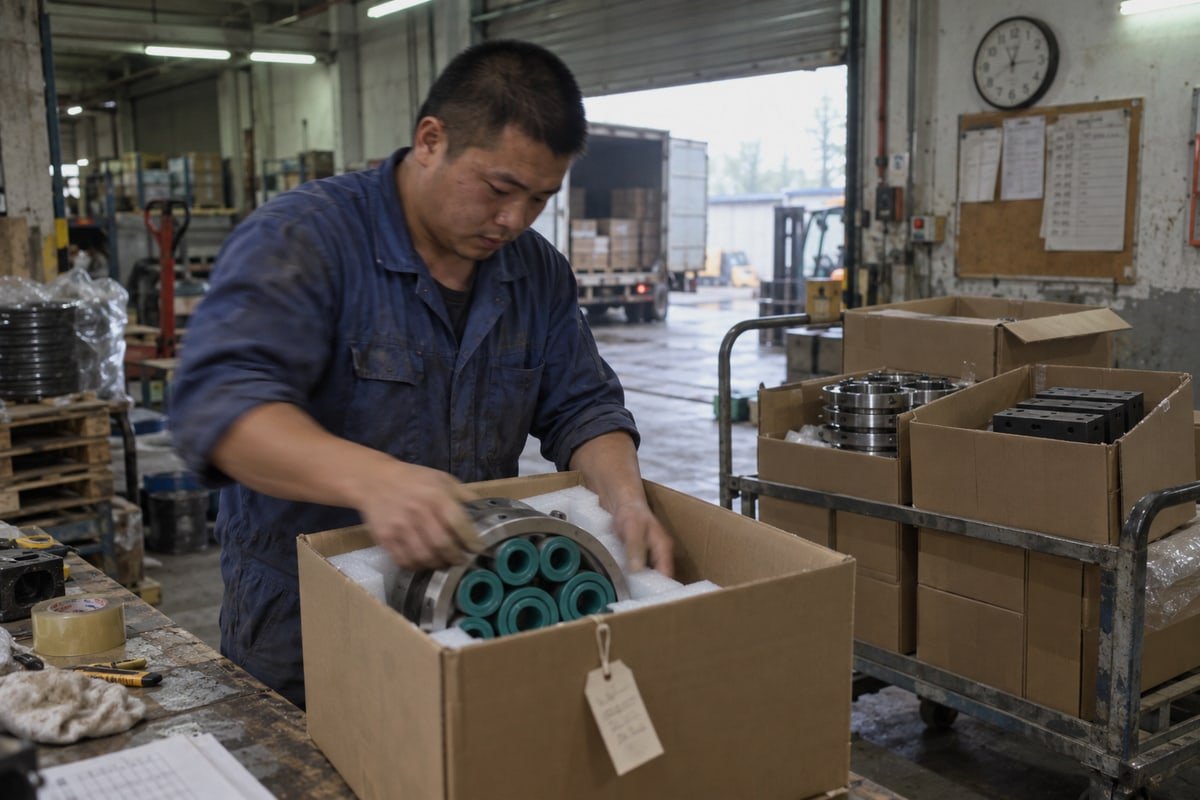
You do not need a failure to learn how a supplier handles one. Every pre-sales interaction is a rehearsal. The trick is to run it deliberately and write down the times. Here is the sequence I recommend to sourcing managers who are qualifying us as a second source.
A five-step pre-order test
- Send a mock fault report. Describe a realistic problem: a module weeping at 0.3 MPa, or a cable diameter 3 at the edge of a step-core range. Attach two photos. Record the time to acknowledgement and the time to a reply from a named engineer. Judge whether the answer is technically useful or just "we will look into it".
- Request engineering data with a deadline. Ask for the cross-reference table from your current model numbers to the supplier's models, plus CAD/STEP files for one frame size. Time it. This also reveals how the supplier handles design software and BIM integration requests.
- Order free validation samples. Track every shipping update. Fit the sample into your existing 120-frame cutout. Note how the supplier reacts when you report the fit result, good or bad.
- Ask an out-of-hours question. Send a short technical query on a Saturday or a local holiday. Note whether you get a person, an auto-reply, or silence.
- Ask for a custom size quote. Choose a non-standard cable diameter or bulkhead configuration. The quoted lead time for a custom module tells you whether the supplier has in-house mold making or must subcontract.
Scoring what you observe
| Metric | What you measure | What a good result looks like |
|---|---|---|
| First response time | Hours from mock report to acknowledgement | Consistent across email, phone, and portal |
| Technical resolution rate | Whether the first engineering reply solves the mock problem | Specific torque, module, or spacing guidance |
| Data turnaround | Days to deliver cross-reference table and CAD/STEP files | Within your stated deadline, complete |
| Sample logistics | Days from request to sample in hand, with tracking updates | Proactive updates, no chasing |
| Out-of-hours coverage | Who answers on a weekend | A qualified person, not a queue |
| Custom engineering lead time | Days to quote a non-standard size | Clear number, with tooling explained |
| Remote assistance capability | Willingness to troubleshoot by live video | Offered without being asked |
Two objections deserve a direct answer. First, "faster service costs more, so why pay for it?" It does cost more. Staffing engineers and holding stock is not free. So decide which links in the chain matter for your project and pay for those, not for a blanket promise. Second, "good product quality makes speed irrelevant." Fewer incidents help. But cable transits sit at bulkheads, in containers, and on offshore platforms where installers make mistakes too. Preventive quality and reactive speed are both needed. When we score after-sales response speed for multi cable transits, we score both, and I suggest you do the same.
What Support Should I Get If a Cross-Referenced MCT Module Fails to Fit My Frame?
We learned early that a cross-reference table is a promise, not a proof. Now every DEWIN model maps to a dimension drawing, and a fit failure triggers a defined engineering path.
If a cross-referenced module does not fit, the supplier should acknowledge within hours, request frame photos and measurements, confirm the root cause against its 120-frame compatibility drawings, ship corrected modules or a custom size at its cost, and offer remote or on-site installation supervision until sealing passes pressure testing.

Drop-in second sourcing is where cost savings live. Our modules are dimensionally compatible with common 120-frame standards 4, and buyers typically cut component cost by 40 to 60 percent when they qualify us alongside their incumbent. Those savings only stay real if a fit problem is handled fast. So I treat fit failures as the sharpest test of after-sales response speed for multi cable transits.
Why a fit failure happens
In my experience the cause is almost always one of five things. Frame cutout tolerance drifts from the nominal standard. The cable diameter sits outside the step-core range of the chosen module. Stay plate spacing does not match the module stack height. The buyer ordered a TSC square module where a TSR round assembly was needed. Or the old frame was modified on site years ago and nobody recorded it. None of these are hard to solve. All of them are slow to solve if the supplier starts by arguing.
| Cause | Support you should receive | Target time |
|---|---|---|
| Frame tolerance outside nominal | Engineer compares your measurements to compatibility drawing, proposes adjusted module width | Diagnosis within one working day |
| Cable diameter outside step-core range | Alternative module size from catalog, shipped as spare part | Dispatch within 48 hours if stocked |
| Stay plate or compression unit mismatch | Corrected stay plates or compression wedges supplied | Dispatch within 48 hours |
| Wrong series selected | Re-issued cross-reference with correct series, replacement at supplier cost if the table was wrong | Same working day |
| Modified or undocumented frame | Custom module from in-house mold making, plus installation guidance | Quoted lead time in days, not weeks |
Remedy language to put in writing
Product warranty terms should state who pays freight, whether replacement modules are new production or stock, and whether the supplier will send someone. Field service engineering is expensive, so many suppliers offer live video first. Accept that, but define when a site visit becomes mandatory. For repeat integrators, ask about installation training programs. A trained crew avoids most fit calls in the first place. And check supply chain reliability behind the remedy: spare parts availability 5 across sealing modules, compression units, and stay plates is what turns a promise into a shipped box. We hold spare sealing modules ready for exactly this reason, and we handle the export documentation so a replacement is not stuck at customs while your commissioning date slips.
Fazit
Vague prompt-support promises leave you exposed when a seal fails. Measure the chain from acknowledgement to restoration, verify documents, and test before ordering. We welcome that scrutiny.
Fußnoten
1. The IMO sets global safety standards for international shipping, including fire and pressure safety for offshore units. ↩︎
2. Official site for the international certification system covering equipment for use in explosive atmospheres. ↩︎
3. The IEC provides international standards for electrical cables and components, including specifications for cable diameters. ↩︎
4. Provides a technical overview of multi-cable transit systems and the industry-standard 120-frame sizing used for modular seals. ↩︎
5. ISO 9001 standards include requirements for resource management and supply chain reliability to ensure product availability. ↩︎



 English
  Español de México
  Deutsch
  Français
  العربية
  Русский