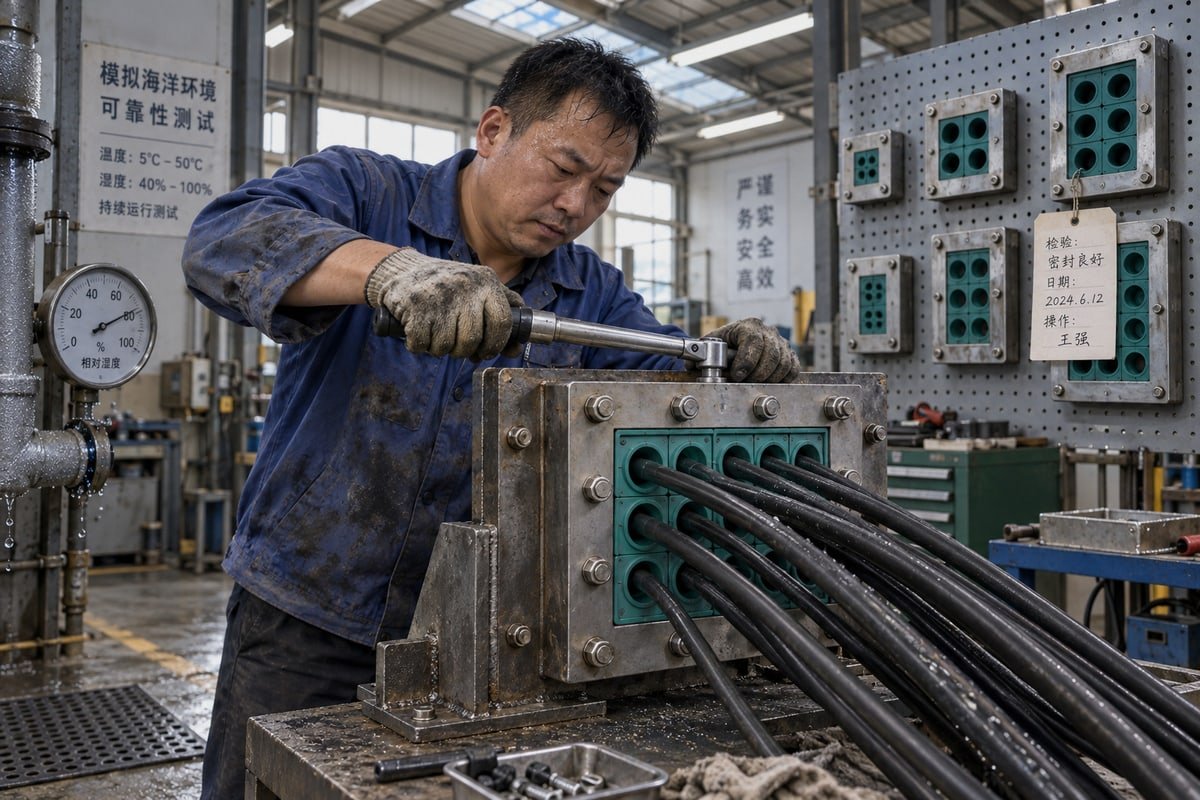
Multi cable transit service life rarely ends at the steel frame. It ends at the rubber. We learned that early on our EPDM module line, and leaks follow fast.
Die Lebensdauer von Mehrfachkabeldurchführungen hängt von der Umgebung, der Installationsqualität und dem Kompressionsverhalten des Gummis ab, nicht vom Kalenderalter. Rahmen halten oft Jahrzehnte, während EPDM-Module bei Bedarf ersetzt werden: jährliche Inspektion und Ersatz, wenn bleibende Verformung, Rissbildung, Aushärtung oder fehlgeschlagene Dichtheitsprüfungen auftreten, typischerweise alle 5–10 Jahre im rauen Betrieb.
That short answer hides a lot of detail. The rest of this article breaks it down. I will cover realistic lifespan ranges, the environmental degradation factors that shorten them, the inspection signs that tell you to act, and the material and maintenance choices that push module life closer to frame life. I write this from the floor of a factory that has made cable penetration seals since 2013, so I will share what we see in returned samples and buyer questions along the way.
Wie lange kann ich erwarten, dass meine MCT-Gummimodule halten, bevor Ersatz nötig ist?
On our compression-set bench, a batch of TSC modules held nearly full rebound after long clamping. That test taught me more about lifespan than any datasheet.
MCT-GummimoduLe halten typischerweise 5 bis 20 Jahre, wobei 5 bis 10 Jahre eine übliche Planungsgröße für den Austausch in exponiertem oder maritimen Einsatz ist. Gut spezifizierte halogenfreie EPDM-Systeme in geschützten Anlagen sind für 25 bis 50 Jahre ausgelegt, sodass der Austausch zustandsbasiert ist, anstatt an einen Kalender gebunden zu sein.

Before we talk about years, we need to agree on what "multi cable transit" means. The term is not universal. In building and flooring contexts, some sources quote a 15-year system life for products also labelled MCT. In offshore, marine, and energy contexts, an MCT is a steel frame packed with elastomeric modules 1, stay plates, and a compression unit. This article is about the second type. That is what we build in our TSR round and TSC square series, and it is where lifespan claims differ most sharply.
Frame life and module life are not the same number
The frame is galvanized or stainless steel. With sound welds and a protected finish, it can outlast the facility. The rubber modules are the wear item. So when a buyer asks about multi cable transit service life, I always split the question in two. How long will the frame stay in the wall? And how often will the rubber inside it need attention?
What the published figures actually say
The ranges in the market look contradictory at first. They are not. They describe different environments and different definitions of "life."
| Source type | Figure quoted | Kontext |
|---|---|---|
| Commercial maintenance guidance | 5–20 years system life; replace modules every 5–10 years | Exposed, marine, or outdoor service with annual or semiannual inspection |
| Manufacturer design data | 20-year shelf life; 40-year minimum service life | Sheltered industrial plants, correct installation, application dependent |
| Petrochemical white paper | Proven in facilities with operating lives over 20 years | Onshore oil, gas, and chemical plants |
| Polymer design guidance | 25–50 year design life for EPDM and halogen-free compounds | Fire, gas, and water ingress resistance under nominal loading |
| Marine class practice | Inspection and replacement aligned to 2.5-year and 5-year survey cycles | Vessels and offshore units under class rules |
A skeptical sourcing engineer will notice the gap between "40 years minimum" and "replace every 5 to 10 years." Here is how I resolve it. The 40-year figure describes the polymer's potential under nominal conditions. The 5-to-10-year figure describes what operators actually plan for when salt, UV, and rework are in play. Both are true. Neither is a promise for your site.
Why we quote condition, not years
When a buyer asks me for a guaranteed lifespan, I give them our test documents instead: A-0/A-60 fire rating, IP68 ingress protection 2, and watertight and gas-tight sealing from 0.01 to 0.4 MPa. Those numbers tell you what a new module does. Sealing capacity retention 3 over time is then set by your environment and your maintenance discipline, not by our nameplate. That is the honest answer, and it is the one that survives an audit.
Welche Faktoren beschleunigen Verschleiß oder Degradation in Kabeldurchführungs-Dichtungsmodulen?
Every time we choose a harder EPDM compound for chemical resistance, we give up some rebound. That trade-off sits at the heart of module degradation.
Cable transit sealing modules wear faster under UV, salt spray, thermal cycling, oils and solvents, cable vibration, and frequent moves, adds, and changes. Poor installation torque, missing lubricant, wrong module sizing, plasticizer migration from cable jackets, and galvanic frame corrosion also accelerate compression set and loss of seal.
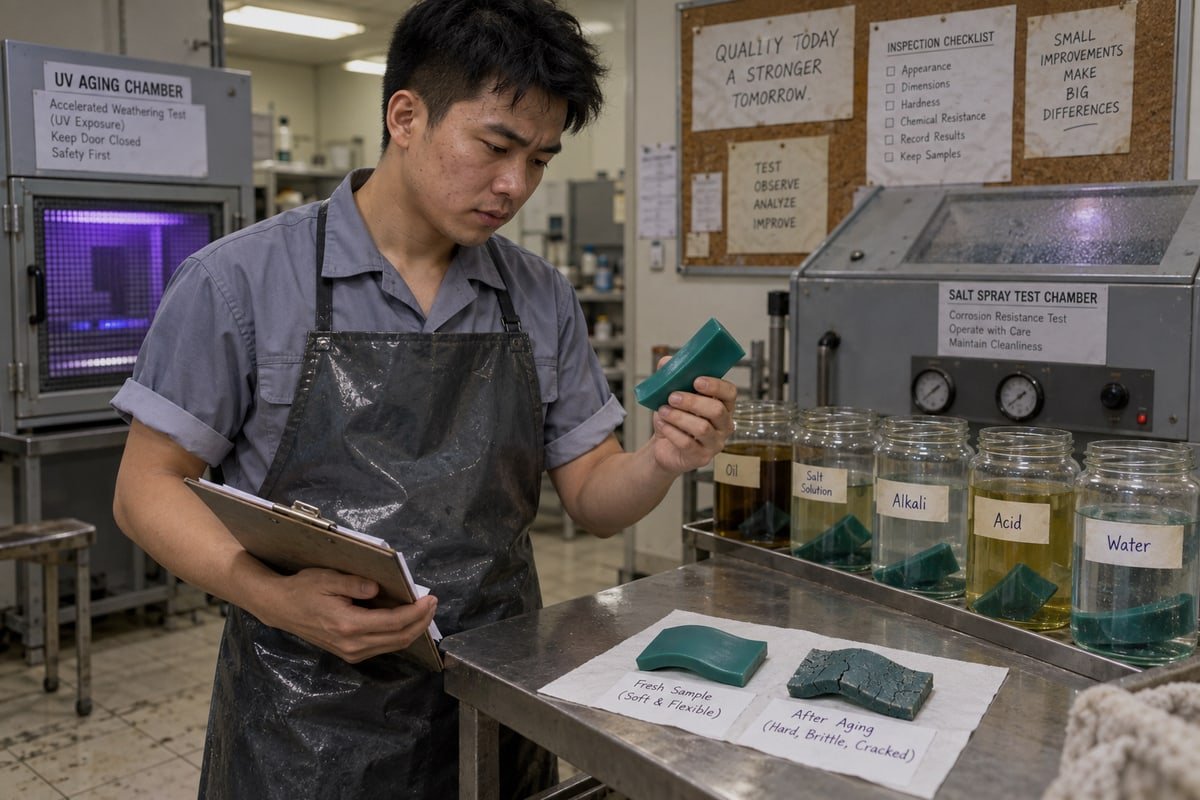
I group the causes into three families: environment, installation, and rework. Most premature failures we see in returned samples involve at least two of them at once.
Environmental degradation factors
| Factor | What it does to the rubber | Wo wir es am häufigsten sehen |
|---|---|---|
| UV radiation | Oxidative aging, surface cracking, chalking | Outdoor BESS containers, rooftop switchgear, deck penetrations |
| Salt spray and humidity | Corrodes frame and bolts; uneven pressure on modules | Coastal plants, marine and offshore installations |
| Thermal cycling | Repeated expansion and contraction fatigues the seal face | Data center walls, container roofs, engine rooms |
| Oils, fuels, solvents | Swelling or hardening depending on compound | Petrochemical, hydraulic bays, vehicle plants |
| Hydrogen or radiation | Rapid embrittlement of standard elastomers | Emerging hydrogen processing and nuclear-adjacent sites |
Halogen-free rubber aging is slower than many people expect in sheltered plants, but it accelerates sharply outdoors. Our step-core EPDM 4 has good ozone and weathering behaviour by nature. Even so, I tell European integrators that a container wall facing the sun for ten summers will not look like the sample they approved.
Installation errors that shorten life on day one
Three mistakes account for most of the early failures I have investigated:
- Under-torqued or over-torqued compression bolts. Too little leaves gaps. Too much drives the rubber past its elastic range.
- Skipped or wrong lubricant. Dry assembly tears the module surface and prevents even seating.
- Wrong module size for the cable. A step-core module adapts within its range. Outside that range, one cable carries all the load.
Compression wedge maintenance starts at installation. If the initial torque is wrong, no later inspection fully recovers it.
Rework, MAC, and fusing
High frequencies of moves, adds, and changes are the silent killer. Every time the pack is opened, the modules that were compressed do not spring fully back. This is compression set. Once opened, a transit needs new modules to reach certified pressure again. Plasticizer migration makes it worse. Over years, cable jackets and rubber can bond or "fuse," so extracting a cable damages the module around it. That is why retrofit and expansion capacity should be designed in with spare modules from the start.
The frame can fail the seal too
Galvanic corrosion in offshore environments creates pits and ridges on the frame face. The rubber may look intact, but pressure is no longer even. Water bypasses at the low points. This is one reason marine and offshore standards tie inspection to class survey cycles rather than to rubber appearance alone.
How do I know when it's time to replace my cable transit rubber modules?
A sourcing engineer in Germany once sent me photos of modules that looked perfect yet leaked. The frame, not the rubber, had corroded.
Replace cable transit rubber modules when periodic visual inspection shows cracking, hardening, permanent deformation, or fused cable jackets, when compression bolts reach full travel without regaining pressure, or when a water, gas, or pressure test fails. Any opened transit also needs new modules because compression set prevents reliable reuse.
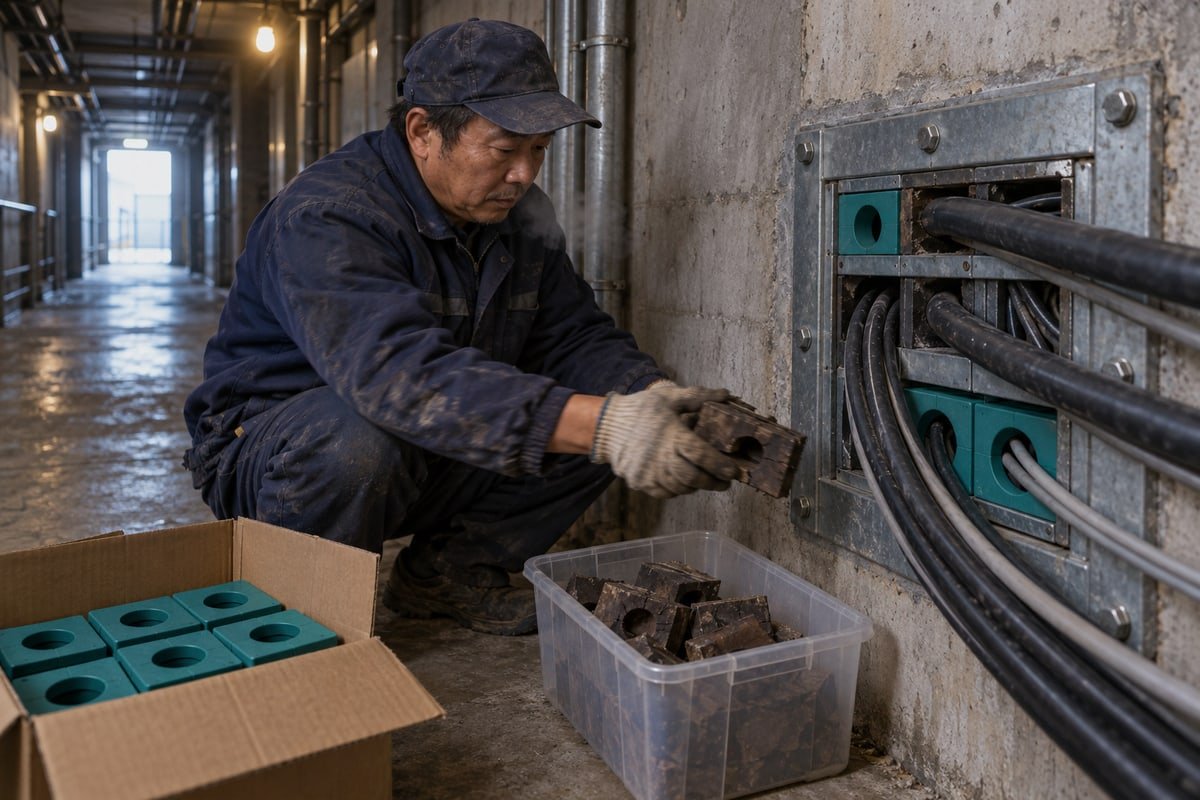
Replacement is a decision, not a date. The photos from that German engineer changed how I write inspection guidance. Now I ask people to look at the whole assembly, not just the rubber.
A simple inspection sequence
Here is the routine I recommend to plant engineers. It takes a few minutes per transit.
- Check the frame face for corrosion, pitting, or paint loss. Note any irregularity near the seal line.
- Look at the module faces. Cracks, chalking, glossy hardening, or extrusion between stay plates all count.
- Press a thumbnail into an exposed edge. A healthy module rebounds. A set module keeps the mark.
- Check the compression unit. If the bolts are at full travel and the pack still feels loose, the rubber has lost its memory.
- Where the site allows, run a mechanical stress testing or pressure check on the penetration. Our modules are tested for 0.01–0.4 MPa watertight and gas-tight performance 5 when new, so a failed retest is a clear trigger.
- Record the result with a photo. Digital lifecycle records make the next survey faster.
Monitor or replace now?
| Observation | Action |
|---|---|
| Light surface dulling, full rebound, bolts mid-travel | Monitor; re-inspect at the next annual cycle |
| Minor chalking on the outer face, rebound still good | Monitor; shorten interval to semiannual in outdoor or coastal sites |
| Visible cracks, hardened face, permanent deformation | Replace the affected row |
| Bolts at full travel, pack still loose | Replace the full pack and re-torque to specification |
| Cable extraction planned and jackets fused to rubber | Replace modules during the same shutdown |
| Failed water, gas, or pressure test | Replace immediately; verify frame face before reassembly |
| Frame pitting or galvanic corrosion at the seal line | Repair or replace the frame; new modules alone will not hold |
Fixed interval or condition-based?
Buyers push back on both approaches, so I raise both objections directly. Some prefer fixed replacement intervals. Their argument is that a schedule is simple, budgetable, and avoids the risk of a missed seal failure. Others argue that a well-designed module can serve much longer, and swapping it early wastes cost and downtime. My position is in the middle. Use condition-based replacement as the rule. Then shorten the inspection interval where the cost of failure is high. Offshore, marine, and hazardous-area operators often replace earlier than the rubber strictly requires, and they align that work to 2.5-year and 5-year class survey cycles. That is a rational safety margin, not waste. Smart compression wedges that report sealing pressure in real time are beginning to make this predictive rather than reactive, and I expect that to spread into modular data centers and BESS fleets.
Can I extend module service life through material selection or maintenance practices?
Our first private-label batch for a BESS builder taught us a hard lesson: the best compound still fails if the torque sequence on site is wrong.
Yes. Specifying halogen-free EPDM sealing modules with proven chemical resistance properties, correct step-core sizing, manufacturer-approved lubricant, and specified compression torque extends service life significantly. Add annual inspections, re-torque checks, fresh modules after any rework, and fluoroelastomers for hydrogen or radiation service, and modules can approach the frame's decades-long life.
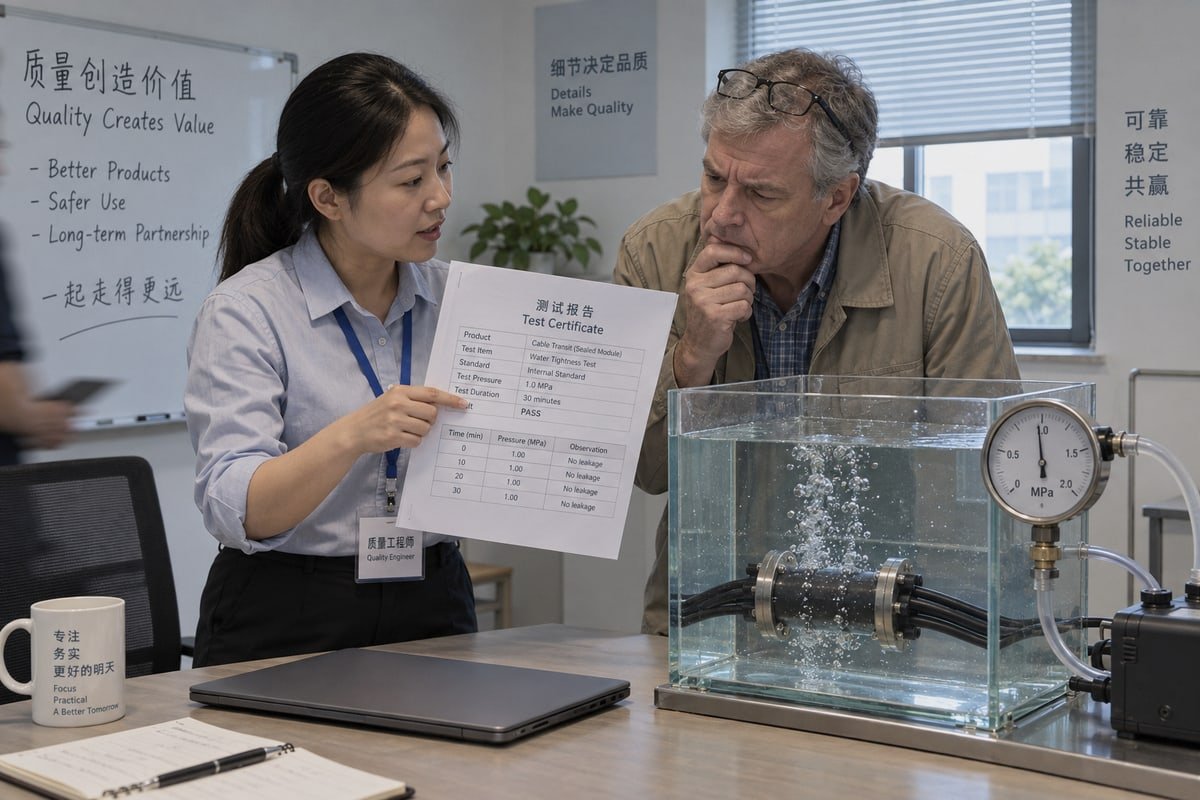
Service life is decided twice. Once at specification, and again every time someone touches the transit. I will take both in turn, and then say a word about spare parts, because that is where sourcing managers actually feel the cost.
Choose the compound for the environment, not the price list
EPDM is the workhorse for a reason. It resists ozone, weathering, water, and heat well, and halogen-free formulations support firestop system integrity without releasing corrosive gases in a fire. That is why we base our TSR and TSC modules on step-core, halogenfreies EPDM. It is also why we hold ISO 9001 and IATF 16949 systems and run a BV-approved factory: the compound is only as good as the process control behind it.
But EPDM is not universal. In fuel and mineral oil contact, it swells. In hydrogen processing or high-radiation zones, standard elastomers embrittle quickly, and advanced fluoroelastomers are becoming essential. Here is how I frame the choice for buyers:
| Service condition | Preferred compound family | Why |
|---|---|---|
| Sheltered indoor plant, data center, switchgear room | Eine Modulgröße passt sich an mehrere Kabeldurchmesser an, | Long design life, low smoke, cost effective |
| Outdoor container, coastal, marine deck | Halogen-free EPDM with UV and ozone stabilisation | Weathering resistance is the limiting factor |
| Oil, fuel, solvent exposure | Oil-resistant elastomer per exposure profile | EPDM swells in hydrocarbons |
| Hydrogen processing, radiation | Fluoroelastomer | Standard rubbers embrittle rapidly |
Maintenance practices that actually add years
- Install to the specified torque in the correct sequence, and record it.
- Use the approved lubricant every time. Dry assembly damages the seal face.
- Size modules so each cable sits inside the step-core range, not at its edge.
- Inspect annually, and semiannually in salt, UV, or vibration-heavy service.
- Re-check compression after the first thermal season, when settling is most visible.
- Keep spare rows in stock so MAC work never tempts anyone to reuse set modules.
Plan spares like a second source, not an emergency
This is where I will be direct about what we do. Rubber module replacement frequency only becomes a budget problem when spare modules are expensive or slow. Our modules are dimensionally compatible with common 120-frame standards, so they drop into existing cutouts as a qualified second source at 40–60% lower cost than the incumbent brand. We back that with model cross-reference tables, free validation samples, CAD/STEP files, and test documents on request. For OEM integrators building BESS containers or modular data centers, we also make custom sizes with in-house molds and supply spare sealing modules under private label. Extending multi cable transit service life is easier when replacing a row costs a fraction of what it used to.
Fazit
Frames last decades; rubber does not. Ignore the modules and leaks arrive. Inspect on condition, install to spec, and keep affordable compatible spares ready.
Fußnoten
1. Technical definition of the flexible polymer materials used to create sealing modules in cable transits. ↩︎
2. Official explanation of IP ratings, which define the sealing effectiveness of cable penetration systems. ↩︎
3. Engineering concepts regarding the ability of gaskets and seals to maintain pressure over time. ↩︎
4. Technical overview of EPDM rubber, the primary material used for durable environmental sealing in industrial transits. ↩︎
5. Information on maritime safety standards for fire and fluid-tight penetrations in offshore structures. ↩︎


 English
 Español de México
 Deutsch
 Français
 العربية
 Русский