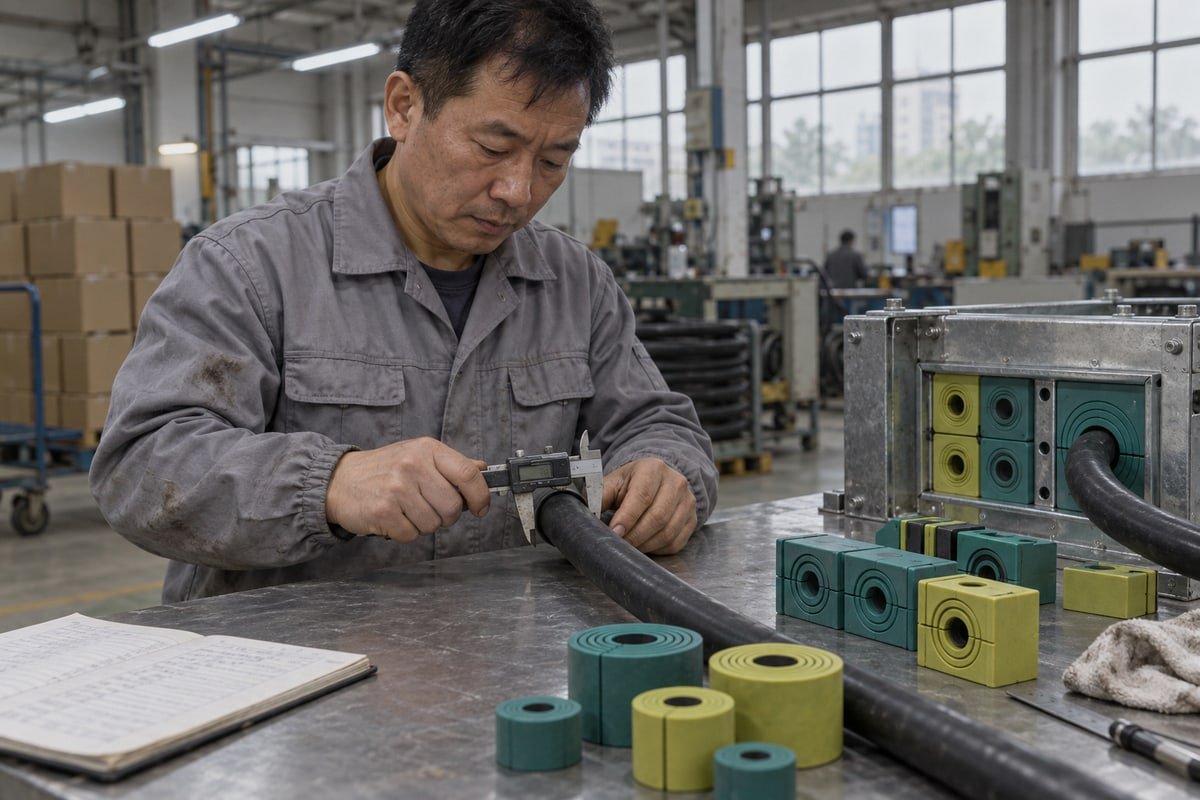
Picking the wrong sealing module size for multi cable transits is a quiet failure. Water finds the gap months later. Our factory has rebuilt enough of those transits to know.
Choose sealing module size for multi cable transits by measuring each cable outer diameter, matching it to the manufacturer’s step-core sizing band, confirming the module base size fits the 120-frame packing space, then verifying fire, IP, and pressure certificates before ordering.
That is the short answer. The rest of this article shows how we do each step at DewinMCT, and how you can check our work before you buy.
How do I match my cable diameter range to the correct step-core module size?
Last year our QC team rejected a batch of client-supplied cable data. The sheet listed conductor cross-sections, not outer diameters. Sizing from it would have failed.
Match cable diameter range to step-core module size by measuring the actual cable outer diameter with calipers, finding the sizing band that contains it with margin on both ends, and choosing the smallest base size whose step core compresses the jacket without slack or forcing.

The most common sizing error we see is simple. Someone reads the cable schedule, sees "16 mm²," and picks a module for a 16 mm cable. That is a conductor area, not a diameter. The jacket may be 22 mm across. The module then sits loose, and the seal fails its first pressure test.
Measure the cable outer diameter first
Start every project with a cable schedule analysis. For each cable, record the cable outer diameter 1 from the datasheet, then confirm it with calipers on a real sample. Jackets vary between batches. A 1 mm difference can push a cable from one band into the next. Measure at two points around the jacket. Use the larger reading.
Read the MCT sizing chart
Most step-core systems, including our TSC square modules, use nominal base sizes 2 of 15, 20, 30, 40, 60, 90, and 120 mm. Each base size covers a band of cable diameters because the step core peels away in layers. Below is a typical industry sizing chart. Always confirm final bands against our own MCT sizing chart for the specific model.
| Module base size (mm) | Typical cable outer diameter band | Notes |
|---|---|---|
| 20 | 4–15 mm | Small control and signal cables |
| 30 | 11–24 mm | Power cables in BESS and switchgear |
| 40 | 21–35 mm | Medium power feeders |
| 60 | 32–54 mm | Large power cables |
| 90 | 48–72 mm | Main incomers, pipes |
The rule we teach installers is this: pick the smallest base size that contains your cable diameter, and aim to land inside the band, not at its edge. One catalog we benchmark against says to select an inside diameter one step smaller than the cable. That reflects the same idea. The module needs an interference fit. The EPDM must compress against the jacket. Slack means leakage. Over-compression means a damaged jacket or a wedge that will not close.
Plan packing, not just single cables
A frame is a shared space. One supplier guideline cites a 70–80% fill ratio 3 as the practical target. Beyond that, you cannot compress evenly. Below that, you waste frame area. For dense fiber optic or signal bundles, multi-hole micro-modules keep each cable in its own gas-tight seal while saving width. Twin or triplet modules do the same for small power cables. One more detail: Low Smoke Zero Halogen jackets show cold flow under long compression. Our halogen-free EPDM step cores are designed to hold compression on that jacket type, but we still recommend the tighter half of the band for LSZH cables.
Can I cross-reference my existing 120-frame model to a compatible DEWIN sealing module?
A sourcing manager in Germany once sent me a nameplate photo and one question: will your module fit this frame? Yes, and our cross-reference table proves it.
Yes. DEWIN TSC square modules and TSR round assemblies are dimensionally compatible with common 120-frame standards. Send your existing module model numbers, and we return a cross-reference table mapping each one to a DEWIN equivalent, plus free validation samples and CAD or STEP files for fit checks.

The 120-frame standard is the reason drop-in second sourcing works at all. The frame has a fixed 120 mm internal width. Modules come in base sizes that add up to that width in each row. If our module has the same base dimensions and the same compression behaviour, it occupies the same slot. Our engineers hold those dimensions to tight tolerances for exactly this reason.
What the cross-reference table contains
When you send us your bill of materials, we map each line. The table is not a marketing sheet. It lists base size, cable band, and what changes.
| Your existing 120-frame item | DEWIN equivalent | Cable outer diameter band | What to verify |
|---|---|---|---|
| Base 20 module | TSC 20 | Small signal band | Same footprint, step core count |
| Base 40 module | TSC 40 | Medium power band | Row height match |
| Round sleeve assembly | TSR series | Per drawing | Sleeve bore, lock ring thread |
| Compression unit | DEWIN compression wedge kit | — | Wedge height, bolt pitch |
| Stayplate | DEWIN stay plate | — | Thickness, row count |
We attach STEP files to each line. Your engineer can drop them into the frame model and check interference in minutes.
Check packing space dimensions before you sign off
Compatibility is more than module width. Calculate net packing space by subtracting the height of the compression wedge from the frame's total internal height. Then confirm every module in a horizontal row shares the same base height. Mixed heights in one row give uneven pressure at final compression. Also check stayplate requirements: a stayplate sits between rows and must match the row count of your frame. Our cross-reference covers these parts too, not only the rubber blocks.
The cost objection, answered honestly
Buyers ask how we can be 40–60% lower in cost and still be a real equivalent. The answer is structure, not shortcuts. We are a factory-direct operation since 2013, with plants in Shaanxi, Shandong, and Hunan, and in-house mold making. There is no distributor margin. The material is still halogen-free EPDM. The frame dimensions are still standard. Some buyers also worry that adaptable step-core modules are less predictable than fixed-size blocks. In practice the reverse is true for procurement: one step-core size replaces several fixed sizes, so your spare inventory shrinks. For spare capacity planning, reserve at least 20% of frame area with solid filler modules. Those fillers seal today and get replaced with cable modules later, without touching the frame.
What certification and test documentation should I request before qualifying a module size?
Every test report we issue costs lab time. So we weigh which documents actually change a buyer's decision. For module sizing, three do: fire rating, ingress protection, and pressure tightness.
Request the fire rating certificate for A-0 or A-60 bulkhead classes, the IP68 ingress protection test report, water and gas tightness results across 0.01–0.4 MPa, ISO 9001 and IATF 16949 certificates, and the BV factory approval, each tied to the exact module size you plan to qualify.

A certificate is only useful if it covers the configuration you will install. A test on a 60 mm module with a 50 mm cable says little about a 20 mm module with a 6 mm cable. So the first thing to ask is: which module sizes, which frame, and which cable fill were on the test rig? We provide that mapping with every document on request.
The document checklist we recommend
| Document | What it proves | Why size matters |
|---|---|---|
| Fire rating certificate, A-0 / A-60 | Fire rated cable seals hold the bulkhead class | Rubber mass and fill ratio in the test frame |
| IP68 test report | Ingress protection under submersion | Small modules are the weak point for water |
| Water and gas tightness, 0.01–0.4 MPa | Gas and water tightness under pressure | Compression per module must be verified |
| ISO 9001 and IATF 16949 | Process control and traceability | Batch-to-batch dimension consistency |
| BV factory approval | Third-party audit of the plant | Confirms the factory, not just a sample |
| Material declaration, halogen-free EPDM | Low smoke, no halogen release | Relevant for BESS and data center enclosures |
IP68 versus IP66/67 protection rating
Many switchgear and control panel specs call for an IP66/67 protection rating 4 on the enclosure. Our modules are tested to IP68, which sits above that. Ask for the full report, not just the rating code. The report shows depth, duration, and which cable sizes were installed. That tells you whether the smallest module in your design was represented.
Pressure, fire, and temperature together
Gas and water tightness is tested across a range for a reason. A BESS container may only see rain. An offshore penetration may see a flooded compartment. Our 0.01–0.4 MPa range covers both ends, but you should match the test pressure to your risk case. For fire, the A-0 and A-60 classes 5 cover most marine and infrastructure bulkheads. For extreme temperature sites, also ask how the elastomer behaves against the steel frame. EPDM and steel expand at different rates. A well-designed step core keeps enough compression reserve so the seal does not relax in cold. We share the material data behind that claim rather than asking you to trust a slogan.
How do I validate module fit and sealing performance before committing to a full order?
One lesson took us years to fully accept: a spec sheet never convinces a skeptical engineer. A sample in a torque-tightened frame does. So we ship validation samples free.
Validate module fit by installing free samples in your actual frame, tightening the compression wedge to the specified torque, checking each step-core module grips the cable outer diameter with no visible slack, then running a site pressure or water test and comparing results with the supplier's certified figures.

A validation sample is worth more than any email thread. It answers three questions at once: does the module fit the frame, does it grip the cable, and does the assembly seal. We suggest a short, repeatable process. It takes one afternoon and one frame.
The five-step validation process
- Request samples against your cross-reference table. Ask for one module of each base size in your design, plus a compression wedge kit and stayplate if you want to test the full stack. We send these free and include STEP files.
- Peel the step core to your measured cable outer diameter. Remove layers until the cable sits in the core with light hand pressure. Do not skip a layer to make insertion easier. That is the slack that leaks later.
- Pack the frame to your real fill ratio. Use fillers for the spare capacity you planned. Keep every module in a row at the same base height.
- Tighten to torque. Industry guidance cites around 5–8 Nm for locking rings on round assemblies and a maximum near 20 Nm for wedge tightening. Use the torque printed on our installation sheet for the specific kit. Apply the recommended lubricant first. Dry rubber gives false torque readings.
- Test and inspect. Run a water spray or low-pressure air test. Then look at every module face. Rubber should bulge evenly at the edges. No cable should turn in its core by hand.
What a pass and a fail look like
| Check | Pass | Fail |
|---|---|---|
| Cable grip | Cable cannot rotate by hand | Cable turns or slides |
| Module face | Even bulge around all edges | Gap at one corner |
| Wedge closure | Reaches torque with wedge fully seated | Torque reached early, wedge not seated |
| Row alignment | Flat, uniform row surface | Steps between modules |
| Pressure test | Holds test pressure with no bubbles or weep | Bubbles at module interface |
From sample to pilot to volume
After the sample passes, most of our European integrator clients place a pilot order for one or two production frames. That lets purchasing check lead time and export paperwork alongside performance. Some also record module occupancy and cable type per transit in their asset system, building a digital twin that flags when a frame is nearing its fill limit. That data makes the next expansion a parts order rather than a redesign. Only after the pilot do we recommend switching volume. That sequence protects you, and it protects our reputation as a second source that stays qualified.
Conclusion
Wrong sealing module size causes late, costly leaks. Measure cable outer diameter, read the chart, verify frame fit, demand size-specific certificates, then test our free samples first.
Footnotes
1. Authoritative government source for measurement standards and technical specifications. ↩︎
2. Official international standard body for industrial and manufacturing specifications. ↩︎
3. Technical explanation of fill factor and ratio in engineering applications. ↩︎
4. Comprehensive overview of international ingress protection ratings for enclosures. ↩︎
5. Primary international authority for maritime fire safety and bulkhead classifications. ↩︎



 English
  Español de México
  Deutsch
  Français
  العربية
  Русский