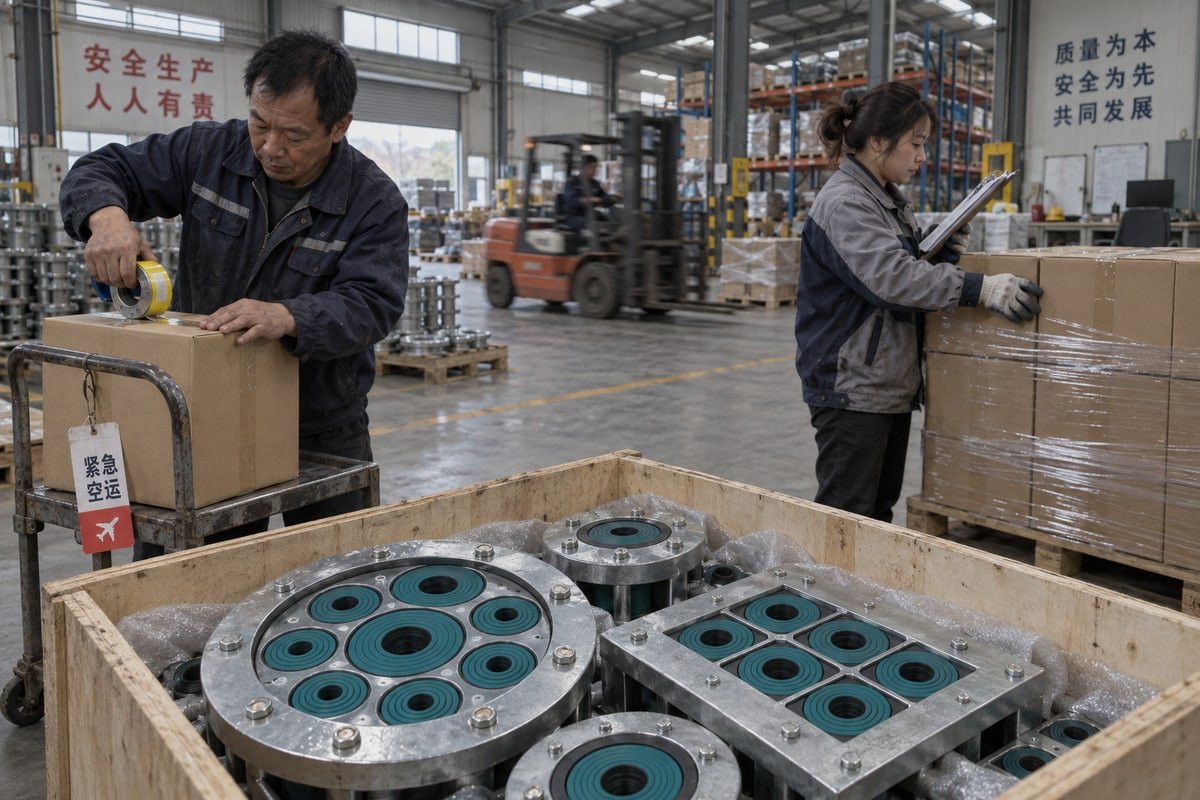
Multi cable transit procurement stalls projects I see from our factory floor: an urgent order, an eight-week wait, a missed installation window. The buying model is usually the cause.
For multi cable transit procurement, an annual framework agreement is the better default when demand repeats and specifications are frozen; ad hoc orders suit one-off, custom, or uncertain needs. Most integrators do best with a hybrid: standard modules on a call-off contract, exceptions bought spot.
The choice is not about which model is always cheaper. It is about which model fits your demand pattern, your engineering freeze level, and your delivery risk. Below I break the decision into four practical questions and show what to expect from each model.
How do I decide between ad hoc orders and an annual framework agreement for MCT procurement?
A sourcing manager at a BESS container builder asked me why his fourth spot order for the same TSC modules needed a fresh quote. That question is the whole decision.
Decide by demand pattern and specification stability. Choose an annual framework agreement when the same MCT product family recurs across projects or sites and the technical envelope is frozen. Choose ad hoc orders when each cable transit package is custom, demand is irregular, or the design is still moving.

Here is the scannable version of the decision. I use this same matrix when I talk to purchasing engineers at switchgear and modular data center builders.
| Decision factor | Favors ad hoc orders | Favors an annual framework agreement 1 |
|---|---|---|
| Demand pattern | Irregular, one project at a time | Recurring, multi-site, or MRO procurement |
| Specification status | Still changing, custom-engineered each time | Frozen product family, standardized components |
| Procurement speed needed | Not critical | Critical; call-offs must go out in days |
| Price sensitivity | Wants price discovery per order | Wants stable pricing and volume discounts |
| Supply risk | Low; commodity-like availability | High; tight capacity, long lead times |
| Number of sites drawing stock | One | Several, sharing one approved list |
The one question that settles most cases
Ask your team this: do we have repeatable demand inside the same technical envelope, or unique scope every time? Modular sealing solutions like round TSR assemblies and square TSC modules are, by design, repeatable. The same frame size, the same module sizes, and the same EPDM compound 2 serve a whole family of cable diameters. If your container or panel design uses the same frame cutouts on every build, your demand is repeatable. That points to a call-off contract.
If, on the other hand, every project needs a new frame geometry, a custom mold, and a fresh fire-rating review, then project-based procurement with ad hoc orders is honest. You are not buying the same thing twice.
Answering the two common objections
Buyers often push back with two arguments for staying ad hoc. The first is "ad hoc preserves competition on every order." That is true, but competition on small, urgent buys is weak. You have no leverage when the installation window is next week. A framework moves that competition to one well-prepared tender, where leverage is real. The second is "a framework locks us into obsolete pricing or specs." That risk is real only if the contract has no indexation and no change-control clause. Both are easy to write in, and I cover them in the last section.
Why a hybrid model works for integrators
Most OEM integrators we supply run a hybrid. Their core list of standardized components sits under an annual agreement. Custom sizes, emergency replacements, and trial parts go through ad hoc orders. This also controls maverick spend 3, where a site buyer picks a non-compliant module to hit a deadline. Once the approved list exists, strategic sourcing becomes a rule, not a hope.
What cost and lead-time differences should I expect between one-off MCT purchases and a yearly supply contract?
Every quarter I weigh the same trade-off on our production schedule: reserve EPDM molding capacity for contracted call-offs, or keep slots open for urgent spot orders. Both have a cost.
Expect one-off MCT purchases to carry higher unit prices, repeated quoting effort, and reactive lead times of roughly 8–12 weeks when no production slot is reserved. A yearly supply contract typically trades some flexibility for volume discounts, fixed or indexed pricing, and shorter, more predictable call-off delivery.

The unit price on a quote is the smallest part of this comparison. I want to separate it from total cost of ownership, because that is where the two models really diverge.
Lead time is a full-chain metric
Procurement teams now treat lead time as the whole chain, not just factory time. The chain for an MCT order usually runs like this:
- Internal approval and budget release
- Tender or PO issue and supplier acceptance
- Manufacturing (frame fabrication, EPDM molding, assembly)
- Inspection and test documentation
- Freight, customs, and export paperwork
- Site receipt and acceptance
An ad hoc order repeats steps 1 and 2 every time. A framework runs them once. After that, a call-off skips straight to step 3. That is the real lead time optimization a framework delivers. It does not make molding faster. It removes the weeks spent before molding starts. I always recommend planning backward from the required-on-site date rather than trusting a quoted ETA, and a framework makes that backward schedule far more reliable.
Where the cost actually sits
| Cost element | Ad hoc orders | Annual framework agreement |
|---|---|---|
| Unit price | Spot price, exposed to metal and elastomer swings | Fixed or indexed price, tiered volume discounts |
| Quoting and approval effort | Repeated per order | Once per year, then simple call-offs |
| Expediting and air freight | Frequent when windows are tight | Rare; capacity is reserved |
| Engineering rework | Higher risk of substitute parts and re-validation | Approved drawing reused across call-offs |
| Inventory management | Either over-stocking or stock-outs | Planned buffers tied to build schedule |
| Schedule slippage | Direct cost of idle installation crews | Reduced by predictable delivery |
Raw material volatility deserves a specific note. Galvanized steel for frames and EPDM for modules both move with commodity markets. Ad hoc buyers absorb every spike at the moment of purchase. A fixed-price clause, or an indexed clause with a stated review trigger, spreads that risk over the contract term.
The honest counter-case
A framework becomes inefficient when estimated volumes are overstated, because tiered pricing may not be reached and the supplier plans capacity that nobody uses. It also fails when the supplier underperforms and the buyer has no exit. Ad hoc buying fails in the mirror image: the same modules get re-sourced, re-quoted, and re-validated many times a year, and expediting costs quietly pile up. Frameworks also allow learning transfer, where installation crews refine compression and spacing technique across successive call-offs and waste drops. Spot buying resets that learning each time a different module lands on site.
For buyers qualifying us as a drop-in second source, the 40–60% lower module cost is the headline. But the framework is what turns that saving into predictable budget lines rather than a one-time win.
How can I secure drop-in dimensional compatibility and validation samples regardless of which procurement model I choose?
On our QC bench, every TSC module batch gets checked against 120-frame cutout dimensions before it ships. That check is what makes a drop-in second source possible.
Secure compatibility by requesting a model cross-reference table, CAD or STEP files, and free validation samples before commercial commitment. Test the sample in your existing 120-frame cutout, record fit and compression results, and write the approved drawing and sample reference into either the purchase order or the framework agreement.

Compatibility is a procurement term, not just an engineering one. If it is not written into the order, it does not exist. The good news is that the validation sequence is the same whether you buy ad hoc or under a framework. Only where you file the result changes.
A five-step validation sequence
- Map the existing part numbers. Send your current module list to the supplier and ask for a cross-reference table, existing model to equivalent model. We maintain these tables for common 120-frame standards, and a serious supplier should answer with dimensions, not just a "yes."
- Check the geometry on screen first. Request CAD or STEP files for the frame, the modules, the stay plates, and the compression unit. Overlay them on your panel or container drawing. This catches cutout mismatches before any sample is shipped.
- Test a free validation sample in a real cutout. Fit the sample in an existing frame, not a test jig. Confirm the module seats flush, the step-core EPDM adapts to your actual cable diameters, and the compression unit reaches the specified torque without gaps.
- Record the result as a controlled document. Note the sample lot, the cable sizes tested, the compression achieved, and who signed it. This becomes your approval record.
- Reference that record in the commercial document. In an ad hoc PO, add a line: "supply per approved sample ref. X." In a framework, add the sample and drawing to the technical annex with a change-control clause.
What to ask for in either model
| Item | Purpose | Ad hoc order | Framework agreement |
|---|---|---|---|
| Cross-reference table | Confirms equivalent model per existing part number | Attach to PO | Technical annex, updated on change |
| CAD/STEP files | Digital fit check against 120-frame cutouts | Per order | Full library at signature |
| Free validation sample | Physical fit and compression check | Before first PO | Before signature and at each design change |
| Dimensional drawing with tolerances | Defines what "compatible" means contractually | Referenced on PO | Controlled annex |
| Test document on request | Proves fire, IP68, and pressure performance | Attached to first delivery | Delivered with each call-off |
Interoperability as an emergency stock strategy
One trend I see among multi-vendor buyers is interoperability planning. They want emergency stock from one brand to fit frames from another. That only works with dimensional compatibility proven on samples and documented in drawings. It also makes a second source useful for MRO procurement, because a spare module can be pulled from either supplier's stock without re-engineering. Our step-core modules cover a range of cable diameters within one size, which reduces the number of standardized components you need to hold.
What certification, documentation, and volume-pricing terms should I negotiate into an annual MCT framework agreement?
One lesson from exporting to Europe stuck with me: a framework without a document schedule is just a price list. Buyers need certificates attached to every call-off.
Negotiate a fixed certification baseline (fire rating A-0/A-60, IP68, watertight and gas-tight sealing to a stated pressure), a document schedule delivering test reports and traceability records with each call-off, tiered volume discounts with indexed raw-material adjustment, reserved production capacity, and a defined validation-sample and change-control process.

A well-built framework has three layers: what the product must prove, what paperwork travels with it, and how money and capacity flow. I take them in that order because certification failures cost more than price failures.
Certification and test document terms
Write the performance baseline as numbers, not brand names. For our TSR and TSC modules that baseline is fire rating A-0/A-60, IP68 ingress protection 4, and watertight and gas-tight sealing tested from 0.01 to 0.4 MPa. State that the supplier holds ISO 9001 and IATF 16949 5 systems and, for marine or offshore work, BV factory approval. Then require that test documents are available on request and that any certificate renewal or scope change is notified within the term. Standardization through the framework is what guarantees identical fire, gas, and water-tightness performance across a global asset portfolio, so do not leave the baseline vague.
Documentation, traceability, and emerging clauses
| Clause | What to specify | Why it matters |
|---|---|---|
| Document schedule | Test report, material declaration (halogen-free EPDM), dimensional drawing with each call-off | Auditability; avoids fragmented records typical of spot buying |
| Traceability record | Lot number and inspection log per delivered module | Marine buyers report classification-driven, IACS-linked expectations for a digital record per installed seal |
| Change control | Written notice and new validation sample before any dimensional or compound change | Protects drop-in compatibility over the term |
| Circular economy | Buy-back or re-certification of unused modules at project end | Reduces waste on over-ordered project stock |
| Digital call-off trigger | Call-offs raised from BIM or digital-twin milestones | Aligns delivery with real construction progress |
Pricing, capacity, and exit terms
On money, negotiate tiered volume discounts with a clear threshold per tier, plus an indexed adjustment tied to a named metal or elastomer index with a review trigger. That answers the "obsolete pricing" objection directly. On capacity, ask for reserved production slots against a rolling forecast, which is what prevents the 8–12 week reactive lead time on urgent orders. For smaller buyers, blanket purchase orders with an agreed ceiling can deliver much of the same benefit with less legal effort. Finally, keep an exit: a performance review at set intervals and the right to place ad hoc orders elsewhere if delivery targets are missed. That clause protects supply chain resilience 6, and a qualified second source makes it real rather than theoretical.
For private-label or OEM buyers, add mold ownership and tooling terms. Our in-house mold making lets us hold custom sizes for a named customer, and the agreement should say who owns that tooling and how export documentation is handled on every shipment.
Conclusion
Spot buying the same modules again and again burns weeks and budget. Put repeatable MCT demand under a framework, keep ad hoc orders for exceptions, and validate every part.
Footnotes
1. International standards for government and commercial procurement agreements and transparency. ↩︎
2. Technical properties of ethylene propylene diene monomer used in cable sealing. ↩︎
3. Definition and impact of purchasing goods outside of established contracts or procedures. ↩︎
4. International standard for degrees of protection provided by enclosures against water and dust. ↩︎
5. Official standard for quality management systems in manufacturing and automotive sectors. ↩︎
6. Global trade perspective on maintaining stable supply chains during disruptions. ↩︎



 English
  Español de México
  Deutsch
  Français
  العربية
  Русский