
A brochure logo is not a certificate. Buyers ask our factory how to confirm multi cable transits meet DNV, ABS, and Lloyd’s Register certifications before a surveyor rejects the install.
To confirm multi cable transits meet DNV, ABS, and Lloyd’s Register certifications, request the Type Approval Certificate number, verify it in each society’s online database, match the certificate scope to your bulkhead or deck type, and check the installed frame, modules, and cable fill against the approved drawings.
The rest of this article walks through that process in order IATF 16949 1. I start with documents. Then I cover what happens when you switch suppliers. After that I list the technical parameters to compare. I finish with a practical way to use free samples before you sign a purchase order.
What documents should I request to verify a supplier's DNV, ABS, and Lloyd's Register certifications are genuine?
Last year a Dutch purchasing engineer sent me a competitor's datasheet with three class logos and asked one question: which of these can I verify? That question shaped this section.
Request the Type Approval Certificate with its number, issue and expiry dates, scope of application, approved drawings, limitations, and installation instructions. Then check the certificate number in the DNV, ABS, or Lloyd's Register online database to confirm it is active, not expired or suspended.

Marine classification societies do not certify a logo. They certify a product family, tested in a defined configuration, for a defined use. So the first thing I tell buyers is to stop reading the brochure and start reading the certificate.
Three levels of approval that buyers mix up
There is a difference between a product certificate, a type approval 2, and installation acceptance. A product certificate says a batch was made and inspected. A Type Approval Certificate says a product family passed defined tests and may be used within a stated scope. Installation acceptance happens on the vessel, when a surveyor confirms the installed cable sealing system matches that scope. A supplier can hold the second and your yard can still fail the third.
Each society issues its own paper. DNV approvals for cable transits typically reference penetrations through A-class divisions 3 and state approval for A-60 steel bulkheads and decks. Lloyd's Register issues type examination certificates 4, and some of them extend scope to aluminium and sandwich panel bulkheads and decks, not just steel. ABS issues a type approval that names a specific transit system. None of these is a general blanket. If a project also falls under the EU Marine Equipment Directive, MED certification with its wheelmark is a separate document again.
The document checklist I hand to buyers
| Document | What to check | Red flag |
|---|---|---|
| Type Approval Certificate | Certificate number, issuing society, product family name, expiry date | Logo only, no number, or a scan with the number cropped |
| Scope of application | A-class division, watertight, gas-tight, hazardous area | Scope silent on your actual use case |
| Approved drawings and annex | Frame types, module sizes, cable diameter range, maximum opening size | Drawing revision differs from the offered product |
| Installation instructions | Packing sequence, compression torque, blanking rules | Instructions not tied to the certificate revision |
| Test reports | Fire test standard, pressure testing standards, IP test method | Summary page only, no test lab named |
| Material certificates | EN 10204 3.1 mill certificates for frames, rubber compound data | Frame grade unknown or "equivalent" |
Cross-check the number, not the PDF
A PDF can be edited. A database entry cannot, at least not by the supplier. DNV, ABS, and Lloyd's Register all publish approval search tools. Type the certificate number, confirm the holder name, and confirm the status is active. If the number returns nothing, or returns a different product name, stop there.
I will be direct about our own position. Our factory is BV-approved and runs ISO 9001 5 and IATF 16949 systems. Our A-0/A-60, IP68, and pressure test documents are available on request. When a vessel specification names DNV, ABS, or Lloyd's Register specifically, I tell the buyer to verify that exact society's certificate for whatever product they install, including ours. That honesty costs me a few quick orders. It saves buyers from a failed survey.
How can I confirm a drop-in replacement MCT module still meets class society approval after switching suppliers?
On our Shaanxi line every TSC module is checked against a 120-frame gauge before packing. That gauge proves fit. It does not prove class approval, and I tell buyers so.
A drop-in MCT module does not inherit the original supplier's approval. To keep class compliance, confirm the replacement module has its own Type Approval Certificate or test evidence, that its scope covers your division and substrate, and that the frame, module stack, and compression match the approved configuration.

This is the section where I lose the most sales, so I want to be precise. Our TSC square modules and TSR round assemblies are dimensionally compatible with common 120-frame standards. We publish cross-reference tables from the existing model to the DEWIN model. That makes qualification easy. It does not make certification automatic.
What transfers and what does not
| Item | Transfers when you switch suppliers? | Why |
|---|---|---|
| Frame cutout dimensions | Yes | Dimensional compatibility is a physical fact you can measure |
| Cable diameter range per module size | Usually, but verify | Step-core EPDM ranges are similar, not identical, across makers |
| Original supplier's Type Approval Certificate | No | The certificate names their product family, not yours |
| Fire test result for the tested configuration | No | The test used their modules, their compound, their compression |
| Installation instructions | No | Torque and packing sequence are product-specific |
| Yard's as-built record | Must be updated | The installed condition has changed |
The mixed-component trap
The most common audit failure I see is not a bad module. It is a mixed transit. A yard keeps the original frame, replaces half the insert stack with a second-source module, and reuses the original compression unit. Now the transit matches nobody's test setup. The original certificate no longer describes it. The replacement supplier's certificate does not describe it either. A surveyor who checks bulkhead and deck penetrations against approved drawings will flag it.
The clean path is simple. Replace the full insert stack and compression unit within one frame with one supplier's approved set. Keep the frame if the replacement supplier's certificate lists that frame type as an approved substrate. Otherwise, replace the frame too.
A five-step continuity procedure
- Pull the original certificate and the as-built packing plan for each affected transit.
- Obtain the replacement supplier's certificate, test reports, approved drawings, and STEP or CAD files.
- Submit the change to the class surveyor before installation, not after. Some societies also recognise approved service suppliers who can inspect and sign off transit work.
- Install per the replacement supplier's instructions, log the compression force or torque, and photograph the finished stack.
- File the new records under a certification continuity protocol, so a single cable added years later is re-compressed and re-sealed under the same documented method.
Our role in this is to make step two painless. We supply the test documents for A-0/A-60, IP68, and the 0.01–0.4 MPa watertight and gas-tight range, plus drawings and an English-speaking engineer who answers within the working day. What we do not do is tell you the old certificate still applies.
Which technical parameters, like fire rating, IP68, and pressure sealing, do I need to check against DNV, ABS, and Lloyd's Register standards?
Every week I weigh the same trade-off: a thinner module wall cuts rubber cost, but it narrows the compression window that our A-60 and IP68 test results depend on.
Check the fire integrity rating (A-0, A-60, H-120, or jet fire) against the vessel's fire zone plan, the IP68 ingress rating and test depth, the watertight and gas-tight pressure range, the approved cable diameter range and fill ratio, and the substrate type listed in the certificate.

Parameters and certificates are two views of the same thing. The certificate tells you what was tested. The parameters tell you whether that test matches your project. I split the check into five groups.
Parameter-by-parameter check
| Parameter | What the certificate should state | What you compare it to |
|---|---|---|
| Fire integrity | Division class (A-0, A-60, H-120, jet fire), test standard, substrate (steel, aluminium, sandwich panel) | The fire zone plan for each bulkhead and deck |
| Ingress protection | IP68 rating, test depth and duration | Exposure on open decks, bilges, or wash-down areas |
| Pressure sealing | Watertight and gas-tight test pressure, test direction | Design head for watertight subdivision or gas boundary |
| Cable fill | Cable diameter range per module, maximum opening size, blanking rules | Your cable schedule and spare capacity plan |
| Material | Frame grade, mill certificate type, rubber compound, halogen-free status | Corrosion class of the location and any low-smoke requirement |
Fire rating: the division drives the requirement
Under SOLAS regulations, A-class divisions are part of the vessel's passive fire protection. An A-60 fire rating 6 means the division holds back fire and keeps the unexposed side below the temperature limit for 60 minutes. A cable transit that penetrates that division must keep the same rating. DNV certificates in this area explicitly reference A-class penetrations and A-60 steel bulkheads and decks. Lloyd's Register type examination certificates may add aluminium and sandwich panel divisions. Offshore hydrocarbon areas raise the bar to H-120 or jet fire ratings, and an A-60 approval does not cover those. Match the certificate to the fire zone plan line by line.
IP68 and pressure: read the test conditions
IP68 is only meaningful with its test depth and duration. Ask for both. For pressure, our modules are tested watertight and gas-tight from 0.01 to 0.4 MPa. That is a range, not a single number, so I ask buyers where their design pressure sits inside it. A gas-tight seal on a battery container boundary and a watertight seal below a ship's waterline are different load cases even when the same module handles both.
Fill, material, and markings
The technical annex defines the cable diameter range for each module size and the maximum opening size per frame. Our step-core, halogen-free EPDM covers a range of diameters in one module size, which helps with spare capacity, but the range is still finite. Overfilling or using undersized blanking modules pushes the transit outside the tested condition. For frames, ask for EN 10204 3.1 mill certificates so the steel grade is traceable. Finally, look at the parts. Permanent markings, batch numbers, and material grades on the module face link the hardware to the test reports. A module with no marking cannot be traced, and a surveyor cannot accept what cannot be traced.
How do I use free validation samples to test class certification compliance before committing to a new MCT supplier?
A hard lesson: a free sample only helps when the buyer tests it like a surveyor would. So we now ship samples with a test guide.
Use free validation samples to verify fit in your existing 120-frame cutout, compare markings and material against the supplier's certificate and test reports, run a bench compression and pressure check, and record photos and measurements so the results can support a class surveyor's acceptance.
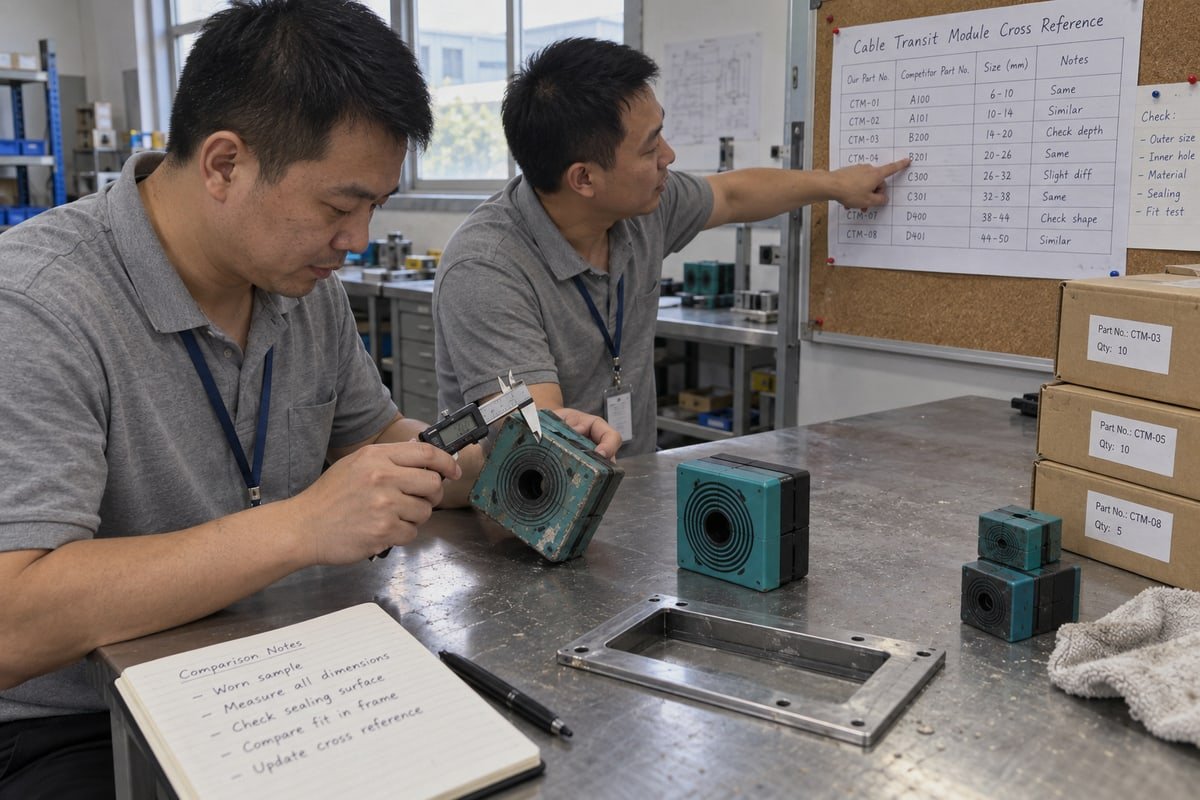
A sample is evidence, but only if you treat it that way. Here is the sequence I recommend to sourcing teams in Europe and the Middle East who use our free validation samples to qualify a second source.
Step one: request the right sample
Use the cross-reference table. Name the existing model, the frame type, and the cable diameters in that transit. Ask for the matching module sizes plus a blanking module. Ask for the certificate, test reports, installation instructions, and STEP files in the same shipment. A sample without paperwork tests nothing.
Step two: measure before you compress
Place the modules in a spare frame or a frame cutout on the bench. Check module width, height, and stack height against the drawing. Check that the compression unit reaches its working range with your cable count. Record the numbers. This is installation quality control done early, while a mismatch is still cheap.
Step three: verify traceability on the part itself
Read the marking on each module. Match the size code, batch number, and compound reference to the test report. Confirm the frame steel grade against the mill certificate. If your yard uses QR or RFID tags on transit frames, this is the moment to link the sample data to that tag so a surveyor can pull it up on site later.
Step four: run a bench compression and leak check
Pack the modules per the instructions, in the stated sequence, to the stated torque or compression force. If you use packing plan software that logs total compression force, log it. Then apply a simple air or water pressure check within the range on the test report. You are not repeating the type test. You are confirming the sample behaves like the documentation says it should.
Step five: record and decide
| Record item | Purpose |
|---|---|
| Photos of markings, stack, and compression unit | Links sample to certificate and drawing |
| Measured dimensions and torque | Proves fit and installation method |
| Bench pressure result | Supports surveyor discussion |
| Document set with revision numbers | Freezes the configuration you qualified |
Now the objection I hear from every finance team: why bother, if the cheaper product fits? Because the 40–60% cost reduction our drop-in modules deliver only counts if the transit passes survey. A cheap module that fails installation acceptance costs a re-work, a delay, and often a return to the original supplier at full price. Documented compliance is what makes the saving real. Our in-house mold shop can also cut custom sizes and private-label modules, and the same sample process applies to those.
Conclusion
Logos do not pass surveys. Verify the certificate number, match scope to your division, test samples with documents in hand, and record every change. Our factory supports each step.
Footnotes
1. IATF 16949 is the global technical specification for automotive quality management systems. ↩︎
2. ABS (American Bureau of Shipping) provides the type approval framework for marine equipment. ↩︎
3. DNV is a leading classification society that sets standards for A-class marine divisions. ↩︎
4. Lloyd’s Register is a global authority issuing type examination certificates for maritime safety. ↩︎
5. ISO 9001 is the international standard for quality management systems mentioned in the article. ↩︎
6. The IMO defines fire rating standards like A-60 under the International Code for Application of Fire Test Procedures. ↩︎



 English
  Español de México
  Deutsch
  Français
  العربية
  Русский