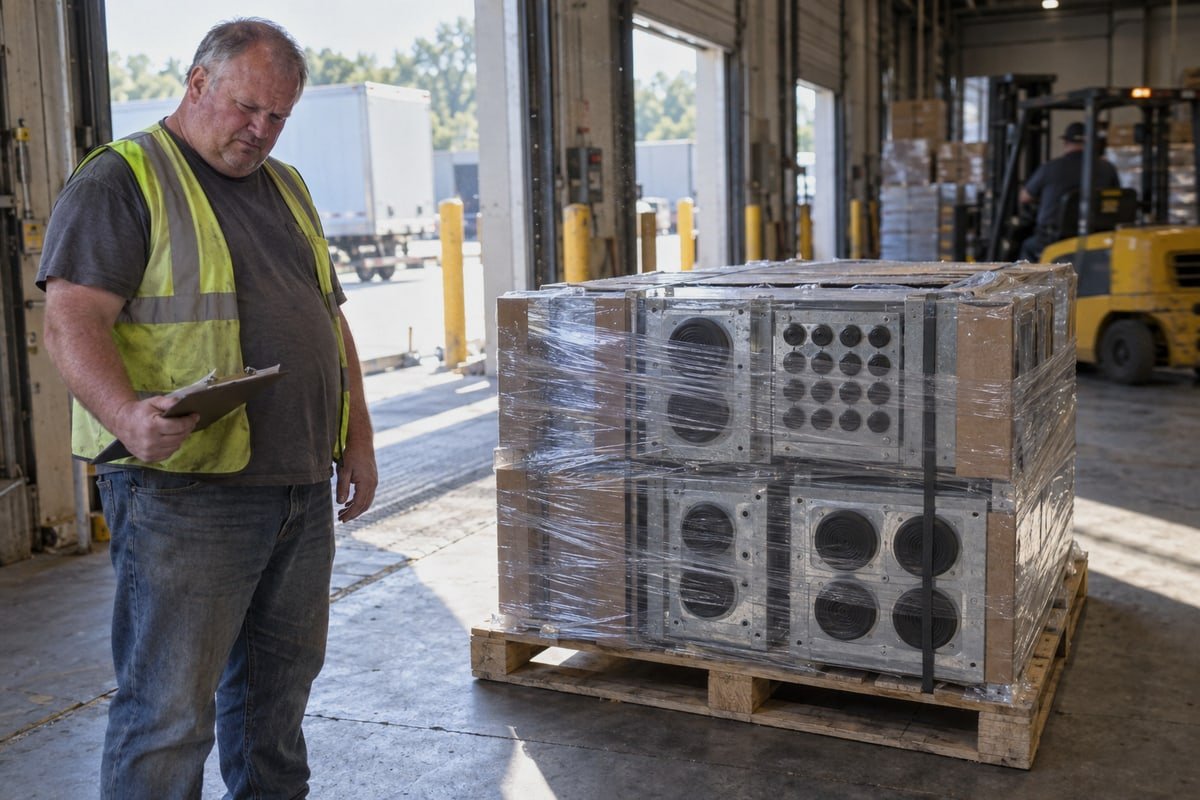
Our MCT rubber sealing modules once sat at a US port because a generic TSCA letter never named PIP (3:1) IATF 16949 1. Painful. So we built a real proof file.
To verify MCT rubber sealing modules from China are TSCA PIP (3:1)-free, request a Declaration of Conformity naming CAS 68937-41-7 at article level, a full material disclosure covering compound, adhesives and coatings, upstream supplier declarations, then confirm with Py-GC/MS testing and keep records five years.
That is the short answer. The rest of this article shows you how to get each piece of evidence, how to check it, and where suppliers usually fall short Bureau Veritas type approval 2. I will use our own TSC and TSR modules as the working example, because that is the product I know from the inside.
What Documentation Should I Request to Confirm TSCA PIP (3:1) Compliance?
Last year a German integrator sent us a one-line question: does your EPDM contain CAS 68937-41-7? That question shaped the document pack we ship today.
Request a TSCA Section 6(h) Declaration of Conformity naming PIP (3:1), CAS 68937-41-7, at article level, plus a full bill of materials, the rubber compound SDS and TDS, upstream compounder and adhesive declarations, and a written change-notification commitment.

Why a Generic TSCA Letter Is Not Enough
Many Chinese suppliers still send a one-page letter that says "TSCA compliant". It rarely names a substance. That was fine a few years ago. It is not fine now. EPA's prohibition on PIP (3:1) in articles took effect on October 31, 2024. A separate prohibition for adhesives and sealants followed on January 6, 2025. Since then, customs brokers and OEM compliance teams expect substance-specific language. The declaration should name phenol, isopropylated phosphate (3:1), state CAS 68937-41-7, and reference TSCA Section 6(h) and 40 CFR Part 751 3. PIP (3:1) is regulated as a PBT chemical, so the letter should also state the substance is not intentionally added and is below the 0.1% (1000 ppm) threshold.
The Document Pack We Recommend
| Document | What it proves | Red flag if missing or vague |
|---|---|---|
| Declaration of Conformity (TSCA 6(h)) | PIP (3:1) status of the finished module as an article | Only says "TSCA compliant", no CAS number |
| Bill of materials by homogeneous material | Every rubber, metal, coating, ink and bonding agent in the module | Lists "rubber" with no compound code |
| SDS and TDS of the EPDM compound | Plasticizers and flame retardant additives used | Supplier refuses to name additives |
| Compounder and adhesive supplier declarations | Upstream PIP (3:1) status at the masterbatch stage | Final molder cannot name the compounder |
| Change-notification clause | Written notice before any formulation change | No commitment on record |
Article Level Versus Material Level
This distinction matters more than most buyers expect. A compound data sheet only proves the rubber block. A sealing module is an article. It may carry a lubricant on the step-core surfaces, a bonding agent, a marking ink, or a coating on the stay plate. 40 CFR Part 751 restricts PIP (3:1) in articles, so the declaration must cover the whole module as shipped. In our own pack, we list every homogeneous material in a TSC module and state the PIP (3:1) status for each one, not just for the EPDM.
How to Word the Request
Keep the request short and exact. Ask the supplier to confirm in writing whether phenol, isopropylated phosphate (3:1), CAS 68937-41-7, is intentionally added, present above 0.1%, or used in any component, coating, adhesive, sealant, or processing aid associated with the module. Ask them to name the compounder. Ask for notice of any formulation change. A supplier who cannot answer these four points has a traceability gap, whatever the certificate says.
How Can I Verify a Chinese Supplier's Material Composition Claims Independently?
Incoming EPDM compound at our Shaanxi plant gets checked against its approved formulation sheet before molding. We started that for hardness consistency, not for TSCA.
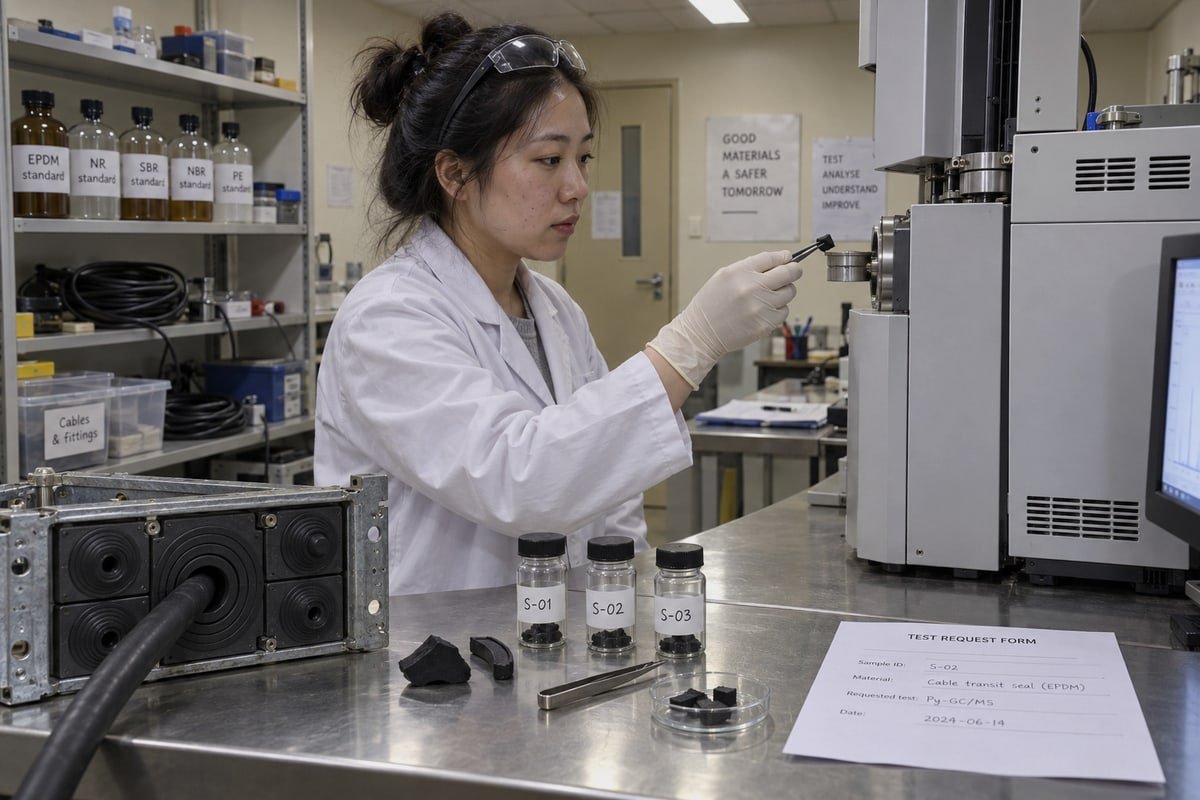
Verify independently by auditing the masterbatch and compounder, requiring a Full Material Disclosure listing 100% of constituents with CAS numbers, then commissioning third-party Pyrolysis-GC/MS testing at the 0.1% (1000 ppm) threshold on flexible parts, adhesives, and any recycled-content rubber.
Follow the Chain to the Masterbatch
Here is the fact many buyers miss. PIP (3:1) is usually introduced at the compounding stage, not by the final module molder. The molder buys a masterbatch, presses it, and ships the block. If the compounder used PIP (3:1) as a plasticizer or flame retardant, the molder may honestly not know. So your supply chain due diligence has to reach one tier up. Ask the molder to name the compounder. Ask the compounder for its own declaration. If the molder compounds in-house, as we do for our step-core modules, ask for the formulation sheet and the raw material list with CAS numbers. A Full Material Disclosure that lists 100% of constituents is the gold standard. It works like conflict-mineral traceability, just applied to chemistry.
A Tiered Verification Process
- Review the Declaration of Conformity and the BOM for gaps.
- Request the compounder's declaration and the SDS for every additive package.
- Screen for recycled-content rubber. Recycled feedstock is a known entry point for legacy PIP (3:1), because the 0.1% threshold applies to unintentional presence too.
- Send samples to a third-party laboratory for Py-GC/MS analysis when documents are incomplete or risk is high.
- Run a fingerprint analysis on later batches to catch secondary plasticizer substitution when raw material prices move.
| Risk tier | Typical situation | Evidence you should hold |
|---|---|---|
| Low | Virgin EPDM, no adhesive, established compounder named | Article-level declaration plus compounder declaration |
| Medium | Flame-retardant compound, coated stay plates, marking inks | Declarations plus SDS review plus one baseline Py-GC/MS test |
| High | Recycled content, unnamed compounder, bonded assemblies | Full Material Disclosure plus batch testing plus supplier audit |
The Objection I Hear Most
Some buyers tell me a written declaration from a reputable supplier is enough. For a plain rubber block from a supplier with full traceability, that view is defensible. But it breaks down the moment an adhesive, a coating, or a legacy formulation enters the picture. EPA's own economic analysis notes that importers may rely on supplier verification and may also use chemical testing. Read that as "both", not "either". Testing alone cannot prove absence across every processing aid in a complex article. Declarations alone cannot survive a customs challenge if the supplier has no upstream records. The tiered approach above matches the evidence to the risk, which is what a skeptical sourcing engineer should want.
What Are the Risks If My MCT Modules Contain Undeclared PIP (3:1)?
Halogen-free EPDM does not automatically mean PIP-free. We learned that when reviewing our flame-retardant package, because PIP (3:1) is a phosphate, not a halogen.
Undeclared PIP (3:1) exposes importers to EPA Section 6(h) enforcement under 40 CFR Part 751, customs detention, mandatory customer notification, product recalls, and contract penalties, because the article prohibition took effect October 31, 2024 and the adhesives and sealants ban on January 6, 2025.

Where PIP (3:1) Hides in a Sealing Module
EPA describes PIP (3:1) as a plasticizer, a flame retardant, an anti-wear additive, and an anti-compressibility additive. It appears in lubricants, greases, coatings, adhesives, sealants, and plastic articles. Now look at a cable transit module. The rubber block needs a plasticizer for flexibility. Marine-grade modules often carry flame retardant additives to reach an A-60 fire rating. Step-core surfaces may get a lubricant. Stay plates may be coated. Some designs bond rubber to a metal insert. Every one of those points is a possible entry route. That is why I treat the whole module as a risk map, not just the EPDM.
The Risk Stack
| Risk type | What happens | Who feels it first |
|---|---|---|
| Regulatory | EPA enforcement for processing or distributing a prohibited PBT chemical in an article | The US importer of record |
| Customs | Shipment held while brokers request substance-specific proof | Project schedule and cash flow |
| Commercial | OEM customer notification obligations, returns, or recall | Your own sales contract |
| Contractual | Breach of restricted-substance clauses in EPC or OEM agreements | Purchasing and legal |
| Reputational | Loss of approved-vendor status after one failed audit | Long-term sourcing |
PBT chemical regulations carry a specific weight here. PIP (3:1) sits under TSCA Section 6(h), which targets persistent, bioaccumulative and toxic substances. Regulators treat these differently from ordinary restricted substances. The 0.1% threshold applies even to unintentional presence, so "we did not add it" is not a defense on its own.
What About Sector Exemptions?
EPA has granted sector-specific compliance extensions in areas such as aerospace, automotive and nuclear, mainly for replacement parts. I get asked whether those cover cable transit systems. For most of our buyers, the answer is no. BESS containers, modular data centers, and switchgear cabinets do not sit inside those carve-outs. Even where a customer does qualify, relying on an extension for new production is a poor strategy. Extensions expire. A clean formulation does not. The safer route is to remove the substance, document the removal, and keep the records for five years.
Which Certifications Should I Check Alongside PIP (3:1)-Free Declarations?
Every certificate we hold cost audit days on our production floor. So when a buyer asks for all certifications, we ask which ones actually change their risk.
Check ISO 9001 and IATF 16949 quality system certificates, a Bureau Veritas type approval, fire ratings A-0/A-60, IP68 ingress protection, watertight and gas-tight test reports at 0.01–0.4 MPa, RoHS and REACH SVHC statements, and halogen-free material certificates alongside the PIP (3:1) declaration.

Why Each Certificate Matters for PIP (3:1)
No single certificate proves PIP (3:1) absence. Each one closes a different gap. The quality system certificates tell you whether the supplier can control formulation changes. The type approval tells you a third party has looked at the factory. The performance reports tell you the compound has not been quietly swapped for a cheaper one that behaves differently.
| Certificate or report | What it covers | Link to PIP (3:1) verification |
|---|---|---|
| ISO 9001 4 and IATF 16949 | Documented process and change control | Supports the change-notification clause and 5-year recordkeeping |
| Bureau Veritas factory approval | Independent audit of the production site | Confirms the compounder and molder are the same audited entity |
| Fire rating A-0/A-60 | Flame performance of the sealed transit | Prompts the question: which flame retardant additives are used? |
| IP68 and 0.01–0.4 MPa sealing tests | Ingress, watertight and gas-tight performance | Fingerprint of the approved compound; a changed plasticizer shows up here |
| RoHS and REACH SVHC 5 statement | EU restricted substances | Does not cover PIP (3:1), but shows the supplier runs a restricted-substance system |
| Halogen-free certificate | Absence of chlorine and bromine | Does not cover PIP (3:1), which is a phosphate |
The RoHS and REACH Trap
This is the most common confusion I see. A buyer receives a RoHS certificate, a REACH SVHC letter, and a halogen-free report, and assumes the module is clean. None of these documents addresses CAS 68937-41-7. PIP (3:1) is not a heavy metal, it is not currently an SVHC in the way buyers expect, and it contains no halogen. A supplier who offers RoHS and REACH as an answer to a TSCA question is either unfamiliar with EPA Section 6(h) compliance or is hoping you will not check. Ask for the separate declaration every time.
How We Package It
When an integrator qualifies our modules as a second source, we send the model cross-reference table, free validation samples, and CAD or STEP files. Alongside those, the compliance pack holds the Certificate of Compliance for the quality system, the Declaration of Conformity for TSCA PIP (3:1), the Material Safety Data Sheets for the EPDM compound, and the sealing and fire test documents on request. The goal is simple. A purchasing engineer should be able to check compatibility, performance, and chemical status in one review, without a second round of emails.
Conclusion
A vague TSCA letter can stop your shipment. Layer the evidence instead: article-level declaration, upstream disclosure, targeted testing, five-year records. That is how we ship MCT rubber sealing modules.
Footnotes
1. Official site for the automotive quality management standard used to verify supplier process control. ↩︎
2. Authoritative third-party certification body for maritime and industrial type approvals. ↩︎
3. Official EPA resource for TSCA Section 6(h) regulations governing PBT chemicals like PIP (3:1). ↩︎
4. The international standard for quality management systems mentioned as a key verification document. ↩︎
5. Official ECHA list for Substances of Very High Concern under EU REACH regulations. ↩︎



 English
  Español de México
  Deutsch
  Français
  العربية
  Русский