
Every month, our sales engineers receive RFQs that name one multi cable transit brand and ask for an equivalent alternative marine bulkheads 1. The named brand is late, expensive, or both.
يتم اقتراح بديل مكافئ لعلامة تجارية محددة من قبل العميل لعبور الكابلات المتعددة من خلال إثبات التوافق الأبعادي مع الفتحة الموجودة في الإطار، ومطابقة شهادات الحريق، ودرجة الحماية (IP)، والضغط مع تقارير الاختبار، وإظهار وفورات في التكلفة الإجمالية للملكية، وتقديم عينات تحقق مجانية وملفات CAD للتحقق من قبل العميل.
That answer sounds simple. In practice, each of those four steps has traps. I have watched good proposals fail on one missing test report or one wrong stay plate thickness. So I will walk through each step the way our own engineers do it when we build a second-source package for a cable sealing system. I will start with dimensions, because that is where the client looks first.
كيف يمكنني إثبات التوافق الأبعاد مع نظام 120 إطارًا المحدد من قبل العميل قبل تقديم اقتراحي؟
On our production line, every TSC module batch is gauge-checked against the 120-frame standard before it leaves Shaanxi. That check is what makes drop-in claims real.
إثبات التوافق الأبعادي من خلال مقارنة عرض فتحة الإطار، والعمق، وارتفاع رصة الوحدة، وسمك لوحة التثبيت، وشوط وحدة الضغط، بمقارنتها برسم العميل للإطار 120، ثم التأكد باستخدام جدول مرجعي تقاطعي، وملفات STEP، واختبار ملاءمة مادي باستخدام عينات تحقق مجانية مثبتة في نفس الفتحة المقطوعة.
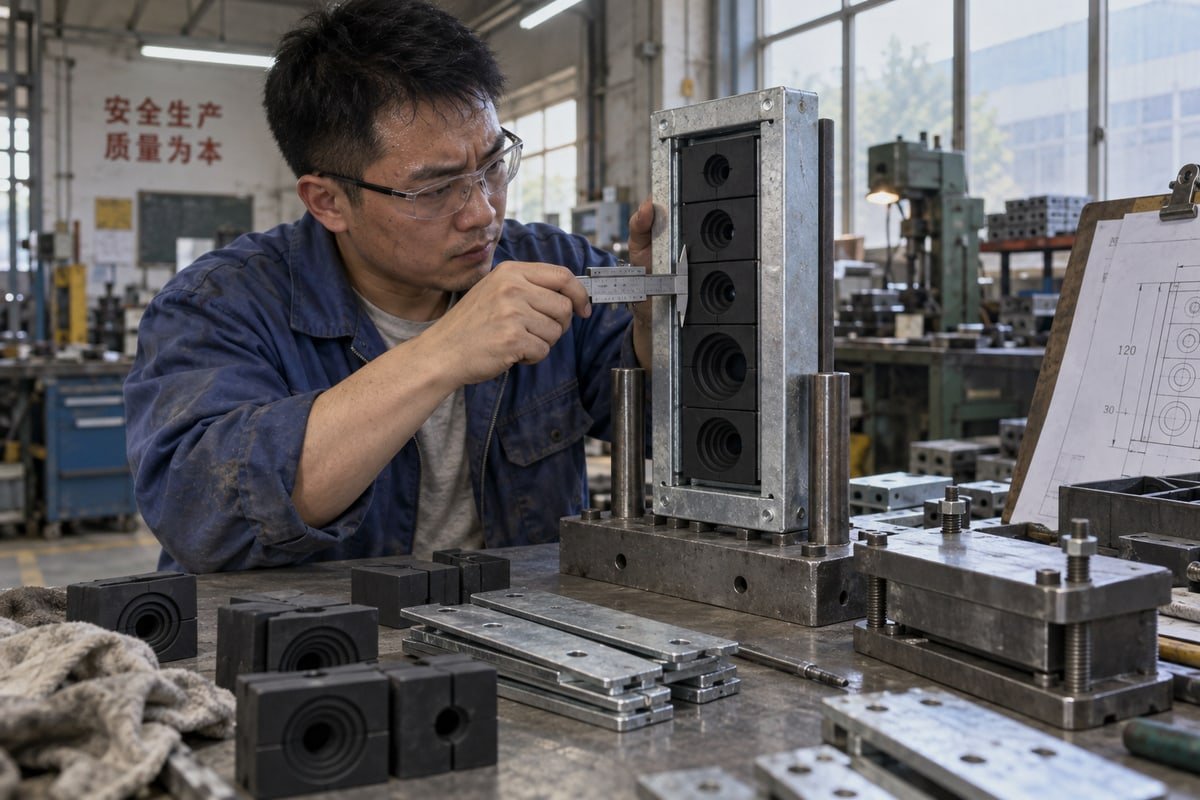
The 120-frame convention is the reason second sourcing works at all in this industry. Most modular transit frames used in switchgear, حاويات BESS 2, modular data centers, and marine bulkheads follow it. The convention fixes the internal opening height, the frame depth, and the size increments of the modules that stack inside. It does not fix the rubber compound, the core design, or the compression hardware. So a module can be dimensionally identical and still perform differently. Keep that distinction in mind. Dimensions get you into the frame. Performance gets you through the audit.
What to measure, and how to verify it
I recommend a written checklist. Our engineers use one like this when they prepare a cross-reference chart from an existing model number to a DEWIN model.
| نقطة فحص | لماذا يهم | كيفية التحقق |
|---|---|---|
| Frame internal opening (height × width) | The module stack must fill the opening completely with no gap | Overlay the client's frame drawing with our STEP file |
| عمق الإطار | Modules and the compression unit must sit flush with the frame face | Measure a validation sample in the actual frame |
| Module size increments | Determines cable count per row and spare capacity | Compare the cross-reference chart line by line |
| سمك لوحة التثبيت | Changes the stack height math; a wrong plate breaks the seal | Confirm plate thickness and quantity per row |
| حركة وحدة الضغط | Sets final seal pressure and the field bolt routine | Install a sample and complete a full compression cycle |
| نطاق قطر الكابل لكل وحدة | Step-core layers must cover the project cable schedule | Peel the core to the real cable and check the fit |
The cutout objection
A common objection is that the cutout is different. In most drop-in cases it is not. If the client keeps the existing frame, only the modules, stay plates, and compression unit change. The bulkhead or panel wall stays untouched. If the client replaces the whole frame, we match the outer flange dimensions and bolt pattern so the weld or bolt-in cutout stays the same. Either way, no structural rework is needed.
Spare capacity and the cable schedule
Our step-core, EPDM خالٍ من الهالوجين 3 modules adapt to a range of cable diameters within one module size. That reduces the number of module sizes on site. It also lets us show the client the same or better spare capacity in the same frame, so future cable additions do not require a new transit. Put that number in the proposal. Skeptical buyers count spare positions.
What certification and test documentation do I need to justify an equivalent MCT brand to a skeptical client?
A purchasing engineer in Europe once replied to our first quote with one line: send the test reports first, then we talk. We did, and the project moved.
To justify an equivalent MCT brand, provide third-party fire test reports (A-0/A-60 or the required rating), IP68 ingress protection certificates, watertight and gas-tight pressure test results, ISO 9001 and IATF 16949 quality system certificates, factory approval evidence, material datasheets, and a clause-by-clause technical data sheet comparison.

Documentation is where most equivalent proposals live or die. The client's consultant will not read a brochure. They will read a specification clause, then look for the document that satisfies it. So build your package in that order: clause first, evidence second, difference explained third.
Map every specification clause to a document
| Specification requirement | Evidence you must supply | What to check before you send it |
|---|---|---|
| Fire rating (A-0, A-60, or the class the wall demands) | Third-party fire test report for the complete assembly | Firestop seal certification applies to the tested system, not to loose modules |
| حماية الدخول 4 rating | IP68 test certificate | State the test depth and duration, not just the code |
| Pressure and gas tightness | Pressure test report covering the project's range | Our modules are tested watertight and gas-tight from 0.01 to 0.4 MPa; show the value the project actually needs |
| Quality management | ISO 9001 and IATF 16949 certificates | Confirm the scope covers cable transit production |
| موافقة المصنع | BV factory approval evidence | Make sure the approval is current and names the production site |
| Marine and offshore standards | DNV, ABS, or IMO type approval where the vessel or platform requires it | Never accept an approval that is listed as pending |
| Hazardous area service | ATEX and IECEx compliance where a zone rating applies | Ask for the certificate number and the equipment category |
| Material durability | EPDM datasheet covering corrosion, chemical, and UV resistance | Compare the compound, not the marketing name |
| EMC or high-vibration zones | Shielding test or vibration test, if the original spec called for it | Do not assume; ask the client whether the requirement is active |
The two hardest objections, and how I answer them
The first objection is that the spec names one brand, so no substitution is allowed. My answer is to read the contract language. Many specifications name a basis of design and include an approved-equal or or-equal clause. If that clause exists, an equivalent proposal is a normal project specification deviation, not a breach. If the clause does not exist, say so early and ask the client whether they want to open one. Do not guess.
The second objection is harder. The client says the transit was tested as a full system. They are right. A fire-rated penetration is certified as frame, modules, stay plates, and compression unit together. So we never propose mixing our modules into another brand's frame for a fire-rated wall unless that exact combination has a test behind it. Instead, we propose the complete tested system. On non-fire-rated panels and enclosures, where the requirement is sealing and ingress protection only, module-level substitution is easier to defend. Know which case you are in.
Write a comparison, not a pitch
The core of the package is a technical data sheet comparison, clause by clause. Where the values match, say so. Where they differ, explain why the difference does not reduce performance in this application. That honesty is what a data-driven buyer is looking for.
How do I calculate and present the real cost savings without appearing to compromise on quality?
The trade-off I weigh on every quote is simple: unit price wins the first meeting, but total cost of ownership 5 wins the approval. We price for the approval.
Calculate real savings by building a total cost of ownership model: component price (typically 40–60% lower for a drop-in second source), landed cost with freight and duty, installation hours, spare module cost, re-entry time for future cables, and lead-time risk, then present it beside unchanged certification evidence.

There is a trap in how cost gets presented. If the first page of your proposal is a price, the reader assumes you are selling price. If the first page is a certification matrix and the price comes on page four, the reader assumes you are selling a qualified second source. Same numbers, different conclusion. Order matters.
Build the model on lines the client already tracks
| Cost element | ما يجب مقارنته | Where the equivalent usually wins |
|---|---|---|
| Component price | Frame, modules, stay plates, compression unit, per transit | Factory-direct pricing removes distributor margin; our second-source pricing typically lands 40–60% below the legacy brand |
| Landed cost | Freight, duty, export documentation | We handle export paperwork, which removes an internal cost the buyer often forgets |
| Installation hours | Compression routine, module count, core peeling | Fewer module sizes with step-core EPDM means faster picking and fewer errors on site |
| وحدات احتياطية | Price and lead time of replacement modules over the asset life | Fast delivery of spare sealing modules keeps the transit serviceable without a new frame |
| Re-entry time | Hours to open, add cables, and re-seal | Modular re-entry avoids cutting a new penetration when cables are added later |
| Lead-time risk | Weeks of schedule exposure if the specified brand slips | Documented stock levels and shorter lead times reduce supply chain exposure |
Present the savings in three steps
- Confirm technical equivalence first. Get written acceptance of the certification matrix before any cost discussion.
- Show the total cost of ownership table, not just the unit price. Let the client fill in their own installation and re-entry hours if they prefer.
- Frame the savings as risk reduction. Supply-chain volatility and long lead times have pushed more projects toward value-engineered substitutions. A qualified second source protects the schedule even when the primary brand is available.
Add the ESG line if the client has targets
Many European integrators now report on material choices. Our modules use halogen-free EPDM, which supports low-smoke and low-toxicity requirements in enclosed BESS containers and data halls. Put that on the same page as the cost model. It shows the alternative was selected for the application, not just for the invoice.
Can I request free validation samples and CAD files to de-risk my equivalent alternative proposal?
The lesson we learned in our first export years was simple: a STEP file and two free modules close more qualifications than any brochure. We now send both by default.
Yes. A credible second-source supplier should provide free validation samples of the proposed modules, CAD or STEP files of frames and modules, and a model cross-reference chart, so you can run a physical fit test, update drawings, and complete a project specification deviation before committing to a purchase order.
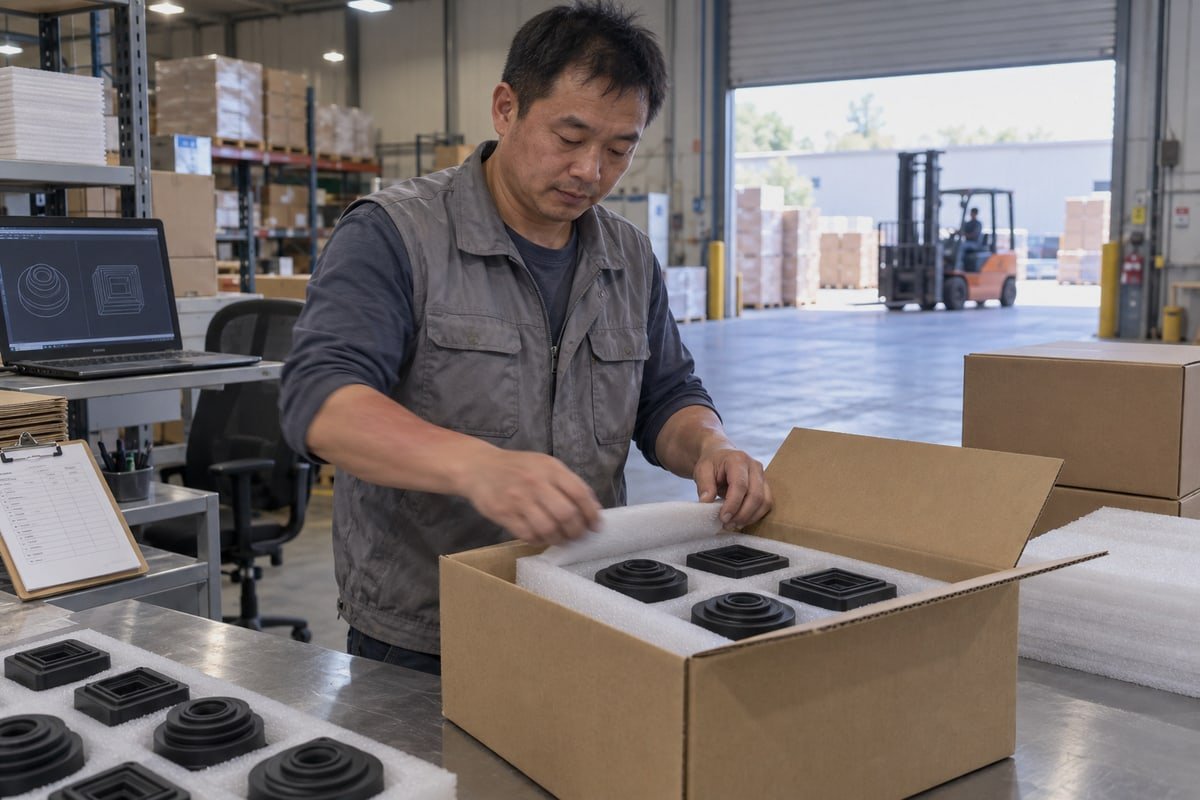
A sample request is not a favor. It is part of a normal supplier qualification. If a supplier hesitates to send a free module or a native CAD file, that tells you something about their confidence in the fit. On our side, we treat the sample as the last step of the dimensional proof, so we send it before the client asks.
A validation process that produces evidence, not opinions
- Send the supplier the frame model, the cable schedule, and the wall or panel type. The supplier returns a cross-reference chart listing the existing model beside the proposed model for every position.
- Request STEP files 6 of the frame, each module size, stay plates, and the compression unit. Overlay them on your existing assembly drawing. Any interference shows up before the sample ships.
- Receive the free validation samples. Install them in the actual frame with real project cables, not test rods. Complete the full compression cycle and record bolt torque and stack height.
- Photograph the installed transit and file it with the project specification deviation request. The photo plus the certification matrix is what the consultant needs to sign.
- Order a pilot quantity for one transit or one panel, then scale.
What to ask for, and why each file matters
| Item requested | Format | Why you need it |
|---|---|---|
| Cross-reference chart | Spreadsheet or PDF | Maps existing model numbers to the equivalent model for purchasing and BOM updates |
| Frame and module models | STEP or native CAD | Verifies fit and updates the assembly drawing without redrawing |
| BIM object with data fields | IFC or vendor BIM format | Feeds the digital twin and lifecycle asset records so the transit is traceable after handover |
| Digital cable schedule template | Spreadsheet | Records which cable sits in which module position for future re-entry |
| Installation instruction | PDF in English | Keeps the field routine consistent between the legacy brand and the alternative |
| عينات التحقق | Physical modules and stay plates | Confirms dimensional compatibility and seal behavior with real cables |
أحجام مخصصة وعلامة تجارية خاصة
When a project has a non-standard cutout or a cable that falls outside standard module ranges, in-house mold making lets us produce a custom size without long tooling delays. For OEM integrators, private-label production means the module can carry the integrator's marking while the underlying test documentation stays with the same certified product. Ask about both during the sample stage, not after the order.
الخلاصة
The specified brand is late or overpriced, and waiting costs the project every week. An evidence-led equivalent proposal — dimensions, certificates, cost model, samples — solves that without giving up compliance.
الحواشي
1. IMO safety standards for fire protection on marine bulkheads and penetrations. ↩︎
2. IEA report on grid-scale storage and BESS technology for energy infrastructure. ↩︎
3. Technical overview of EPDM rubber properties and its use in industrial sealing. ↩︎
4. Official IEC page explaining the IP68 ingress protection standard for sealing performance. ↩︎
5. Economic concept used to evaluate the long-term value of industrial equipment. ↩︎
6. ISO homepage for international standards including CAD data exchange formats like STEP. ↩︎



 English
 Español de México
 Deutsch
 Français
 العربية
 Русский