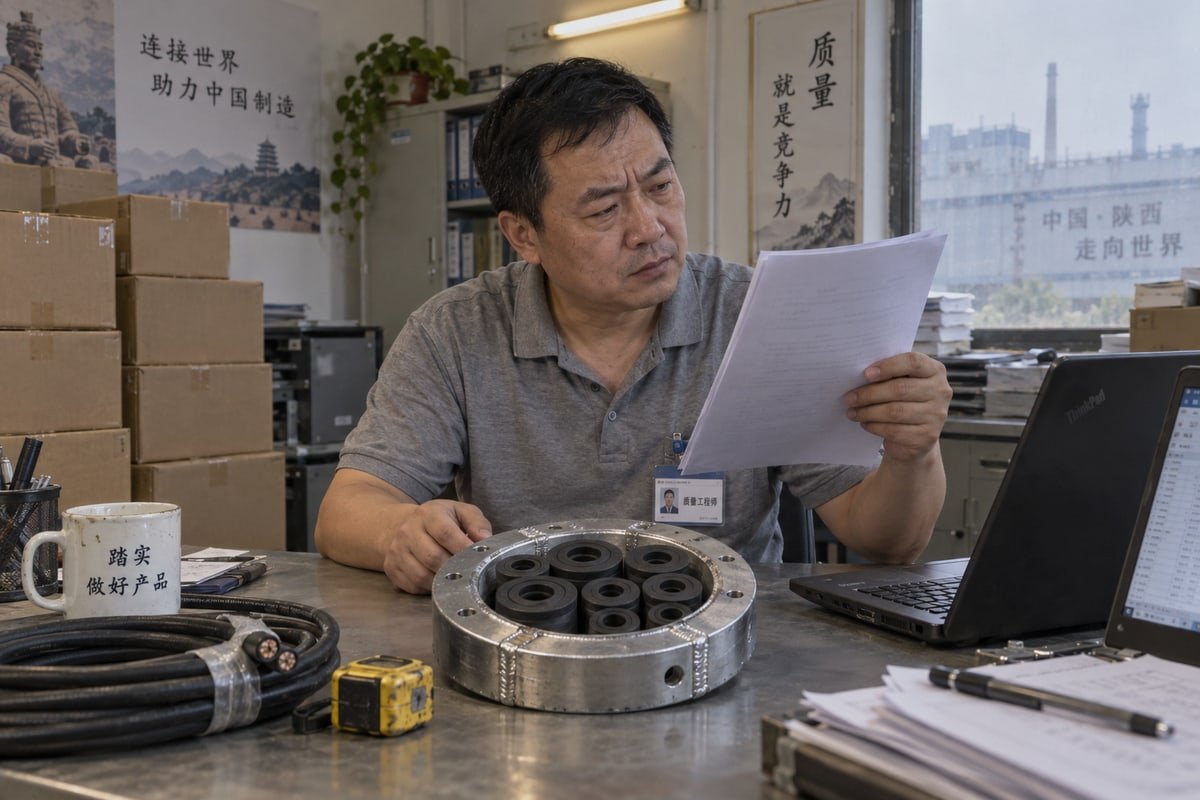
Every week our export desk gets RFQs asking for seawater immersion test reports 1 on multi cable transit systems. Most buyers ask vaguely. Vague requests get vague PDFs.
To request seawater immersion test reports for multi cable transit from China, ask for the full report naming the standard (IEC 60529 IP68 or hydrostatic test), accredited lab, report number, tested model, immersion depth, duration, and pass criteria, plus written confirmation that the quoted MCT matches the tested sample.
Below I break the request into four parts. First, the standards to name. Second, how to check that the paper is real. Third, what data lets a supplier cross-reference your existing model ABS certification standards 2. Fourth, how free samples close the loop before you sign a purchase order.
What Test Standards Should I Ask For When Requesting Seawater Immersion Reports?
Last year our QC team ran an IP68 immersion on a TSC module set, and the first question from the witnessing engineer was which edition of IEC 60529 we used.
Ask for IEC 60529 with the IP68 code and stated depth and duration, hydrostatic pressure testing in MPa for watertight cable penetration, IEC 60092-350 for shipboard cable context, A-60 fire rating for bulkhead penetrations, and ASTM B117 salt spray or accelerated aging for corrosion resistance of frames and EPDM.
That question about the edition was fair. A standard without an edition is a name, not a test. So let me walk through what each standard actually proves, and what you should write in the RFQ.
Why IP67 Is Not Enough for Seawater Service
IEC 60529 defines the IP code. The second digit covers water. IP67 means temporary immersion, up to 1 meter, for a short fixed period. IP68 means continuous immersion under conditions agreed between the maker and the user. That last part matters. An IP68 ingress protection claim with no stated depth and duration is incomplete. When we run IP68 tests on our TSC and TSR assemblies, the report states the depth, the time, and the water temperature. Ask any supplier for those same three numbers.
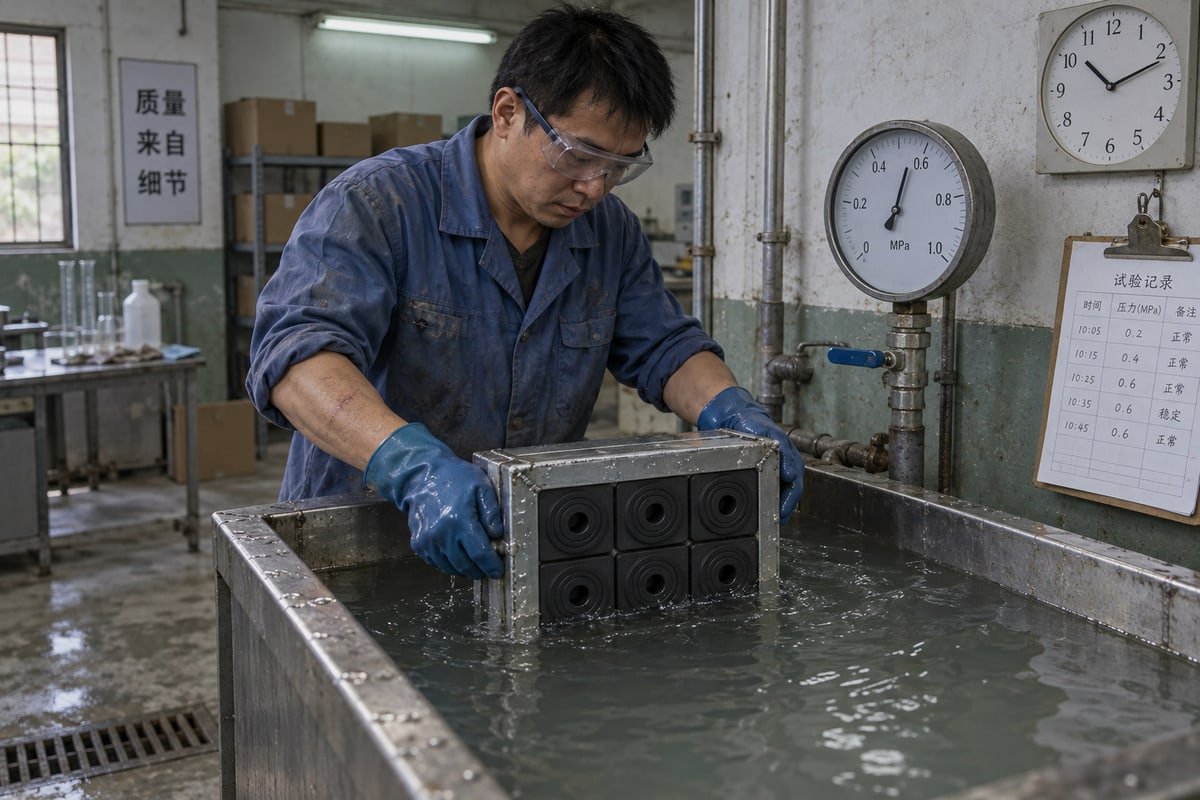
Some suppliers argue that an IP67 report proves seawater readiness. I disagree. A bulkhead transit on a vessel or an offshore skid can sit in standing water for days. Temporary immersion does not describe that duty. Ask for IP68, or ask for hydrostatic pressure testing with a real pressure figure. Our watertight and gas-tight tests run from 0.01 to 0.4 MPa, and the report shows both the pressure and the hold time.
Standards Worth Naming in Your RFQ
| Standard or test | What it proves | What to write in the RFQ |
|---|---|---|
| IEC 60529, IP68 | Ingress protection under continuous immersion | State depth in meters and duration in hours |
| Hydrostatic pressure test | Watertight cable penetration at a set pressure | State MPa and hold time; ask for both sides if needed |
| IEC 60092-350 | Shipboard cable construction and testing context | Confirm the cables used in the test match your cable types |
| A-60 fire rating | Structural fire protection for bulkhead and deck | Ask for the fire test report, not only a certificate line |
| ASTM B117 3 salt spray | Corrosion resistance testing of frame and hardware | State exposure hours and the rating after exposure |
| IACS UR Z28 register | Traceability of installed seal systems | Ask for data fields that fit the register |
Beyond the Single Immersion Report
Marine buyers rarely need immersion alone. Classification rules bundle watertightness with the A60 fire rating, because the same penetration must hold water and hold fire. US naval qualification goes further. It combines vibration, shock, fire stop resistance, and hose stream in one sequence. You may not need that full package. But you should decide which parts your project needs before the RFQ goes out. My advice is simple. Put the standard list in the RFQ. Then every supplier answer becomes easy to compare, line by line.
How Do I Verify That a Chinese Factory's Test Documents Are Authentic and Not Just Marketing Claims?
A sourcing manager in the Netherlands once sent our BV factory approval back to us and asked us to prove it. We were glad she did.
Verify authenticity by checking the report number with the issuing laboratory, confirming CNAS or CMA accreditation covers immersion testing, matching the tested model code and drawing to your quote, checking the factory business license in official Chinese databases, and requesting a third-party inspection report from SGS, Intertek, or Bureau Veritas.
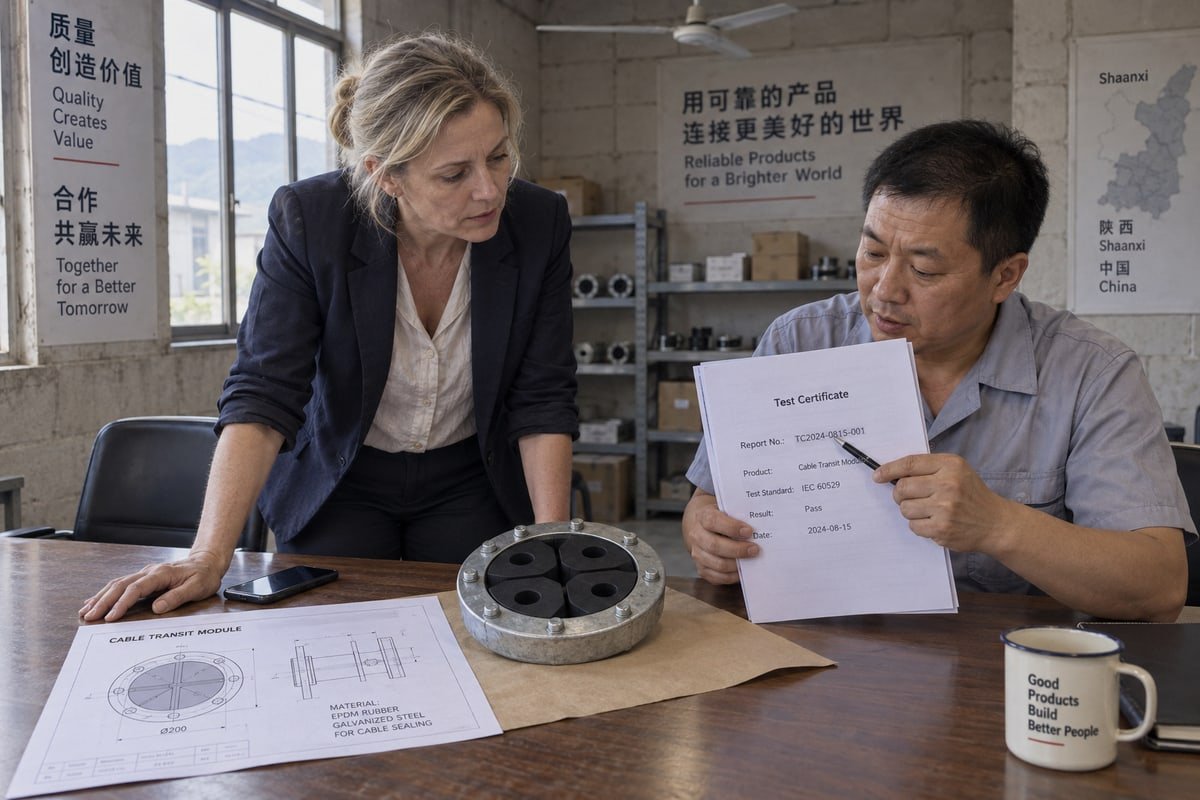
She had seen a rebranded certificate before. Her routine took her about two hours per supplier. It is the same routine I would use if I were sitting on the buying side.
A Five-Step Verification Routine
- Check the report number with the lab. Email or call the lab, not the supplier. Give the report number and date. Ask whether the report exists and which client it was issued to.
- Check the accreditation scope. A Chinese lab should hold CNAS or CMA accreditation. The scope should list immersion, watertightness, or seawater corrosion testing. A general electrical scope does not cover a seawater immersion test report.
- Match the product. The tested item name, model code, and drawing in the report must match the quoted item. Same frame size. Same EPDM module material. Same compression method.
- Verify the factory. Look up the business license and export permit in official Chinese databases. This shows whether you deal with a factory or a trading intermediary. Our registration shows RMB 50M capital and plants in Shaanxi, Shandong, and Hunan, and any buyer can confirm that.
- Ask for a third-party layer. A DNV type approval certificate 4, an approval under ABS certification standards, or a CCS certificate places the product under an IACS member. A third-party inspection report from SGS, Intertek, or Bureau Veritas 5 can witness a production batch. Our factory holds BV approval, and our quality management system ISO 9001 and IATF 16949 certificates carry registrar numbers you can look up.
Red Flags in Supplier Test Documents
| Red flag | What it usually means | What to ask for |
|---|---|---|
| No report number | A summary sheet or marketing page | The full report with numbered pages |
| Standard named without edition | Copied from a brochure | Standard, edition, and clauses tested |
| Product name differs from the quote | Report from a related SKU | A signed declaration of identical configuration |
| Lab name missing or unsearchable | Internal test presented as external | Lab address and accreditation number |
| Screenshot or cropped PDF | Pages removed or edited | The original file from the lab |
Linking Paper to Product
Some suppliers say a domestic Chinese report should simply be accepted. I think that view is half right. A CNAS lab is fine when the scope fits. But paper must link to product. Ask for a Certificate of Conformity that names the batch number of the modules you buy and the report that covers them. Some factories now offer QR-code portals that show the certificate live, which beats a static PDF. We add the batch number to the nameplate on each frame for the same reason.
What Information Should I Provide to Get Accurate Cross-Reference Data for My Existing MCT Model?
We learned early that a cross-reference built from a model number alone fails. The frame code is only half the picture; the cable schedule decides the module mix.
Provide the existing frame model and cutout dimensions, frame material and mounting type, the module list with cable outer diameters per opening, compression unit type, required IP68 and A-60 ratings, the classification society, and drawings of the installed transit so the supplier can map each part to an equivalent.

The lesson came from a BESS container project. The buyer sent one frame code. We matched it. Then the cable list arrived, and half the modules changed size. Now we ask for the full data sheet before we open the cross-reference table.
The Data We Need Before We Cross-Reference
| Information | Why it matters | What to send |
|---|---|---|
| Existing frame model and opening size | Decides drop-in fit within common 120-frame standards | The frame drawing or nameplate photo |
| Frame material and mounting | Galvanized, marine grade stainless steel, or aluminum change corrosion life and cost | Material spec and weld or bolt mounting |
| Cable schedule | Outer diameter per cable decides module size and count | Cable list with OD in mm per opening |
| Compression unit and stay plates | Must match frame depth and row layout | Current part numbers or photos |
| Required ratings | IP68, A-60, gas-tight pressure in MPa | Project spec extract |
| Classification society | Decides which certificate applies | DNV, ABS, CCS, or none |
| Installed drawings | Show orientation, spare space, and cable routing | Assembly drawing or site photos |
Why Step-Core Modules Change the Module Count
Our modules use halogen-free EPDM with a step-core. One module size covers a range of cable diameters. You peel layers to fit the cable. So the cross-reference from your existing modular cable seal system is not always one-to-one. A row that used three module sizes on your current brand may use two on ours. That can reduce spare stock. It can also change the stay plate layout. This is why the cable schedule matters more than the model number.
What You Get Back From Us
We return three things. First, a cross-reference table that lists your existing model and the matching DEWIN model, row by row. Second, CAD and STEP files for the frame and module set, so your engineer can check the cutout in the assembly. Third, a note that states which frame sizes and module sizes the immersion report covers. Suppliers often say one report represents a product family. That is true only when the frame geometry, insert material, and compression method are the same. Where your configuration differs from the tested one, we say so in writing, and we offer a project-specific test rather than a stretched claim.
Can I Request Free Validation Samples Before Committing to a Bulk Order?
Every free sample we ship costs mold time and a courier bill, so we weigh it against one question: does the buyer have a real frame cutout to test?
Yes. Factory-direct MCT makers provide free validation samples of sealing modules, stay plates, and compression units so you can fit-check them in your existing 120-frame cutout and run your own immersion or hydrostatic test before a purchase order; you normally cover freight, and custom-size frames may carry a tooling charge.
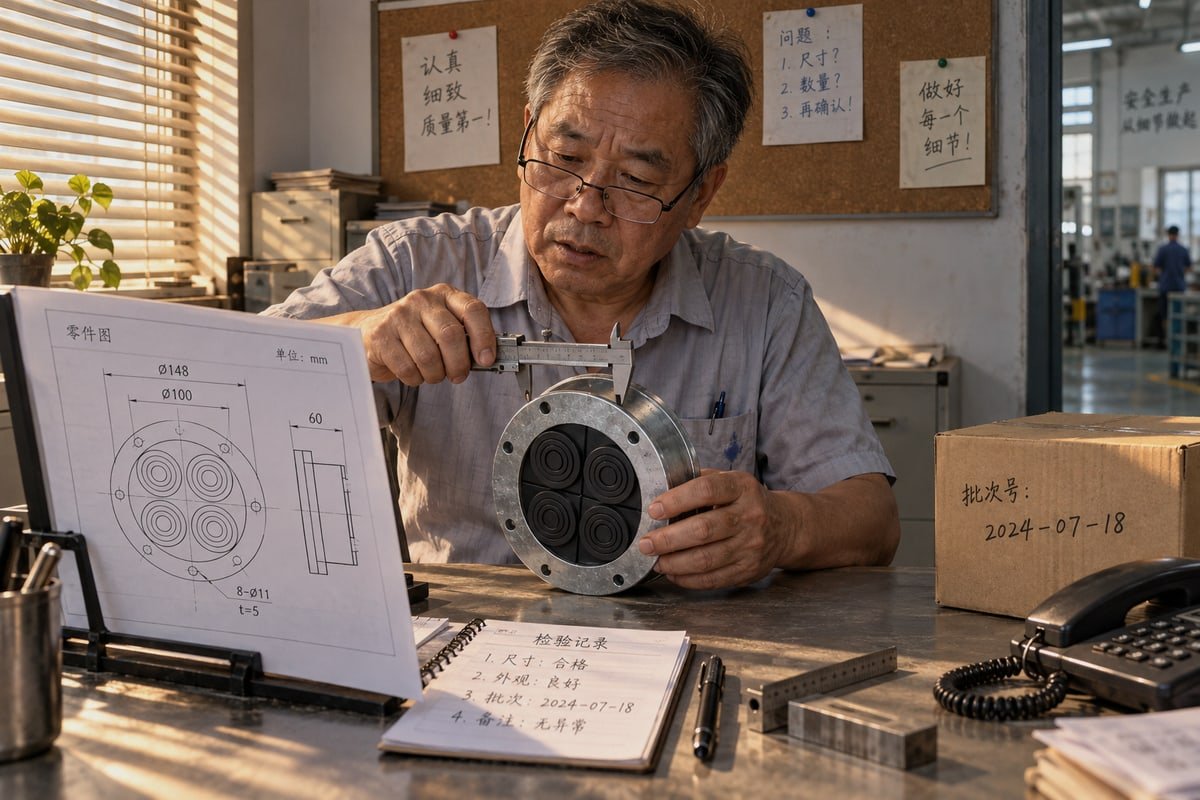
The trade-off is worth it for both sides. A sample that fails on your bench costs a courier fee. A container of modules that fails on site costs a project. Here is how I suggest you use the sample once it lands.
A Practical Sample Validation Plan
- Fit check. Drop the module into your existing frame. Confirm the stay plate seating and the compression unit travel. Compare with the STEP file.
- Compression check. Torque the compression bolts to the supplier figure. Note whether the rubber blocks show even contact across the row.
- Bench immersion. Seal a test frame with the sample modules and your own cable samples. Immerse it to the depth stated in the supplier report, or apply hydrostatic pressure to the MPa figure. Look for water on the dry side.
- Material check. Cut one spare module. Confirm the EPDM is step-core and halogen-free, and compare the hardness with the datasheet.
- Record the result. File it next to the supplier report and the Certificate of Conformity. That file becomes your second-source qualification record.
What the Sample Cannot Replace
Buyers often raise a strong objection. A lab immersion, or your bench test, is not the same as years of seawater, vibration, and thermal cycling. I agree. This is why the sample test and the document pack work together. For long-term seawater duty, ask the supplier for accelerated aging data on the elastomer, with 1,000 or more hours of high-salinity exposure, and for a salt spray test ASTM B117 report on the frame and bolts. If the site sits near industrial runoff or heavy organic load, ask for pH sensitivity and microbial resistance data as well. Corrosion resistance testing on the frame matters as much as the rubber. A sealed module inside a rusted frame is not a watertight cable penetration.
Sample Versus Report: What Each Proves
| Evidence | Proves | Does not prove |
|---|---|---|
| Free validation sample | Fit, compression behavior, short-term sealing | Long-term aging, fire performance |
| Supplier immersion report | Standard compliance on a defined configuration | Fit in your specific frame |
| Accelerated aging and salt spray data | Material and frame durability under salt exposure | Installation quality on site |
| Classification certificate | Acceptance by DNV, ABS, or CCS | Batch-level conformity without a CoC |
Conclusion
Vague requests produce vague PDFs, and vague PDFs sink projects. Ask for the exact standard, verify the lab, match the configuration, and test our free validation sample before you commit.
Footnotes
1. Official international standard for ingress protection ratings, specifically covering the IP68 immersion criteria mentioned in the article. ↩︎
2. Major classification society providing certification standards for marine and offshore equipment to ensure compliance with safety regulations. ↩︎
3. International standard for salt spray testing used to evaluate the corrosion resistance of metal frames and hardware. ↩︎
4. Leading global classification society providing type approval for marine equipment to ensure safety and reliability in offshore environments. ↩︎
5. Global inspection and certification body that provides third-party witnessing of production and testing for industrial components. ↩︎



 English
  Español de México
  Deutsch
  Français
  العربية
  Русский