
Every week our sales desk in Shaanxi hears the same worry: how do I protect deposits to Chinese cable transit suppliers? A lost deposit hurts. There is a better way.
To protect deposits to Chinese cable transit suppliers, use milestone-based escrow for first or custom orders, since credit insurance like Sinosure protects the supplier after shipment, not your prepayment. Keep the deposit low, tie each release to inspection evidence, and verify the factory before wiring anything.
The rest of this guide walks through the four questions we get most often. First, how to check that the factory is real. Second, which tool actually protects your money. Third, what to put in the contract. Fourth, how samples and certificates lower the risk before any cash moves.
How can I verify a Chinese cable transit supplier's legitimacy before wiring a deposit?
A German sourcing engineer once asked us for our business license 1, plant address, and a live video of the mold shop before he would even discuss a deposit. Smart move.
Verify a Chinese cable transit supplier by checking its business license and registered capital on official registries, confirming the factory address matches the license, requesting ISO 9001 and IATF 16949 certificates with certificate numbers, running a supplier verification audit, and matching bank account name to company name.
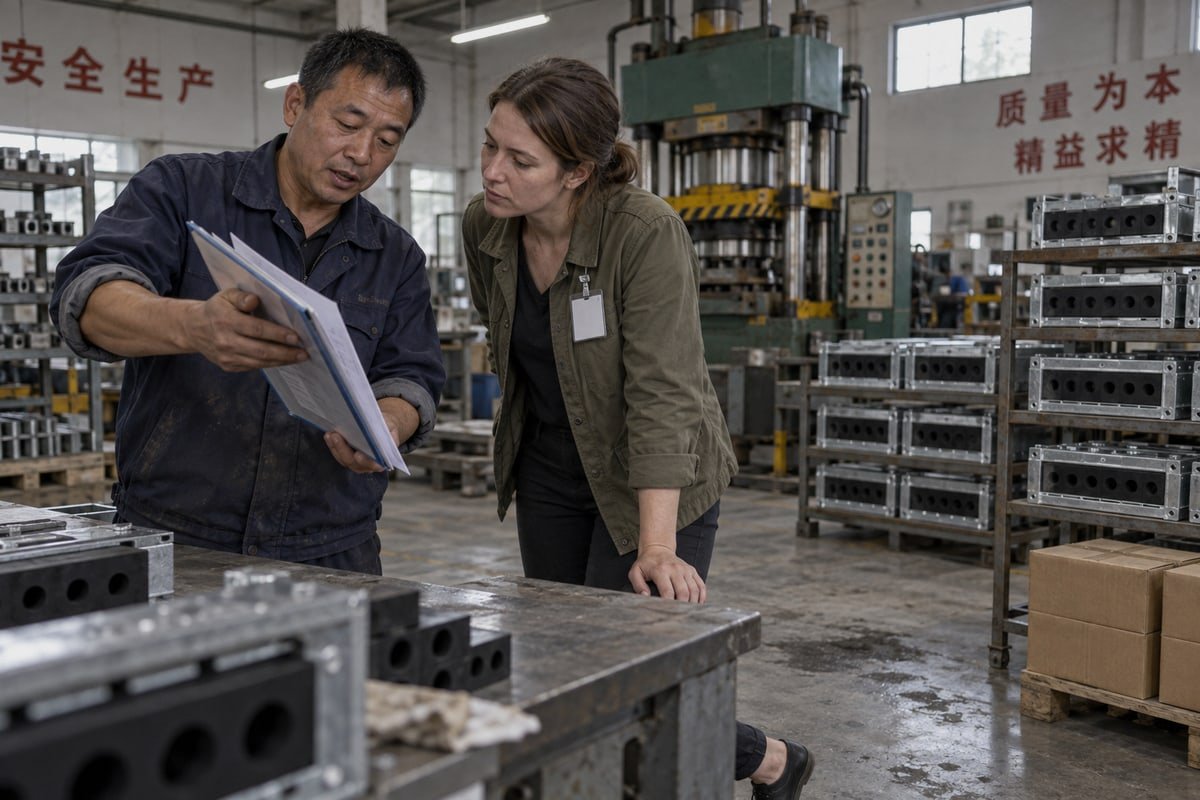
Most deposit losses do not come from bad factories. They come from entities that were never factories at all. A trading company with a nice website can take your 30 percent, subcontract the job, and vanish when the subcontractor fails. So the first job is simple. Prove that the company you are paying is the company that makes the product.
Documents that separate a factory from a trading company
Ask for the documents below and check each one against a public source, not against the supplier's own PDF. When buyers audit us, we hand over our license showing RMB 50M registered capital, our patent list with 38+ granted patents, and our BV factory approval. A real plant can do this in a day.
| Document | What to check | Red flag |
|---|---|---|
| Business license | Registered capital, business scope includes manufacturing, address | Scope says "trading" only |
| Factory address | Matches license; visible on satellite maps; video tour possible | Address is an office tower |
| ISO 9001 / IATF 16949 | Certificate number verifiable with the certification body | Scanned image, no number |
| Third-party approvals | BV or similar factory approval, test reports on request | "Certified" but no report |
| Bank details | Account name equals company name on the license | Personal account or offshore name |
| Patents | Granted patents listed under the same legal entity | Patents belong to another firm |
Why the bank account check matters most
Non-delivery risk often starts with a mismatched beneficiary. If the invoice says "Company A" but the wire goes to "Mr. Zhang" or to a Hong Kong shell, stop. Legitimate factories collect through a corporate account in the licensed company's name. We have three production sites, in Shaanxi, Shandong, and Hunan, but every deposit lands in one corporate account tied to our license.
A short supplier verification audit you can run remotely
- Pull the license from the national enterprise credit registry.
- Confirm the certification numbers with ISO and IATF databases.
- Request a live video walk of the mold shop and rubber press line.
- Ask for two recent export declarations with the buyer names redacted.
- Match the bank beneficiary to the license before any wire.
This takes a few hours. It removes the largest share of fraud risk before you even think about escrow.
Is trade credit insurance or an escrow service safer for protecting my MCT sealing system orders?
We weigh this trade-off on nearly every new export deal: accept escrow and wait for cash, or insist on a deposit and lose a cautious first-time buyer.
Escrow is safer for protecting a deposit on MCT sealing system orders because funds are held by a neutral party and released only at agreed milestones. Trade credit insurance, including Sinosure cover, protects the supplier against buyer non-payment after shipment and does not reimburse a lost prepayment.
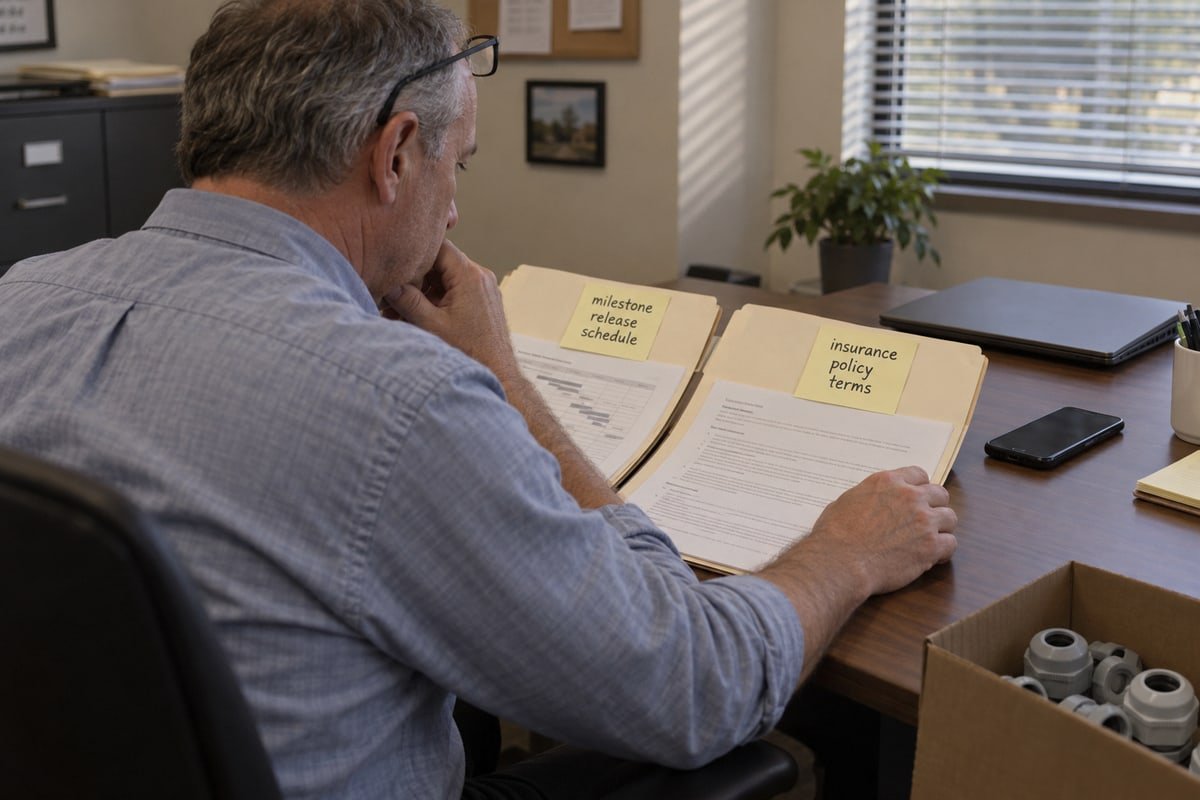
The two tools solve different problems. One protects the seller's invoice. The other protects the buyer's cash. Here is the direct comparison.
| Tool | Who it protects | When it works best | Main drawback |
|---|---|---|---|
| Trade credit insurance (Sinosure) | The supplier's receivable after shipment | Repeat trade where the factory offers about 90-day terms | Does not cover your deposit |
| Escrow (Tazapay, Escrow.com, Alibaba Trade Assurance) | The buyer's deposit before shipment | First orders, custom molds, new suppliers | Only as good as the release wording |
| Irrevocable Letter of Credit | Both sides through banks | Large orders with standard documents | Bank fees, paperwork, slow amendments |
| Low deposit plus milestone release | Both sides, by aligned incentives | Customized cable transit projects | Needs clear milestone definitions |
What credit insurance really does
Sinosure was launched in 2001 as China's export credit insurer. It underwrites the buyer, not the seller. When a factory has Sinosure credit limits 2 approved on your company, it can ship on open account and still get paid if you default. That is a trade finance solution. It is not deposit protection. So the objection "just use credit insurance and ask for open terms" only works if the supplier is willing and insured. For repeat orders of TSR round seals or TSC square modules, we do explore this. It removes the deposit question entirely. For a first order with new molds, most factories will not carry that risk.
What escrow really does
Escrow holds your money with a neutral party. The agent releases it only when the contract says so. It is a control mechanism, not insurance. This brings up the second objection: "escrow adds complexity and does not solve performance risk." That is fair. If the release trigger says "after production," the agent cannot judge what "after production" means. The fix is objective evidence, which the next section covers.
Where the market is going
Cross-border trade remains the largest use case for trade credit insurance, and Asia-Pacific buyers are asking for coordinated credit limits across suppliers in several jurisdictions. Chinese trade fairs now feature export supply-chain insurance and cross-border RMB settlement products alongside classic cover. Good trade credit management means using both ideas in sequence. Escrow for the first order. Insured open terms once trust is built.
What contract terms and documentation should I require to secure my deposit against production risk?
One lesson from twelve years of exporting TSC modules: vague words like "after production" cause more disputes than any price clause. We now define every trigger in writing.
Require a bilingual sales contract naming CIETAC arbitration or a Chinese court, a defined milestone schedule with objective release evidence, liquidated damages for late delivery, a raw material indexing clause, refund and defect-remedy language, and, for large orders, an advance payment guarantee or performance bond from the supplier's bank.
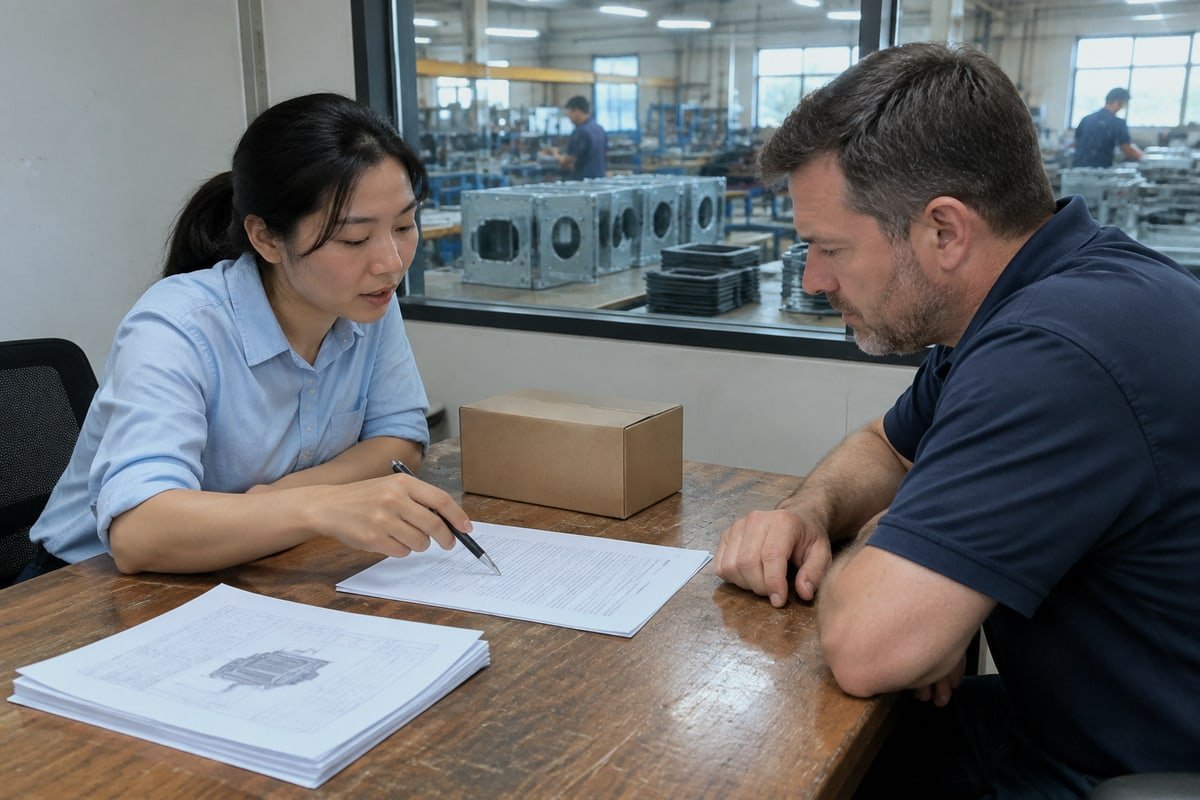
The standard term in our industry is 30/70. Thirty percent deposit, seventy percent against the bill of lading. That first thirty percent is the capital at risk. The contract's job is to make that thirty percent recoverable if the factory fails, and to make the factory's job clear so it does not fail.
Step one: make the contract enforceable in China
A contract written under German or Dutch law is hard to enforce against a plant in Shaanxi. A bilingual contract that names CIETAC arbitration or a competent Chinese court is far easier. Add liquidated damages 3 per week of delay. Keep them realistic, or a Chinese tribunal may reduce them.
Step two: split the deposit into evidence-based milestones
A single lump sum gives the escrow agent nothing to judge. Tiers give it a checklist. Here is a schedule we have accepted on custom projects.
| Milestone | Objective evidence | Release |
|---|---|---|
| Order confirmed | Signed contract, drawings, CAD/STEP approved | 0% |
| Raw material secured | Purchase records for EPDM compound and galvanized steel, dated photos | 10% |
| Tooling complete (custom sizes) | First-article photos from in-house mold shop, dimensional report | 10% |
| Sealing test passed | Pressure test report in the 0.01–0.4 MPa range, IP68 check | 10% |
| Pre-shipment inspection | Third-party PSI certificate uploaded to escrow | Balance to 30% |
| Shipped | Bill of lading, packing list, export declaration | Remaining 70% |
Each line names a document. The agent does not need to know what a stay plate is. It only needs to see the report.
Step three: close the loopholes
A raw material indexing clause stops a supplier from demanding extra cash if steel or rubber prices jump after your deposit. State the index and the tolerance band. Add refund language: if a milestone is missed by more than a set number of days, the escrow returns the deposit. Add defect-remedy language: rejected modules are replaced at the factory's cost within a fixed lead time.
Step four: add supplier-side security on big projects
For EPC-scale orders, ask the factory's bank for an advance payment guarantee 4. It returns your deposit if the plant does not perform. A performance bond covers the delivery obligation itself. Both cost the supplier money, so expect resistance on small orders. For very large risks, some insurers now offer supply chain disruption insurance that covers deposit losses from sudden regulatory or "dual control" energy shutdowns in China.
The "a partial deposit is enough" objection
Many factories argue that a small deposit already aligns incentives. There is truth in that. A low deposit is the most realistic compromise for custom sealing modules. But it is not a substitute for the contract terms above. A low deposit limits how much you can lose. The contract decides whether you can get it back.
How do free validation samples and factory certifications reduce my payment risk when qualifying a new supplier?
Last quarter our QC team sent free TSC validation samples to a European BESS integrator, who tested them in his own frame cutout before paying anything.
Free validation samples and verifiable certifications cut payment risk because you test real product before any deposit. Fit the sample into your 120-frame cutout, pressure-test it, and check the ISO 9001, IATF 16949, BV, A-60 and IP68 certificates with the issuing bodies. Proven quality lowers non-delivery and rejection risk.
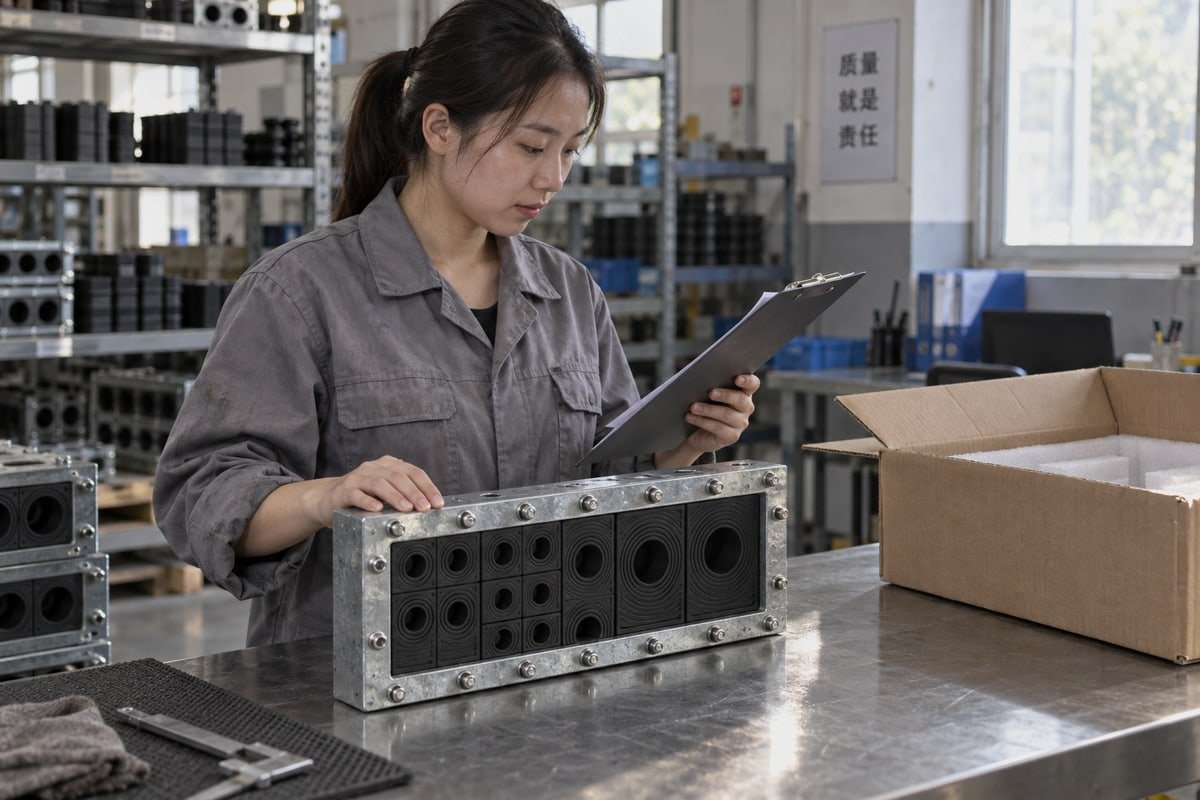
Escrow protects money after the order starts. Samples and certificates protect you before it starts. They answer a different question: will this factory even make what I need? If the answer is yes, most of the production risk that escrow guards against disappears.
What a validation sample proves
A free sample lets your engineers run the qualification you would run on any second source. Our step-core, halogen-free EPDM modules 5 are dimensionally compatible with common 120-frame standards. So a buyer can drop the sample into an existing frame cutout, insert the real cable diameters, compress it with the standard compression unit, and check the seal. We supply a cross-reference table, existing model to DEWIN model, so the comparison is line by line. If the sample fails, you have lost a few weeks. You have not lost a deposit.
What certifications prove, and how to check them
| Evidence | What it proves | How to verify |
|---|---|---|
| ISO 9001 | A documented quality system exists | Certificate number in the registrar's database |
| IATF 16949 | Automotive-grade process control and traceability | IATF global database lookup |
| BV factory approval | Independent survey of the plant and process | Ask for the approval document and number |
| A-0 / A-60 fire rating | Bulkhead fire performance | Request the test report, not the badge |
| IP68 and 0.01–0.4 MPa | Watertight and gas-tight sealing | Request the test report; repeat on samples |
Certificates alone do not protect a deposit. But a factory that can produce test reports on request has already passed the audits that matter. That lowers the chance of a rejected shipment, which is the most common cause of a payment dispute after partial completion.
How this changes the payment structure
A qualified supplier with tested samples deserves a simpler deal. Many buyers move from full escrow on order one to a small deposit plus quality control inspection on order two, and to insured open terms later. Supply chain risk mitigation is a ladder. Samples and certificates let you climb it faster. They also make the 40–60 percent cost saving real, because the saving only counts if the module passes your test.
Conclusion
A lost deposit can stall a whole BESS or data center build. Verify the factory, escrow the deposit, tie releases to evidence, and test free samples first. Talk to us.
Footnotes
1. Authoritative definition of the legal document required for verifying a supplier’s legitimate business operations. ↩︎
2. Official website of China’s export credit insurer, explaining how they underwrite trade receivables. ↩︎
3. Legal encyclopedia entry explaining the contractual provision for specified compensation in case of a breach. ↩︎
4. The International Chamber of Commerce provides standards for bank guarantees used to secure prepayments in trade. ↩︎
5. Technical overview of the EPDM material properties used in cable transit sealing systems. ↩︎


 English
  Español de México
  Deutsch
  Français
  العربية
  Русский