
Misjudging a multi cable transit supplier 1‘s remote technical support looks cheap until commissioning stalls. In our export work, we have watched a wrong module choice halt a whole container line.
Evaluate a multi cable transit supplier’s remote technical support by checking written response-time commitments, whether product engineers answer queries, availability of CAD, test reports and installation guides, live video or AR diagnostics, escalation paths, spare-parts speed, and post-warranty coverage, then test it with a real application before committing.
Remote support is not a courtesy feature for cable sealing systems. It is a selection criterion. Below, I break the evaluation into four practical questions. Each one comes with checks you can run before you sign anything.
What Response Times Can I Expect for Urgent MCT Technical Queries?
A sourcing manager in Rotterdam once emailed us at 22:00 his time about a TSC module clash. He needed an answer before the morning shift, not a ticket number.
For urgent MCT technical queries, expect a first response within a few hours during business hours and within one working day for engineering answers. Suppliers serious about support publish these targets in a Service Level Agreement, offer 24/7 coverage for critical projects, and route emergencies straight to engineers.

Response time has two layers. The first is acknowledgement. Someone confirms they received your query. The second is resolution. An engineer gives you a usable answer. Many suppliers quote the first and hide the second. You need both in writing.
Ask for SLA tiers, not a single promise
A single number like "we respond within 24 hours" tells you very little. A line stop on a BESS container line and a question about a stay plate finish are not the same urgency. Ask the supplier to split their commitments by severity. Here is the structure I recommend buyers request when they draft a Service Level Agreement with any multi cable transit supplier.
| Severity | Example situation | First response target to request | Engineering answer target to request |
|---|---|---|---|
| Critical | Sealing module will not compress; commissioning blocked | Within hours, any day | Same working day |
| High | Cable diameter outside module range on site | Same business day | Next working day |
| Medium | Cross-reference check for a drop-in replacement | Next business day | Two to three working days |
| Low | Request for updated technical data sheets or STEP files | Next business day | Within a week |
These are targets you can negotiate, not industry law. The point is to make the supplier commit to a tiered promise and to name who fulfils each tier.
Time zones and language coverage
Our factory sits in Shaanxi. Our main markets are Europe, Asia-Pacific and the Middle East. That means a six- to seven-hour gap to central Europe on most days. I am open about this with buyers. The honest question is not "are you 24/7" but "who covers my morning." Ask whether the supplier staggers engineer shifts, keeps an English-speaking engineer reachable during your working hours, and can support international jobsites in more than one language. A quick chat reply in broken English at midnight does not count as coverage.
Chat availability is not technical competence
Some suppliers show an "online now" badge and call it 24/7 support. That badge often leads to a sales agent reading a brochure. When you test a supplier, send one real technical question, for example a cable bundle with mixed diameters in a 120-frame cutout, and time how long the first engineering answer takes. Then judge the answer, not the speed alone.
How Do I Verify a Supplier's Engineering Team Can Handle My Application Details?
During a compression test on a TSR round assembly last spring, one of our engineers caught a step-core layer trimmed one step too far. That detail matters in support too.
Verify an MCT supplier's engineering team by sending a real application: cable schedule, frame cutout, fire and IP requirements. Ask who answers, check their product certifications like ATEX, IECEx or class approvals, request similar case examples, and judge whether they challenge your assumptions rather than simply confirm them.
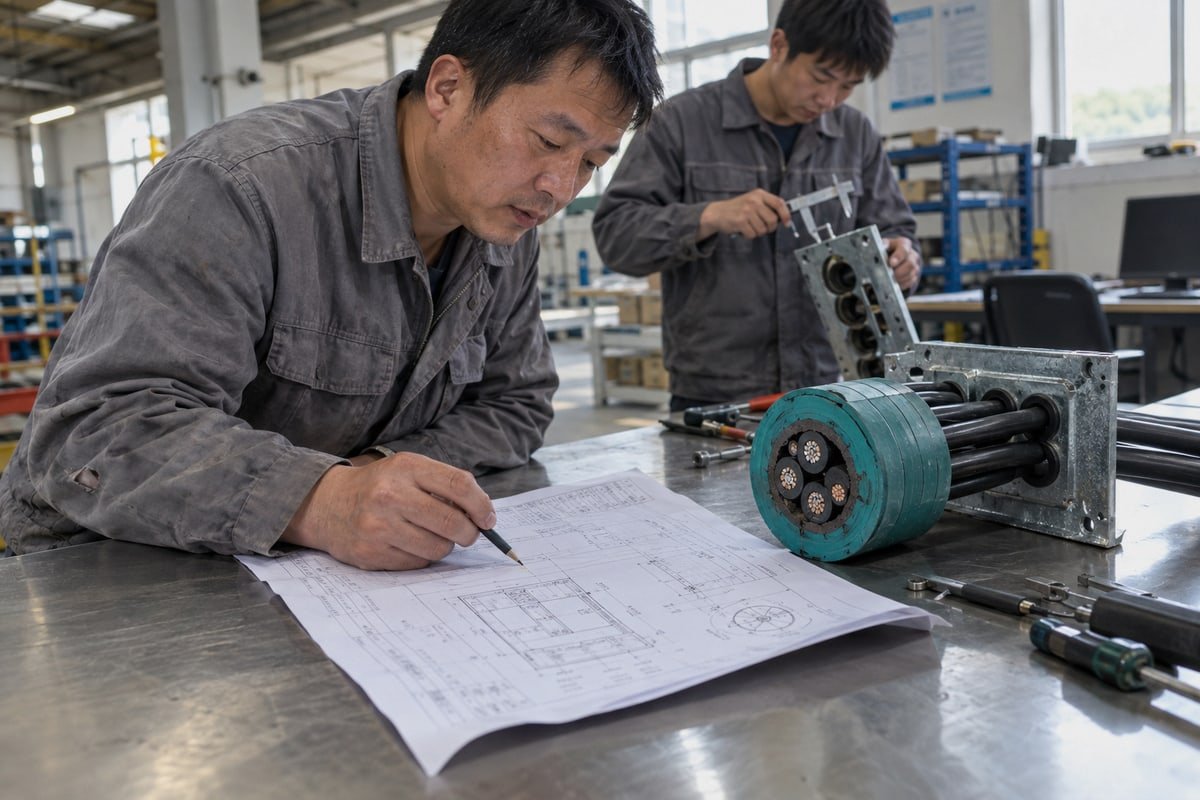
Spec sheets tell you what a product should do. A support conversation tells you whether the people behind it understand why. I suggest a short test packet. It costs you an hour and reveals more than any brochure.
The five-step test packet
- Send a real or realistic cable schedule with mixed diameters, including one cable near the edge of a module range.
- Attach the frame cutout drawing and state whether the frame is an existing 120-frame standard or a new design.
- State the fire rating you need, such as A-0 or A-60 for marine or offshore bulkheads, and the Ingress Protection rating, such as IP68 for outdoor enclosures.
- Ask for a module fill plan and a bill of materials, ideally generated through a web-based configuration tool if the supplier offers one.
- Ask one deliberately wrong question, for example a compression pressure that is too high for the application, and see whether they correct you.
A capable team will push back on step five. A weak team will say yes to everything.
What a strong answer looks like
Our modules use step-core, halogen-free EPDM rubber. One module size adapts to a range of cable diameters. A good engineer will explain which core layers to peel for each cable, how much clearance to leave, and how the fill affects watertight and gas-tight performance 2 across the 0.01–0.4 MPa range we test to. They will also ask about spare capacity for future cables. If the answer is only "yes, that fits," keep looking.
| Signal | Weak support team | Strong engineering team |
|---|---|---|
| Who replies | Sales or general service agent | Product or application engineer |
| Response content | Restates the catalogue | Fill plan, drawing markup, reasoning |
| Certification talk | Vague "certified product" | Names the test standard and offers the report |
| Hazardous-area queries | Deflects | Confirms whether ATEX and IECEx certifications 3 apply to the exact part number |
| Compatibility | "Should fit" | Cross-reference table mapping existing model to their model |
Certifications for your industry, not just any industry
Ask about the certifications your application actually needs. Marine and offshore buyers should ask for firestop performance standards 4 and class approvals. Hazardous-area buyers should check ATEX and IECEx certifications for the specific module, not the brand. Our own factory is BV-approved and runs ISO 9001 and IATF 16949 systems, and I always tell buyers to ask for the actual test documents rather than trust a logo on a website.
Local presence or remote depth?
Some buyers insist on a local distributor. Local help is useful for logistics and site visits. But a distributor cannot redesign a fill plan or explain a compression failure. Many failures need expert diagnosis faster than a visit can be arranged. The right balance is a local contact backed by direct access to the factory engineers who know the mold and the rubber compound.
What Documentation Should I Request Before Committing to a Remote Support Relationship?
Every week we weigh how much documentation to release before a purchase order arrives. Too little and the buyer cannot qualify us; too much and drawings float around unchecked.
Before committing to remote support, request technical data sheets, fire and Ingress Protection test reports, ISO 9001 or IATF 16949 certificates, CAD and STEP files or BIM objects, installation and torque instructions, a troubleshooting guide, the written Service Level Agreement, an escalation chart, and the post-warranty support policy.
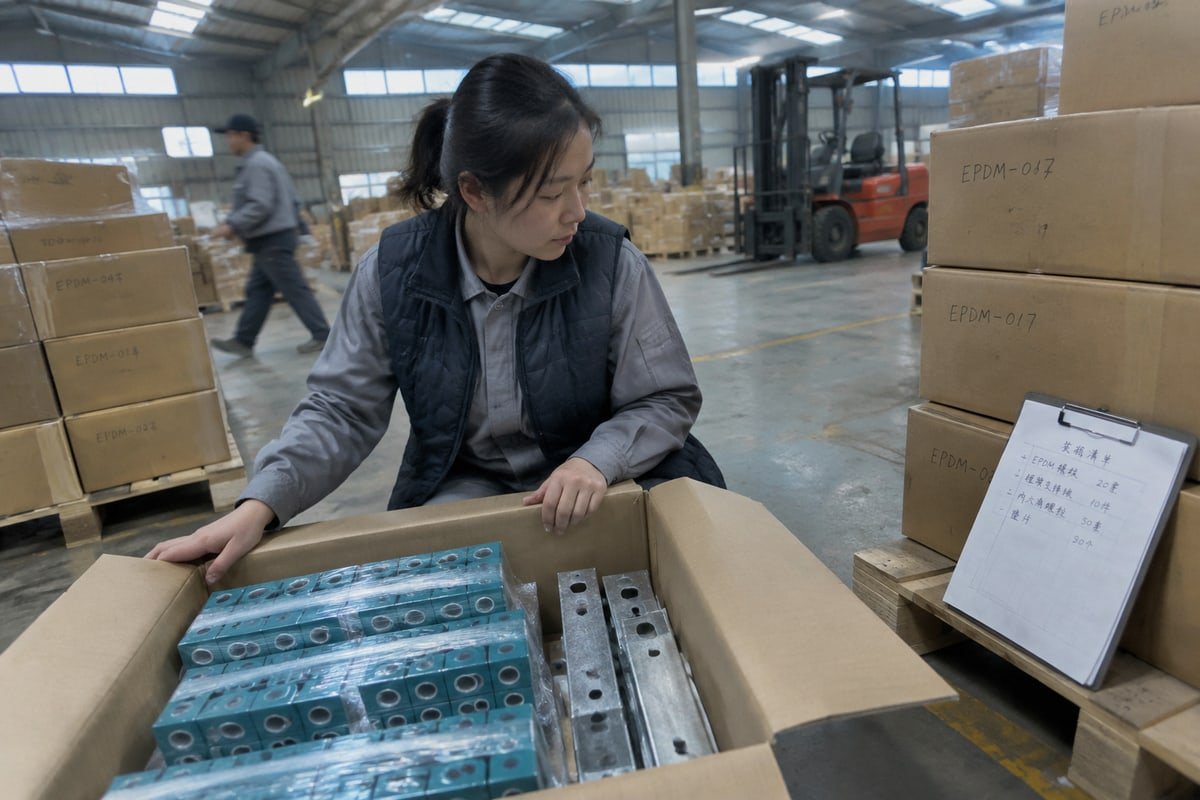
Documentation is the raw material of remote support. When an engineer on site opens a video call, both sides need to look at the same drawing, the same torque value, and the same fill plan. If the supplier cannot hand you current documents up front, they will struggle to support you later. I treat the document request as a dress rehearsal for the relationship.
The core document checklist
| Document | Why it matters for remote support | Red flag |
|---|---|---|
| Technical data sheets per module size | Confirms diameter range, material, temperature limits | Data sheet has no revision date |
| Fire test report, for example A-0/A-60 | Proves firestop performance standards for bulkheads and container walls | Only a summary certificate, no full report |
| IP68 and pressure test report | Confirms Ingress Protection ratings and watertight/gas-tight range | "Tested in-house" with no method stated |
| ISO 9001 and IATF 16949 certificates | Shows a controlled process behind spare-part consistency | Certificate expired or issued to a trading company |
| CAD, STEP and BIM objects | Enables BIM and CAD integration for clash checks before cutting steel | Only PDF drawings available |
| Installation manual with compression sequence and bolt torque | Lets a remote engineer talk a site crew through installation troubleshooting step by step | Generic manual not matched to your frame |
| Model cross-reference table | Confirms drop-in fit for existing 120-frame cutouts | Supplier "will check" each part manually |
| Written SLA and escalation chart | Names the people and hours behind support | Support described only in marketing text |
| Post-warranty support policy | Shows lifecycle commitment | Silence beyond the warranty period |
Digital library depth
The ranking pages on this topic all stress digital assets, and I agree. Ask whether the supplier keeps a searchable library of 3D CAD models 5, BIM objects and installation manuals, and whether a web-based configurator can validate a frame layout and generate a bill of materials in real time. We provide CAD and STEP files with our cross-reference tables because European integrators typically model the frame before they model the cables. A supplier who emails one drawing at a time will slow every remote session.
Free validation samples as documentation
A physical sample is documentation you can measure. We ship free validation samples so a buyer's QC team can check the module against their existing frame cutout with their own calipers. That test closes the gap between a drawing and a purchase order faster than any email thread.
Data handling during remote sessions
Your BIM models and facility floor plans are sensitive. Ask how the supplier stores files shared in support tickets, who inside the factory can open them, and whether they will sign a non-disclosure agreement. Ask which platform they use for screen sharing and whether sessions are recorded. Cybersecurity is now part of the support evaluation, not a separate IT topic.
Can I Trust a Supplier's Remote Support During Critical Installation or Commissioning Phases?
One lesson stuck with us after supporting a BESS container commissioning across a seven-hour time gap: a live camera on the frame beats twenty emails of photos.
You can trust remote support during installation or commissioning when the supplier offers live video or AR walkthroughs, has engineers available in your working hours, provides a compression and torque checklist, keeps spare sealing modules ready to ship, and can escalate to a site visit if remote fixes fail.
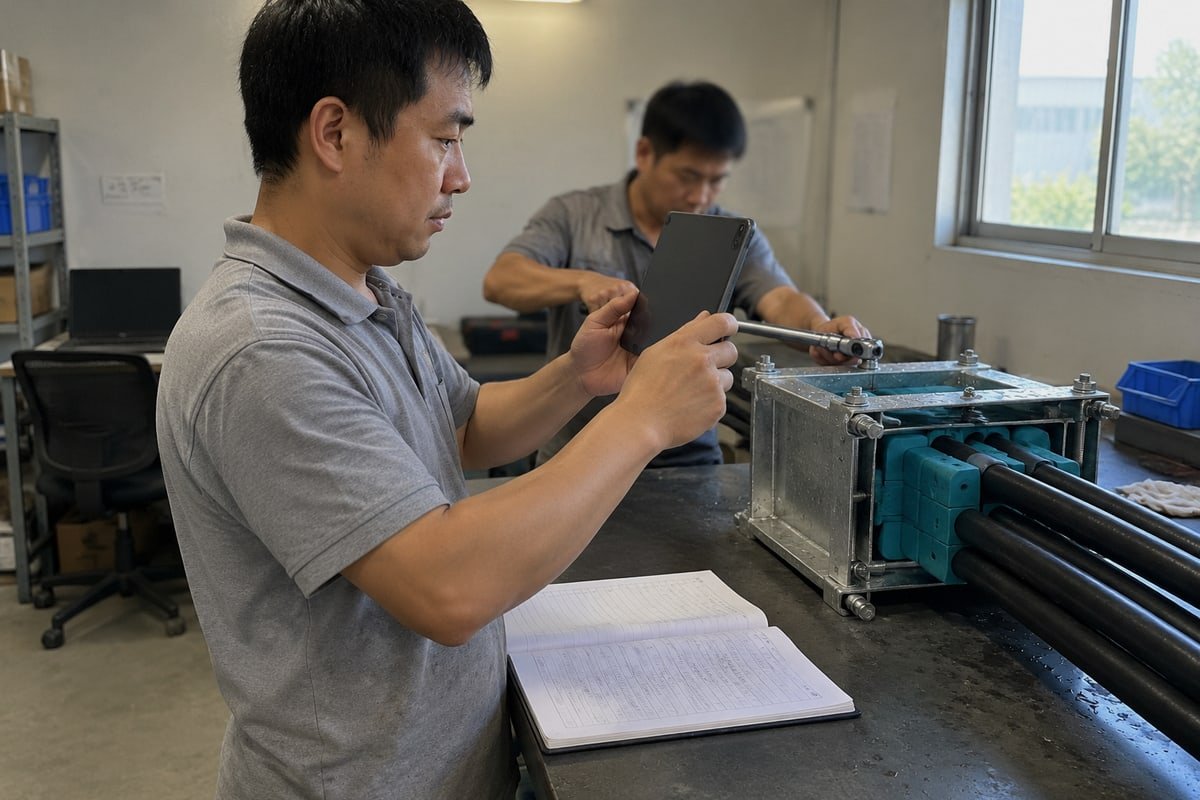
Commissioning is where remote support earns or loses its value. Travel is expensive and slow. A site team in Saudi Arabia or Norway cannot wait a week for a factory engineer to fly in. So the question is not whether remote help is ideal. It is whether the supplier has built a process that works under time pressure.
Where installations actually go wrong
Cable sealing systems look simple. A frame, some modular sealing solutions, a compression unit, two bolts. That simplicity leads some buyers to argue that support matters less than price. I hear this often. In our experience, the errors are also simple, and they are still expensive.
| Phase | Typical remote-support failure | What good support does |
|---|---|---|
| Frame welding and fitting | Cutout out of tolerance, frame distorted by heat | Reviews weld photos and tolerance checks before modules ship |
| Module fill | Step-core layers peeled to the wrong diameter, gaps in stay plate rows | Live video review of the fill against the fill plan |
| Compression | Bolts torqued unevenly, compression unit not seated | Guides the torque sequence on camera and confirms visually |
| Pressure or leak test | Test method does not match the certified method | Provides the test procedure from the IP68 or pressure report |
| Final inspection | Non-compliance found late by class surveyor | Runs a virtual site inspection with a checklist before the surveyor arrives |
Each of these is a small mistake. Each can delay a sign-off by days. That is the hidden cost factor in MCT procurement, and it rarely shows up in a price comparison.
Tools that make remote commissioning credible
Ask about the tools directly. Live HD video with the camera on the frame is the baseline. Some suppliers now use AR "see-what-I-see" tools where the engineer overlays markers on the physical hardware. Others offer virtual site inspections against a digital twin 6 of the vessel or plant, or AI tools that analyze photos of completed fills and flag packing errors before inspection. These are not universal yet. Ask which the supplier really uses on live projects, and ask for one example similar to your application. A demo video is not a track record.
Spares and escalation
Remote diagnosis is only half the fix. If a module is damaged or mis-sized, you need a replacement fast. Our spare sealing modules ship quickly because we mold them in-house and hold common sizes, and I recommend every buyer ask their supplier the same question: how many days from "we need a replacement" to "it is on a plane." Then ask what happens if the remote fix fails. A trustworthy supplier will name the point at which they send someone, and who pays.
Conclusion
Poor remote support quietly inflates MCT project cost. Judge suppliers on SLAs, engineering depth, documentation and commissioning readiness, and choose a partner whose modules and people both pass your tests.
Footnotes
1. Wikipedia overview of the multi cable transit (MCT) systems discussed in the article. ↩︎
2. Replaced broken homepage with a specific technical topic page explaining gas tightness in engineering. ↩︎
3. Official international system for certification to standards relating to equipment for use in explosive atmospheres. ↩︎
4. UL is a primary authority for fire-resistance and firestop performance testing standards. ↩︎
5. NIST provides authoritative guidance on product modeling and 3D CAD digital representation standards. ↩︎
6. Wikipedia entry defining the digital twin concept used in remote site inspections and modeling. ↩︎



 English
  Español de México
  Deutsch
  Français
  العربية
  Русский