
Most E-House drawings that reach our engineering desk list MCT systems in the E-House BOM under a single brand part number, so one late cable change freezes the whole approval.
Include MCT systems in an E-House BOM by specifying performance, not brand: list required fire rating, IP rating, hazardous-area certificate, frame cutout size, and cable OD range, then attach a Qualified Manufacturers List. Name a reference model with “or approved equivalent” and explicit, testable equivalency criteria.
That sounds simple. In practice it fails when the [equivalency criteria are missing or vague](https://dewinmct.com/?p=348) factory quality certificate 1. Below I walk through how we help purchasing engineers write BOM lines that keep compliance intact and keep the door open for a qualified second source.
How do I define MCT part numbers in my BOM without locking the design to a single supplier?
A sourcing manager 2 in Germany sent us a BOM last year with over a dozen MCT line items. Every one carried a competitor part number and nothing else.
Define each MCT line item with a generic description and performance code — frame cutout dimensions, module count, cable OD range, fire and IP rating — then list the incumbent part number as a reference only. Add a cross-reference column for approved alternates so the design stays vendor-neutral.
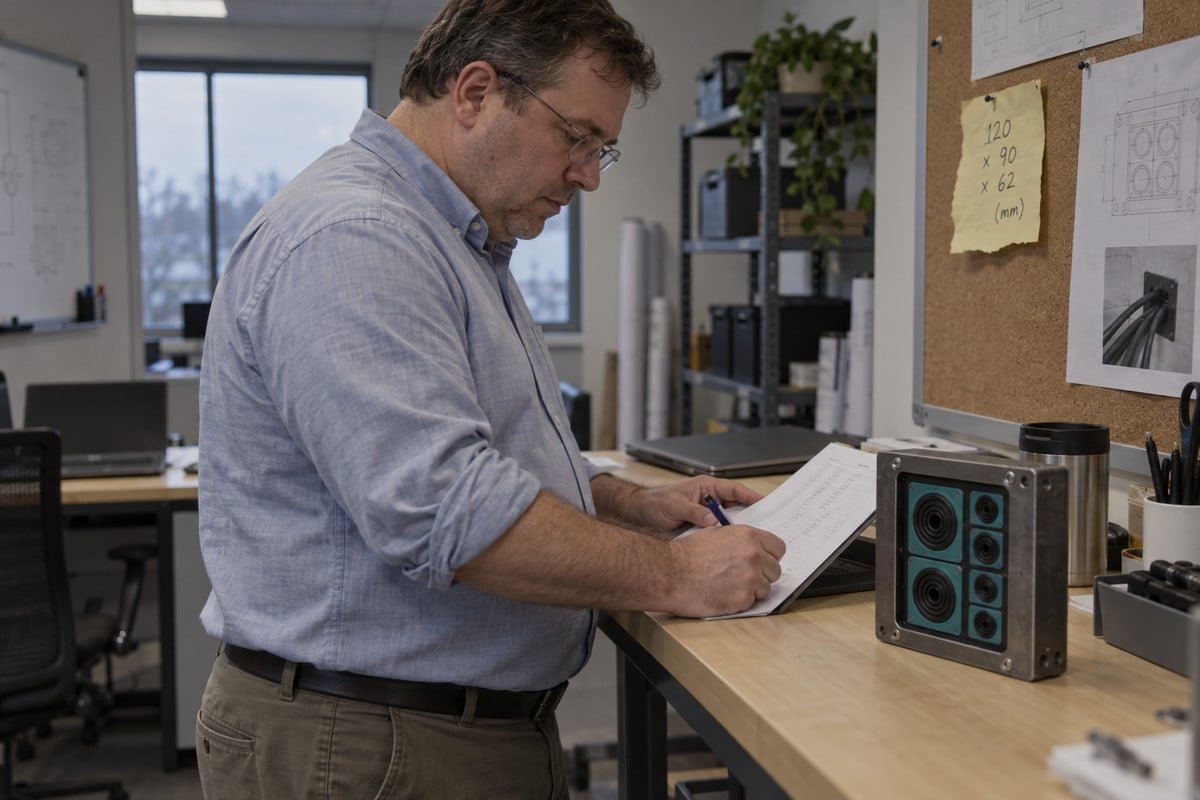
That German BOM could not be quoted by anyone but the incumbent. The buyer wanted a second source, but his own document blocked it. We rebuilt the line items together, and the same approach works for any prefabricated electrical modules, not just E-Houses.
Three ways to write the line item
There are three common styles. Each one has a different effect on approval flexibility.
| Style | Example line text | Approval effect | Sourcing effect |
|---|---|---|---|
| Named product only | "Brand X, Model 120-4, qty 6" | Fast to approve once, but any change reopens approval | Single supplier, no leverage |
| Performance only | "Cable transit, 120-frame cutout, A-60, IP68, OD 4–95 mm" | Committee must check every offer from scratch | Open, but risk of untested substitutes |
| Reference plus criteria | "Brand X Model 120-4 or approved equivalent per Note MCT-01" | Approved once; alternates checked against Note MCT-01 | Two or more qualified vendors |
The third style is the one we recommend. The incumbent part number stays as a reference. The note carries the testable criteria. The cross-reference column shows the DEWIN model that maps to it.
Buyer objection: naming a precise model is safer
Many EPC engineers tell me the same thing. "If I name the exact model, the committee cannot argue." That is true for the first approval. It is false for the rest of the project. E-House projects change cable count, cable size, and entry location late. A named-product BOM turns every change into a new submission. A reference-plus-criteria BOM absorbs the change as long as the criteria still hold.
Standardize the cutout, not the brand
The most powerful step is to fix the structural opening. If every cable entry frame 3 on the E-House uses the same cutout geometry, frames from different makers can be interchanged. Our TSC square modules and TSR round assemblies are dimensionally compatible with common 120-frame standards. That means they drop into the same cutout a competitor frame was designed for. The BOM only needs to say "120-frame compatible cutout" and the interchange is built in.
Can I write BOM specifications that qualify DEWIN as an approved alternate to my existing frame system?
On our TSC module line, every batch gets checked for compression and sealing pressure before it ships, because a second source earns its place when the test sheet matches the incumbent.
Yes. Write the specification around measurable criteria: dimensional compatibility with 120-frame cutouts, halogen-free EPDM modules, A-0/A-60 fire rating, IP68 ingress, and gas/watertight sealing to 0.4 MPa with test reports. DEWIN modules meet these criteria and ship with cross-reference tables and free validation samples.

The key is to describe the incumbent by what it does, not what it is called. Once you do that, qualification becomes a checklist, and a checklist is something an approval committee can sign.
A five-step qualification path
- Pull the incumbent's certificate data. Note the fire class, IP class, pressure rating, and the cutout drawing. This becomes your baseline.
- Write the criteria into a BOM note. Use the baseline values as minimums. Do not copy brand-specific feature names.
- Request the cross-reference table. We supply an existing-model-to-DEWIN-model table so each line item maps directly.
- Order free validation samples. Fit them in the actual frame cutout. Check module fit, compression unit travel, and stay plate seating.
- File the evidence. Test documents 4, the sample fit report, and the CAD/STEP file go into the submittal package.
Equivalency criteria a committee can actually test
| Criterion | How to state it in the BOM | DEWIN evidence available |
|---|---|---|
| Cutout compatibility | "Fits 120-frame standard cutout without modification" | Cross-reference table, STEP file, sample fit |
| Module material | "Halogen-free EPDM, step-core, adapts to OD range within one size" | Material datasheet |
| Fire rating | "A-0 or A-60 firestop cable transits as per project fire plan" | Fire test documents on request |
| Ingress | "IP68 minimum; IP66/67 ingress protection acceptable where drawing allows" | IP test documents on request |
| Gas and watertight seals | "Tested 0.01–0.4 MPa" | Pressure test documents on request |
| Factory system | "ISO 9001 or IATF 16949 certified factory" | Certificates on file |
Buyer objection: a cheap substitute fits but fails certification
This is the most reasonable objection I hear, and it deserves a straight answer. A module that fits a 120-frame cutout is not automatically equivalent. Fit is dimensional. Equivalence is documentary. That is why our factory is BV-approved and why we hand over test documents rather than marketing claims. It is also why I tell buyers to demand the same from every vendor on the list, including us.
One honest caveat. If the E-House sits in a hazardous zone, the transit configuration needs ATEX/IECEx certification referenced to IEC 60079-0 5, or a documented engineering practice such as API RP 500/505 in North American work. Some product families exclude certain sizes because of certificate limitations. Ask every supplier for the certificate that covers the exact module size and frame combination on your drawing. A general certificate for the family is not enough.
What technical documentation should I attach to the BOM line item to satisfy my approval committee?
We learned early in our export work to Europe that a committee rejects a datasheet with no test number faster than it rejects a higher price.
Attach a performance data sheet, type approval certificates for fire and IP rating, hazardous-area certificates if applicable, a factory quality certificate such as ISO 9001, CAD/STEP models of the frame cutout, a cross-reference table, and the sample validation report. Together these cover enclosure, transit, and project-level approval.

The reason the package needs so many parts is that "approval" is not one thing. On an E-House there are three separate approval layers, and each one asks a different question about the cable entry.
The three approval layers
| Approval layer | Question it asks | Documents that answer it |
|---|---|---|
| Enclosure approval | Does the transit keep the E-House at its declared IP and fire rating? | Type approval certificates, IP and fire test reports |
| Transit (component) approval | Is the MCT itself certified for this environment, including hazardous locations? | Component certificate, ATEX/IECEx or equivalent where required |
| Project engineering approval | Does this specific frame, module set, and cutout meet the drawing? | Performance data sheet, STEP file, cross-reference table, sample fit report |
A common failure is attaching only the first layer. The committee then asks whether the MCT is part of the enclosure's certified assembly or a separately approved component. If you cannot answer, the line item stalls. State it plainly in the note. On most modular data center and BESS container builds we supply, the transit is treated as a separately approved component installed into a cutout the enclosure maker has already qualified.
What we include in a DEWIN document pack
For each line item, our team assembles the following. I list it so you can request the same pack from any vendor.
- Performance data sheet. Fire class, IP class, pressure range 0.01–0.4 MPa, cable OD range per module size, and operating temperature. Where the project has seismic or blast loads, the sheet must declare them explicitly; we confirm these case by case rather than assume.
- Type approval certificates. Issued documents, not summary logos.
- Factory certificates. ISO 9001, IATF 16949, and our BV factory approval.
- CAD/STEP and BIM objects. These let your designers check clearance around the compression unit and cable bend radius inside the E-House layout before anything is ordered.
- Cross-reference table. Existing model to DEWIN model, line by line.
- Sample validation report. Written after the free sample is fitted in your frame.
Buyer objection: performance-based specs shift the burden onto the committee
That is fair. A purely generic spec forces reviewers to evaluate every offer from zero. The document pack solves this. When the BOM note states the minimums and the pack proves them, the reviewer compares two columns. That is less work than approving a named product with no supporting evidence, and it is far less work than a re-submission after a cable change.
How do I structure my BOM notes to allow future cost negotiation without triggering a full re-approval cycle?
The trade-off we weigh with every EPC buyer is simple: tight notes protect compliance, loose notes protect price, and the wrong wording loses both.
Split BOM notes into two tiers: fixed compliance notes (ratings, certificates, cutout geometry, spare capacity) that require re-approval to change, and commercial notes (supplier, price, lead time) governed by a Qualified Manufacturers List appendix. Swapping between QML vendors then needs only a document check, not re-approval.

Most re-approval cycles are triggered by accident. A buyer changes a supplier, and because the supplier name lived inside the technical note, the change control system treats it as a design change. Separating the two tiers prevents that.
The two-tier note structure
Tier 1 — Compliance notes (change requires re-approval)
- Cutout: 120-frame compatible, dimensions per drawing.
- Fire: A-60 firestop cable transits at fire-rated walls; A-0 elsewhere.
- Ingress: IP68 on bottom cable entry; IP66/67 ingress protection acceptable on side entries per drawing.
- Sealing: gas and watertight, tested to 0.4 MPa.
- Module material: halogen-free EPDM.
- Bonding: where electromagnetic interference shielding or armour bonding is required, the module set must include a bonded variant; confirm availability per vendor.
- Spare capacity: minimum 20% of module positions left as blanks; 40% where future cable additions are planned.
Tier 2 — Commercial notes (change by QML update only)
- Approved suppliers: see QML Appendix A.
- Preferred supplier for this order: as per purchase order.
- Delivery: per contract.
Why the QML is a dynamic appendix
The Qualified Manufacturers List sits outside the drawing. Adding DEWIN to it after sample validation is a procurement action. It does not touch the compliance tier. That is what makes vendor-neutral procurement work in practice. When a buyer later negotiates price between two QML vendors, the engineering approval is untouched because the drawing never named a supplier.
Spare capacity as a cost lever
Spare capacity requirements belong in Tier 1, but they pay off in Tier 2. Frames ordered with 20–40% blank positions let operators add cables later without cutting the wall. That is real future-proof cable management. It also means the next order is spare sealing modules only, which is where the largest cost difference between an incumbent and a drop-in second source shows up. On the line items we cross-reference, buyers typically see 40–60% lower cost on modules and spares, and those spares ship fast because we make the molds in house.
Buyer objection: a narrow BOM reduces engineering uncertainty
It does reduce uncertainty for the first order. But a narrow BOM concentrates supply-chain risk on one vendor's lead time and one vendor's pricing. The two-tier structure keeps the engineering certainty in Tier 1 and moves the risk into Tier 2, where a second qualified factory can absorb it. From our side, that is the whole point of positioning as a long-term second source rather than a one-off low bid.
Conclusion
Rigid MCT line items freeze approvals. Performance-based, certificate-backed, QML-governed line items keep MCT systems in an E-House BOM flexible, compliant, and open to a qualified second source.
Footnotes
1. Official ISO page for quality management standards required for manufacturing facility qualification. ↩︎
2. Wikipedia reference for the professional role responsible for procurement and vendor selection mentioned in the case study. ↩︎
3. Official site for IECEx, the international system for certifying cable entry components in hazardous environments. ↩︎
4. Authoritative global testing and inspection body providing the type approval and validation documents mentioned. ↩︎
5. Authoritative source for the international standard governing electrical equipment in explosive atmospheres. ↩︎



 English
  Español de México
  Deutsch
  Français
  العربية
  Русский