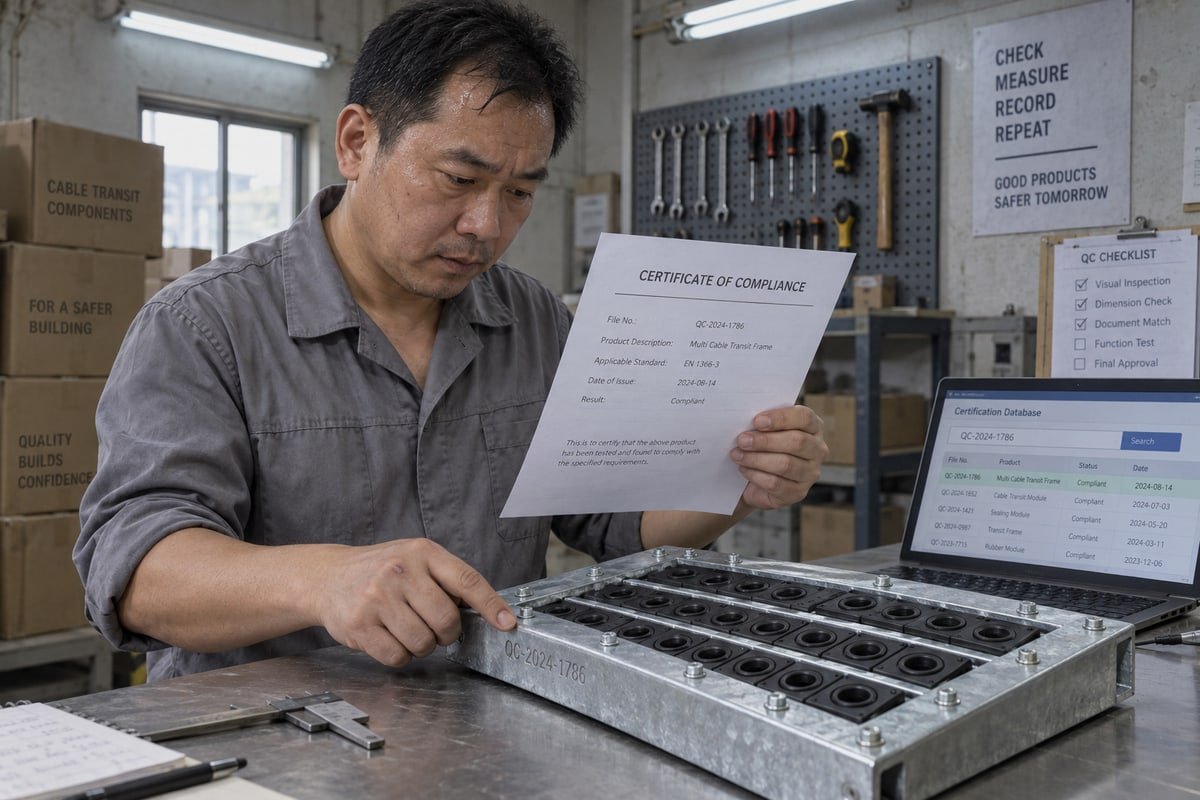
Verifying UL 514B 1 NRTL certification for multi cable transits 2 from China starts with a question our export team hears weekly: is this PDF real? Too often, the directory says no.
To verify UL 514B NRTL certification for multi cable transits, request the E-file number and Certificate of Compliance, search the UL Product iQ directory or the issuing NRTL’s portal, confirm the model, CCN, and scope match, check the mark on the product, and confirm the listing is current.
That answer sounds simple. In practice, each step hides a place where a supplier can stretch the truth. Below, I walk through the documents, the database checks, the red flags, and the compatibility question that trips up even careful buyers.
What documents should I request to confirm a China-made MCT holds genuine UL 514B NRTL certification?
Last quarter a German BESS integrator sent our sales engineer a one-page checklist before requesting samples. It asked for six documents. We think that list is the right starting point.
Request the UL or NRTL file number (usually E followed by digits), the Certificate of Compliance naming the exact model and CCN, the listing report scope pages, a photo of the marked nameplate, the factory's Follow-Up Services record, and the Chinese business license to match the trade name.

Before we look at each document, one point matters. UL 514B is a U.S. standard for fittings used with cable and conduit. OSHA lists it among the recognized test standards 3 for fittings for conduit and outlet boxes. It is a standard reference. It is not proof of certification by itself. A supplier can quote the standard number all day without ever having a listing. So every document you request should tie the standard to a certifier, a file, and a specific product.
The six documents and what each one proves
| Document | What it proves | What it cannot prove |
|---|---|---|
| NRTL file number (E-number for UL) | A certification file exists under that company | That your model is inside the file |
| Certificate of Compliance (CoC) | The certifier issued a formal statement for named models | That the certificate is still current |
| Listing report scope pages | Exact sizes, materials, and constructions covered | Field installation compliance |
| Nameplate or body photo with the mark | The product is marked, not just the brochure | That the mark is authorized |
| Follow-Up Services (FUS) record | The factory accepts unannounced inspections | Product performance on your site |
| Chinese business license | The legal entity behind the trade name | Anything about the product |
The Certificate of Compliance is the document buyers ask for first. It is useful, but it is a snapshot. The listing report scope pages are more useful. They tell you whether the 30 mm module, the 60 mm module, and the frame are all covered, or only one of them. In our experience, the scope pages are the document Chinese suppliers are least eager to share. Ask anyway.
Listed versus Recognized Component
Two marks look similar and mean different things. A UL Listed mark means the complete product was evaluated for field installation. A UL Recognized Component mark means the part was evaluated only for use inside another certified assembly, with conditions of acceptability. An MCT bolted through a container wall by an installer is a field installation. It generally needs a full Listing, not a Component Recognition. Ask the supplier which mark they hold. Then check whether the mark on the nameplate photo matches the answer.
cULus and the Canadian side
If your project touches Canada, look for the cULus mark. It signals evaluation to both the U.S. standard and the Canadian counterpart 4, CSA C22.2 No. 18.3. A U.S.-only UL mark is not wrong. It just does not cover Canadian installations. The CoC should state both standards if the supplier claims both markets.
Tested to, not certified under
Many suppliers, including well-known European brands, describe their multi cable transits as tested to UL 514B cable retention requirements. Roxtec, for example, publicly references testing against UL 514B Table 27 with more than 2000 N retention for a 50 mm outer-diameter cable. That is a real performance statement. It is not the same as an NRTL listing. When a Chinese factory copies this language and adds EN 50262 and IEC 62444 in the same sentence, the buyer has to separate three things: test data, European standard references, and actual North American certification. The documents above force that separation. We hand over our own fire, IP68, and pressure test documents on request, and we tell buyers to run the same document check on us as on anyone else.
How can I cross-check a supplier's UL certificate directly with the NRTL database before placing an order?
A lesson we learned early in exporting: a supplier PDF proves the supplier owns a printer. The certifier's live record proves the listing. Our engineers share these search steps openly.
Open the UL Product iQ directory, search by the E-file number, then confirm the company name, factory address, CCN such as DWTT, model numbers, and UL 514B in the standards field. For Intertek or other NRTLs, use their own online directory and validate the Certificate of Compliance number there.

UL file number verification takes about ten minutes once you know where to look. The problem is that most buyers stop after the first hit. They see the company name and feel reassured. The real check has five layers. Here is the process I recommend to our own customers, whether they are checking us or a competitor.
Step-by-step database check
- Confirm the certifier is on the OSHA NRTL list for UL 514B. UL Solutions is one NRTL. Intertek (ETL) is another. Both can certify to UL standards. A lab that is not on the OSHA list for this standard cannot issue an NRTL certification for it, no matter what the certificate says.
- Search the UL Product iQ directory by E-file number. The number normally starts with E and is followed by several digits. Do not search by company name alone. Names are easy to copy and hard to spell consistently.
- Match the applicant and the manufacturing location. The directory entry shows the company and often the factory address. Compare the factory address to the shipping origin on the supplier's packing list. A listing held by a factory in Zhejiang does not cover product made in an unlisted plant in Guangdong.
- Read the CCN. The Category Control Number tells you what kind of product the file covers. Confirm the description reads as fittings for cable or conduit, not as unrelated hardware or a general electrical enclosure category.
- Match the model string exactly. A listing for a 120 x 120 frame with modules 15 through 60 does not cover a 120 x 240 frame or a 90 mm module.
What to compare, and where
| Certificate field | Where to confirm it | Pass condition |
|---|---|---|
| E-file number | UL Product iQ directory search bar | Record opens and is active |
| Company trade name | Directory record and Chinese business license | English name matches the licensed entity |
| Factory address | Directory record, packing list, commercial invoice | Same city and site |
| CCN | Directory record heading | Category describes cable or conduit fittings |
| Standards | Directory record standards field | UL 514B present; CSA C22.2 No. 18.3 if cULus claimed |
| Model numbers | Directory record model list | Your purchase order models appear verbatim |
| Certificate number | Issuing NRTL's certificate portal | Portal returns a matching active certificate |
When the directory is not enough
Sometimes a file exists but the record is unclear. UL Solutions states that certification validity 5 can be confirmed through its Customer Experience Center. Use it. A short email with the E-number and the model list gets a clear answer. For product in hand, the UL Verify mobile application can scan holographic labels or QR codes where the manufacturer uses them. These give traceability to a production batch, which is useful when you suspect a mark was applied to product from a different run.
One more point on currency. Intertek has noted that after updates to UL 514B, new certifications are evaluated to the most updated requirements. An older certificate is not automatically invalid. But it is a reason to ask the certifier whether the listed construction still meets the current edition. A directory record that shows recent activity is a good sign. A record that has not changed in many years deserves a question.
What red flags indicate a fake or expired UL 514B certification on cable transit products from Chinese factories?
Every low quotation forces a trade-off we weigh on our own pricing: cost versus proof. When a competing offer undercuts even our factory-direct price, our first suspicion is the paperwork.
Red flags include a certificate without an E-file number, a trade name that differs from the business license, wording like built to UL standards or UL 514B tested, a Recognized Component mark on a field-installed transit, elastomer missing from the Yellow Card database, and no recent Follow-Up Services inspection.
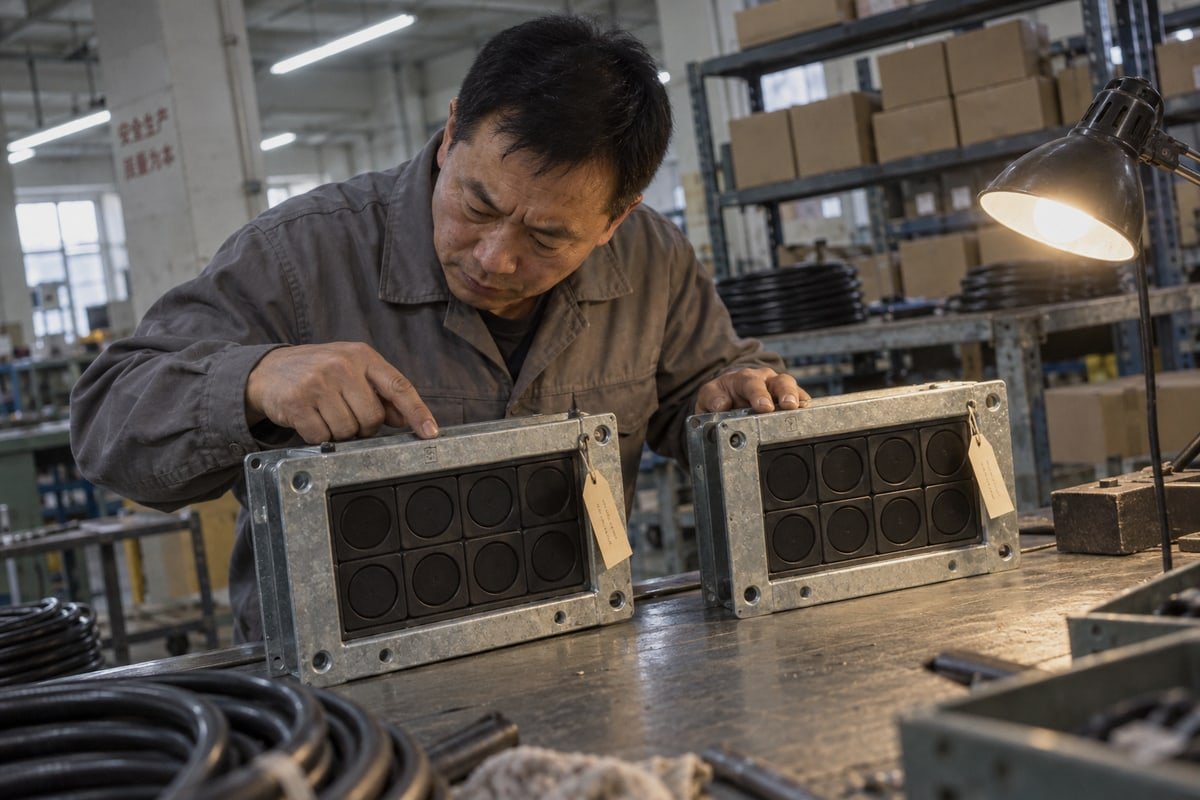
Fake certificates are the obvious risk. Stretched certificates are the common one. A supplier holds a real listing for one frame size, then applies the same marketing to twenty sizes. Or a trading company borrows the file of a factory it no longer buys from. The table below covers both types.
Red flag table
| Red flag | Why it matters | Action |
|---|---|---|
| Certificate shows no E-number or file reference | Nothing to search in the directory | Reject until a searchable number is supplied |
| Trade name on certificate differs from business license | Listing may belong to another factory | Ask for the license and compare the registered English name |
| Phrases like built to UL standards, UL compliant, or NRTL grade | Signals no actual listing | Ask which NRTL, which file, which CCN |
| Certificate scope lists one size; catalog claims all sizes | Listing is being stretched | Request scope pages and match each model |
| Recognized Component mark on a wall-mounted MCT | Component recognition is not a field Listing | Confirm Listed status for the complete assembly |
| Rubber compound not traceable to a UL Yellow Card | Material substitution risk on low-cost runs | Ask for the compound grade and card reference |
| No FUS inspection activity | Listing may be lapsed or factory changed | Ask the certifier to confirm the file is active |
| Claims of hazardous location fittings approval under UL 514B | UL 514B does not cover hazardous location ratings | Request the separate hazardous location certification |
| NEMA 4X rating stated with no test basis | NEMA and IP ratings come from different test methods | Ask which lab tested which rating |
The elastomer question
Multi cable transit modules live or die by their rubber. The colored blocks that grip the cable are the sealing element and the retention element. A factory can pass initial testing with one EPDM compound, then switch to a cheaper compound after the audit. The Yellow Card database exists to make plastics and elastomers traceable by grade. If a supplier cannot tell you the compound grade in the module, the certification may still be real, but the product in your container may not be the product that was tested. Our modules use step-core, halogen-free EPDM. We disclose the compound when asked, and we expect every serious buyer to ask.
Pull-out claims without a certified model
Pull-out test requirements are where marketing gets creative. A brochure might say the transit resists more than 2000 N of pull for a 50 mm cable, echoing the Roxtec public example tied to UL 514B Table 27. The number may be genuine for one tested configuration. It becomes a red flag when it is quoted for every module size, every frame, and every factory variant. Performance claims may be real, but they still need to be matched to the exact certified model and scope. If the supplier cannot show which model produced the number, treat the number as marketing.
Expired is not always visible
An expired listing does not turn red in a PDF. It only shows up in the live record. That is why the previous section matters so much. A certificate dated years ago, from a factory that has since moved, with no FUS activity, is the classic profile of a lapsed file still in circulation.
Does UL 514B certification on my MCT modules still guarantee compatibility with my existing 120-frame system?
On our inspection bench, every TSC module batch is gauged against the 120-frame cutout before it ships. Certification paperwork never touches that gauge. The two checks answer different questions.
No. UL 514B certification covers the fitting's safety and cable retention performance, not frame dimensions. Compatibility with a 120-frame system depends on module width, depth, and compression travel. Confirm both separately: verify the listing scope, then validate fit with a cross-reference table, CAD files, and a physical sample.

Buyers often collapse two questions into one. Is it certified? Will it fit? A yes to the first says nothing about the second. A yes to the second says nothing about the first. Here is how I separate them for sourcing managers who want a qualified second source without a redesign.
Certification check versus compatibility check
| Question | What answers it | What does not answer it |
|---|---|---|
| Is the module certified to UL 514B? | NRTL directory record, CoC, nameplate mark | Dimensional drawings |
| Does it fit my 120-frame cutout? | Cross-reference table, STEP files, physical sample | Any certificate |
| Does it seal to IP68? | Ingress Protection IP68 test report | UL 514B listing |
| Does it hold fire rating A-0 or A-60? | Firestop seal certification and fire test report | UL 514B listing |
| Does it hold pressure? | Watertight and gas-tight test at 0.01 to 0.4 MPa | Frame compatibility |
| Does it meet NEMA 4X rating? | NEMA-based enclosure testing | IP68 report |
Why dimensional fit is a separate engineering task
The 120-frame convention defines the opening. Modules from different makers can share that opening while differing in compression behavior, rubber hardness, and step-core geometry. Our TSC square modules and TSR round assemblies are built to drop straight into existing 120-frame cutouts. We back that with model cross-reference tables that map an existing model number to the DEWIN equivalent. We also send free validation samples so a purchasing engineer can bolt the module into a real frame and torque the compression unit before signing anything. That physical test is the compatibility check. No certificate replaces it.
Why certification scope matters when you mix brands
Here is the part many suppliers skip. An NRTL listing for an MCT is normally a system listing. It covers a frame, a set of modules, a compression unit, and stay plates as evaluated together. If you place a second-source module inside another brand's listed frame, the combination may fall outside both listings. The module can be certified. The frame can be certified. The mixed assembly may not be. For a European integrator shipping to a U.S. site, this is a question to raise with the inspector or AHJ before installation, not after. We are direct about this with buyers. We provide our ISO 9001 6 and IATF 16949 system documents, our BV factory approval, and our fire, IP68, and pressure test reports. Then we tell the buyer exactly which combinations those reports describe.
Making the second-source decision defensible
A drop-in second source at 40 to 60 percent lower cost is only a saving if the paperwork survives inspection. So build the file in this order. First, verify the NRTL record for whatever product carries the UL 514B claim. Second, verify fit with a sample in your own frame. Third, document which test reports apply to the exact assembly you will install. With in-house mold making, we can also produce custom module sizes when the standard range does not match a legacy cutout. Even then, the certification question is asked again for the new size. Nothing carries over automatically.
Conclusion
Fake or stretched UL 514B claims turn a cheap cable sealing system into a rejected installation. Verify the record, match the model, then test fit with a free sample.
Footnotes
1. Intertek is a leading NRTL that provides certification and testing to UL 514B standards. ↩︎
2. General overview of the multi cable transit product category and its applications. ↩︎
3. OSHA’s NRTL program oversees the safety standards and laboratories for electrical equipment. ↩︎
4. CSA Group provides the Canadian safety standards equivalent to the U.S. UL 514B. ↩︎
5. Official website for UL Solutions, the primary NRTL for verifying product certification validity. ↩︎
6. Official source for the ISO 9001 quality management standard used in manufacturing processes. ↩︎



 English
  Español de México
  Deutsch
  Français
  العربية
  Русский