Every quote reaching our factory asks whether multi cable transit rubber is low-smoke and halogen-free. Guess wrong, and a sealed room fills with acid smoke. Here is how we verify.
Multi cable transit rubber can be low-smoke and halogen-free, but only when the specific module compound is formulated that way. Halogen-free EPDM modules release no hydrogen chloride and produce limited smoke, which makes them suitable for enclosed spaces. Always verify each product with test documents, not the category name.
The transit is a system. The rubber inside it is a material. Those are two different things. A frame can be perfect and the modules can still be wrong for a confined room. So this article separates the two. I will show you which materials qualify, which papers prove it, how EPDM compares with standard rubber, and what happens to your frame cutouts if you switch suppliers.
What materials and certifications confirm my MCT rubber is truly halogen-free for enclosed spaces?
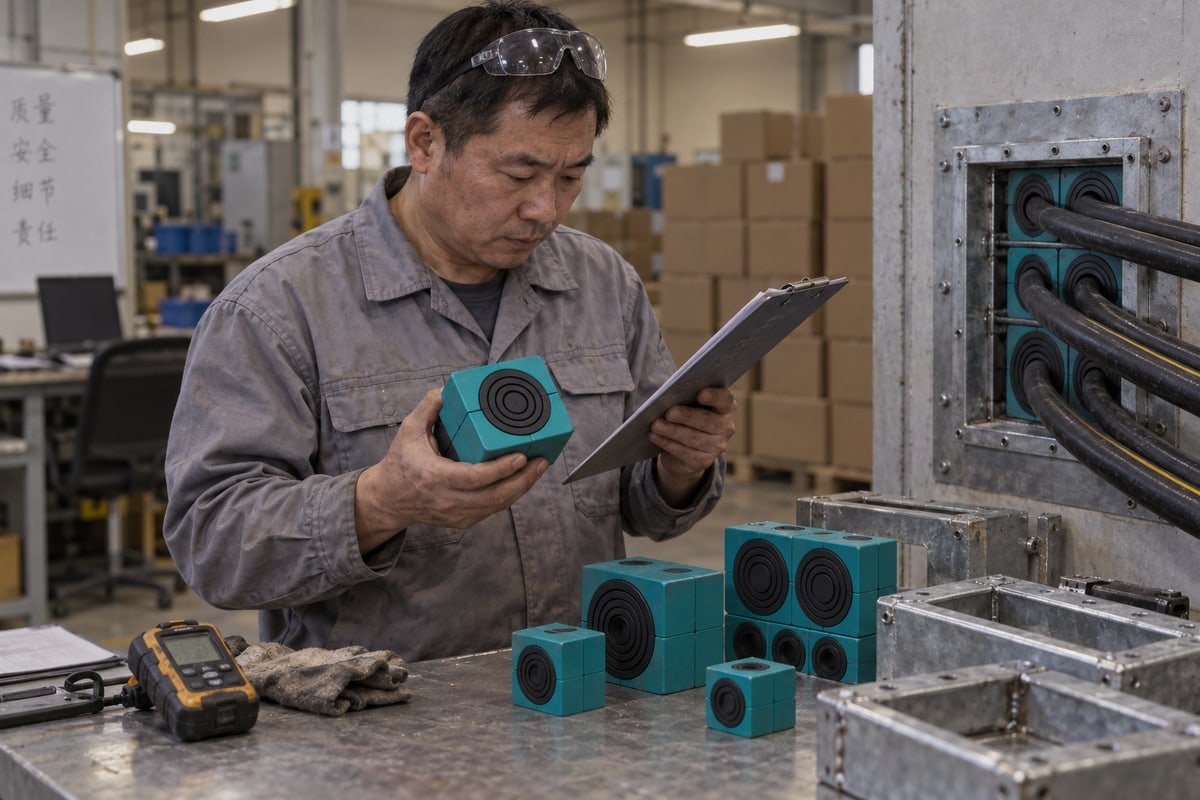
Last spring, our QC team held a batch of teal EPDM blocks at the press until the raw compound's material declaration 1 was checked against our halogen-free spec.
Truly halogen-free MCT rubber is confirmed by three things: an EPDM base compound with no chlorine, bromine, fluorine, or iodine; a material declaration showing halogen content at or below 0.1 weight percent; and third-party evidence such as RoHS and REACH compliance plus fire test reports from an accredited body.
The word "rubber" tells you nothing about halogen content. That is the first lesson I give to any buyer who is new to modular cable sealing. Let me break the question into its parts.
Start with the base polymer
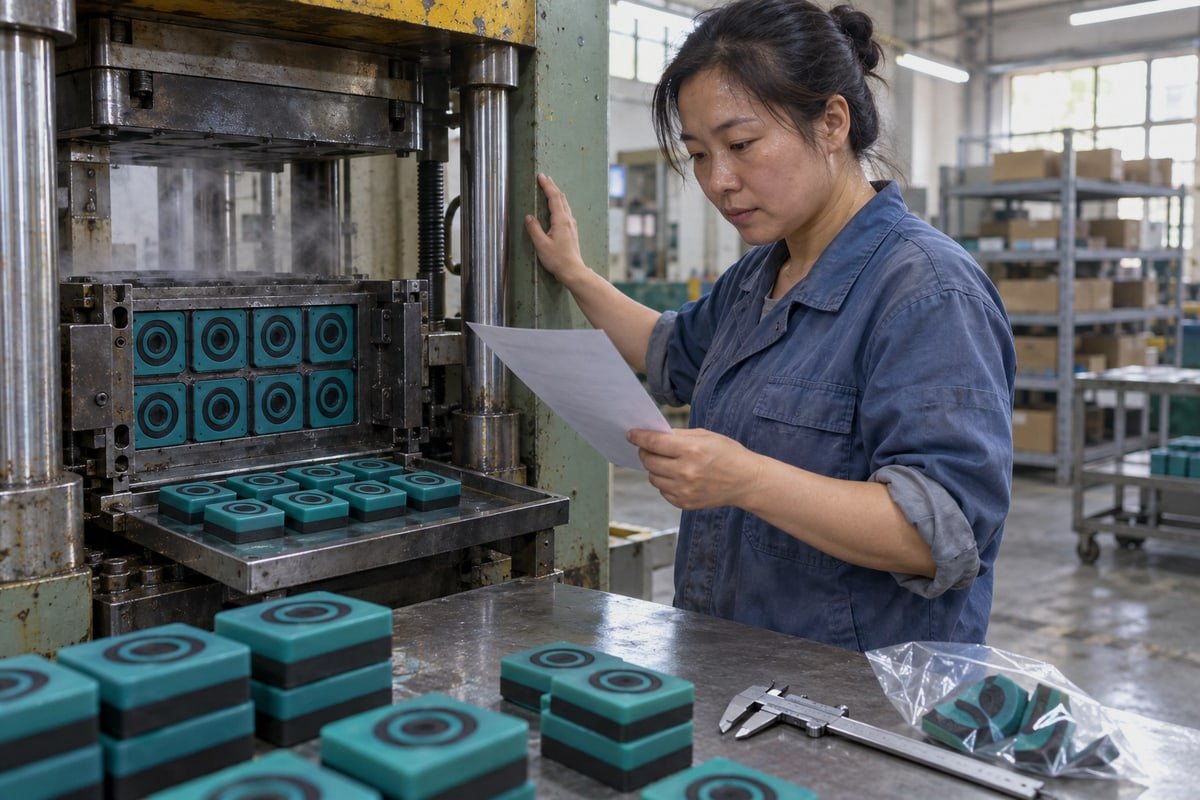
Neoprene is polychloroprene. It carries chlorine in every repeat unit of the chain. PVC-based sealing compounds are also built on chlorine. Fluoroelastomers carry fluorine. EPDM, which stands for ethylene propylene diene monomer 2, carries none of the four halogens in its backbone. That is why our TSR round assemblies and TSC square EPDM sealing modules begin with an EPDM base.
But the polymer is only half the story. Flame retardant additives 3 can bring halogens back into the mix. Brominated flame retardants were common for decades because they work well and cost little. A genuinely halogen-free flame retardant elastomer uses mineral fillers instead, such as aluminum hydroxide or magnesium hydroxide. These release water vapor when heated and dilute the flame without producing corrosive gas.
| Compound base | Halogen source | Main fire byproduct | Fit for enclosed spaces |
|---|---|---|---|
| EPDM خالٍ من الهالوجين | None in polymer or additives | Water vapor, CO, CO₂, limited smoke | نعم |
| النيوبرين (CR) | Chlorine in polymer | Hydrogen chloride, dense smoke | Not recommended |
| PVC-based compound | Chlorine in polymer | Hydrogen chloride, dense smoke | Not recommended |
| Fluoroelastomer (FKM) | Fluorine in polymer | Hydrogen fluoride | Not recommended |
What the declaration must state
A halogen-free claim should carry a number. The threshold used by leading suppliers in this field is halogen content at or below 0.1 weight percent. Ask for the material declaration that states this figure for the exact compound in your module. Ask for RoHS and REACH compliance statements too. These directives cover restricted substances, not fire behavior, but they prove the compound has been characterized in a lab rather than described in a brochure.
Which approvals matter for your environment
Different enclosed spaces answer to different rulebooks. Marine bulkheads follow the مدونة IMO FTP 4 under SOLAS. Rail vehicles follow EN 45545-2. Building penetrations in North America often reference the UL 1479 fire test. Our factory runs ISO 9001 5 and IATF 16949 quality systems and is BV-approved, and our modules carry A-0 and A-60 fire ratings. If your project sits in rail or a specific regional code, ask us for data against that standard before you sign. I would rather send a document than a promise.
Can I verify low-smoke fire performance with test documents before I specify DewinMCT modules?
A sourcing engineer at a European switchgear builder once told me he would not open our price sheet until he had read the fire test report. I sent it first.
Yes. DewinMCT provides fire test documents on request before you specify, including A-0 and A-60 fire rating reports, IP68 ingress test results, and gas-tight sealing data from 0.01 to 0.4 MPa. Request smoke density and toxicity test data for your specific module size and application to confirm low-smoke performance.

That engineer had the right instinct. Fire resistance, smoke density, and gas tightness are three separate properties. Each one has its own test. A single certificate rarely covers all three. So here is the order I recommend when you audit a firestop penetration system.
A five-step document audit
- Ask for the fire resistance report. For marine and offshore work this follows the IMO FTP Code. An A60 fire rating means the transit held back flame and limited temperature rise on the unexposed side for 60 minutes in a standard furnace test. A-0 means the same integrity with no insulation time requirement.
- Ask for smoke density testing results. This measures how much light the smoke blocks. It is the number that decides whether people can see the exit sign in a sealed control room.
- Ask for a smoke toxicity index or equivalent gas analysis. This tells you what the smoke contains, not just how thick it is. EPDM خالٍ من الهالوجين keeps hydrogen chloride out of that list.
- Ask for the gas-tight and watertight report. Our modules are tested at 0.01 to 0.4 MPa and hold IP68. A gas-tight cable transit stops cold smoke moving between compartments long before flame ever reaches the seal.
- Check that every report names the same module size, frame type, and compression setting you plan to install. A report for a different configuration is not your report.
| الوثيقة | ما يثبته | ما لا يثبته |
|---|---|---|
| A-0 / A-60 fire report | Integrity and insulation under fire for the rated time | Smoke volume or smoke toxicity |
| Smoke density test | Visibility loss during burning | Whether gases are corrosive or toxic |
| Toxicity index or gas analysis | Chemical content of smoke | Fire duration performance |
| اختبار IP68 والضغط (0.01–0.4 ميجا باسكال) | Water and gas tightness before fire | Any fire behavior |
| Material declaration (≤0.1 wt% halogen) | Compound chemistry | Installed system performance |
Low-smoke is not zero smoke
I want to be direct here, because I have seen brochures overstate this. Every organic material makes some smoke when it burns. Low-smoke means the compound was formulated and tested to keep that output down. It does not mean a clear room. If a supplier will not show the density value, treat the claim as unverified. We would rather lose a tender than win it on a number we cannot back.
How does halogen-free EPDM sealing compare to standard rubber compounds in my safety-critical projects?
Every time we cost a module, we weigh compound price against fire behavior. Halogen-free EPDM costs more per kilogram than commodity rubber, and we accept that.
Halogen-free EPDM sealing modules emit no hydrogen chloride, produce less dense smoke, and resist ozone, UV, and water better than neoprene or PVC-based compounds. Halogenated rubber costs less and may resist oil better, but in occupied or confined spaces its corrosive, toxic smoke makes EPDM the safer specification.

| الخاصية | EPDM خالٍ من الهالوجين | Neoprene / PVC-based compound |
|---|---|---|
| Halogen content | None, declared ≤0.1 wt% | Chlorine built into the polymer |
| Fire byproduct | Water vapor, CO, CO₂ | Hydrogen chloride, dense black smoke |
| Effect on electronics after fire | Minimal corrosion | HCl attacks copper and PCBs |
| Weather, ozone, UV resistance | ممتاز | Good to moderate |
| مقاومة الزيت والوقود | معتدل | جيد |
| Raw compound cost | Higher | Lower |
| Typical use in our customer base | BESS containers, data centers, switchgear rooms | Open-air, unoccupied, oil-exposed areas |
Where standard rubber still gets chosen
Some specifiers push back on the premium. Their argument is fair. In an unoccupied outdoor kiosk, smoke toxicity matters less than oil resistance and unit cost. I do not argue with that choice. But I do ask one question: what sits on the other side of the seal? In a battery energy storage container or a modular data center, the answer is millions of euros of electronics and often a technician. Hydrogen chloride from a burning neoprene block turns into hydrochloric acid on every cold copper surface it touches. The fire may be small. The asset loss is not.
Why the cable and the seal must match
Most enclosed projects already specify LSZH cable seals and LSZH jackets on the cables themselves. That effort is wasted if the multi cable transit rubber around those cables is a chlorine-based compound. The transit becomes the weakest link in the passive fire protection chain. The rubber module needs its own halogen-free declaration, separate from the cable datasheet.
Secondary benefits I did not expect
Our step-core EPDM design adapts to a range of cable diameters within one module size, so the installer peels layers rather than stocking dozens of sizes. The compound density that supports low-smoke performance also dampens sound, which control room builders have noticed. And some advanced elastomers in this class expand slightly under heat, filling gaps left by shrinking cable jackets. That behavior should appear in a test report, not just a claim, so ask for it.
Will switching to DewinMCT's halogen-free modules require any changes to my existing 120-frame cutouts?
We learned early that a perfect compound is useless if the module does not fit the frame. So we built dimensional compatibility into the tooling from day one.
No. DewinMCT halogen-free EPDM modules are dimensionally compatible with common 120-frame standards, so they drop into existing cutouts without modification. Use the model cross-reference table to map your current module to the DEWIN equivalent, then confirm fit with a free validation sample before changing your bill of materials.
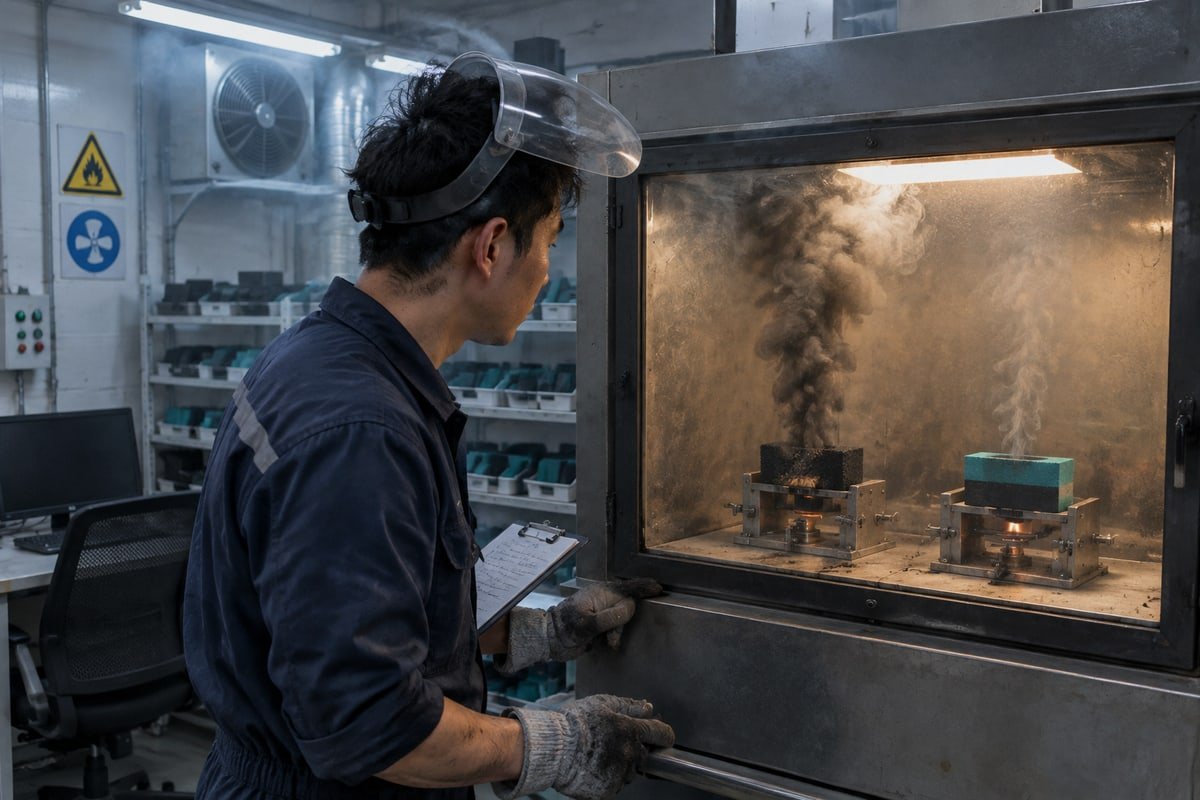
Dimensional compatibility is the whole point of second sourcing. If the frame, compression unit, and stay plates stay in place, the switch becomes a purchasing decision rather than an engineering project. Here is how the change breaks down.
What stays and what changes
| المكون | Existing installation | After switching to DewinMCT |
|---|---|---|
| Bulkhead or wall cutout | Cut to 120-frame standard | No change |
| إطار العبور | Existing welded or bolted frame | No change, or DEWIN frame if you prefer one supplier |
| وحدة الضغط | Existing | Reusable, or DEWIN compression unit |
| لوحات التثبيت | Existing | Reusable, or DEWIN stay plates |
| وحدات الإغلاق | Current brand | DEWIN TSC or TSR halogen-free EPDM modules |
| Cable count and routing | As designed | No change |
Our four-step qualification process
- Send us your current module list. We return a cross-reference table mapping each existing model to its DEWIN equivalent, with CAD and STEP files so your engineer can check dimensions in the assembly.
- Request free validation samples. Fit them into your existing frame with your existing compression unit. Torque the hex bolts to your normal setting.
- Run your incoming inspection. Compare the sample against our A-0/A-60, IP68, and 0.01–0.4 MPa test documents. Check the halogen-free material declaration.
- Place a pilot order for one project. Then compare landed cost. Buyers typically see 40 to 60 percent savings against the incumbent brand without losing certification.
When a change is actually needed
Two cases exist. First, if your frame is not a 120-standard cutout, we make custom module sizes with our in-house mold shop. Second, if you want to move the whole gas-tight cable transit to one supplier, we supply frames, compression units, and stay plates as a set. Either way, spare sealing modules ship fast, and export paperwork is handled on our side.
الخلاصة
Toxic smoke in a sealed room is the problem. Unverified rubber makes it worse. Specify halogen-free EPDM modules with test documents, and demand a validation sample before you commit.
الحواشي
1. ECHA guidance on material compliance and substance tracking, relevant to verifying halogen-free compound claims. ↩︎
2. Technical overview of EPDM rubber, explaining its chemical structure and inherent halogen-free properties. ↩︎
3. EPA resource on chemical substances, providing context on the use and regulation of flame retardant additives. ↩︎
4. Official IMO resource for fire protection standards, essential for marine bulkhead safety and transit testing. ↩︎
5. Official ISO landing page for the 9001 quality management standard used to audit manufacturing processes. ↩︎



 English
 Español de México
 Deutsch
 Français
 العربية
 Русский