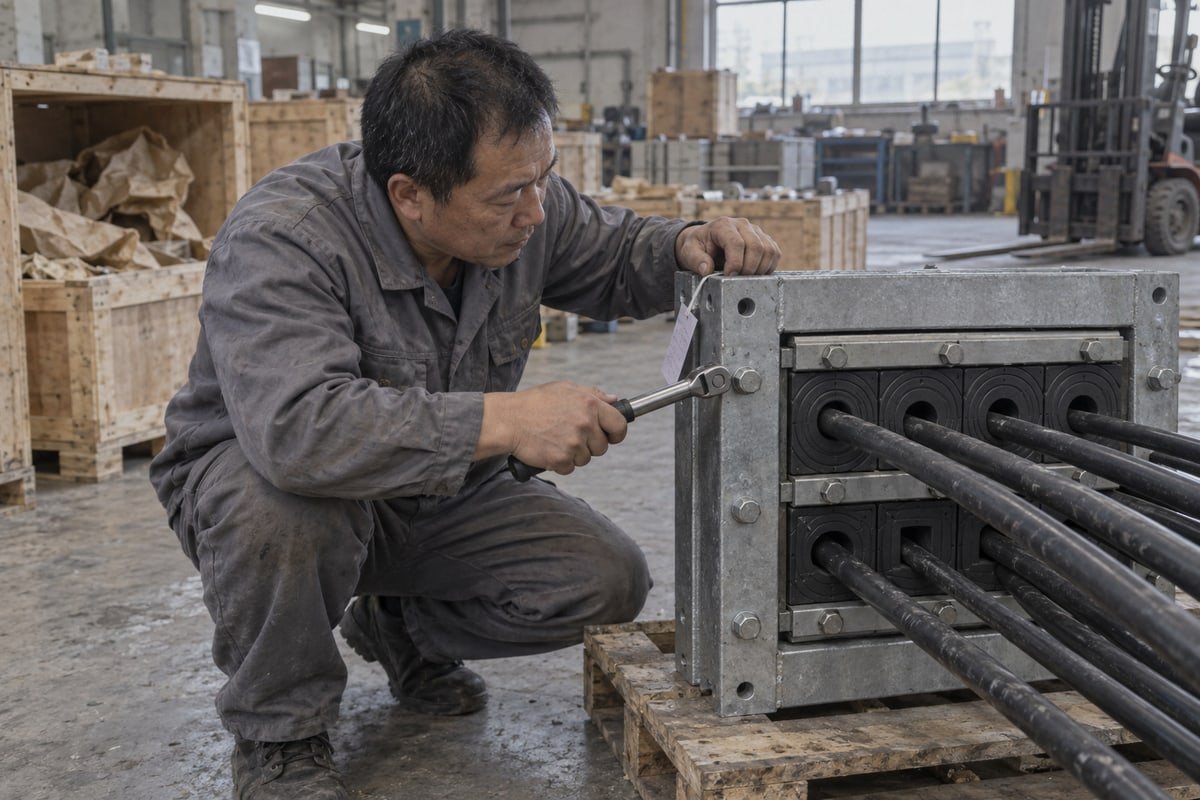
Every batch of multi cable transit sealing modules we ship from Shaanxi rides trucks, cranes and container ships IATF 16949 1. Vibration on that route can quietly relax bolt tension before commissioning.
Multi cable transit sealing modules should not be blindly re-tightened after transport vibration. Instead, inspect them before commissioning: verify compression unit torque against the published specification, check the packing gap, and look for leakage signs. Re-tighten only if torque or compression has dropped, and never exceed the rated torque.
Here is the logic. These modules seal by compression. Compression comes from bolt tension. Vibration can reduce bolt tension. So the real question is not whether to tighten. It is how to check, and what to do with the result. Below I walk through detection, torque specifications, non-invasive verification, and what all of this means for your certification.
How do I know if transport vibration has loosened my MCT sealing modules before commissioning?
Last year a QC engineer on our Shandong line unpacked a returned frame and found the compression wedge nuts a quarter turn loose. Nothing had leaked yet.
You can detect loosening by four field checks: apply a calibrated torque wrench to each compression unit nut and compare with the published value, measure the packing gap with a feeler gauge, confirm the rubber modules still bulge with lubricant traces visible, and look for shifted stayplates or cables.
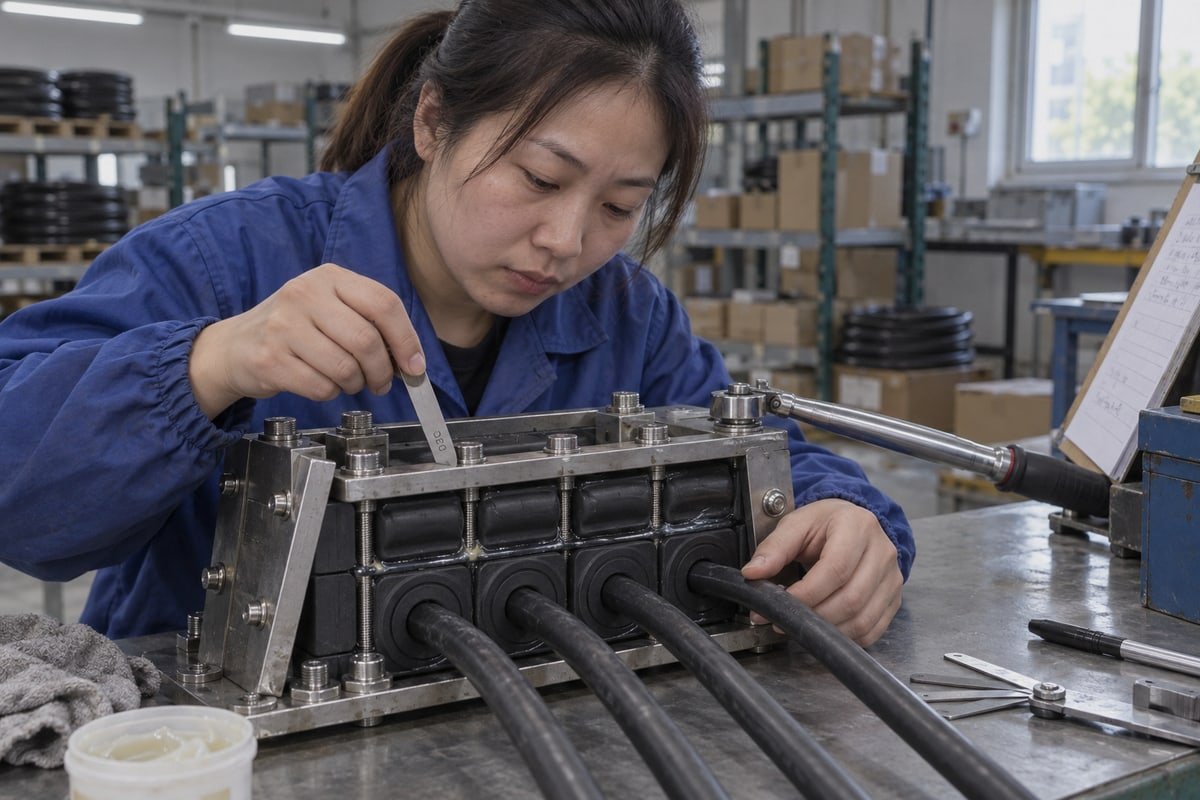
That returned frame taught us something simple. A transit can look perfect and still be under-compressed. The eye cannot see a 10% drop in preload. A wrench and a feeler gauge can.
Why a compression seal is sensitive to transport
Our TSR round seals and TSC square modules are step-core, halogen-free EPDM blocks. They sit inside a cable transit frame, separated by stayplates, and a compression wedge pushes down on the stack. The rubber presses against the cable, the frame wall and the neighbouring modules. That squeeze is the seal. Anything that reduces the squeeze opens a leak path.
Four mechanisms can reduce it during shipping:
- Fastener back-off. Sustained vibration lets nuts rotate a few degrees at a time. Bolt tension falls, and the wedge relaxes.
- Cold flow. EPDM is viscoelastic. It relaxes slowly after compression. Vibration accelerates this relaxation. Most manufacturers advise a 24-to-48-hour settling period after installation. If the assembly ships inside that window, it is far more likely to need re-torquing.
- Differential thermal expansion. A galvanized steel frame and rubber modules expand at different rates. A container that leaves China in winter and lands in the Middle East in summer has cycled through this many times.
- Micro-pumping. At certain resonance frequencies, a seal that has lost tension can breathe. Air and moisture get drawn in with each cycle.
Field indicators you can check in minutes
| Indicator | What you see | What it means | Action |
|---|---|---|---|
| Torque reading | Wrench clicks below the published value | Bolt tension has relaxed | Re-tighten crosswise to spec |
| Packing gap | Gap outside the target range, for example beyond 1.0 mm on systems that specify 0.1–1.0 mm | Compression is incomplete | Re-tighten, then re-measure |
| Rubber surface | Flat faces, no slight bulge | Modules are not loaded | Investigate before energizing |
| Lubricant traces | Squeezed-out lubricant visible at module edges | Modules were compressed and could shift evenly | Good sign, log it |
| Stayplates and cables | Plates tilted, cables move by hand | Packing space has opened up | Re-torque and re-check retention |
Vibration resistance is not a preload guarantee
Some buyers push back here. They tell me the product literature promises vibration-proof cable retention, so a check is redundant. I understand the objection, but retention and preload are two different things. Vibration resistance describes how the seal holds cables in service once it is correctly compressed. It does not promise that the nuts stayed where the installer left them after three weeks in a shipping container. The check confirms the starting condition that the vibration claim depends on.
What re-tightening torque specs should I follow for TSR and TSC series after shipping?
There is a trade-off we weigh on every compression unit design: enough bolt tension to hold a pressure tight seal, but not so much that EPDM modules deform permanently.
Follow the torque value printed on the installation sheet supplied with your specific TSR or TSC compression unit; do not use a generic figure. Industry values for comparable 120-frame systems range from about 4 Nm to 12 Nm by product family. Tighten crosswise and never exceed the published maximum.
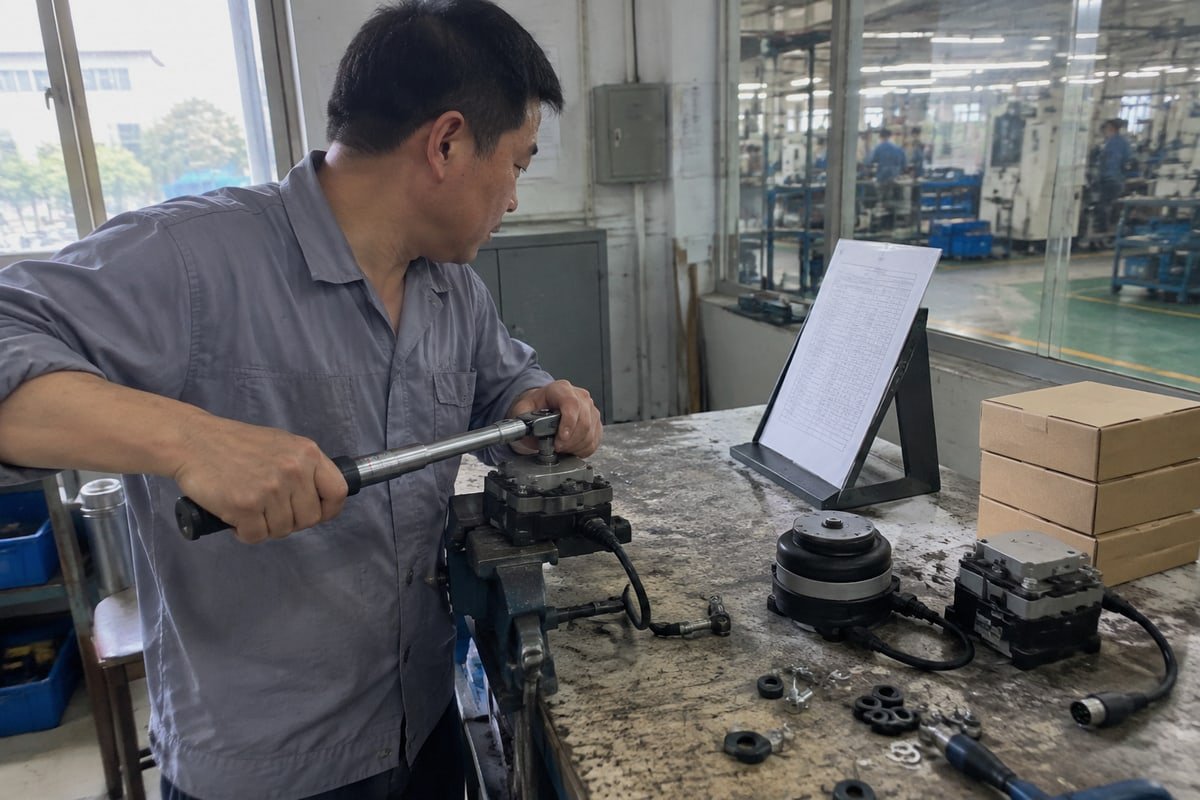
I get asked for one universal number all the time. There is no such number, and I would be doing you a disservice if I gave you one. Torque specifications depend on wedge geometry, thread size, frame depth and module hardness. That is why our installation sheet states the value per compression unit, and why we supply the same figures with the test documents on request.
Why torque varies between product families
Published instructions from the leading European brand quote values such as 4 Nm, 7 Nm, 8–12 Nm and 10 Nm depending on frame and module type. Those numbers are useful as a sanity check. If your sheet says 8 Nm and your wrench is set to 25 Nm, something is wrong. But they are not a substitute for the value tied to the exact unit in your frame. Because our modules are dimensionally compatible with common 120-frame standards, buyers using us as a second source should still confirm the torque for our compression unit rather than carrying over the value from the incumbent brand. The cross-reference table we provide maps model numbers, and the installation sheet maps torque.
The crosswise re-tightening sequence
When a post-transport torque check falls short of spec, follow this order:
- Set the calibrated wrench 2 to the published value. Do not add a safety margin.
- Loosen nothing. Simply apply torque to the first nut until the wrench clicks.
- Move to the diagonally opposite nut, then to the remaining nuts, crosswise.
- Repeat the full pattern a second time. Rubber redistributes load between passes.
- Measure the packing gap. It should fall inside the published range.
- Record every reading on the commissioning sheet.
Crosswise tightening matters because uneven compression leaves one side of the packing space tight and the other side slack. A seal with a slack corner is not a seal.
Under-torque, correct torque, over-torque
| Condition | What happens to the EPDM | What happens to the frame | Sealing result |
|---|---|---|---|
| Under-torque | Modules sit loose, faces flat, cables can move | No stress | Leak path, poor strain relief |
| Correct torque | Slight bulge, lubricant traces at edges, step-cores locked on cable | Elastic load only | IP68 and gas-tight performance as tested |
| Over-torque | Permanent set, cracked step-core layers, extrusion between stayplates | Bowed sides, distorted weld seams | Seal fails early, modules must be replaced |
Resolving two common objections
The first objection is that a factory-installed, tested, well-packed transit needs no re-tightening at all. I agree with the conclusion, but only after the check. If the wrench confirms the torque and the gap is in range, you leave it alone and document it. The second objection comes from operators who prefer never to touch a sealed assembly in the field, to avoid over-compression or warranty disputes. That concern is exactly why the published torque exists. Re-tightening to the published value is not field improvisation. It is restoring the installed condition. Newer compression wedges with bolt-depth markers or integrated torque indicators make this even lower risk, because the installer can see when the unit has reached its rated position without guessing.
Proper lubrication at first assembly also pays off here. Lubricated modules can shift slightly and share load when the wedge is re-torqued. Dry modules bind and create gaps.
Can I verify seal integrity without fully disassembling the cable transit frame?
A sourcing engineer at a BESS container 3 builder in Germany once asked us whether his site team had to pull every module to prove sealing integrity. They did not.
Yes. Non-invasive checks cover most cases: torque verification on the compression wedge bolts, a feeler-gauge gap check, visual inspection for bulging rubber and lubricant traces, and ultrasonic leak detection across the frame face. Full disassembly is only needed when these checks fail or when modules show damage.

Disassembly is the last resort, not the first step. Pulling a packed frame means cutting cable ties, re-lubricating, re-packing and re-torquing. It also restarts the 24-to-48-hour settling clock. A tiered inspection avoids all of that in most cases.
A tiered verification workflow
I recommend working from the least invasive method to the most invasive, and stopping as soon as the evidence is sufficient.
- Visual survey. Look at the frame face from both sides if you can. Check for bulging rubber, lubricant traces, tilted stayplates, and cables sitting off-centre in their step-core bores.
- Torque verification. Apply the calibrated wrench to each nut on the compression wedge. If it clicks without turning, bolt tension is intact.
- Gap check. Measure the residual gap with a feeler gauge and compare it to the range on the installation sheet.
- Leak detection. For pressure tight applications, use ultrasonic leak detection across the seal face. It finds micro-voids that the naked eye cannot see, and it does not disturb the assembly.
- Pressure or water test. Where the specification demands it, test the transit in place at the required pressure. Our TSR and TSC assemblies are rated for watertight and gas-tight sealing between 0.01 and 0.4 MPa, so the test target should sit inside that band.
- Partial disassembly. Only if a step above fails. Remove the wedge and the top row, inspect, and re-pack that section.
Comparing inspection methods
| Method | Invasiveness | Detects | Time per frame | Limitation |
|---|---|---|---|---|
| Visual survey | None | Gross loosening, shifted parts | Minutes | Misses small preload loss |
| Torque wrench check | None | Bolt tension loss | Minutes | Does not prove seal, only compression |
| Feeler-gauge gap check | None | Incomplete compression | Minutes | Needs published gap range |
| Ultrasonic leak detection | None | Micro-voids, gas paths | Under an hour | Needs trained operator and reference |
| In-situ pressure test | Low | Actual leak rate | Hours | Needs test rig and access to both sides |
| Partial disassembly | High | Module damage, cold-flow set | Hours | Restarts settling period |
Where verification is heading
The industry is moving toward what some suppliers call smart compression: sensors embedded in the wedge that report compression pressure and alert the operator if transport-induced loosening occurs. Our engineers follow this closely, because it fits the modular data center and BESS container market, where the frame is packed at the integrator and shipped thousands of kilometres. Until that technology is common, the six-step workflow above is what we recommend to our customers. It gives you documented evidence without touching the seal.
Will skipping a post-transport check void my IP68 and gas-tight certification?
One lesson from years of exporting to the Middle East: a test certificate proves what the assembly did on our bench, not what it does after six weeks at sea.
Skipping the check does not cancel the certificate, because IP68 and gas-tight ratings are type approvals for the tested design. It does, however, remove your evidence that the installed seal still matches the certified condition, which project specifications, class surveyors and warranty terms require you to demonstrate at commissioning.
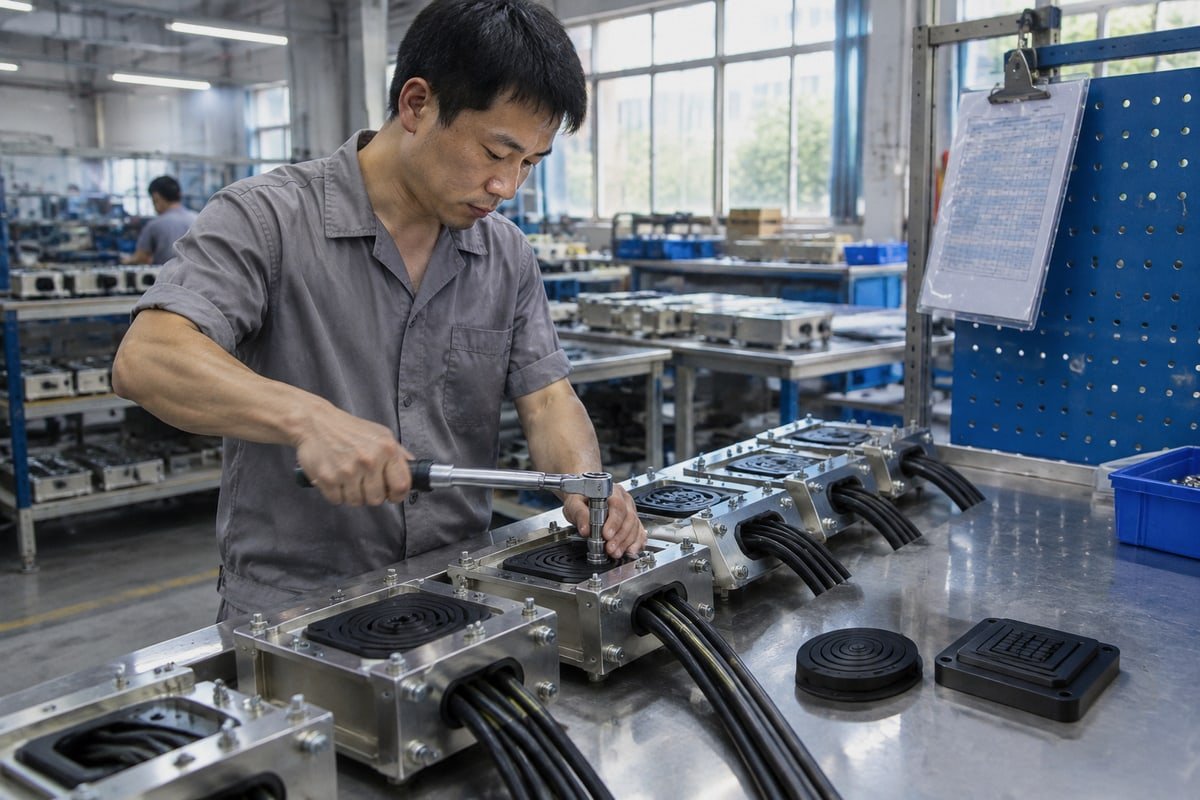
I want to be precise about this, because purchasing engineers read the fine print. A certificate has two halves. The first half is the type test. The second half is the installation condition it assumes.
What the certificate actually covers
Our modules are produced under ISO 9001 4 and IATF 16949 systems in a BV-approved factory. The fire rating of A-0 and A-60, the IP68 ingress protection 5 and the watertight and gas-tight sealing between 0.01 and 0.4 MPa were all achieved on frames packed to the published torque and gap. The certificate is valid for that design. It stays valid whether or not you inspect after transport. What changes is your ability to show that the frame in your E-house or skid is still in the tested state.
For modular equipment such as E-houses, offshore skids and BESS containers, a re-tightening or torque verification step at the final destination is a standard commissioning requirement. It is the step that restores, and documents, the certified IP rating. A class surveyor or an EPC inspector who asks for the commissioning record is asking for proof of that step. Without it, you have a certificate and a question mark.
Where the risk is highest
| Application | Transport profile | Vibration risk | Recommended post-transport action |
|---|---|---|---|
| Rolling stock and rail cabinets | Long road plus rail, constant low-frequency vibration | High | Full torque and gap verification, record every frame |
| Marine and offshore skids | Road, crane lift, sea passage, thermal swing | High | Torque check plus in-situ pressure test where gas-tight is specified |
| BESS containers | Road and sea, often shipped within days of packing | High | Verify torque after settling, ultrasonic scan on gas-tight frames |
| Modular data centers | Road and sea, controlled climate on arrival | Medium | Torque and gap check, visual survey of stayplates |
| Switchgear and control panels | Road only, crated | Medium | Torque spot-check per panel type, escalate if any fail |
| Export-packed loose modules | Crated, not compressed | Low | Standard installation, no re-torque needed |
The commissioning checklist
Some buyers argue that every shipped assembly must be re-torqued regardless of findings. I would rather they follow a checklist, because a checklist gives you a record and avoids over-compression when the seal is already correct. Here is the post-installation inspection routine we suggest:
- Visual inspection of both frame faces: bulge, lubricant, stayplates, cable position.
- Torque verification on every compression unit nut, calibrated wrench, published value only.
- Gap check against the installation sheet range.
- Re-tighten crosswise only where a reading fails, then re-measure.
- Leak or pressure test where the specification requires a pressure tight seal.
- Sign-off sheet with frame ID, torque values, gap readings and test result.
That sheet is the document that keeps your certificate meaningful. It also makes supplier qualification easier when you bring in a second source, because you compare the same readings across two brands in the same 120-frame cutout.
Conclusion
Transport vibration can relax bolt tension in multi cable transit sealing modules, so the seal you certified may not be the seal you commission. Blind re-tightening risks over-compression.
The answer is inspect first: verify torque, check the gap, look for leaks, then re-tighten to the published value only where needed, and document everything.
Footnotes
1. The international standard for automotive quality management systems, ensuring high-quality manufacturing processes. ↩︎
2. Wikipedia overview of torque wrenches, essential for achieving the correct compression in sealing modules. ↩︎
3. Wikipedia entry explaining Battery Energy Storage Systems, a key application for cable transit frames. ↩︎
4. Official ISO page for the quality management standard governing the production of these sealing modules. ↩︎
5. The International Electrotechnical Commission’s standard for ingress protection, defining the IP68 rating. ↩︎



 English
  Español de México
  Deutsch
  Français
  العربية
  Русский