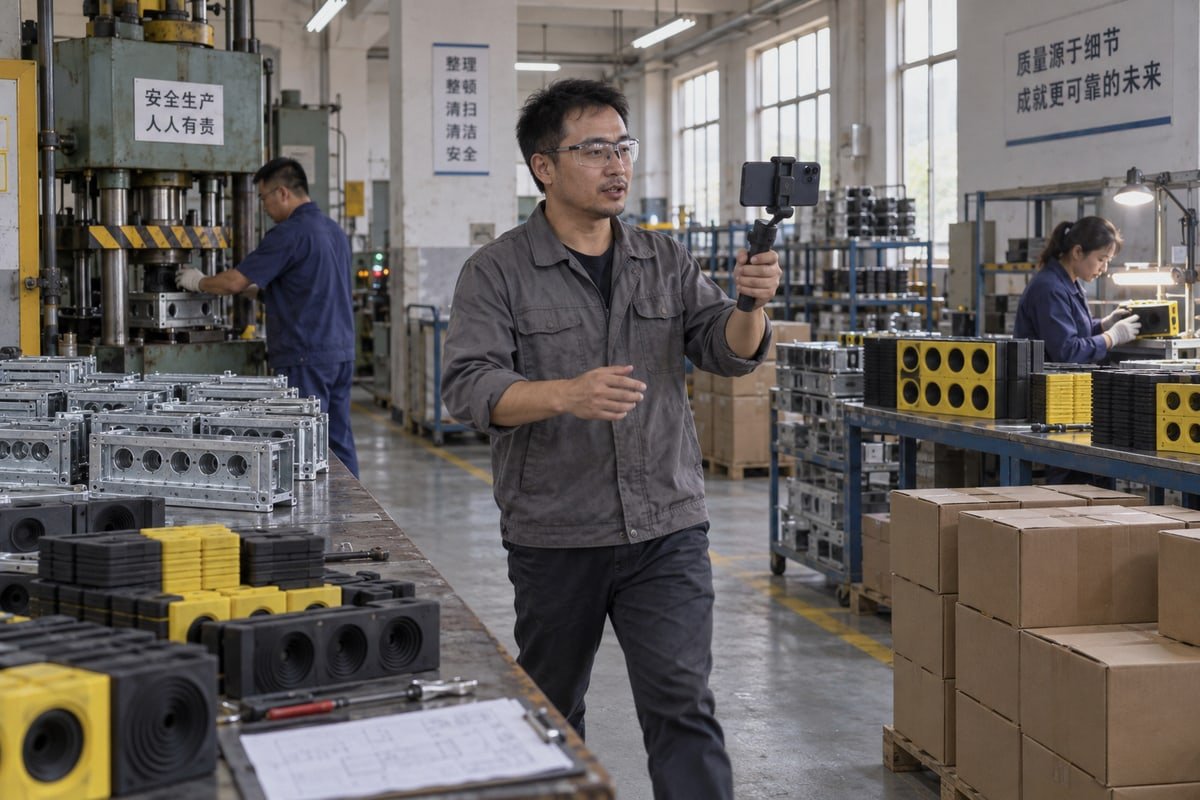
A remote factory audit for multi cable transit products can fail before it starts BV-approved factory 1. From our production floor, we’ve seen buyers accept polished videos and later discover [a trading office](https://dewinmct.com/?p=576).
A remote factory audit for multi cable transit products combines pre-call document verification, a live unedited video walkthrough of production and QC, review of fire, IP68 and gas-tight test reports, and validation samples with CAD/STEP files to confirm drop-in fit before ordering.
Below, I walk through the four stages we see careful buyers use. Each stage builds on the last. Start with paper, move to live video, then test evidence, then physical samples.
What documents and certifications should I request before scheduling a remote factory audit?
One lesson took us years to absorb: a scanned certificate proves nothing until someone checks it. Now we send buyers our license and BV approval with the verification path attached.
Request the business license with unified social credit code, ISO 9001 and IATF 16949 certificates, third-party factory approval such as BV, fire-rating and IP68 test reports, material mill certificates, a quality manual, and recent batch production logs, then verify each against the issuing body.

Paper comes first because it is cheap to check and expensive to fake well. A remote factory audit for multi cable transit products should begin with a technical documentation review at least a week before any video call. That gap gives you time to cross-check records. It also lets you write questions the supplier cannot dodge on camera.
Start with proof of a real factory
The supplier verification process begins with the business license. Every Chinese company carries a unified social credit code. You can check it on the national enterprise credit registry. Confirm the registered address, the registered capital 2, and the business scope. The scope should include manufacturing, not only trading. Then look at the registered address on a satellite map. An industrial site looks different from an office tower or an apartment block. Our own registration shows RMB 50M capital, a Shaanxi headquarters, and production sites in Shandong and Hunan. We expect buyers to check this. So we send the registry link together with the scan.
The certification set that matters for cable sealing systems
| Document | What it proves | How to verify it |
|---|---|---|
| Business license with unified social credit code | Legal identity, scope, registered capital | National enterprise credit registry |
| ISO 9001 certification | A working Quality Management System (QMS) | Certificate number on the certification body's database |
| IATF 16949 certificate | Automotive-grade process control | IATF global database |
| Third-party factory approval (e.g. BV) | Independent audit of the production site | Ask for the approval scope; confirm with the society |
| Fire rating report A-0 / A-60 | Passive fire protection performance | Issuing lab, tested assembly, report date |
| IP68 and gas-tight reports | Ingress and pressure sealing | Lab name, test parameters, module size covered |
| Material mill certificates | Steel and EPDM grade traceability | Match heat or batch numbers to production logs |
| Granted patents | Genuine in-house engineering | Patent office search by applicant name |
If the supplier claims marine and offshore standards such as UL, FM, ABS or DNV, cross-reference the certificate number in the official registry database. Do not accept a logo on a brochure. We hold BV approval and we state plainly which tests we run in-house and which we outsource. A factory that cannot answer that question clearly has something to hide, or simply does not know.
The objection I hear most: "documents alone are enough"
Some buyers stop at paper. I understand the logic. It saves a call and a week of scheduling. But a scan can be edited. A real certificate can cover a different product line. An expired scope can still look current. So treat documents as the first filter in your supply chain risk management 3, not the last one. Use a secure cloud folder for the review. Both sides then see the same version of every file, and you keep a dated trail.
How do I verify dimensional compatibility and drop-in fit during a live video inspection?
A sourcing engineer in Europe once asked us to hold a caliper against a TSC module on camera for twenty minutes. That call taught us what live inspection really needs.
During a live video inspection, ask staff to measure frame cutout dimensions, module width, height and step-core diameters with a calibrated caliper on camera, then test-fit a module into a standard 120-frame with the compression unit installed, recording every reading against your cross-reference table.
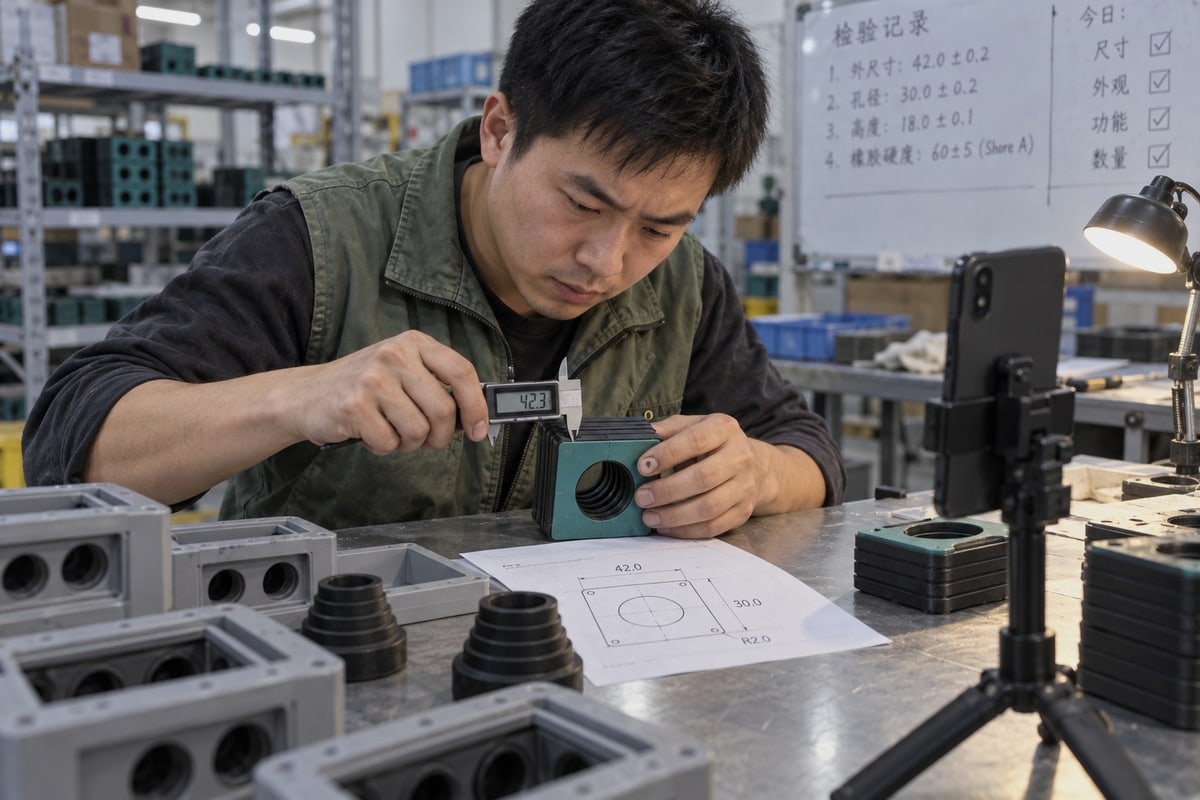
A virtual site inspection is only as good as the camera discipline behind it. Drop-in fit is the reason most integrators contact us. Our TSC square modules and TSR round assemblies are dimensionally compatible with common 120-frame standards. That is a claim. Your job during the call is to turn it into a measurement.
Set up the call correctly
- Use a high-definition platform such as Zoom, Microsoft Teams, or WeChat video. Ask for a wired connection if the workshop Wi-Fi is weak.
- Insist on two factory staff. One holds the camera. The other answers questions and fetches records.
- Record the call with the supplier's consent. The recording is your audit trail if a dispute arises later.
- Ask for time-stamped, geo-tagged photos of key measurements sent right after the call.
- If the factory has AR smart glasses, use them. A hands-free first-person view shows insert block tolerances and sealing surfaces far better than a shaky phone.
A seven-step live measurement routine
- Show the caliper's calibration label and the date of the last calibration.
- Measure the frame's internal cutout width and height. Compare it with your existing frame drawing on screen.
- Pull a random module from the finished goods rack, not from the showroom shelf. Measure width, height, and depth.
- Measure the step-core layers. The minimum and maximum cable diameter for that module size must match the cross-reference table.
- Insert the module into a 120-frame on camera. It should slide in without force and sit without visible gaps.
- Fit the stay plates and the compression unit. Tighten to the stated torque. Watch the halogen-free EPDM compress evenly on all four sides.
- Read the nameplate or work order on a current job in progress. This confirms the parts belong to live production, not a curated display.
What live video can and cannot prove
Some sourcing advisers estimate that a virtual audit covers roughly 60–70% of what an on-site visit delivers. Live measurement closes part of that gap. You see the number appear on the caliper. You see the module seat in the frame. What you do not see is machine condition under load or floor discipline across a full shift. So write two lists at the end of the call. One list holds verified facts. The other holds open items for a third-party inspection agency or an on-site visit.
Red flags during the walkthrough
A supplier who shows one corner of one room is not showing a factory. Other warning signs include no order in progress, a headcount that does not match the claimed capacity, and a "live" tour that never pans to the requested area. A pre-recorded clip presented as live is the clearest signal to end the qualification.
What should I look for when reviewing test reports for fire rating, IP68, and gas-tight sealing performance?
Every test report forces a trade-off between what a lab measured and what your project needs. We weigh this daily when we compile A-60 and IP68 documents for BESS integrators.
Check that fire reports state the A-0 or A-60 class, tested assembly and issuing lab; that IP68 reports specify depth, duration and module size; and that gas-tight reports show held pressure within 0.01–0.4 MPa with dated results traceable to the exact module you will buy.
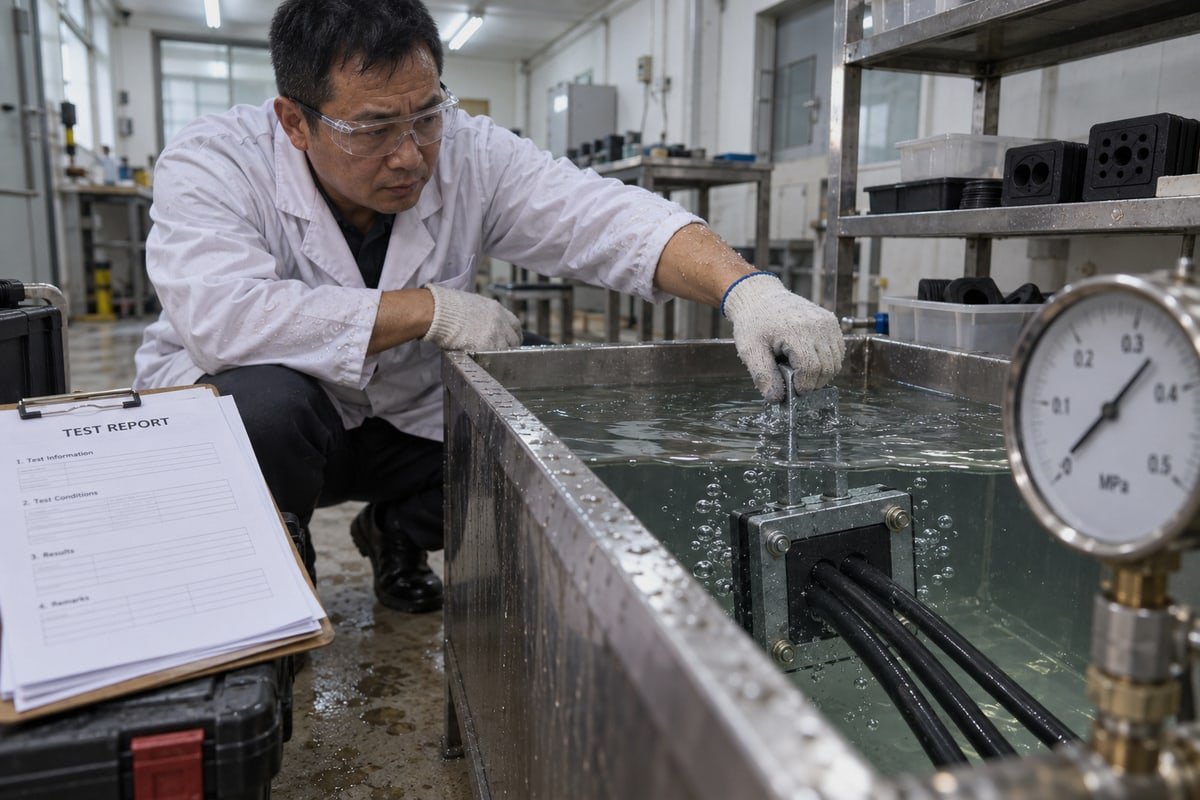
Cable transit modules are safety hardware. In a BESS container, a switchgear room, or a ship's bulkhead, the module forms part of the passive fire protection and the ingress barrier. Firestop modular seals sit between compartments. A weak report is therefore not a paperwork problem. It is a project risk that lands on the purchasing engineer's desk.
Read each report for scope, method, and traceability
| Test | What the report must state | Red flag |
|---|---|---|
| Fire rating A-0 / A-60 | Class achieved, the full tested assembly (frame, modules, stay plates, compression unit), substrate, test standard, lab name | Report covers modules alone, or a frame size you are not buying |
| IP68 ingress protection | Immersion depth, duration, module type, cable diameters used, pass criteria | "IP68" printed on a datasheet with no lab report behind it |
| Watertight / gas-tight sealing | Pressure held within 0.01–0.4 MPa, test medium, hold time, leakage criterion | Pressure figure quoted without hold time or module size |
Match the report to your bill of materials
A report proves the tested configuration. It does not cover every item in the catalogue by default. So ask which module sizes and which frame series the report includes. Then compare that list with your order. When we issue A-60 documents, we mark the frame series and module range that were tested. We also say plainly when a custom size is covered by similarity rather than by a direct test. A buyer who reads spec sheets will spot that distinction, and we would rather state it first.
Ask for a live, unedited demonstration
Reports show past performance. A live pressure test shows present capability. Ask the factory to run a water or air pressure check on a sealed frame during the call. If the factory has automated test equipment, ask to see the gauge or the data screen in real time, not a value typed into a form. Some buyers now request a data export straight from the equipment. This bypasses manual entry and removes the chance of quiet manipulation.
Marine and offshore standards versus industrial use
If your project needs classification society approval, the approval must appear on a certificate you can verify, not in a sales email. For offshore work, check ABS or DNV approvals 4 against their registries. For most BESS, modular data center, and switchgear projects, the working baseline is an ISO 9001 QMS 5, a BV-approved factory, and lab-backed A-60, IP68 and gas-tight reports. Decide which baseline your project needs before you judge the supplier against it.
How can I use free validation samples and CAD/STEP files to confirm quality before placing an order?
Last quarter our mold shop cut a custom TSR sample for a data-center builder in three weeks. The buyer's bench test on that sample closed the qualification, not our brochure.
Load the supplier's STEP file into your frame assembly to check interference, then fit the free validation sample into an existing 120-frame cutout, compress it with your torque procedure, and run a leak or pressure check; matching CAD, physical fit and test data confirms quality before ordering.
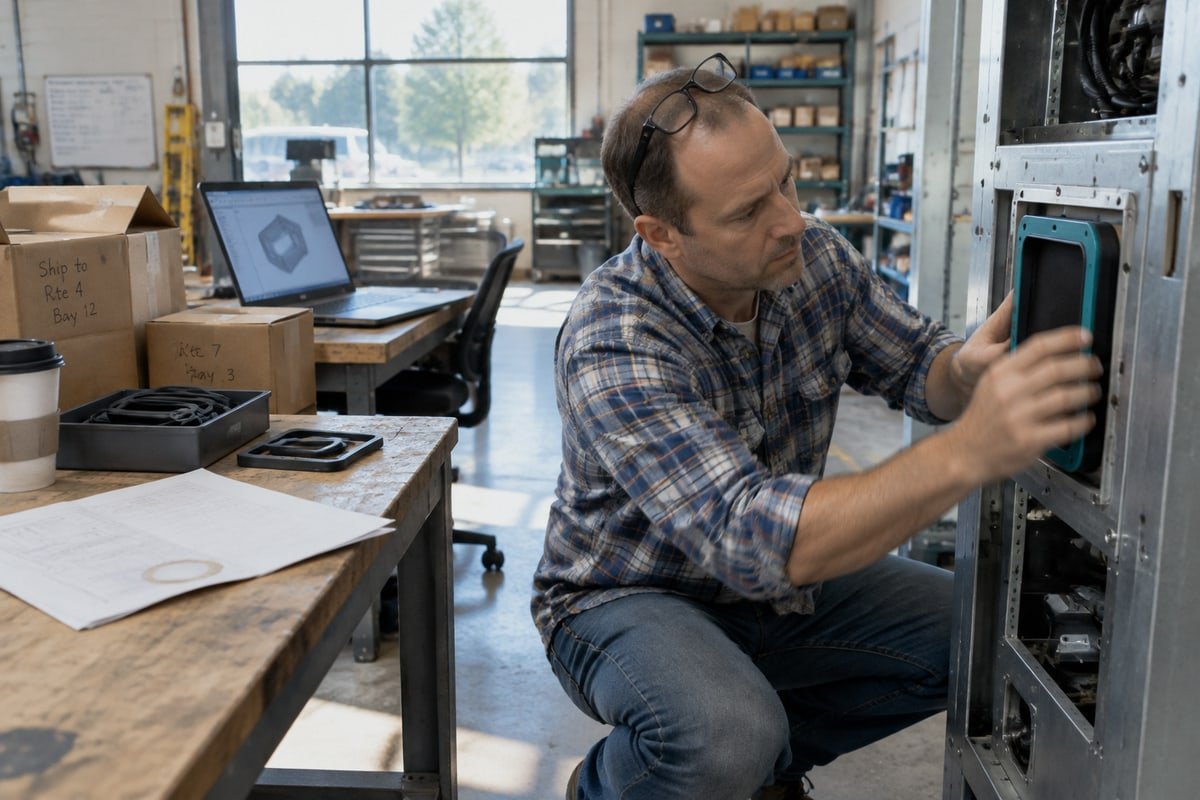
Samples and CAD files answer the question a video call cannot. Which audit depth is enough for your order? The table below is how I frame that choice with buyers.
| Approach | Cost and time | What it verifies | Best suited for |
|---|---|---|---|
| Remote audit only | Lowest cost, one to two weeks | Legitimacy, QMS, documents, live measurement; roughly 60–70% of on-site scope | Screening several factories, spare module orders |
| Hybrid: remote lead auditor plus local third-party inspector | Moderate | Adds physical spot checks, witnessed Factory Acceptance Test (FAT), independent photos | First orders, custom sizes, private-label runs |
| Full on-site audit | Highest cost and travel time | Floor discipline, machine condition under load, labor practices | Large safety-critical orders, long-term framework agreements |
The cautionary view is that remote audits never replace an on-site visit. For hidden operational detail, that view is fair. But for multi cable transit products, a free sample in your own lab gives physical evidence that even an on-site visit does not deliver. You hold the part. You measure it. You test it. The balanced position is to treat the remote factory audit for multi cable transit products as a decision filter, then let samples and a hybrid FAT carry the final weight.
Digital fit check with STEP files
Import the STEP file into your existing frame assembly. Check the module footprint against your cutout, the stay plate spacing, and the compression travel. Count modules per frame and compare with your current layout. Ask for both a neutral STEP file 6 and a native format if your team needs it. A supplier who cannot supply STEP files within a few days is likely not doing its own engineering.
Physical validation with free samples
- Measure the sample against the STEP file. Flag any deviation before you touch a frame.
- Test-fit the module into an existing 120-frame cutout beside the incumbent brand's module.
- Compress with your standard torque procedure and inspect the seal faces for even contact.
- Run a water or air leak check at your project pressure.
- Check the rubber marking for the halogen-free EPDM grade and confirm it matches the mill certificate.
- Scan the label. A QR code should trace the module to its raw material batch and production log.
- Inspect the packaging. Seals and components must arrive clean, dry, and undeformed.
Turning results into a purchase decision
When the sample passes, the commercial case becomes simple. Our cross-reference tables map each existing model to a DEWIN model. That mapping, plus a verified drop-in fit, supports second sourcing at 40–60% lower cost without giving up certification. In-house mold making covers custom sizes. Private-label production and export documentation are handled on our side. For the first shipment, ask for a witnessed FAT, either live on video or through a local inspector. Then place the order with evidence, not impressions, behind it.
Fazit
Unverified cable transit suppliers put fire and ingress safety at risk. A structured, evidence-based remote audit—documents, live measurement, test reports, samples—lets you qualify a second source with confidence.
Fußnoten
1. Bureau Veritas is a global leader in testing, inspection, and certification for manufacturing facilities. ↩︎
2. Wikipedia entry for registered capital, a key metric verified during the business license check. ↩︎
3. CISA provides guidance on identifying and mitigating risks within global supply chains. ↩︎
4. DNV is a leading classification society providing certification for marine and offshore equipment. ↩︎
5. Official ISO page for the 9001 standard, the global benchmark for quality management systems. ↩︎
6. ISO standard for STEP files, ensuring interoperability in CAD data exchange. ↩︎


 English
  Español de México
  Deutsch
  Français
  العربية
  Русский