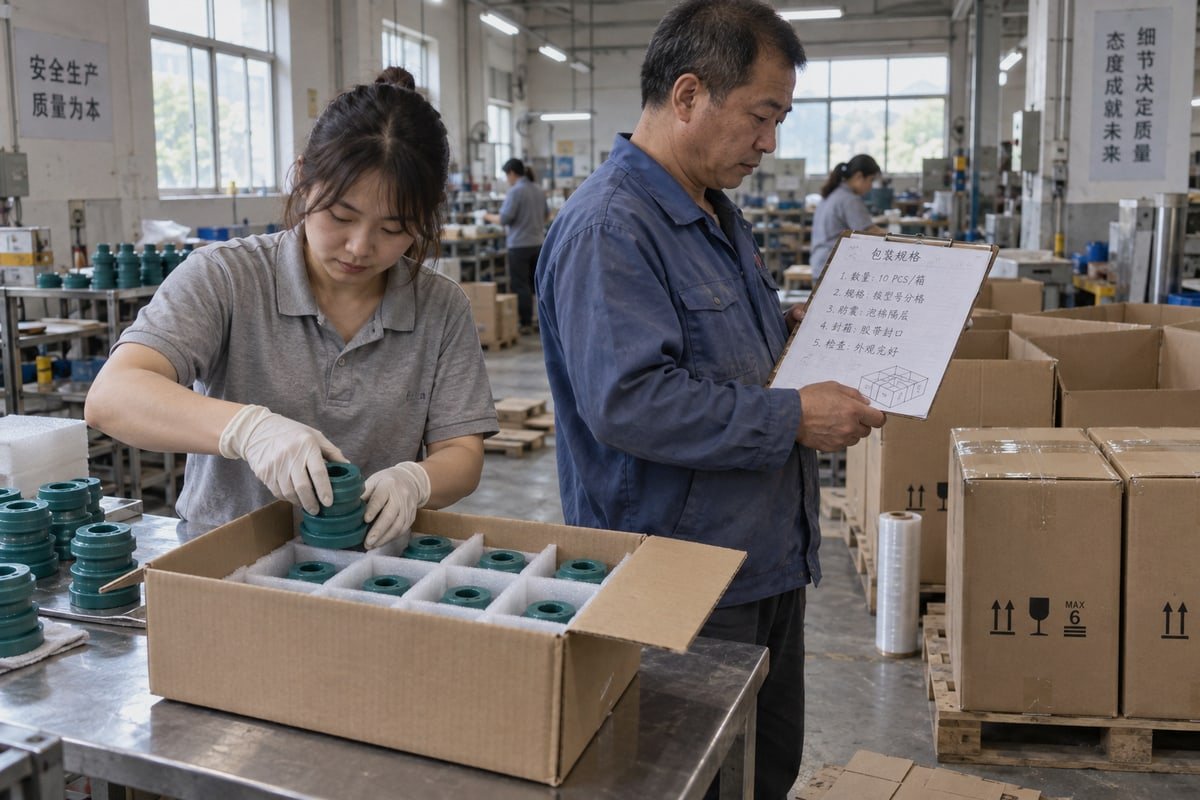
Correct cable sealing modules still fail at receiving docks when cartons crush. Our packing line taught us that carton and inner packaging methods for multi cable transit orders decide acceptance.
Confirm carton and inner packaging methods for multi cable transit orders by requesting a written packing specification before production: unit protection per module, inner-box counts, carton size and wall grade, net and gross weight, shipping marks, palletization, then approving pre-shipment photos and matching the packing list to the packout.
This is a verification problem, not a packaging tutorial. Below, I walk through the four questions our European buyers ask most often, and I show what we put on paper to answer each one.
What Details Should I Confirm About Carton Dimensions Before Placing My MCT Order?
A purchasing engineer in Europe sent us a PO with only a part count and no carton data. We asked about his rack depth first, because carton size drives everything.
Before placing an MCT order, confirm internal and external carton dimensions, wall grade (single or double-wall corrugated), modules per inner box, cartons per pallet, net and gross weight per carton, closure method, and stacking limit. Request these on a packing specification sheet with a drawing, not in an email.
Start with the packaging hierarchy, not the box
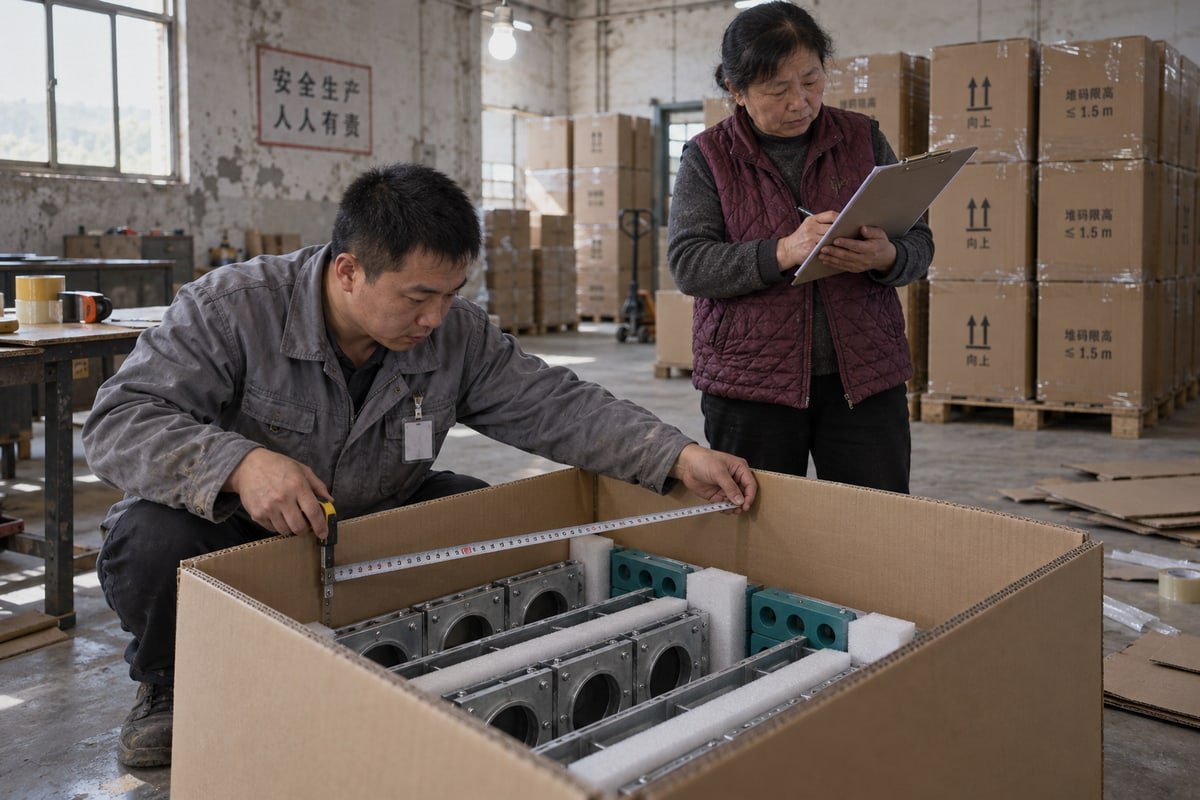
Carton dimensions only make sense inside a hierarchy. We define four levels on every packing specification: unit protection around each module, the inner box that groups modules, the master carton, and the pallet or crate. Each level carries its own dimension, weight, and label. If you only see the master carton size, the inner-box count becomes a guess. Guesses cause miscounts at the site.
Here is what we ask buyers to confirm line by line.
| Item to confirm | Why it matters | Where it appears |
|---|---|---|
| Internal and external L×W×H | Fit on your racks and in your container plan | Packing spec drawing |
| Wall grade (single or double-wall corrugated) | Crush resistance under stacking | Packing spec header |
| Modules per inner box, inner boxes per carton | Fixed counts stop miscounts and simplify receiving | Packing spec table |
| Cartons per pallet layer and layers per pallet | Palletization layout and forklift access | Pallet drawing |
| Net weight and gross weight per carton and per pallet | Freight cost and handling equipment | Packing list |
| Closure method and tape spec | Tamper evidence and seal strength | Packing spec |
| Stacking limit and orientation arrows | Prevents crushed lower cartons | Shipping marks |
Single-wall or double-wall?
Our TSC and TSR modules are light for their size. The transit frame assembly is not. A galvanized frame with stay plates and a compression unit concentrates weight in a small footprint. So we split the rule: single-wall corrugated is acceptable for module-only inner boxes, but double-wall corrugated or an ISPM 15 1 heat-treated wooden crate is what we specify for frames and mixed cartons. If your order mixes both, confirm which carton type holds which line item.
Gross weight calculation
Ask how the gross weight calculation 2 is done. Net weight equals unit weight times quantity. Gross adds inner boxes, inserts, and the carton itself. Pallet gross adds the pallet, corner boards, and stretch wrap. Your forwarder charges on the higher of gross and volumetric weight. An oversized carton therefore costs you twice: once for void fill, once for freight.
One objection we hear is that fixed carton dimensions remove supplier flexibility. In practice, we keep a standard master carton footprint and customize the inner partitions to the module sizes on each order. Confirm both, and you get standard handling with product-specific protection.
How Can I Ensure Inner Packaging Protects EPDM Sealing Modules During Long-Distance Shipping?
During a packing audit, one of our QC staff tipped a filled inner box on its side. Two TSC modules shifted. That box design never shipped again.
Protect EPDM sealing modules during long-distance shipping by bagging each module in PE, grouping modules by size and type in partitioned inner boxes, using foam, corrugated, or molded pulp inserts sized to the block profile, and filling every void so nothing moves when the carton is tipped.

Match the cushioning to the actual risk
Our step-core EPDM is resilient, but the peelable rings on each module are the working surface. Deep scoring or long-term crushing under a heavy frame can change how the ring layers peel and seat around the cable. So we choose protective cushioning materials by the risk on the route, not by habit.
| Risk during transit | Inner packaging method we specify | Why |
|---|---|---|
| Abrasion between modules | PE bag per module or per matched pair | Stops surface scuffing on the sealing faces |
| Movement inside the box | Corrugated dividers or partitioned slots, one module per slot | Fixed positions, no collision on tipping |
| Stacking pressure from above | Foam or molded pulp insert sized to the block profile | Spreads load across the module body |
| Moisture in sea freight | Sealed PE bag plus desiccant in the inner box | Keeps a moisture-proof barrier at the smallest unit |
| Void space | Paper or air pillows only after dividers are in place | Fill is a last step, not a substitute for structure |
Group by size and type, or kit by location?
Grouping modules by size and type in each inner box makes receiving counts fast. Your goods-in team opens one box and counts one SKU. For EPC projects, some buyers ask us instead to build installation kits per bulkhead or per frame cutout. Each kit holds the frame, the stay plates, the exact module mix, and the compression unit. This shifts sorting labor from the site to our packing line. Both work, but you must choose one before production, because the inner-box labels and the packing list follow from that choice.
Color-coded dividers add another safeguard. When one order holds both fire-rated seals for A-60 bulkheads and standard modules, a colored divider that matches the rating on the label reduces the chance of a wrong module in a rated frame.
Low-cost fill versus damage claims
A common objection: heavier inner packaging raises unit cost and volumetric weight. Our answer is that the divider board and PE bag are cheap next to a concealed-damage claim and a stalled site. Where buyers want less plastic, we offer molded pulp inserts 3 shaped to the module profile in place of polyethylene foam. Same slot control, recyclable material.
What Moisture and Damage Protection Standards Should I Ask My Supplier to Meet?
Every quote forces one choice on us: VCI wrap and desiccant on a galvanized transit frame assembly costs money, yet white rust on arrival costs a claim.
Ask your supplier to meet a written moisture and damage standard: PE or VCI wrap on steel and aluminum frames, desiccant inside sealed cartons, a moisture-proof barrier under pallet stretch wrap, ISPM 15 heat-treated wood, double-wall corrugated for dense loads, and a stacking limit printed on the shipping marks.
Moisture protection
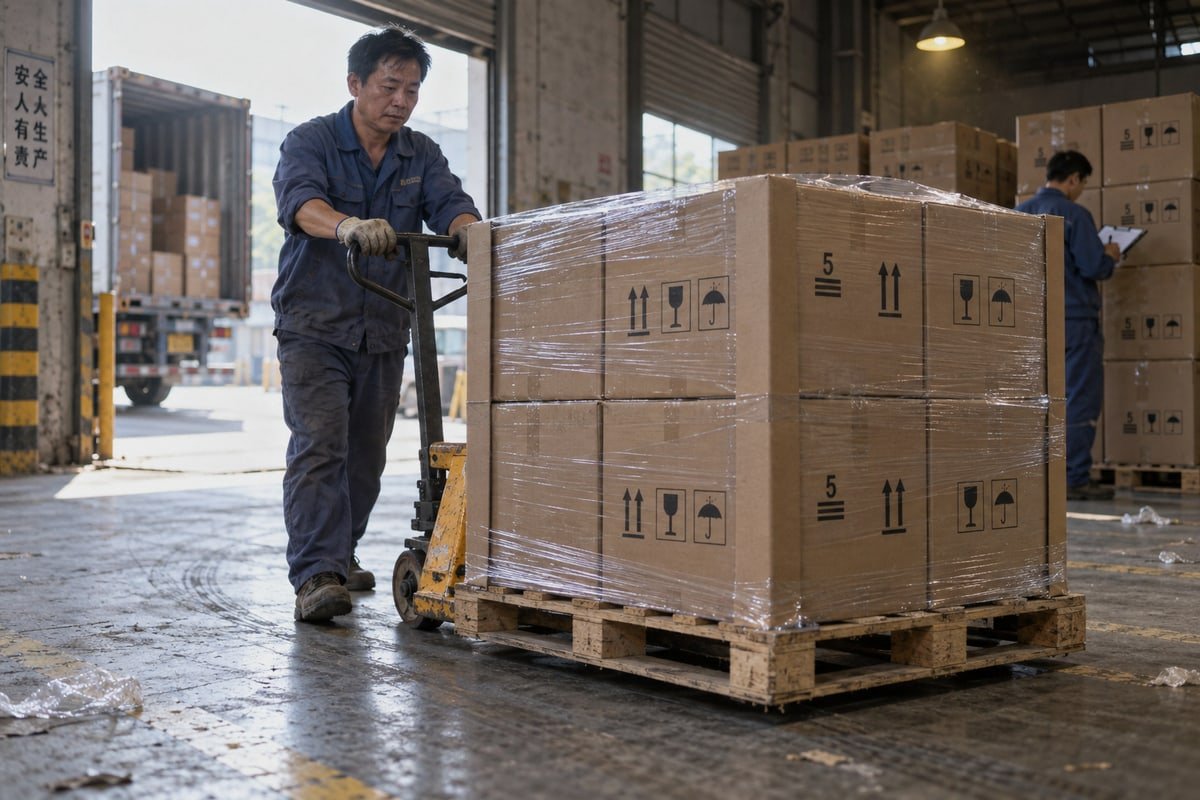
Sea freight to Europe and the Middle East means weeks of humidity cycling inside a container. Our EPDM modules are rated IP68 in service, but the frames, bolts, and stay plates are metal. So we treat the two differently. Frames get VCI film 4 or a PE wrap with desiccant. Modules get a sealed PE bag and go into a lined inner box. The pallet then gets a moisture-proof barrier film before the stretch wrap. Ask your supplier to state each of these on the packing specification, not just "export packaging."
Damage protection
Damage protection is about handling conditions, not just fitting the product into a carton. A pallet of MCT hardware will meet forklifts, container straps, and a crane at some ports. That is why we follow the rule of packing for handling conditions on freight orders, and we put the stacking limit on the shipping mark specifications.
| Protection area | Standard to request | Applies to |
|---|---|---|
| Corrosion | VCI or PE wrap plus desiccant | Frames, compression units, stay plates |
| Water ingress | Sealed PE bags, lined inner boxes, pallet barrier film | Modules and documents |
| Crush | Double-wall corrugated or wooden crate, stacking limit marked | Mixed and frame cartons |
| Customs on wood | ISPM 15 heat-treatment stamp visible on the pallet or crate | All wooden packaging |
| Handling | Corner boards, banding, "This Side Up" and fragile marks | Every pallet |
Frame-first thinking
For cable products, reel condition often matters more than the carton. For MCT orders, the equivalent is the frame. If the frame flange bends in transit, the modules will never compress correctly, even if every module arrives perfect. So we ask buyers to check frame edges, weld seams, and the nameplate on receipt, and we check the same points before dispatch under our ISO 9001 and IATF 16949 systems.
Some suppliers argue that minimal packaging reduces cost and volumetric weight. That is true on the invoice. It is false on the total cost once a claim, a re-shipment, and a delayed site acceptance are added.
Can I Request Packaging Photos or Documentation Before My MCT Shipment Leaves the Factory?
We learned the hard way: one mislabeled inner box in a mixed TSR and TSC shipment cost the receiving site a day of sorting. Photos now precede every dispatch.
Yes. Request a pre-shipment packaging record before release: photos of open inner boxes, closed cartons with labels, the palletization layout, and the packing list side by side. Any serious factory will provide this, and you should hold final payment approval until photos, labels, and documents match.

The confirmation workflow we run
Here is the sequence we follow on every export order. You can copy it as your own quality control checklist.
- Confirm the line items. Each TSR or TSC size, each frame model, and each spare part gets its own row with quantity.
- Approve the packing specification. Carton dimensions, wall grade, inner-box counts, cushioning, and shipping marks are signed off before packing starts.
- Approve a sample packout on the first order. We photograph one complete inner box and one complete carton and send them for review.
- Run final inspection. QC checks product, label accuracy, packaging integrity, and quantity.
- Send the pre-shipment photo set and documents.
- Release only after the buyer confirms the match.
What the photo set should contain
| Photo or document | What you verify |
|---|---|
| Open inner box, top view | Slot fill, module orientation, no voids |
| Inner-box label close-up | Part number, size, quantity, project tag, batch number |
| Closed carton with shipping marks | Carton number, gross weight, stacking limit, orientation arrows |
| Full pallet before and after wrap | Palletization layout, corner boards, ISPM 15 stamp |
| Packing list next to the pallet | Quantities, marks, dimensions, weights, and contents match |
| Waterproof document pouch on the inner lid | Packing list and installation guide reach the site with the goods |
Red flags to reject
Loose movement when a box is tilted. Missing or handwritten labels. Oversized voids filled only with paper. Weak tape seals. A packing list that does not match the carton count. Any one of these justifies a hold before dispatch.
For larger integrators, we can add RFID or NFC tags 5 at the inner-box level. This lets your warehouse verify transit components without opening cartons. It is optional, but it fits well with the standardized labeling most export packaging standards already expect.
Fazit
Wrong cartons turn correct modules into site delays. Confirm the written pack spec, sample, photos, and documents before dispatch, and packaging stops being a risk in your MCT order.
Fußnoten
1. Official international standard for wood packaging materials to prevent pest spread. ↩︎
2. Standard definition of the total weight of a shipment including goods and packaging. ↩︎
3. EPA data on sustainable packaging materials and recycling practices for containers. ↩︎
4. Technical overview of chemical inhibitors used to protect metal parts from corrosion during transit. ↩︎
5. Global standards for tracking and identifying goods in the supply chain using radio frequency. ↩︎



 English
  Español de México
  Deutsch
  Français
  العربية
  Русский