Multi cable transit module compatibility is hard to prove from a datasheet. A near-miss fit stalls a whole project. Our factory built a checklist to remove that risk.
To confirm multi cable transit module compatibility, match four things: the frame’s internal window size and depth, the module family and cable diameter range, the compression hardware generation, and the fire and IP certification. Verify each against the manufacturer’s cross-reference table and a physical validation sample.
The rest of this article walks through those four checks in order. I will show you what to measure, what to read, what to request, and what to test before you commit to a bulk order.
What Frame Dimensions and Cutout Specifications Should I Compare Before Ordering?
A sourcing manager in Europe once sent us a photo and one number: the frame width. That was not enough. We asked for six more measurements before quoting.
Compare the internal packing space width and height, frame depth (60 mm standard or 30 mm compact), wall or bulkhead cutout size, frame material and fixing method, and the stay plate pitch. All five must match the module family before you place an order.

A cable penetration seal only works when every part of the stack fits the frame. The frame is a rigid box. The modules, stay plates, and compression wedge assembly must fill that box completely. If one dimension is off, the seal does not compress evenly. So I always start with measurements, not with catalog numbers.
Transit frame window size and packing space
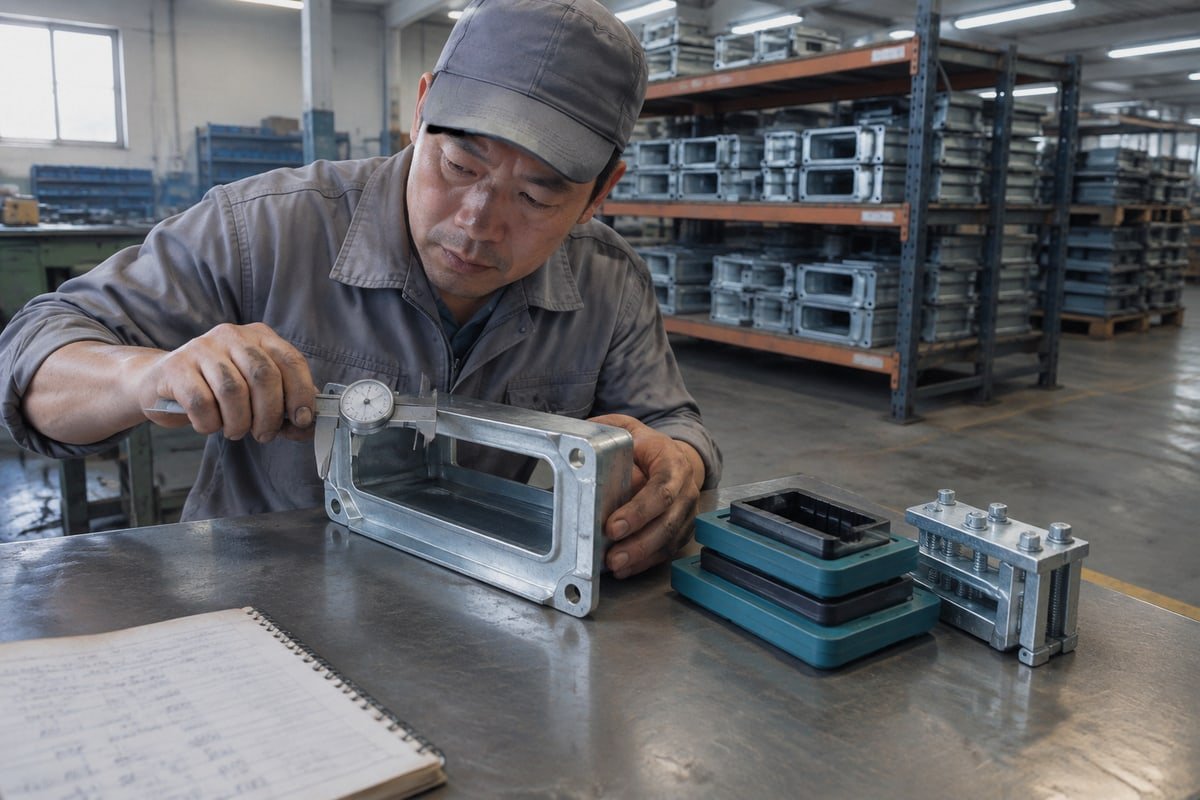
The transit frame window size is the internal opening you can actually pack. It is not the outer flange size. Measure the internal width and height with a caliper, corner to corner, at two or three points. Old frames can be slightly out of square after years of thermal cycling. Modules are sized in standard metric increments, and they must fill the internal window fully. A gap of even a few millimetres at the top means the wedge cannot build pressure.
Module depth and the compression wedge assembly
Depth matters as much as width. Most standard industrial frames accept 60 mm deep modules. Compact frames accept 30 mm modules. Our TSC square modules and TSR round assemblies are made to the common 120-frame standard 1, so their depth lines up with the frame rails in that family. If your frame is a compact version, tell us before we quote. A 60 mm module in a 30 mm frame will never seat.
Cutout, material, and fixing method
Next, look at how the frame is attached. It may be welded to a steel bulkhead, bolted to a steel structure, anchored into concrete with screw anchors, or cast in. This does not change the module size, but it does change how much compression load the frame can take. A corroded anchored frame in concrete deserves a closer look before you load it with a dense module stack.
| Check item | What to measure or note | Why it matters for fit |
|---|---|---|
| Internal window width and height | Caliper reading at top, middle, bottom | Insert block sizing must fill the window exactly |
| Frame depth | 60 mm standard or 30 mm compact | Module depth must match the rail depth |
| Wall or bulkhead cutout | Outer opening and plate thickness | Confirms the frame was installed correctly |
| Stay plate pitch and slot type | Distance between rails, plate thickness | Stayplate installation must match module rows |
| Cable cross-section total | Sum of cable diameters per row | Leaves room for the wedge and filler modules |
| Frame material and fixing | Steel, stainless, aluminum; welded, bolted, anchored | Sets the safe compression load |
Finally, do a quick cable count. Add up the diameters in each row and leave the vertical space the wedge needs. Some systems cover cable diameters from about 4 mm to 99 mm with a small set of module sizes. Our step-core EPDM rubber modules follow the same idea. One module size adapts to a cable diameter range, so the layout is simpler and spare capacity is easier to plan.
How Can I Verify My Current Sealing Frame Model Against DEWIN's Cross-Reference Table?
During incoming inspection last spring, our QC team laid a customer's legacy module beside our TSC block on a granite plate. The gauge told the story in seconds.
Locate the nameplate on your frame, note the manufacturer, series, frame size code, and module generation, then find that row in DEWIN's cross-reference table. The table maps each legacy model to a DEWIN TSC or TSR equivalent that shares the 120-frame standard dimensions.

I hear one objection often, and it is fair. Buyers ask whether a universal module can really replace a brand-specific one. Many MCT systems are proprietary. Modules from one vendor are rarely interchangeable with another vendor's frame by accident. That is exactly why we built the cross-reference table. It is not a claim of universal fit. It is a mapped list of legacy models and the DEWIN model made to the same 120-frame dimensions. Similar-looking is not the same as verified. The table makes the check explicit.
Step-by-step verification
- Photograph the nameplate. Most frames carry a small metal plate between the compression bolts. Record the brand, series, and any frame size code such as a width-by-height figure.
- Identify the module generation. Look at the stay plates and wedge. Older generations often use a different plate profile. New modules on old plates can create uneven pressure and seal failure.
- Open the cross-reference table and find the legacy row. Each row lists the DEWIN equivalent, its nominal window size, depth, and the cable diameter range it seals.
- Compare your caliper readings from the previous section against the DEWIN column. If the numbers agree within the stated tolerance, the model is a drop-in candidate.
- Flag anything outside the table. If your frame is not listed, send us the nameplate photo and dimensions. Our engineers add new rows regularly.
What each column of the table tells you
| Column | Content | How to use it |
|---|---|---|
| Legacy model | Original brand series and size code | Match to your nameplate |
| DEWIN equivalent | TSC (square) or TSR (round) model | The part number to sample and quote |
| Nominal window and depth | Standard 120-frame dimensions | Compare with your internal measurements |
| Cable diameter range | Min–max diameter per module | Confirm your cables fall inside the range |
| Compatible hardware | Stay plate and wedge generation | Decide whether to reuse or replace hardware |
| Test documents | Fire, IP68, pressure reports | Pull the right file for your approval |
Where the table has limits
The table confirms dimensions. It does not confirm frame condition. A legacy frame with pitting, weld splatter in the corners, or heavy repaint can push the real window below nominal. This is the tolerance audit we ask every buyer to do. Also check chemical compatibility. Old primers and some legacy lubricants can attack elastomers over time and cause slippage. Our modules are halogen-free EPDM 2, and we specify the lubricant that goes with them. If the table row is green and the frame is clean, you move to the next step: documents and samples.
What Documents or Test Reports Should I Request to Confirm Fire and IP68 Sealing Compatibility?
Every week I weigh a trade-off: send a buyer a thick certificate bundle, or the three pages that prove the seal holds. I now send those pages first.
Request the fire test report for A-0/A-60 bulkhead rating, the IP68 ingress test report, the watertight and gas-tight pressure test at 0.01–0.4 MPa, the halogen-free EPDM material datasheet, and the ISO 9001/IATF 16949 certificates. Check that the tested frame and module match yours.

A fire-rated bulkhead seal 3 is tested as a system, not as a loose module. The report describes a specific frame, a specific module family, a specific stay plate layout, and a specific wedge torque. If any of those differ from your installation, the rating may not carry over. So the first thing I check in any report is the tested configuration table. Then I compare it to the buyer's frame.
The core document set
| Document | What it proves | What to check inside it |
|---|---|---|
| Fire test report (A-0 / A-60) | Barrier holds under fire on a steel bulkhead or deck | Frame type, module depth, insulation side, test duration |
| IP68 ingress test report | Continuous immersion protection | Depth, duration, module and cable sizes used |
| Watertight and gas-tight pressure test | Seal holds 0.01–0.4 MPa | Pressure direction, hold time, leak criteria |
| EPDM material datasheet | Halogen-free rubber, hardness, aging | Compound name matches the module label |
| ISO 9001 and IATF 16949 certificates | Stable quality system | Scope covers the production site, dates are valid |
| BV factory approval | Third-party surveyed production | Approval number and site address |
IP ratings are not interchangeable
Buyers sometimes treat IP66, IP67, and IP68 as the same tier. They are not. IP66 covers powerful water jets. IP67 covers short immersion. IP68 covers continuous immersion under conditions the manufacturer states. Some split multi-cable transit products 4 are rated IP66 and UL Type 12/4X, which suits connector-friendly installations but is not the same as an IP68 gas-tight cable transit. If your original frame was specified to IP67 or IP68, the replacement module must show the same or better, and the report must say so.
Reading a fire report with a critical eye
An A-60 result 5 depends on the bulkhead, the frame weld, and the packing. Ask three questions. Was the test done on a 60 mm or 30 mm frame? Were the modules the same EPDM compound you are buying? Was the module fill ratio similar to yours? Our factory keeps A-0 and A-60 reports and IP68 reports on file, and we send them on request along with the pressure test. We are BV-approved and run ISO 9001 and IATF 16949 systems, so the document trail is complete. Still, I want you to read the configuration table, not just the cover page.
Can I Request Free Validation Samples or CAD Files to Test Fit Before Committing to Bulk Orders?
We learned this lesson the hard way: a buyer approved our modules from a PDF drawing alone, then found a repainted frame had shrunk its window. Samples now ship first.
Yes. DEWIN supplies free validation samples of TSC square and TSR round modules, plus STEP CAD files, before any bulk order. You can test-fit the sample in your existing frame, run a clash check in your 3D model, and then qualify DEWIN as a second source.

Free samples and CAD files exist for one reason: to move the risk from your site to our bench. A drawing shows nominal dimensions. A sample in your hand shows real fit. I recommend using both, in this order.
A practical sample validation process
- Send us the nameplate photo, your caliper readings, and your cable list. We return the cross-reference row and the STEP file for the matching TSC or TSR model.
- Load the STEP file into your CAD model of the frame. For complex MCT system retrofit work, some teams now use a handheld 3D scanner to create a digital twin of the legacy frame. Clash detection then shows any tight corner before hardware arrives.
- Receive the sample set. We usually send a small mix of module sizes so you can test insert block sizing across your cable diameter range.
- Dry-fit the sample in the actual frame with the existing stay plates. Check that the module seats flush in the corners and that the wedge has its required vertical space.
- Torque the compression wedge assembly to the value in our instructions. Watch for even bulge on both faces. Uneven bulge points to a plate generation mismatch or a frame tolerance problem.
- Record the result. If it passes, you have a qualified second source at 40–60% lower cost than the incumbent, with documents already in hand.
Retrofit, adapt, or replace: the decision after the sample
The sample test also settles the retrofit-versus-replacement question. Retrofit keeps cables live and downtime short. Replacement is safer when the frame is uncertified, corroded, deformed, or unable to carry the load of a dense modern module stack. High-vibration sites deserve a dynamic load check on the mounting method before you add mass.
| Sample result | Frame condition | Recommended path |
|---|---|---|
| Fits flush, even compression | Clean, certified, documented | Reuse frame, install DEWIN modules |
| Fits flush, plates mismatched | Clean frame, old hardware | Adapt: replace stay plates and wedge |
| Tight or loose in corners | Repaint, pitting, weld splatter | Retrofit with openable or split frame around live cables |
| Cannot compress evenly | Deformation, missing certification | Replace frame and modules as a matched system |
One more objection deserves an answer. Some engineers prefer closed welded frames over openable ones for perceived robustness. That is a real trade-off. Openable frames make installation around existing cables easy, while welded frames offer structural continuity. The sample test lets you judge that on your own bulkhead rather than on a brochure. If you need a custom size, our in-house mold shop can cut a new module geometry, and private-label marking is available on the same line.
Fazit
Compatibility risk stalls projects and inflates cost. Measure the window, verify the cross-reference row, read the test reports, and test-fit a free sample. Then order with confidence.
Fußnoten
1. The International Organization for Standardization homepage for global industrial and manufacturing quality standards. ↩︎
2. Provides technical background on the durable elastomer material used in industrial cable sealing modules. ↩︎
3. Comprehensive overview of firestopping systems used to maintain the fire rating of walls and floors. ↩︎
4. Official IEC page explaining the ingress protection (IP) ratings for electrical and mechanical enclosures. ↩︎
5. IMO safety resource regarding fire protection standards for marine bulkheads and cable penetrations. ↩︎



 English
  Español de México
  Deutsch
  Français
  العربية
  Русский