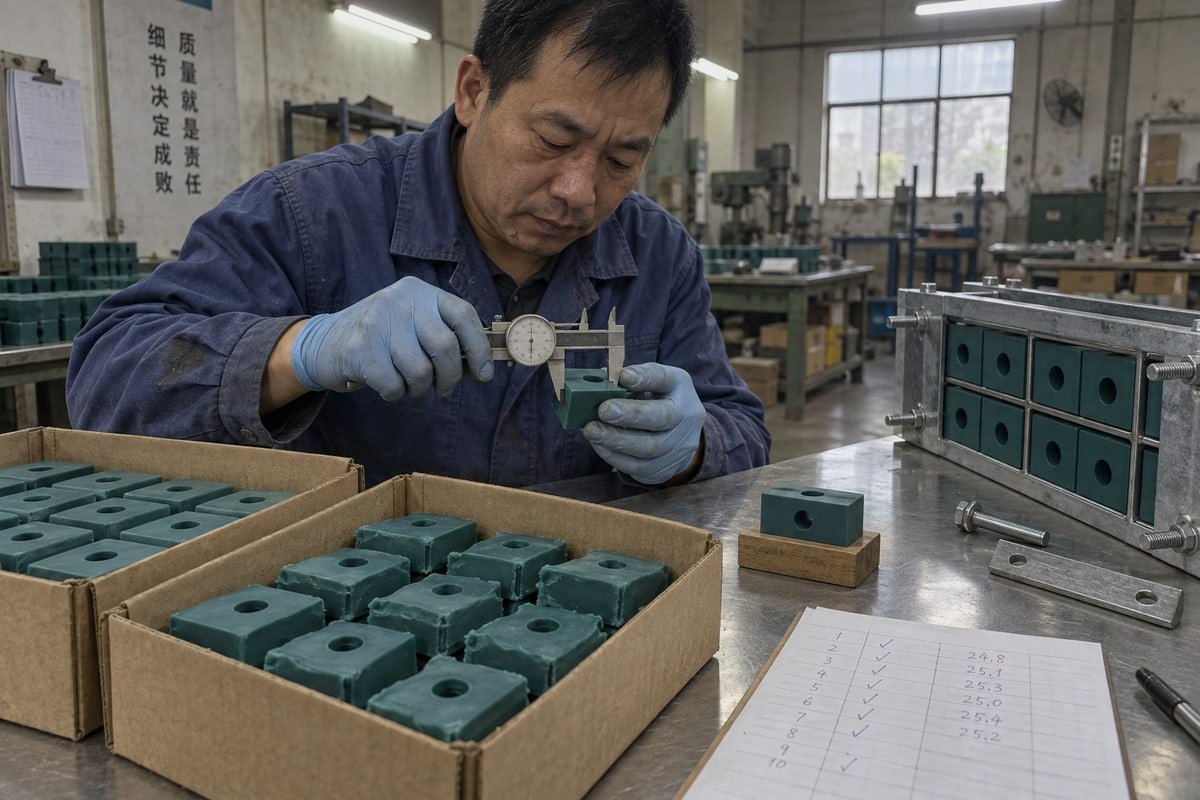
Your multi cable transit sample passed. Then bulk order quality slipped: soft blocks, leaks, rework. I have seen this hurt buyers before they reached our factory floor.
Bulk order quality matches the sample when you turn the approved multi cable transit unit into a signed golden sample with written tolerances, request batch-level test reports and material traceability, verify certifications cover the production line, and run pre-shipment inspection before release.
Sample approval is a start, not a guarantee. Below, I walk through the four checks that our engineering-minded buyers in Europe use with us, in the order they use them.
How can I verify that DewinMCT's validation samples truly represent production-batch quality before I place a bulk order?
One of our QC engineers keeps a sealed TSC module on her desk. It is the reference unit for a European BESS project, and nothing ships until it matches.
Verify DewinMCT validation samples by confirming they come from the standard production line, not a prototype mold, then comparing them against the technical data sheet and drawing, recording lot numbers, and signing a golden sample agreement that fixes dimensions, hardness, and material grade.

The free validation samples we send are pulled from the same molds and the same EPDM compound as our production runs. That is the first thing you should confirm with any supplier, and it is the first thing I tell buyers to ask us. A sample cut from a hand-finished prototype tells you what a factory can do once. A sample from the line tells you what it does every day.
Marketing sample vs production sample
Ask where the sample came from. The answers should be specific and checkable.
| Question to ask | Answer that reduces risk | Answer that raises risk |
|---|---|---|
| Which mold produced this block? | Production mold number is stated on the sample record | "A test mold" or no answer |
| Which compound lot? | Lot number matches a Material Test Report | Lot number not recorded |
| Was the block post-cured like production parts? | Yes, same vulcanization cycle | Cure cycle unknown |
| Is the technical data sheet for this exact model? | Yes, TSC or TSR model number matches | Generic datasheet for the series |
Turning the sample into a golden sample
A golden sample is a physical unit signed by both parties. It becomes the benchmark for every inspection and any later dispute. In our workflow, we photograph the unit, record its width, height, and bore, measure Shore hardness 1 at several points, and attach the compound lot number. Then both sides sign the record. If a bulk block later measures outside the tolerances written on that record, the record settles the argument, not memory.
Some buyers tell me a sample is enough if the supplier is reputable. I understand the time saving. But the real risk shows up at scale, in small changes to filler lots, mold wear, or cure time. Reputation does not catch those. A signed golden sample with written acceptance criteria does. So treat the sample as the start of a contract, not the end of qualification.
What quality control documents and test reports can I request to confirm consistency between samples and mass production?
A sourcing manager in Germany once asked me for one document that proves consistency. I told him there is no single document. There is a set.
Request the technical data sheet, batch-specific Material Test Reports, Shore hardness and dimensional inspection records, fire and IP68 test certificates tied to the production line, Factory Acceptance Test reports, ISO 9001 and IATF 16949 certificates, and a signed certificate of conformity for each shipment.
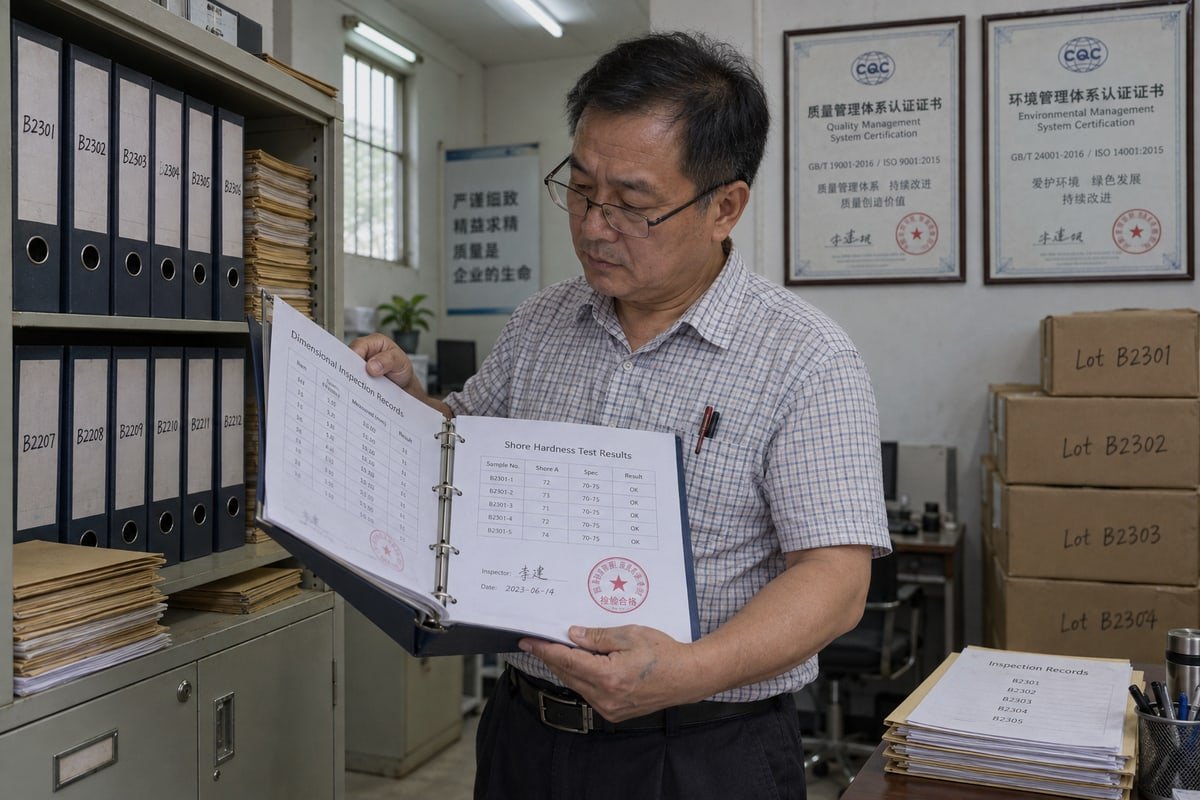
Quality control documentation works when each document answers one specific question. The table below shows what we provide on request and what each item proves. I recommend you ask for these before the deposit, not after the shipment.
| Document | What it proves | When to request |
|---|---|---|
| Technical data sheets (per model) | Nominal dimensions, cable range, material, ratings | At quotation |
| Material Test Report (per compound batch) | EPDM grade and composition match the sample | Before production starts |
| Dimensional and Shore hardness inspection records | Each batch stays inside stated dimensional tolerances and hardness range | During production and before shipment |
| Fire safety certifications (A-0/A-60) | Penetration seal tested to applicable fire standards | Before bulk commitment |
| Ingress protection rating report (IP68 2) and pressure test (0.01–0.4 MPa) | Watertight integrity and gas-tight sealing | Before bulk commitment |
| Factory Acceptance Test report | Assembled frame, blocks, and compression unit pass fit and seal tests | Before dispatch |
| ISO 9001, IATF 16949, BV factory approval | Quality management system is active and audited | At supplier qualification |
| Certificate of conformity | Shipment matches the golden sample record | With every shipment |
Certifications must cover the production line
A common trap is a certificate based on an outdated prototype. Fire safety certifications and ingress tests are only useful if the tested item is the same design and compound you are buying. SOLAS 3 and IMO related requirements expect penetration seals to be tested to the applicable fire standards, so for marine or safety-critical work, confirm the certificate scope, the model number, and the compound before you release the order. Our BV-approved factory status and our A-0/A-60 and IP68 test documents are tied to our standard TSC and TSR production, and we state the model scope on request.
Material fingerprinting and storage history
For high-value orders, two extra reports are worth the cost. First, FTIR spectroscopy 4 fingerprinting on bulk elastomer blocks can detect hidden fillers or cheaper polymers that were not in the sample. We use halogen-free EPDM, and an FTIR trace makes that easy to confirm. Second, batch-specific aging reports show that blocks were not exposed to UV or ozone during warehouse storage. Rubber that sat in sunlight can pass a visual check and still fail a seal test months later.
How do I check dimensional and material compatibility across multiple production batches for drop-in replacement reliability?
Tight tolerances cost mold money. Loose tolerances cost field time. We weigh this on every TSC mold, because a block that fits the sample frame must fit yours.
Check cross-batch compatibility by measuring block width, height, and bore against the drawing with stated dimensional tolerances, mapping Shore hardness across batches, confirming the EPDM grade on each MTR, and test-fitting blocks from every lot into a standard 120-frame with the compression wedge assembly.
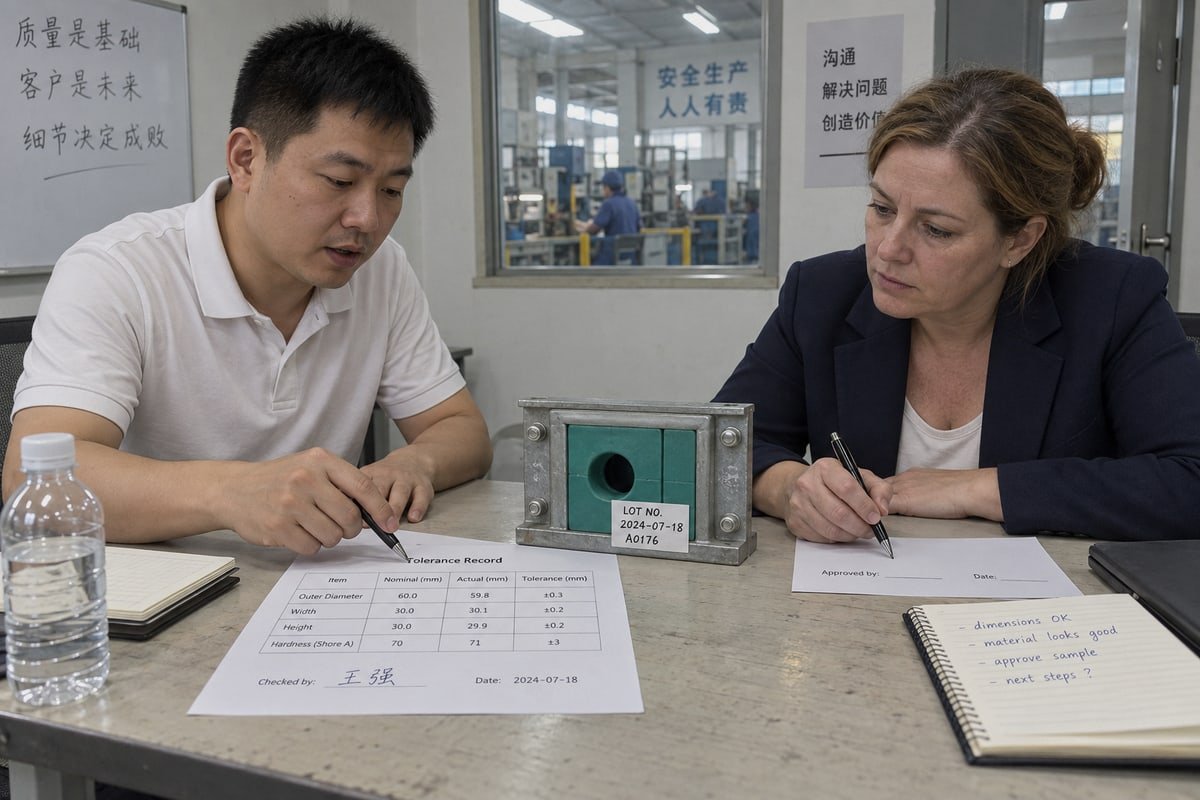
Drop-in replacement is the core promise of a second source. Our modules are dimensionally compatible with common 120-frame standards, and our cross-reference tables map existing models to DEWIN models. But compatibility is only real if every batch holds the same dimensions as the golden sample. This is where tolerance stack-up hides. One block slightly wide does not matter. Six blocks slightly wide across a frame column will not compress correctly.
A fit-up process you can repeat on every batch
- Pull a defined number of blocks from each production lot, not just the first lot.
- Measure width, height, and bore diameter against the drawing. Record the readings against the tolerances written in the purchase agreement.
- Read Shore hardness at fixed points on each block and build a durometer consistency map across the lots. Hardness variation changes compression behavior and can cause leaks even when dimensions pass.
- Check the Material Test Report for each compound batch. The EPDM grade and halogen-free components must match the sample record.
- Stack blocks from mixed lots into a 120-frame with stay plates and the compression wedge assembly. Tighten to the specified compression and inspect the fit.
- Run a pressure or air test on the assembled frame where the application demands watertight integrity.
Why the drawing matters more than the sample
The sample shows one unit. The drawing shows the allowed range. That is why we supply CAD and STEP files with our quotations. Your engineers can overlay the drawing on your existing frame cutout, confirm the insert configuration, and check cable diameters before any metal is cut. The step-core design of our blocks covers a range of cable diameters within one module size, which reduces the number of variants you need to track. But it does not remove the need to measure. A block that is inside tolerance on paper and inside tolerance in every batch is the only block that is truly drop-in.
What steps can I take with DewinMCT to prevent quality drift during large-volume manufacturing of my MCT order?
Early on, we learned that quality drift rarely comes from one big mistake. It comes from a slightly shorter cure, a new filler lot, a skipped check.
Prevent quality drift by freezing the approved design in writing, agreeing on batch testing protocols with sampling frequency, auditing vulcanization logs and raw material lots, scheduling in-process and pre-shipment inspections, using third-party witness testing for first orders, and requiring batch-specific aging reports before dispatch.

The difference between a sample-only approach and a sample-plus-QA approach is easiest to see side by side.
| Stage | Sample-only approach | Sample-plus-QA approach |
|---|---|---|
| Before production | Approve one sample | Sign golden sample record, freeze design, define batch testing protocols |
| Raw material intake | Supplier discretion | Material traceability per compound lot, MTR on file |
| Molding and curing | Not reviewed | Vulcanization logs checked against the sample cycle |
| Final inspection | Visual check | Dimensional, hardness, and seal tests per lot, recorded |
| Before shipment | Packing list | Factory Acceptance Test, pre-shipment inspection, packing photos, aging report |
| On arrival | Count boxes | Compare received units against the golden sample checklist |
Freeze the design, then watch the process
Freezing the design means the factory cannot change compound, filler, insert configuration, or accessory set without your written approval. At our plants, the frozen record includes the mold number, compound formula reference, and cure parameters. You can audit the vulcanization logs of your run to confirm the curing time and temperature cycles match the parameters used for the sample. Since our ISO 9001 and IATF 16949 5 systems apply to high-volume runs and not only to sample batches, a formal factory audit will show the same in-process controls at any production scale.
Use independent eyes where the risk is high
Third-party inspection is not an insult to a supplier. It is a normal part of serious procurement, especially for first orders, new suppliers, or safety-critical jobs. We host witness testing for fire, water, and gas tightness at our factory before dispatch. Regulated marine work goes further; NAVSEA standard items reference local air hose testing for new and disturbed multi-cable transit devices, which shows that performance verification can be mandatory, not optional. Some buyers argue that low price matters most. My answer is that the cost saving we offer, typically 40 to 60 percent against the incumbent brand, only holds if documented repeatability holds with it. A cheap block that leaks costs more than the saving.
Receiving checks close the loop
When the shipment lands, check marking, lot labels, accessory sets, and packing condition against the golden sample record. Keep a digital register of every transit installed, with its lot and certificate. That register becomes your evidence for future audits and your baseline for the next reorder.
Fazit
A cheap MCT order that leaks costs more than it saves. Bulk order quality matches the sample only when the sample becomes a controlled, documented, inspected reference.
Fußnoten
1. Background concept explaining the hardness measurement scale referenced throughout inspection processes. ↩︎
2. ISO standard reference for ingress protection rating tests cited for watertight integrity. ↩︎
3. Official IMO reference for the maritime safety convention governing fire penetration seal testing. ↩︎
4. Background reference explaining the material fingerprinting technique used for compound verification. ↩︎
5. Authoritative reference for quality management system standards mentioned in certification requirements. ↩︎



 English
  Español de México
  Deutsch
  Français
  العربية
  Русский