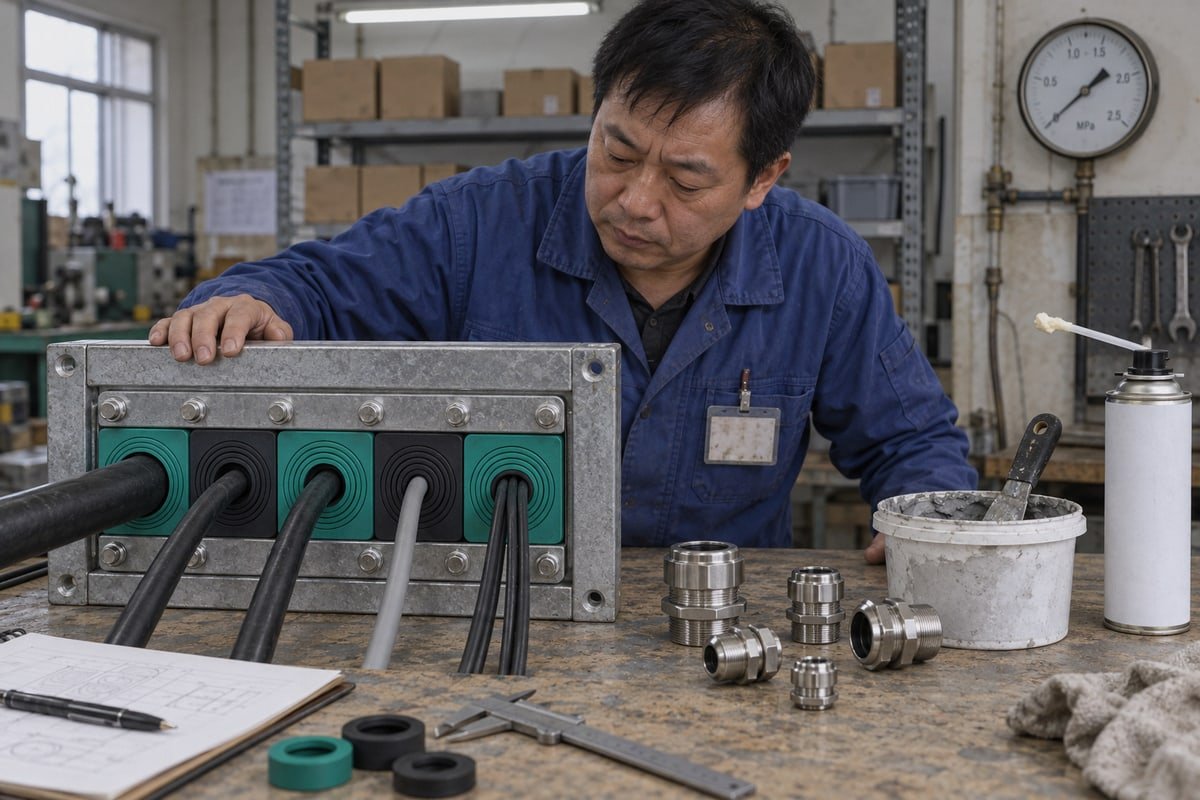
A failed cable penetration can flood a compartment or let fire cross a barrier. On our production line, MCT vs traditional packing glands, putty and foam is a daily question.
MCT (Multi Cable Transit) is a modular, compression-sealed frame system that passes many cables through one rated opening with certified fire, watertight and gas-tight integrity. Packing glands seal one cable per entry, while putty and foam are field-applied fillers with no modular re-entry and limited certified performance.
Each method solves a different problem. I will compare them on performance, layout impact, documentation, and lifetime cost. The goal is a clear answer for sourcing engineers who read spec sheets before they reply to anyone.
How do MCT systems compare to putty and foam in sealing performance and reliability?
During pressure tests at our Shaanxi plant, we hold sealed frames between 0.01 and 0.4 MPa. Foam and putty datasheets rarely quote numbers like that.
MCT systems outperform putty and foam on certified, repeatable sealing. A compressed EPDM module delivers rated A-0/A-60 fire integrity, IP68 ingress protection and gas-tight sealing to 0.4 MPa, and can be inspected visually. Putty and foam depend on installer skill, hide internal voids and degrade with movement.

The fastest way to see the difference is a side-by-side view. The table below covers the criteria our European customers ask about most often.
| Criterion | MCT (frame + modules) | Cable gland | Putty / foam |
|---|---|---|---|
| Typische Anwendung | Many cables through one barrier | One cable into one enclosure | Filling voids around penetrations |
| Fire integrity | Rated A-0 / A-60 with tested modules | Limited to the entry point | Variable; often intumescent sealants with no re-entry |
| Watertight integrity | Tested from 0.01 to 0.4 MPa | Depends on gland class | Rarely pressure rated |
| Gas-tight seals | Yes, by mechanical compression | Partial | Poor after curing shrinkage |
| Ingress protection (IP) rating | IP68 | IP66–IP68 per gland | Not usually rated |
| Wiederöffnung für neue Kabel | Loosen compression, swap modules | Drill a new hole | Cut out and re-apply |
| Inspection | Visual, from the face of the frame | Visual | Internal voids stay hidden |
Why the mechanical seal wins on reliability
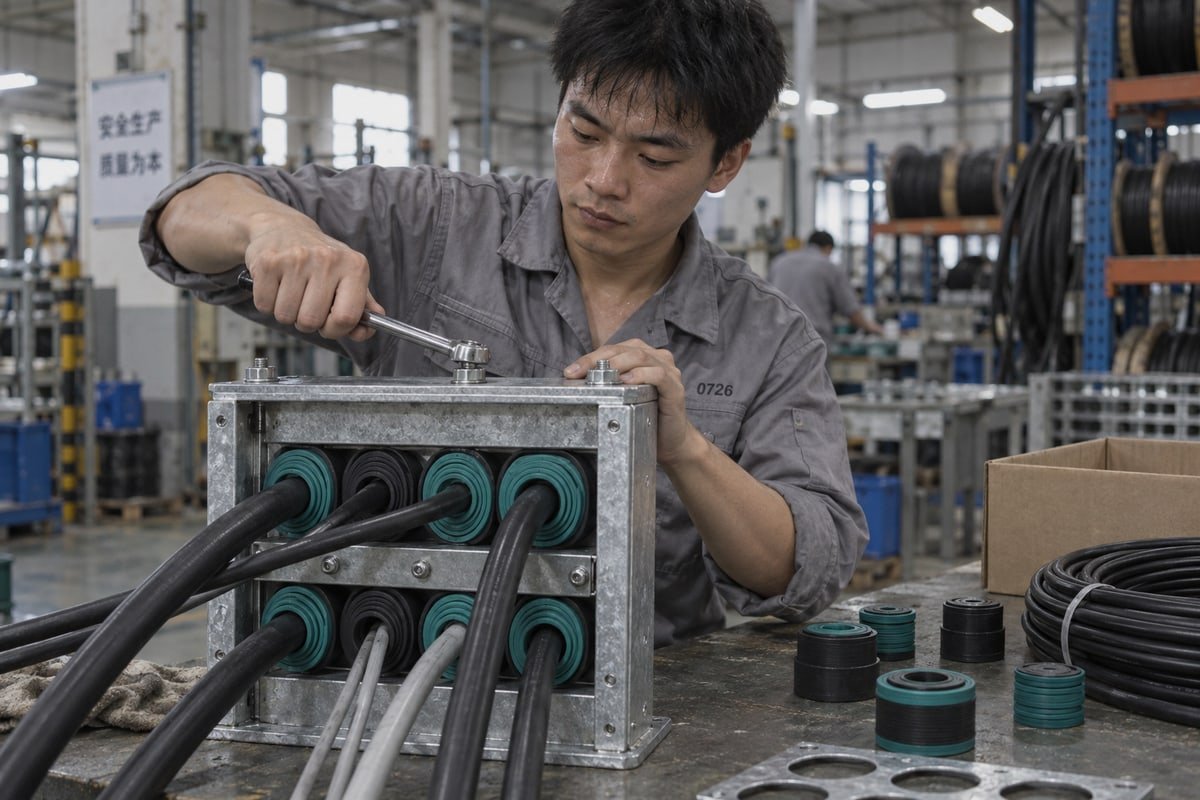
An MCT seal does not rely on adhesion or curing. The installer stacks modules inside a steel frame, adds a stay plate between rows, and tightens a compression wedge or compression unit at the top. The EPDM rubber 1 spreads sideways and grips every cable jacket. If a cable moves, the elastomer follows it. This is why elastomeric inserts damp vibration and resist seismic movement 2 in ships, wind turbines, and BESS containers. Foam and putty do the opposite. They cure hard, crack under movement, and let the cable jacket abrade against the edge of the opening.
Where putty and foam still make sense
I do not tell buyers to ban foam. For a non-rated interior wall in a dry plant room, a low-pressure duct, or a temporary construction opening, foam is cheap and quick. The cost-focused view is right there. It stops being right the moment a barrier carries a fire class, a pressure rating, or a classification-society stamp. In those cases, a hidden void inside a foam block is a failure you cannot see and cannot prove absent to an inspector.
The halogen-free detail that matters
Our modules use step-core, halogen-free EPDM. Step-core means one module size covers a range of cable diameters, so installers peel layers instead of stocking dozens of sizes. Halogen-free means low smoke toxicity in a fire, which many marine and data center specifications 3 now require. Most site-applied foams cannot make the same claim.
Can I switch from traditional packing glands to MCT without redesigning my panel layout?
A switchgear buyer in Germany once sent us a panel drawing with dozens of individual gland holes and asked whether one cutout could replace them all.
Usually yes. You replace a cluster of gland holes with one rectangular or round cutout sized to a standard 120-frame or TSR sleeve, keep the enclosure body unchanged, and route cables through modules instead. Only the entry plate needs redrawing, and CAD/STEP files make that a short task.

First, a terminology note. In pump and valve work, "packing gland" means braided gland packing around a rotating shaft. In cable work, buyers use the same phrase for stuffing-tube style cable glands. This article covers the cable meaning. The comparison of MCT vs traditional packing glands, putty and foam only makes sense for cable and pipe penetrations.
The retrofit process we walk buyers through
- Send us the existing gland plate drawing and the cable schedule with outer diameters.
- We return a frame proposal, a module packing plan, and a cross-reference table mapping your current module numbers to DEWIN equivalents.
- You cut one opening instead of many. A TSC square frame welds or bolts to the plate; a TSR round assembly drops into a single bore.
- Pull cables through, peel step-core layers to fit, stack modules with stay plates, and tighten the compression unit.
- Request free validation samples before the first production order so your own QC can confirm fit.
Where glands still deserve a place
I would be misleading you if I said MCT replaces every gland. A single heavy power cable entering a motor terminal box under strong vibration is better served by a metal gland. Glands give superior strain relief and pull-out resistance for one cable. Most of our OEM customers therefore run a hybrid layout: modular transit systems at the container wall or cabinet roof, glands at the final device.
| Situation | Keep glands | Move to MCT |
|---|---|---|
| One or two cables into a small junction box | Yes | No |
| Ten or more cables through one cabinet wall | No | Yes |
| Barrier with A60 fire rating or pressure class | No | Yes |
| Expected cable additions over asset life | No | Yes, retrofit capability is built in |
| Heavy single cable with high pull-out load | Yes | Only with added strain relief |
Pre-installing frames for future capacity
The smartest BESS and modular data center builders we supply now weld empty frames into the wall during fabrication and fill spare space with blank modules. Later, a technician removes blanks and adds cables in minutes. The cable density inside one frame far exceeds a row of glands, which is why panel real estate often gets freed up rather than consumed.
What certification and test data should I request before replacing legacy sealing methods with MCT?
We learned early that a factory certificate and a product test report answer different questions. Buyers who confuse the two end up with paperwork that inspectors reject.
Request four things: a fire test report showing A-0/A-60 performance to marine and offshore standards, an IP68 ingress protection test, a watertight and gas-tight pressure report covering your operating range, and quality-system evidence such as ISO 9001, IATF 16949 and a classification society factory approval.
Skeptical buyers are our favorite buyers. They ask for documents, and documents are easy for a real factory to supply. Here is the checklist I send to sourcing managers before any qualification meeting.
| Document | What it proves | What to check |
|---|---|---|
| Fire test report | A-0 or A60 fire rating of the assembled transit | Frame type, module type, and cable fill match your design |
| IP68 test report | Ingress protection (IP) rating against dust and immersion | Immersion depth and duration stated |
| Pressure test report | Watertight integrity and gas-tight seals | Range covers your case; ours runs 0.01–0.4 MPa |
| ISO 9001 / IATF 16949 certificates | The quality system is audited | Scope lists cable transit products, not just "rubber goods" |
| Classification society factory approval | The plant itself was inspected | Approval body named; ours is BV-approved |
| Material declaration | Halogen-free EPDM, low smoke | Compound named, not just "rubber" |
| Cross-reference table | Dimensional compatibility with 120-frame standards | Module height, width, and diameter range per size |
Factory certificates versus product test data
ISO 9001 tells you the factory follows a documented process. IATF 16949 tells you that process meets automotive-level traceability, which matters when a switchgear OEM must trace a module back to a batch. Neither certificate proves a seal survives fire. Only a product test report does that. Ask for both, and read the scope line on each one.
Qualifying a second source properly
When an EPC team qualifies us as a drop-in alternative, we recommend a short, evidence-led sequence. Compare the cross-reference table against the incumbent catalog. Order free validation samples and measure them against the existing frame cutout. Run your own compression fit test. Then request the test reports for the exact module family you plan to use. Our 38 granted patents cover details such as the step-core geometry, so ask how the peel layers are dimensioned rather than assuming every teal block is identical.
Special-function modules
If your control system is sensitive to interference, ask whether the supplier offers modules with electromagnetic shielding 4 (EMC). These variants bond the cable screen to the frame and are common in data center and automation specifications. Confirm they carry the same fire and pressure data as standard modules.
Will switching to an MCT system actually reduce my long-term maintenance and installation costs?
The trade-off is simple: one of our TSC modules costs more than a tube of foam, and a frame more than a row of glands. The payback comes later.
Yes, for most rated penetrations. MCT cuts installation labor by sealing many cables in one operation, removes the cost of re-drilling and re-sealing during retrofits, and lowers inspection time. With a compatible second source priced 40–60% below the original brand, the upfront gap shrinks and lifecycle savings dominate.

Let me handle the cost objection directly, because I hear it in every first call. A purchasing engineer compares a bill of materials for forty glands against one frame with modules and sees a higher line item. That comparison stops at the loading dock. Total cost of ownership starts there.
Where the money actually goes
Installation labor is the first hidden cost. Forty glands mean forty drilled holes, forty threads, forty torque checks, and forty places where a seal can be wrong. One frame means one cutout, one stack, one compression wedge tightened to the marked position. Putty and foam look cheap on paper too, but every rework means cutting out cured material, cleaning the opening, and re-applying it while an inspector waits.
Retrofit is the second cost. Assets like BESS containers 5 and data centers add cables during their life. With glands, each addition is a new hole and a new IP risk. With foam, each addition destroys the existing seal. With MCT, a technician removes a blank module and inserts a cable. The certified barrier stays intact.
Inspection is the third cost. Standardized MCT components give inspectors a consistent, visually verifiable seal. Foam and putty force them to guess what lies inside.
| Cost factor | Glands | Putty / foam | MCT |
|---|---|---|---|
| Material cost per cable | Low | Very low | Higher, lower with a qualified second source |
| Installation time per opening | High for many cables | Moderate | Low |
| Cost of adding a cable later | New hole, new gland | Full re-seal | Swap one module |
| Inspection effort | Per gland | Uncertain, hidden voids | Single visual check |
| Rework risk | Moderate | High | Low |
How the second-source model changes the equation
Our factory-direct pricing runs 40–60% below the established brands for dimensionally compatible modules. That removes most of the upfront penalty. Since 2013 we have also kept spare sealing modules on short lead times from three plants, so a maintenance team is not waiting weeks for one replacement block. For OEM customers, in-house mold making supports custom sizes and private-label packaging without a tooling delay. The performance-focused view and the cost-focused view stop being opposites once the module price falls into line.
Fazit
Uncertified seals risk floods, fires and failed inspections. MCT vs traditional packing glands, putty and foam comes down to this: rated barriers deserve modular, tested, drop-in compatible transits.
Fußnoten
1. Technical properties of the EPDM elastomer used in high-performance mechanical sealing modules. ↩︎
2. Scientific explanation of seismic movement and its impact on industrial structures and components. ↩︎
3. Official IMO safety standards for fire protection in marine and offshore environments. ↩︎
4. Technical overview of methods used to protect electronic equipment from electromagnetic interference. ↩︎
5. IEA report on the growth and technical requirements of grid-scale battery energy storage systems. ↩︎



 English
  Español de México
  Deutsch
  Français
  العربية
  Русский