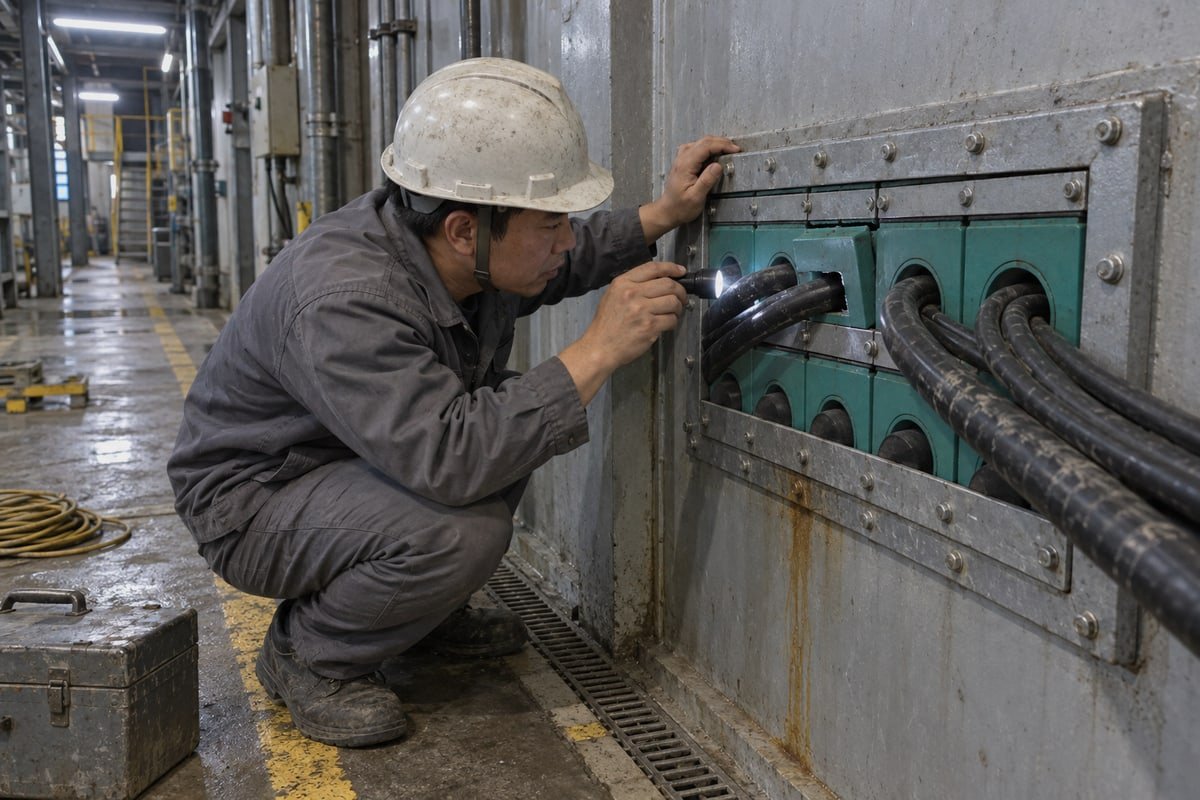
Every month our engineers review customer inspection photos where MCT fire-stopping failure began as one loose module. Left alone, that gap spreads fire, smoke, and water. It is fixable.
MCT fire-stopping failure breaks compartmentation, letting fire, smoke, heat, water, and pressure pass through a rated bulkhead or deck, and voids the tested listing. Compliant temporary fixes are tested intumescent fire pillows, approved interim closures, and administrative controls used only until certified replacement modules are installed.
A failed Mehrfachkabeldurchführung 1 is not just a hole in a wall. It is a breach of a multi-hazard barrier. Below, I walk through how to spot the problem early, what you may use as a stop-gap, which documents prove your system still performs, and how to bring in a second-source module without opening a compliance gap.
How can I identify early warning signs of MCT fire-stopping failure before an audit flags them?
During a final compression check on a TSC module batch, our QC lead found one stay plate sitting visibly proud. That small offset is exactly what auditors look for.
Early warning signs of MCT fire-stopping failure include uneven compression bolts, gaps around cables, hardened or cracked rubber, missing stay plates, unsealed spare modules, water stains or corrosion on the frame, and undocumented cable additions. Inspect frames visually and with a feeler gauge on a fixed schedule.

Why a packed-looking frame can still fail
Some contractors tell me a transit that still looks full is fine. I understand the logic. But the listing does not certify appearance. It certifies a tested assembly under a defined compression. When the compression unit relaxes, the EPDM stops pressing against the cable jacket. Hot gas finds that path first. Smoke and gas leakage usually appears long before flame does. It is the quieter danger, because it fills escape routes and blinds crews while the flame is still on the far side.
A short field checklist
| Warning sign | What it usually means | What to do next |
|---|---|---|
| Compression bolts at different heights | Compression wedge failure or uneven tightening | Re-torque per the tested instruction; check for permanent set |
| Visible daylight or a feeler gauge slides beside a cable | Wrong module size or lost core layers | Mark the opening as defective; plan replacement |
| Rubber is hard, glossy, or cracked | Heat, UV, or chemical aging | Replace the full module set, not one block |
| Rust streaks or water marks below the frame | Water ingress; watertight rating already lost | Treat as a fire and flooding defect together |
| Cables added but no updated packing record | Field modification without re-sealing | Audit the frame against the drawing |
| Missing or bent stay plates | Frame fill is unsupported under pressure | Stop and rebuild the stack |
What we see most often
Cable transit system integrity rarely fails all at once. In the returned frames our team examines, the pattern is usually the same. Someone added two cables during a retrofit. They pulled a spare module, pushed the cables through, and did not peel the step-core layers to the right diameter. The compression unit was never re-set. Two years later, vibration finished the job. Wrong sizing, packing errors, later modifications, and aging cover almost every case I have seen.
Monitoring is moving beyond the eye
Some operators in naval and data-center specs now ask for fiber-optic sensors 2 embedded in the frame to track compression over time. We have not seen it become common in BESS containers yet, but the direction is clear. Until then, a torque check and a feeler gauge on a fixed interval remain the most reliable low-cost signal. Write the reading on the nameplate record. An auditor trusts a dated number far more than a memory.
What are the compliant temporary fixes I can use until certified replacement modules arrive?
Speed versus certification is the trade-off we weigh with every urgent spare-module order. A quick field patch restores operations today. An untested patch also transfers liability to you.
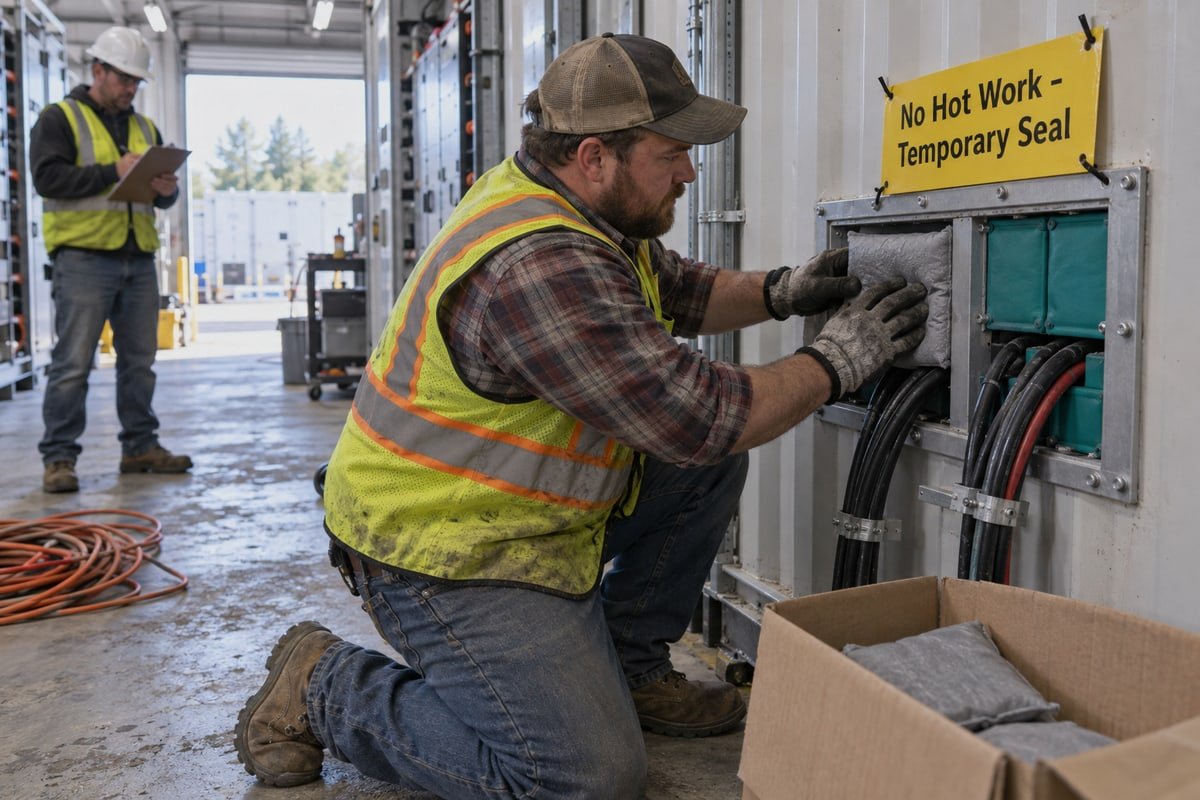
Compliant temporary fixes are tested intumescent fire pillows in open MCT frames, approved fire-rated sealants or mastics for small voids where listed for that transit type, and administrative controls such as isolating the opening, banning nearby hot work, and documenting the defect. Untested foam, tape, or caulk is not acceptable.
What counts as a compliant interim measure
Temporary does not mean unregulated. That is the single point I repeat most to maintenance teams. Passive fire protection only works if every part of the barrier has a tested basis, even the stop-gap. STI's marine guidance specifically describes firestop pillows 3 as a temporary firestop around open MCT frames, sleeves, and access ports, one that can be removed and reused once the final installation goes in. That is the model to follow: a product that was tested for that opening, used for a limited period, and then taken out.
| Interim method | Where it fits | Conditions for use | Duration |
|---|---|---|---|
| Intumescent fire pillows | Open or partly packed MCT frames, sleeves, scuttles | Product must be listed for that opening type and orientation | Short-term, removed at permanent repair |
| Fire-rated sealants or intumescent mastics | Small voids or cracks around an otherwise intact module | Only where part of a tested repair method for that transit and wall type | Short-term, until re-packing |
| Engineered temporary closure device | Larger openings with no cables installed yet | Approved for that exact size and barrier rating | Short-term, documented |
| Administrative controls | Any defective opening | Isolate area, restrict hot work, post the defect, schedule repair | Until permanent restoration |
The objection from the deck
Marine operations teams often push back here. Their priority is schedule and keeping the vessel watertight. I respect that. But the surveyor's priority is certified fire and pressure performance under SOLAS fire safety regulations 4 and class society rules. A pillow restores a thermal and smoke barrier. It does not restore IP68 or a hydrostatic rating. So in a below-waterline bulkhead penetration seal, the temporary fix must be paired with a flooding-risk assessment, not treated as a full solution.
A six-step response we recommend
- Identify the failed frame and photograph it with a scale reference.
- Isolate the compartment side that holds combustibles or sensitive electronics.
- Document the defect, the cable count, and the module sizes on the frame record.
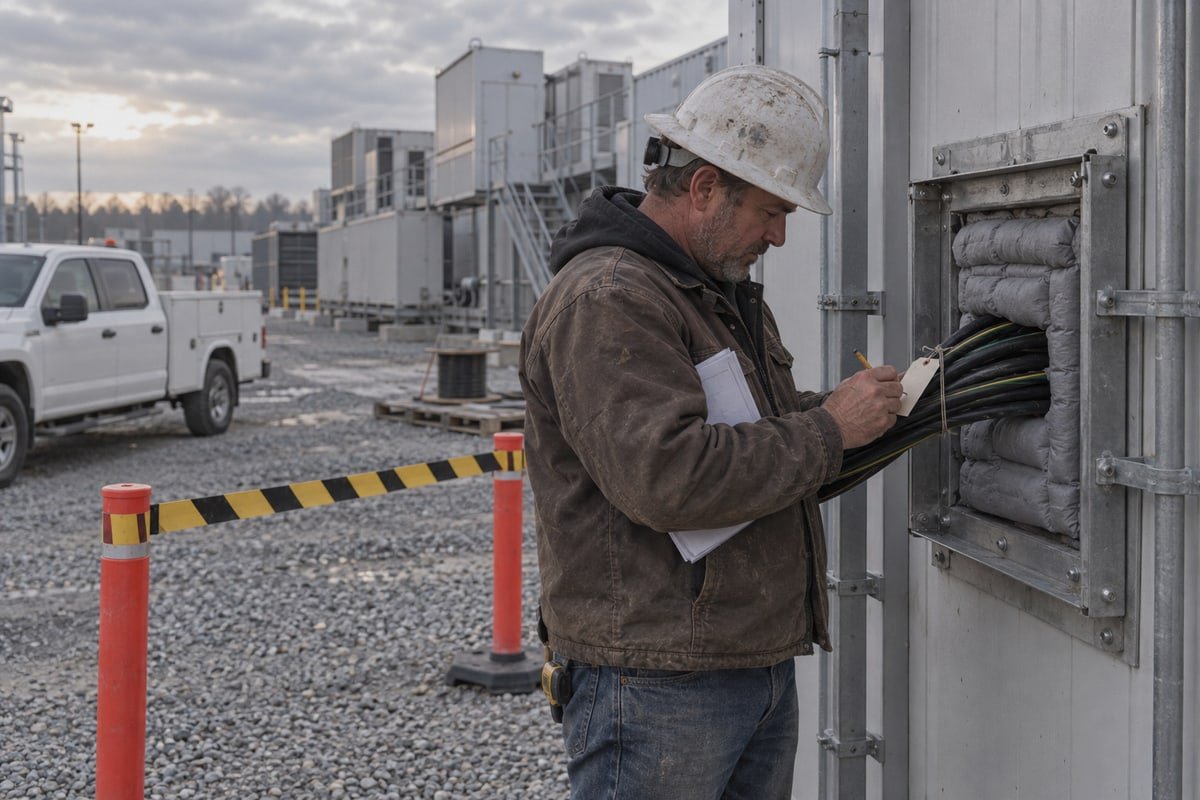
- Temporarily protect the opening with a tested interim product.
- Inspect adjacent frames, because the same installer usually made the same mistake twice.
- Permanently restore with certified modules and re-set the compression unit to the tested value.
Our factory ships spare sealing modules fast for exactly this reason. The interim measure buys days, not months.
Which certification and test documents should I request to confirm my MCT system still meets fire and IP68 ratings?
A sourcing engineer in Rotterdam once replied to our quote with a single line: send the test reports first. We did, and that is the right order.
Request the fire test report showing A-0 or A-60 class per marine fire safety standards, the class society or BV approval certificate, IP68 ingress test report, watertight and gas-tight pressure test data at 0.01–0.4 MPa, material data sheets for the EPDM, and the installation instructions the tests were based on.

The document set, and what each one proves
I keep a standard pack ready for every buyer who asks. The reason is simple. A certificate without its supporting test report tells you very little, and a test report without the installation instruction cannot be reproduced in your frame.
| Document | What it proves | Question to ask the supplier |
|---|---|---|
| Fire test report, A-0 / A-60 class | The transit held integrity and insulation for the rated period in a bulkhead or deck test | Which frame size, module sizes, and cable fill were tested? |
| Class society approval (BV-approved factory in our case) | The factory and product are audited against marine fire safety standards | Is the approval still within its validity date? |
| IP68-Eindringschutz-Prüfbericht | Dust and immersion protection at the tested depth and time | At what depth and duration, and with which cable types? |
| Watertight and gas-tight test data, 0.01–0.4 MPa | Sealing under pressure from the unprotected side | Was it tested from both sides of the frame? |
| EPDM-Materialdatenblatt | Halogen-free composition, hardness, aging behavior | Is the compound the same one used in the fire test? |
| Installation and compression instruction | The exact torque and packing method the tests assumed | Does my current stack match this drawing? |
| ISO 9001 und IATF 16949 Zertifikate | Process control and traceability behind each batch | Can you trace my module batch to a raw-material lot? |
Why hydrostatic pressure testing belongs in a fire discussion
Buyers sometimes ask why I bring up water when the topic is fire. The answer is that the same compression that stops flame also stops water. Hydrostatic pressure testing is the fastest way to prove the seal is still under tested compression. If a frame passes at 0.4 MPa today, its rubber has not relaxed. If it leaks at 0.01 MPa, the fire rating is already suspect, even without a fire test. We treat the two as one measurement of cable transit system integrity.
The instruction sheet is the hidden certificate
The listing applies to the assembly as tested. That includes the stay plate spacing, the number of spare modules, and the compression value. When a customer sends us a frame photo, the first thing our engineers compare is the stack against the tested drawing. A frame packed with the right modules in the wrong arrangement is not the tested assembly. Ask for the drawing. Then compare it to the wall.
How do I switch to a drop-in second-source MCT module without risking compliance gaps during replacement?
One lesson from years of second-source qualification: dimensional fit is the easy part. The paperwork gap between old and new modules is where compliance quietly breaks.
Switch safely by confirming 120-frame dimensional compatibility with a cross-reference table, testing free validation samples in your actual frame, matching fire, IP68, and pressure certificates to the original listing, replacing complete module sets rather than mixing brands, and re-torquing compression units per the tested instructions.
A qualification sequence that closes the gap
Our TSC and TSR modules are dimensionally compatible with common 120-frame standards, so they fit existing cutouts. That solves geometry. It does not automatically solve certification. The steps below are what we walk a purchasing engineer through before a first production order.
- Send us the existing module list. We return a cross-reference table mapping each existing model to the DEWIN equivalent, with CAD or STEP 5 files.
- Request free validation samples and fit them in one live frame, not a bench mock-up.
- Match our A-0/A-60, IP68, and 0.01–0.4 MPa test documents against the rating your original design required.
- Decide the replacement scope per frame. Replace the whole module stack in a frame, so the tested assembly is one system with one instruction.
- Re-set the compression unit to our tested value and record it on the nameplate.
- Update the frame drawing and the penetration register before the surveyor visits.
| Risk during changeover | How it shows up | How we close it |
|---|---|---|
| Mixed brands in one frame | Two instruction sheets, two compression values | One full stack per frame, one instruction |
| Halogen or smoke behavior mismatch | Different toxicity data in the fire report | Halogen-free EPDM with material data supplied |
| Diameter range mismatch | Cable slightly outside the module's step-core range | Step-core design covers a range within one module size; sample check confirms fit |
| Missing spare capacity | No blank modules for future cables | Spare sealing parts included in the same batch |
| Lead-time slip mid-project | Temporary fix stays in place too long | Fast spare-module delivery from Shaanxi, Shandong, or Hunan plants |
The objection I hear most: is cheaper really safe?
A 40–60% lower unit cost makes skeptical buyers nervous. I understand. The answer is not a promise. It is the document pack above, a BV-approved factory, 38+ granted patents, and a sample you test in your own frame. Since 2013 we have positioned ourselves as a qualified second source, not a discount substitute. Compression wedge failure, module mismatch, and undocumented changes cause MCT fire-stopping failure far more often than the brand on the rubber does. The switch is safe when the evidence matches, and unsafe when it does not.
Fazit
MCT fire-stopping failure is a multi-hazard breach. Spot it early, protect it with tested interim measures, prove performance with documents, and replace with validated modules.
Fußnoten
1. Wikipedia entry defining multi-cable transit systems used to seal cable and pipe penetrations. ↩︎
2. IEEE is a leading authority on technical standards for electronic equipment and sensor technologies. ↩︎
3. Wikipedia entry explaining firestopping methods and materials used to maintain fire-resistance ratings of walls and floors. ↩︎
4. The IMO sets international standards for the safety and security of shipping and the prevention of pollution. ↩︎
5. ISO standards define the STEP format for the exchange of product model data in CAD systems. ↩︎



 English
 Español de México
 Deutsch
 Français
 العربية
 Русский