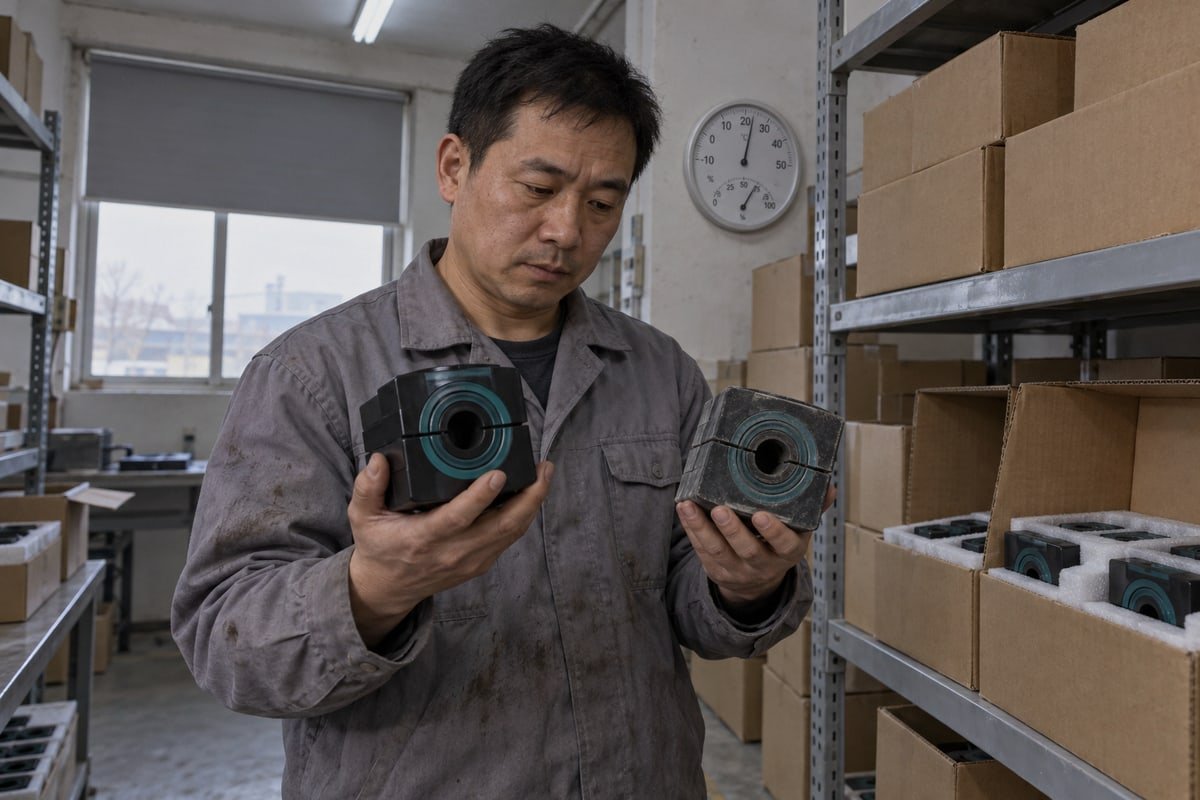
A buyer once emailed our factory about the shelf life and storage requirements for rubber MCT modules after his stocked seals hardened ISO 2230-style storage charts 1. Spares that fail before install stall whole projects.
Die Haltbarkeit von Gummi-MCT-Modulen in EPDM beträgt 5–10 Jahre unter Standard-Gummi-Diagrammen und 10–20 Jahre bei kontrollierter Innenlagerung. Lagern Sie sie bei 15–25°C, unter 75% Luftfeuchtigkeit, fern von UV-Strahlung, Ozon und Chemikalien, spannungsfrei in versiegelter Originalverpackung.
Those numbers are a starting point, not a promise. The exact figure depends on the compound, the cure date, and how the modules were kept. Below I break down each part of the question so you can plan stock with confidence.
How long can I store EPDM rubber MCT modules before they degrade or lose their sealing performance?
During an incoming-material check at our Shaanxi plant, we compared a fresh EPDM batch against retained samples from years earlier. The hardness gap told the shelf-life story clearly.
EPDM rubber MCT modules fall into the 5–10 year group in ISO 2230-style storage charts, and many cable transit suppliers quote 10–20 years for sealed, temperature-controlled indoor storage. Beyond that window, hardness rises, compression set grows, and the module may no longer hold its rated seal.

The first thing I ask a buyer to separate is shelf life from service life. MIL-HDBK-695 defines shelf life as the maximum period between cure and the first removal from storage for installation. During that period, a properly stored part should keep its original characteristics. Service life starts the moment the module is compressed inside a frame. Both clocks matter, but they do not run at the same time.
Why one chart says 5–10 years and another says 10–20
This is the objection I hear most. A generic rubber storage chart 2 puts EPDM alongside neoprene, nitrile, and butyl in the 5–10 year group. Yet SERP results for MCT modules quote 10 to 20 years. Both can be right. The generic chart assumes an unknown compound and average storage. The longer figure assumes a specific halogen-free elastomer, a sealed pack, and a controlled indoor store. The rule I give buyers is simple: use the manufacturer's stated figure for the exact module when you have it. When you do not, fall back to the elastomer-family baseline and inspect before use.
| Elastomer group | Baseline shelf life in ISO 2230 / MIL-HDBK-695 style charts | Where you see it |
|---|---|---|
| Natural rubber, SBR, polyisoprene, polyurethane | 3–5 years | General-purpose gaskets, bumpers |
| EPDM, neoprene, nitrile, butyl, HNBR, ACM, ECO | 5–10 years | Cable transit sealing system modules, weather seals |
| Silicone, FKM, FFKM | 10–20 years | High-temperature and chemical-duty seals |
| Uncured compound stock | 3–12 weeks | Factory raw material, not finished parts |
What actually happens to EPDM in storage
EPDM rubber degradation is slow, but it is not zero. The material aging characteristics show up as three changes. First, surface oxidation makes the skin harder and slightly chalky. Second, cross-link creep raises compression set, so the module springs back less after the compression wedge assembly is tightened. Third, factory lubricant migrates or dries. Our fire-rated modular seals 3 rely on the EPDM staying elastic enough to fill the gap around the cable. Once hardness climbs, the IP68 and A-60 ratings we test at the factory are no longer guaranteed in the field. That is why I treat the shelf-life window as a hard planning limit, not a soft suggestion.
What storage conditions—temperature, humidity, and UV exposure—do I need to maintain for my rubber sealing modules?
The trade-off I weigh in our own finished-goods store is climate-control cost versus scrapped stock. A modest storeroom upgrade usually beats replacing a pallet of seals.
Store rubber sealing modules at 15–25°C, never above 38°C, with relative humidity below 75%. Block direct sunlight and strong artificial light, keep them away from ozone sources like motors and transformers, isolate them from solvents and oils, and leave every module relaxed with no compression or bending.
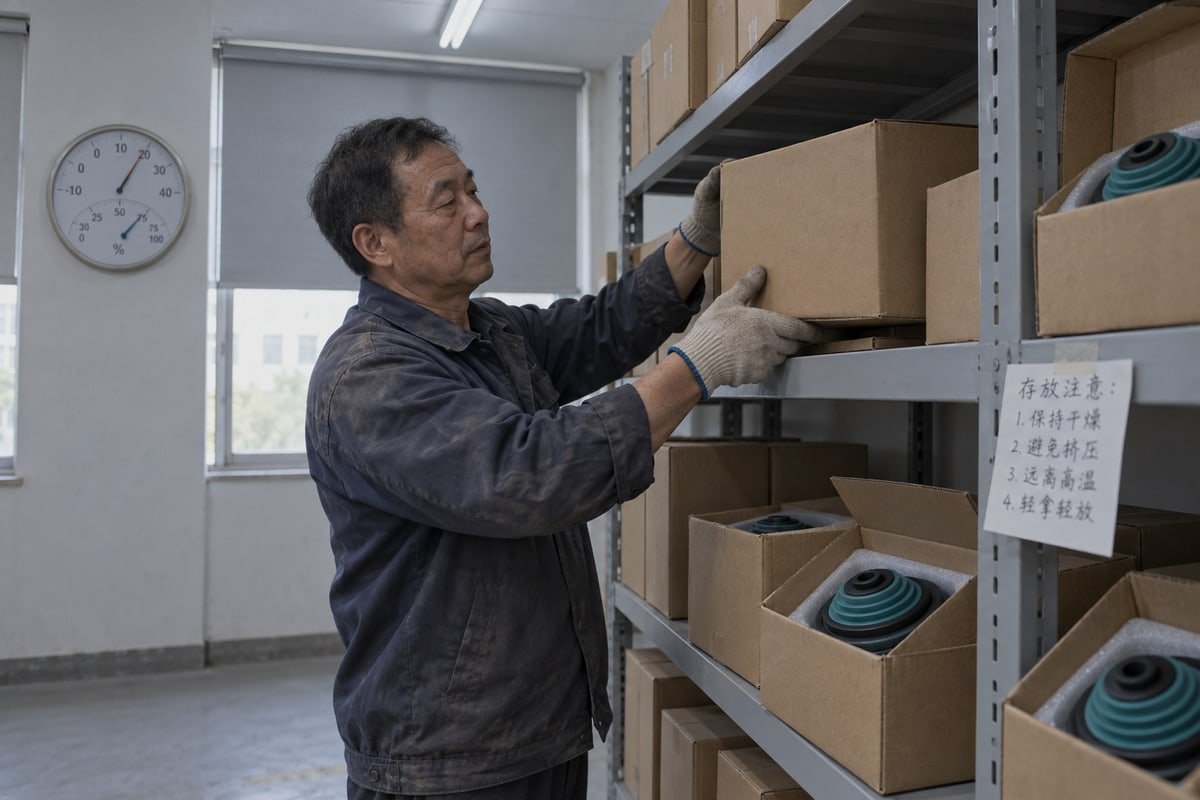
Every one of these limits targets a specific failure mode. I find buyers accept the rules faster when they understand what each one prevents. The table below is the same checklist we hand to distributors who stock our TSC square modules and TSR round assemblies.
| Factor | Target | What it prevents | Typical failure sign |
|---|---|---|---|
| Temperature | 15–25°C (59–77°F); absolute ceiling 38°C (100°F) | Accelerated cross-linking and hardening | Loss of elasticity, layer fusion |
| Relative humidity | Below 75% (65–75% in stricter charts) | Moisture uptake, packaging breakdown | Swollen cartons, surface bloom |
| Light | No direct sunlight or intense artificial light | Surface oxidation, crazing | Fine surface cracks, dull skin |
| Ozone | No motors, welders, transformers, or high-voltage gear nearby | Deep structural cracking | Cracks perpendicular to stress lines |
| Chemicals | No solvents, oils, fuels, or reactive vapors in the same room | Swelling, softening | Tacky or gummy surface |
| Mechanical strain | Relaxed, flat, no hanging or compression | Permanent deformation, compression set | Distorted grommet steps |
| Vibration | Away from heavy machinery and forklift lanes | Surface fretting between modules | Abraded contact faces |
UV and ozone protection: the two invisible enemies
Sunlight through a warehouse skylight is enough to craze an EPDM face over a few seasons. Ozone is worse because you cannot see the source. An electric motor on a nearby conveyor, a welding bay, or a transformer room all generate ozone. Ozone attacks stressed rubber 4 first, so any module left bent or stacked under load cracks along the stress line. Good UV and ozone protection means opaque packaging plus physical distance from that equipment. Temperature-controlled storage on its own does not solve either problem.
Layer fusion: a problem specific to step-core modules
Unsere step-core design lets one module size adapt to a range of cable diameters. The installer peels away layers until the core matches the cable. That feature creates a storage risk that flat gaskets never face. Heat above the 38°C ceiling, combined with the weight of a tall stack, can make the layers bond to each other. The buyer then cannot peel them cleanly and the module becomes unusable. Stack low, keep cool, and the layers stay separable for the full shelf-life window.
How can I verify if my stocked MCT modules are still within their usable shelf life before installation?
A European sourcing manager once sent us photos of unmarked modules and asked whether to trust them. My answer started with the cure date, not the photos.
Check the cure date or batch code against the manufacturer's stated shelf life first. Then inspect each module for cracking, crazing, hardening, tackiness, chalking, or fused step-core layers, confirm the layers still peel freely, and test a sample in a compression wedge assembly for sealing performance.
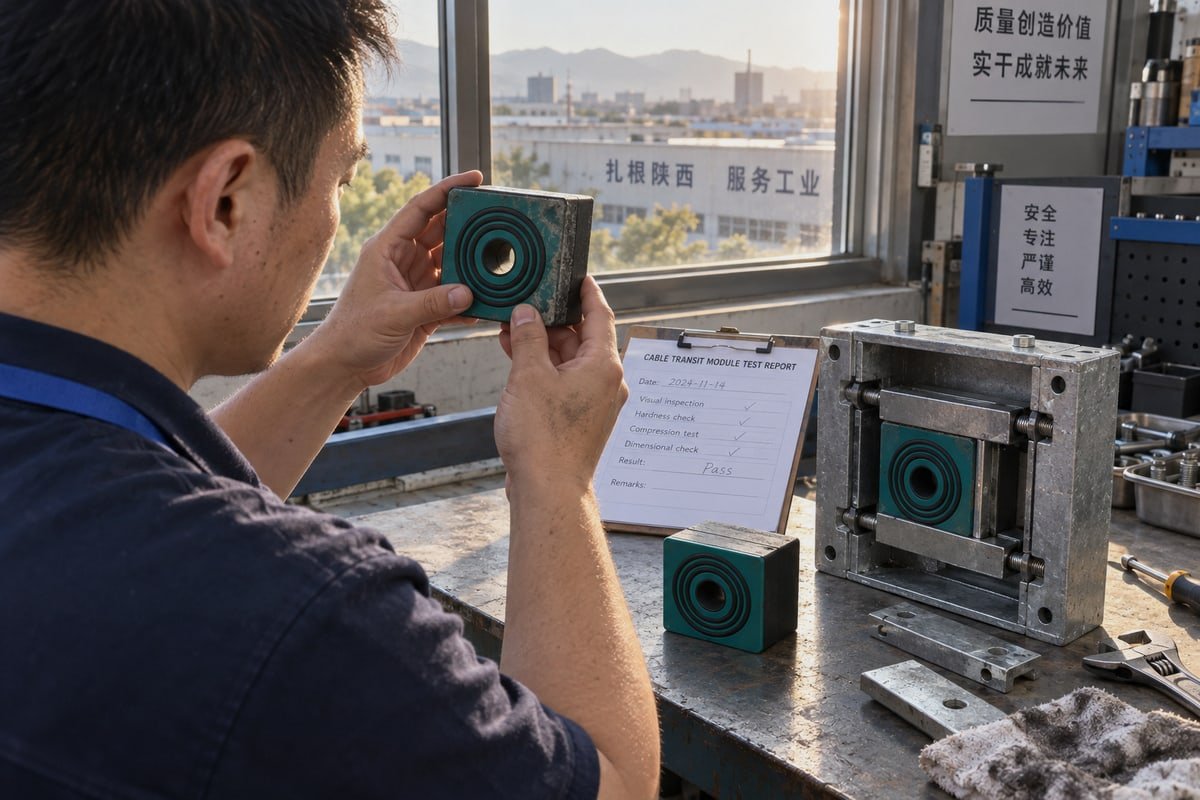
Verification is a sequence, not a single glance. I walk buyers through five steps. Each step either clears the batch or sends it to the next check. Skipping ahead is how good-looking but expired modules end up in a switchgear panel.
The five-step verification sequence
- Read the date code. Every module we ship carries a batch code tied to a cure date on the packing list. Subtract that date from today. If the result exceeds the stated shelf life, stop here and quarantine the batch.
- Check the packaging. A torn, faded, or swollen bag means the module saw light, moisture, or heat. Treat the contents as suspect even if the date is fine.
- Inspect the surface. Use the table below. Bend a corner gently and watch for crazing. Press a thumbnail into the face; it should recover fully within seconds.
- Peel one layer. On a step-core module, the outermost layer must separate cleanly with hand force. Sticking or tearing points to layer fusion.
- Run a functional check. Fit a sample into a frame with a compression wedge assembly, tighten to the normal torque, and perform watertight integrity testing at the rated pressure. Our modules are tested at 0.01–0.4 MPa for watertight and gas-tight sealing, and that same test is the final word on an aged batch.
| Observation | Likely cause | Decision |
|---|---|---|
| Fine surface cracks (crazing) | UV or ozone exposure | Reject |
| Hard, glossy, or chalky skin | Heat aging, oxidation | Reject |
| Tacky or gummy feel | Chemical vapor contact | Reject |
| Dry, dull face with no lubricant | Lubricant migration in long storage | Re-lubricate and retest |
| Layers will not peel | Heat plus stacking pressure | Reject |
| Slight dust, clean packaging, full recovery on press test | Normal long storage | Accept after functional test |
When shelf-life extension is allowed
Some standards permit an extension after a documented inspection for elastomers in the EPDM group. The extension length depends on the standard and on manufacturer policy. I advise buyers to ask the supplier in writing before relying on it. For critical infrastructure, a growing number of integrators now track cure dates through QR codes on each carton. The scan feeds a FIFO rotation system and produces an audit trail for marine and offshore certifications 5 or BESS site inspections. It costs little and removes guesswork from the shelf life and storage requirements for rubber MCT modules across multiple warehouses.
What packaging and warehousing practices should I follow when stockpiling spare rubber sealing modules for future projects?
One lesson from our spare-module shipments to the Middle East: sealed inner bags matter more than sturdy outer cartons. Cartons stop knocks; bags stop moisture.
Keep spare rubber sealing modules in their original sealed, opaque packaging, stacked flat and no more than a few cartons high, in a temperature-controlled indoor store away from motors, welders, and solvents. Label every carton with cure date and batch, rotate stock first-in-first-out, and re-inspect annually.
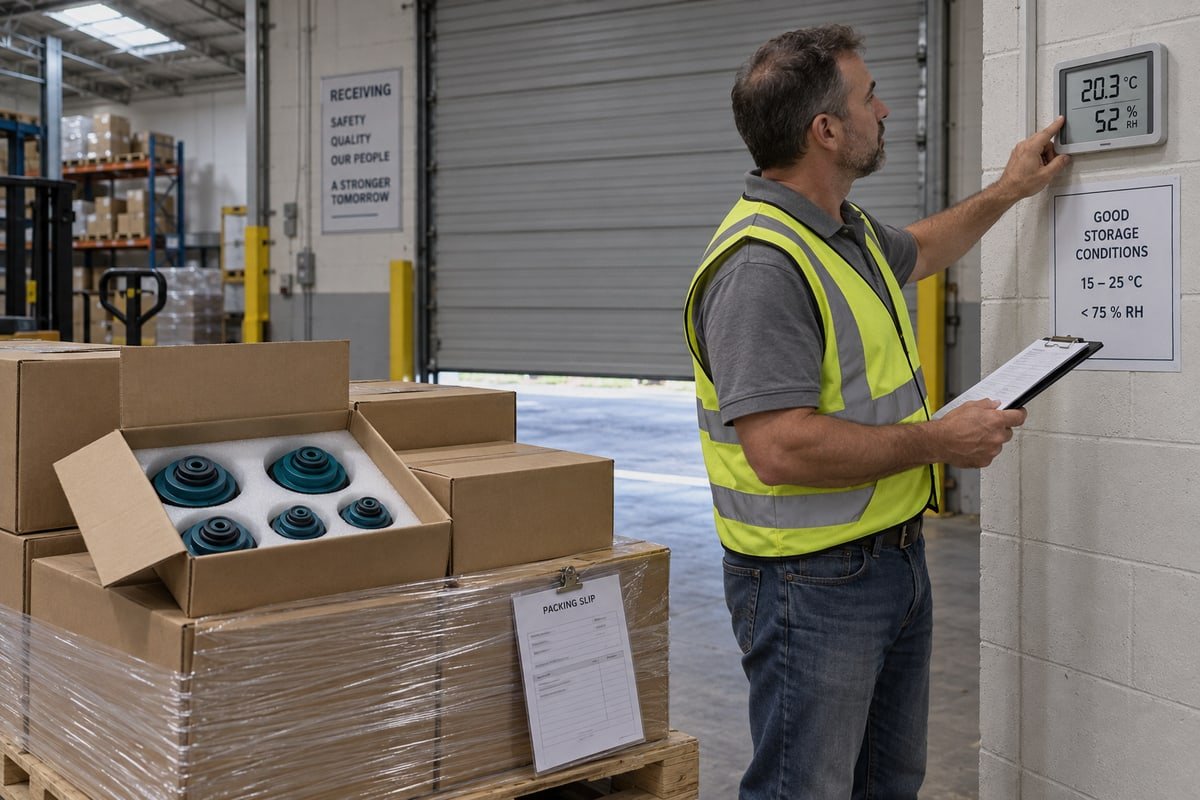
Stockpiling spares is smart for a data center builder or an EPC contractor. Lead times on odd sizes can hurt a schedule. The risk is that the spares age faster than the installed seals. Good packaging and warehousing practice closes that gap. Below is how I structure the advice for a purchasing engineer setting up a spares program.
Packaging: what to ask for from the supplier
Ask for opaque, moisture-proof inner bags that are heat-sealed, not folded. Ask that modules lie flat inside the bag with no bending. Ask for the cure date and batch code printed on both the bag and the carton. When we ship private-label modules, we apply the buyer's own label format so their warehouse system reads it without re-labeling. Ask for the test documents too. A batch that ships with fire-rating and IP68 test reports is easier to requalify years later than one with nothing but a delivery note.
Warehousing: do and do not
| Do | Do not |
|---|---|
| Store at 15–25°C with humidity logged | Leave cartons in a shipping container in summer |
| Stack flat, low, and on pallets off the floor | Stack pallets high enough to compress lower cartons |
| Place racks away from motor rooms and welding bays | Store beside the compressor or forklift charging station |
| Keep solvents, oils, and paints in a separate room | Share a shelf with cleaning chemicals |
| Rotate first-in-first-out by cure date | Pull from the nearest open carton |
| Re-inspect and re-lubricate samples yearly | Assume sealed cartons never need checking |
Why micro-vibration matters more than people think
Heavy machinery sends low-level vibration through a warehouse floor. Over years, modules in a carton rub against each other. That fretting abrades the contact faces that seal against the frame and neighboring modules. The wear is small, but it can be enough to compromise a certified pressure-seal rating. Place spares on the quietest side of the building. Rubber foam dividers between modules also help.
A buyer's note on second sourcing spares
When a European integrator keeps spares for an existing 120-frame system, they often stockpile the original brand at full price. Because our TSC and TSR modules are dimensionally compatible with common 120-frame standards, a buyer can hold DEWIN spares as a qualified second source at 40–60% lower cost. We supply a cross-reference table mapping existing model numbers to ours, and free validation samples so your team can run the same peel test and watertight check before committing. That way the spares budget stretches further without changing the storage requirements for rubber MCT modules already in your procedure.
Fazit
Aged spares fail quietly and expensively. Track cure dates, hold 15–25°C and under 75% humidity, keep out UV and ozone, inspect before install, and source spares smartly.
Fußnoten
1. Official ISO standard for the storage of vulcanized rubber products. ↩︎
2. US Department of Defense standard for elastomer shelf life and storage. ↩︎
3. Technical overview of multi-cable transit systems used for fire and water sealing. ↩︎
4. Environmental agency data on ozone pollution and its effects on materials. ↩︎
5. International maritime authority governing safety and watertight integrity standards for ships. ↩︎



 English
 Español de México
 Deutsch
 Français
 العربية
 Русский