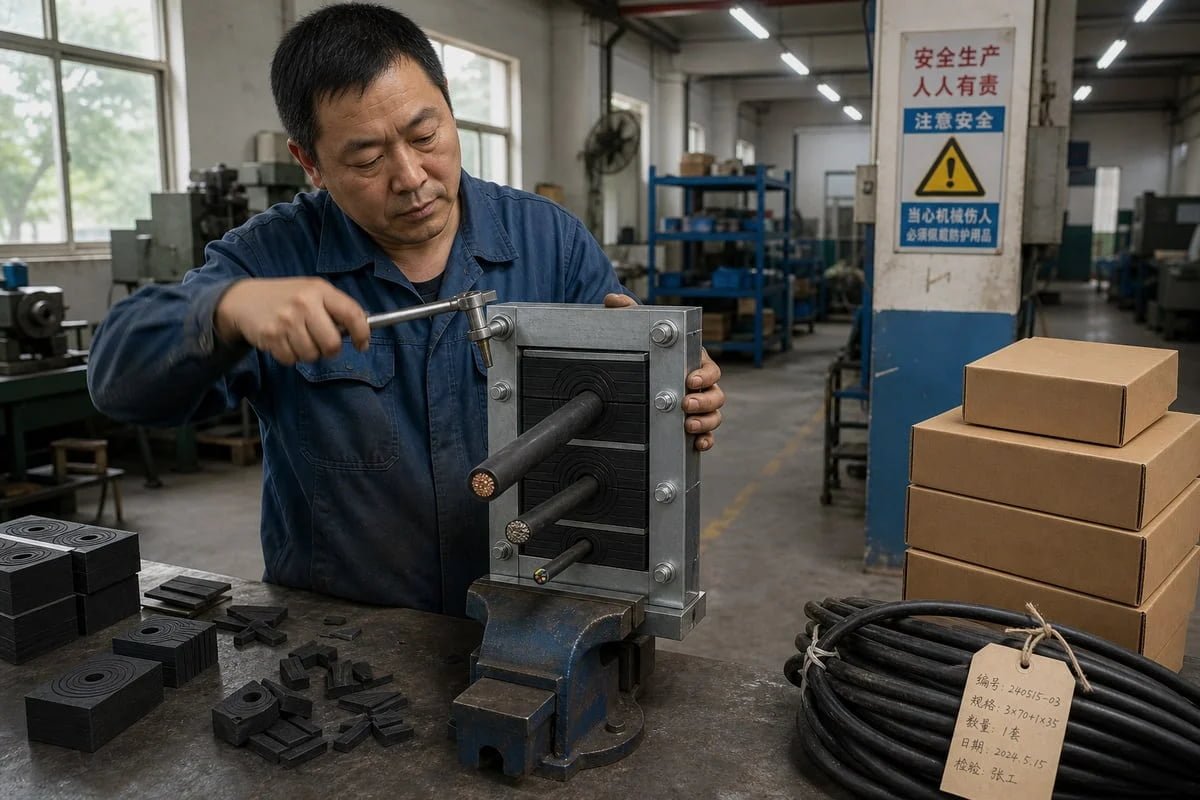
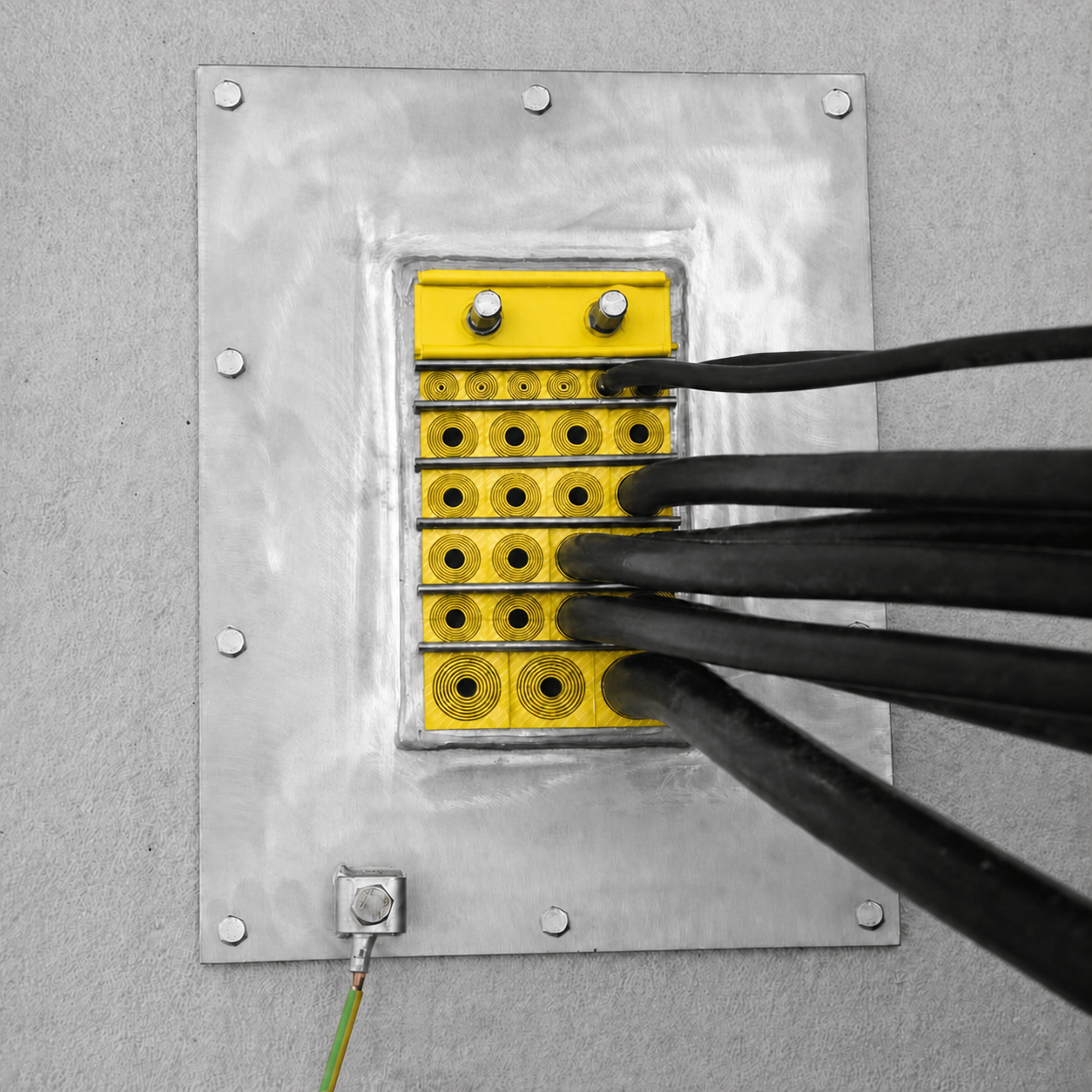
Eine einzige undichte Kabeldurchführung kann einen BESS-Container überfluten oder den Brandschutz zunichte machen. In unserer Produktionslinie dient die Mehrfach-Kabeldurchführungsabdichtung dazu, ein solches Versagen von vornherein zu verhindern.
Eine Mehrfach-Kabeldurchführungsabdichtung funktioniert durch das mechanische Komprimieren von elastomeren Gummimodulen in einem starren Rahmen. Installateure ziehen abziehbare Schichten ab, um sie an den jeweiligen Kabeldurchmesser anzupassen, stapeln die Module zwischen Ankerplatten und ziehen dann eine Presseinheit fest, sodass sich der Gummi ausdehnt und eine feuerfeste, wasser- und gasdichte Barriere bildet.
Das ist die kurze Antwort. Aber wenn Sie einen Zweitlieferanten qualifizieren, benötigen Sie mehr als nur das Prinzip. Sie müssen wissen, wie die Abdichtung zustande kommt, wie Sie die Maßkompatibilität überprüfen, welche Prüfdokumente Sie anfordern müssen und wie Sie Muster validieren, bevor Sie sich festlegen. Ich werde im Folgenden auf jede dieser Fragen eingehen und dabei auf das zurückgreifen, was wir täglich in unserer eigenen Produktion sehen.
Wie erreichen komprimierte Gummimodule eine wasser- und gasdichte Abdichtung in meinem MCT-System?
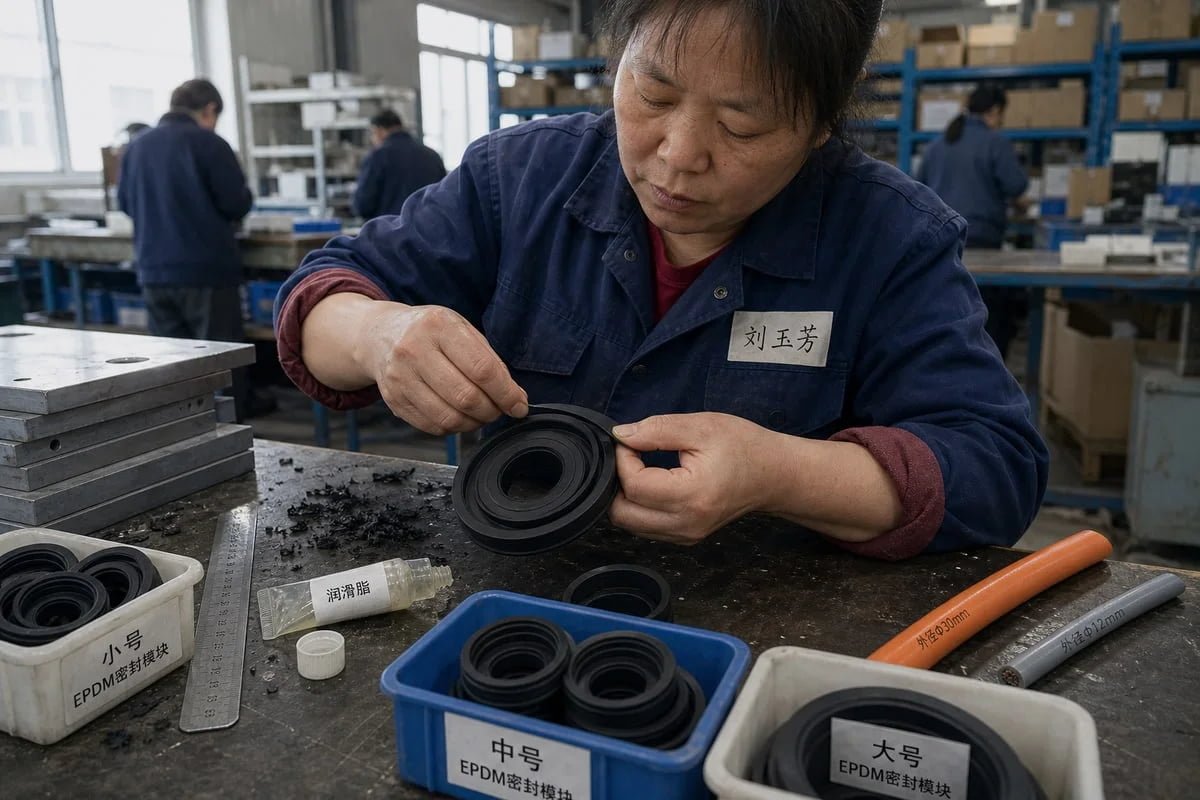
Jede Charge von EPDM-Modulen 1 auf unserer Linie wird vor dem Verpacken einer Kompressionsprüfung unterzogen. Dieser Test wird durchgeführt, weil die Dichtung nur dann funktioniert, wenn sich der Gummi exakt wie vorgesehen verformt.
Komprimierte Gummimodule dichten durch mechanische Verformung ab. Wenn die Presskeileinheit festgezogen wird, dehnt sich jedes Elastomermodul nach innen gegen den Kabelmantel und nach außen gegen den Rahmen aus, wodurch Hohlräume vermieden werden und ein kontinuierlicher Anpressdruck entsteht, der Wasser, Gas, Rauch und Feuer blockiert.
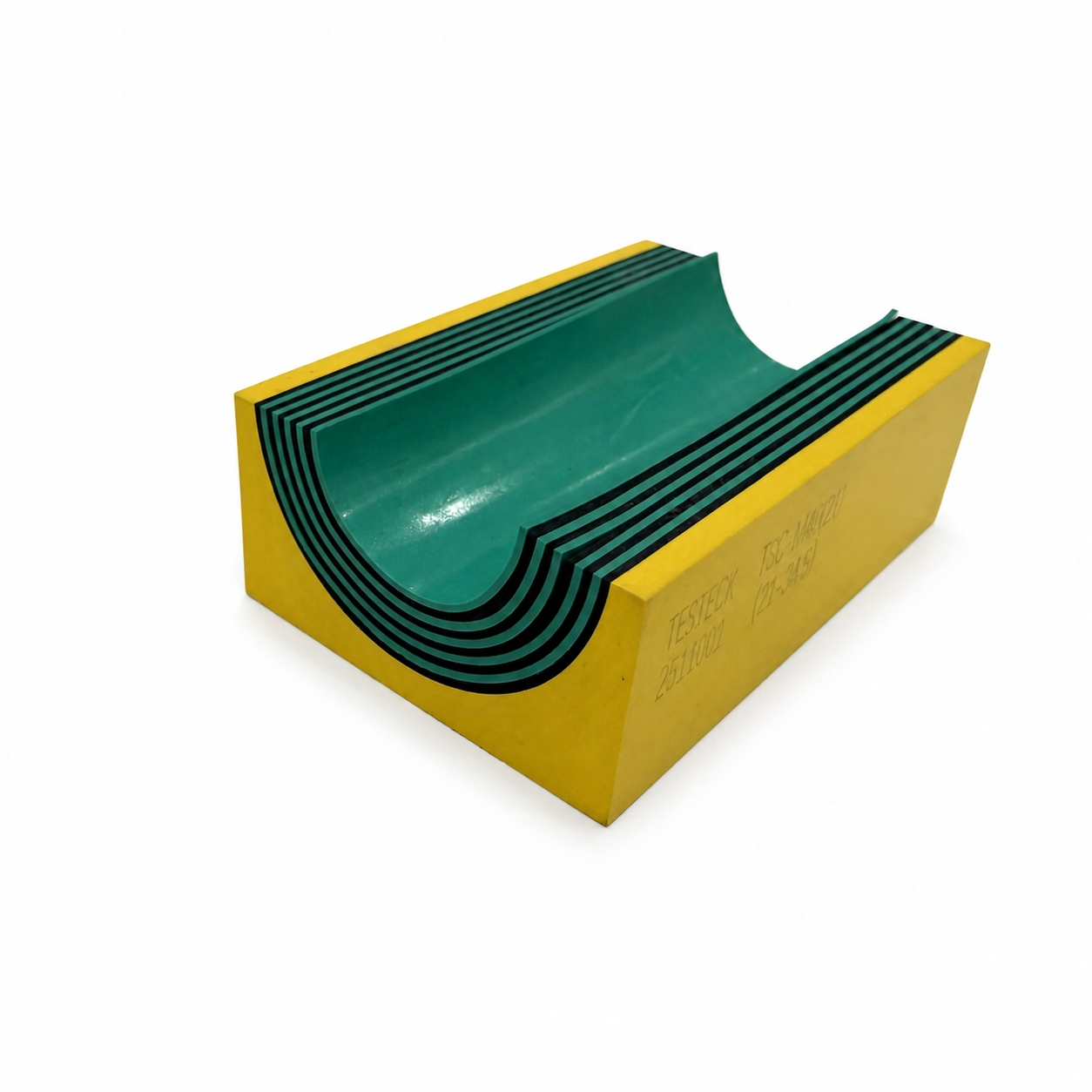
Das System ist eine Frage der Passgenauigkeit, keine Stopfarbeit. Vier Teile arbeiten zusammen: ein starrer Rahmen, der in die Wand, das Deck oder die Platte eingeschweißt oder eingeschraubt ist; Elastomer-Dichtungsmodule 2; Ankerplatten und Rahmen, die die Reihen beim Festziehen in Position halten; und die Kompressionseinheit, die die Dichtkraft erzeugt. Wenn auch nur eines dieser Teile fehlerhaft ist, leidet die gasdichte Integrität der gesamten Durchführung.
Der Kompressions- und Expansionsmechanismus
Der Prozess folgt einem strengen Ablauf. Erstens zieht der Installateur konzentrische Schichten von jeder Modulhälfte ab, bis der Innendurchmesser 0,5–1,5 mm kleiner ist als der Außendurchmesser des Kabels. Dieses geringe Untermaß garantiert den Halt vor der endgültigen Kompression. Zweitens werden die Modulflächen geschmiert, damit die Blöcke luftfrei ineinandergleiten, während die Oberflächen, die das Kabel greifen müssen, sauber bleiben. Drittens werden die Module Reihe für Reihe mit Ankerplatten dazwischen gestapelt. Viertens werden die Schrauben schrittweise und über Kreuz angezogen, damit sich der Druck gleichmäßig verteilt. Schließlich sollte die Durchführung mindestens 48 Stunden lang nicht unter Druck gesetzt werden, da der Innendruck Zeit zum Ausgleichen benötigt, insbesondere bei niedrigen Temperaturen.
Es gibt noch einen bemerkenswerten Zusatzeffekt. Da der halogenfreie Gummi nicht leitend ist, wirkt die Durchführung als dielektrische Trennung zwischen der Kabelarmierung und der Stahlkonstruktion, was die galvanische Korrosion in Marine- und Offshore-Installationen verringert.
Kompressionsbasierte vs. dichtmittelunterstützte Systeme
Einige Lieferanten werden Ihnen sagen, dass ihre Module nur Führungen sind und ein Dichtmittel die eigentliche Arbeit erledigt. Das ist eine legitime Konstruktion, aber sie ist nicht gleichwertig, und Einkäufer sollten die beiden Systeme nicht als austauschbar betrachten.
| Eigenschaft | Kompressionsbasierte MCT | Dichtmittelunterstütztes System |
|---|---|---|
| Dichtkraft | Mechanisch, durch die Keildichtungseinheit | Chemische Haftung des Dichtmittels |
| Wiederöffnung für neue Kabel | Lösen, Module hinzufügen, wieder festziehen | Ausschneiden und Dichtmittel neu auftragen |
| Auszugs- und Vibrationsfestigkeit | Hoch, durch Anpressdruck | Begrenzt |
| Langzeitdruck | Geregelt durch Nachziehen oder federbelastete Einheiten | Abhängig von der Alterung des Dichtmittels |
| Typische Anwendung | Marine, Offshore, BESS, explosionsgefährdete Bereiche | Gebäudedurchführungen mit geringen Anforderungen |
One more engineering detail matters over decades: rubber undergoes viscoelastic relaxation, sometimes called cold flow. Advanced systems counter this with spring-loaded compression units that maintain constant sealing pressure as the material settles. Ask your supplier how their design handles it.
Kann ich bestätigen, dass diese Kompressionsmodule in meine vorhandenen 120-Rahmenausschnitte passen, ohne mein Panel neu zu entwerfen?
Last quarter, a Dutch switchgear builder sent us a frame drawing and asked one question: will your modules drop into our existing cutouts? We answered with measurements, not promises.
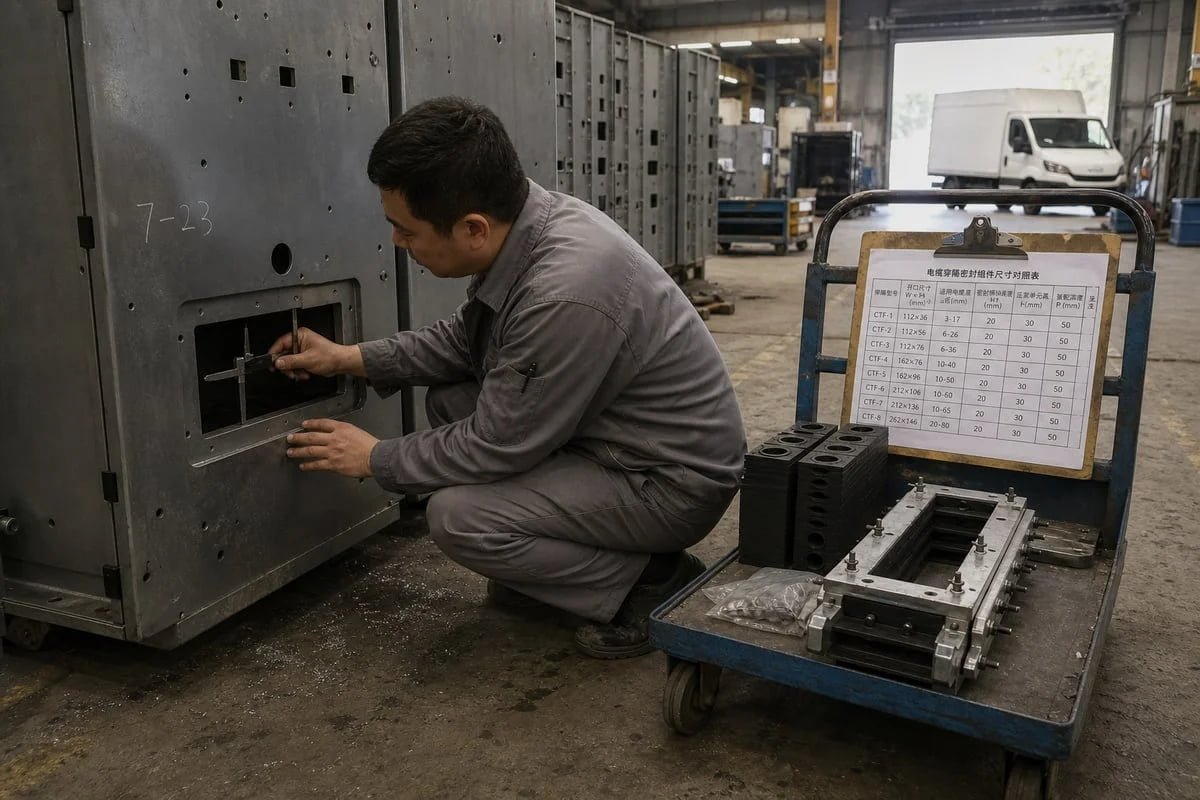
Ja. Module, die nach gängigen 120-Rahmen-Maßstandards gebaut sind, passen direkt in vorhandene Ausschnitte. Bestätigen Sie die Passform, indem Sie die Größe der Rahmenöffnung, die Modul-Grundfläche, die Packtiefe und den Weg der Kompressionseinheit mit einer Querverweistabelle des Lieferanten abgleichen, und überprüfen Sie dies vor der Bestellung mit einem kostenlosen Validierungsmuster.
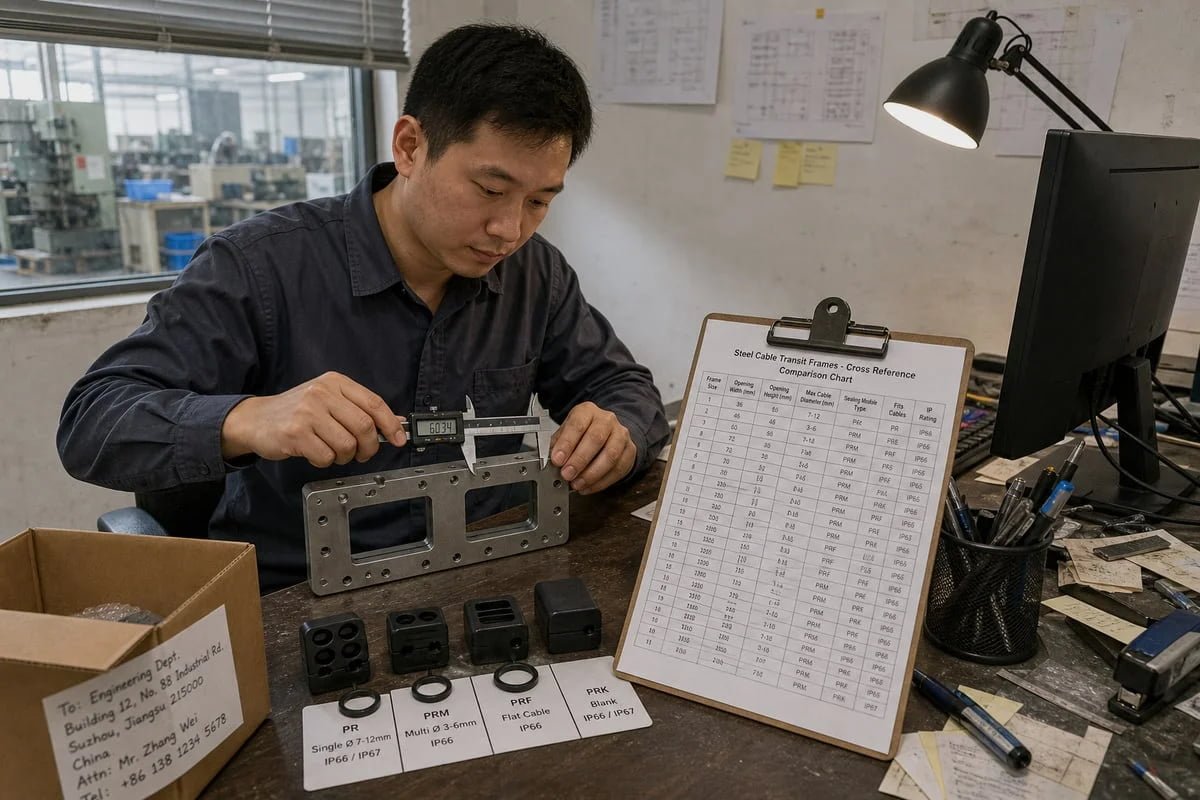
Dimensional compatibility is the whole point of second sourcing a modular cable entry system. If a switch forces you to re-cut panels, re-draw approvals, or re-train installers, most of the cost saving disappears. Our TSC square sealing modules and TSR round sealing assemblies were dimensioned from day one to match the common 120-frame standards, so they install in existing frames without any panel redesign. We support that claim with model cross-reference tables that map each existing module designation to the matching DEWIN model, plus free samples for physical verification.
The Dimensional Checks That Actually Matter
Here is the practical checklist we send buyers. It takes an afternoon with calipers and your current spec sheet.
| Check | What to verify | Why it matters |
|---|---|---|
| Frame opening | Internal width and height of your existing cutout | The stacked module rows must fill it exactly |
| Module footprint | Face dimensions of each module size | Mixed sizes must still complete each row |
| Module depth | Typically 60 mm; deeper modules exist | Depth scales hydrostatic pressure resistance |
| Cable diameter range | Peelable layer coverage per module size | One family can cover roughly 3.0–99.0 mm |
| Compression travel | Space needed by the wedge unit when open | The unit must close fully inside your frame |
Two of these deserve emphasis. Module depth is not cosmetic: a deeper module gives a higher bar-rated watertight cable seal, which is why sub-surface and flood-exposed applications specify deeper blocks. And cable diameter adaptability directly cuts your inventory, because one step-core module size accepts a range of diameters, so you stock fewer SKUs and still keep spare solid modules in the frame for future cables. Those spares can be swapped for cable-carrying modules later without disturbing the rest of the transit.
Welche Zertifizierungs- und Testdaten sollte ich anfordern, um die Brandschutzklasse und IP68-Leistung zu überprüfen, bevor ich den Lieferanten wechsle?
Early in our export business, we learned a lasting lesson: European buyers never accept a fire rating printed on a datasheet. They want the test report behind it. Rightly so.
Request the full fire test report showing A-0 or A-60 class for the complete assembly, an IP68 ingress test certificate, watertight and gas-tight pressure test data covering 0.01–0.4 MPa, plus ISO 9001, IATF 16949, and classification-society factory approval such as Bureau Veritas.
Certificates only mean something when they describe the exact assembly you will install. A fire-rated cable penetration 3 is tested as a system: frame, modules, stay plates, and compression unit together, in a defined bulkhead or deck construction. So when you review documents, match the tested configuration to your own build. An A60 fire class rating achieved in a 120-frame with 60 mm modules does not automatically transfer to a different frame or module depth.
The Document Checklist We Hand to Sourcing Teams
| Document | What it proves | What to look for |
|---|---|---|
| Fire test report (A-0 / A-60) | Passive fire performance of the full assembly | Tested frame type, module depth, cable loading |
| IP68 test certificate | Sustained immersion protection | Test depth, duration, assembly details |
| Pressure test data | Watertight and gas-tight sealing, 0.01–0.4 MPa | Pressure steps, hold times, pass criteria |
| ISO 9001 / IATF 16949 | Quality system maturity | Current validity, certifying body |
| Classification-society approval | Independent factory audit (we hold BV approval) | Scope covers the product family you buy |
| Material data sheet | Halogen-free rubber compound properties | EPDM chemistry, smoke and toxicity data |
Questions Beyond the Certificates
Ask three follow-up questions. First, what elastomer is used? EPDM is the standard, but environments with aggressive hydrocarbons or solvents 4 may need FKM-based modules, so confirm chemical exposure up front. Second, how is long-term compression maintained? Ask for the supplier’s position on viscoelastic relaxation and whether spring-loaded compression is available. Third, if a supplier quotes extended performance, such as a 4-hour fire-resistant configuration, request the exact tested build, because such claims are configuration-specific. In our experience with multi cable transit sealing projects across Europe, Asia-Pacific, and the Middle East, suppliers who answer these questions with documents within days are the ones worth qualifying.
Wie kann ich Validierungsmuster oder CAD/STEP-Dateien erhalten, um die Kompatibilität komprimierter Gummimodule zu testen, bevor ich eine Bestellung aufgebe?
There is a real trade-off in supplier qualification: rigorous testing takes weeks, but skipping it risks a failed penetration in the field. Free samples remove most of that friction.
Contact the supplier’s technical team with your frame drawings and cable schedule. A factory-direct manufacturer should provide free validation samples, model cross-reference tables, and native CAD or STEP files within days, letting you bench-test fit, compression, and sealing before committing to a purchase order.
We built our qualification process around the way European purchasing engineers actually work: spec sheet first, physical evidence second, purchase order last. Since 2013 we have run this as a factory-direct operation, with headquarters in Shaanxi, additional production in Shandong and Hunan, and 38+ granted patents behind our step-core module designs. Because we make our own molds in-house, we can also cut custom sizes and run private-label production when your project needs it. Here is the sequence we recommend.
- Send your current bill of materials. List your existing module model numbers, frame types, and cable schedule. We return a cross-reference table mapping each existing model to the matching DEWIN equivalent, typically with a 40–60% cost reduction against your current pricing.
- Request CAD or STEP files. Drop the 3D models into your panel assembly to check frame opening, module stack height, and compression unit clearance digitally before anything ships. No purchase commitment is required for the files.
- Receive free validation samples. Inspect the halogen-free rubber, peel the layers, and check consistency. Many multidiameter modules use two-colored layers so removal stays visually identical on both halves; use that as a quick QC check.
- Run a bench fit test. Install samples in a spare frame, torque the compression unit crosswise, and hold pressure per your own protocol. Remember the 48-hour equalization window before pressurizing.
- Place a pilot order. Start with one project’s worth of frames and spare sealing modules. We handle export documentation, and our spare-parts line ships fast so replacement modules never hold up your build schedule.
This staged approach costs you a few hours of engineering time and removes almost all switching risk before money changes hands.
Fazit
Cable penetrations fail at the weakest detail. Compressed rubber modules, correct installation, and verified test data close that gap. Request cross-reference tables and free samples to qualify your second source.
Fußnoten
- Provides technical background on the EPDM elastomer used in the manufacturing of sealing modules. ↩︎
- Defines the elastomeric materials that allow for mechanical deformation and sealing in MCT systems. ↩︎
- The IMO sets international standards for fire-rated penetrations and safety in marine and offshore environments. ↩︎
- Authoritative chemical database for verifying the compatibility of elastomers with aggressive hydrocarbons or solvents. ↩︎


 English
  Español de México
  Deutsch
  Français
  العربية
  Русский