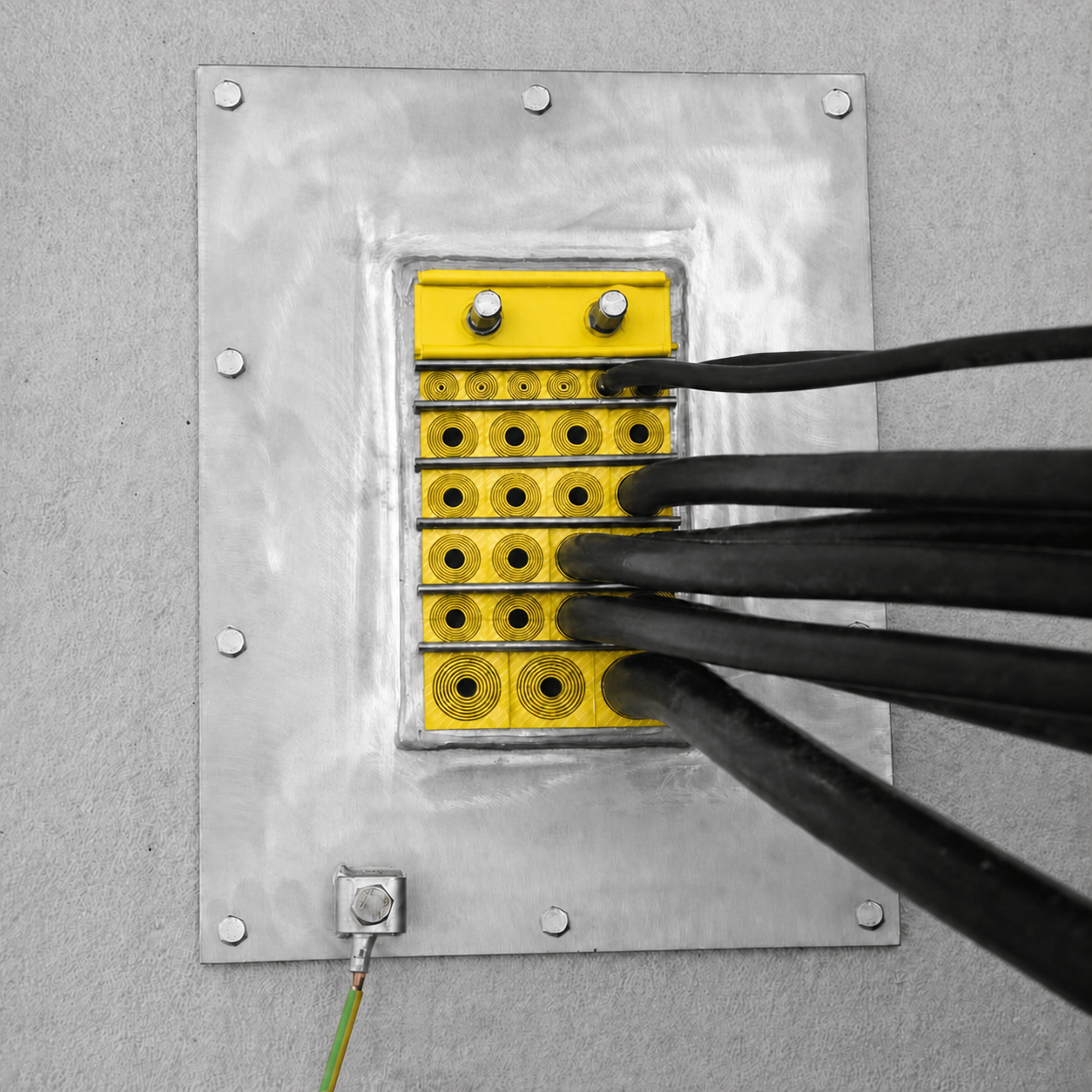
One leaking cable penetration can flood a BESS container or kill a fire rating. On our production line, multi cable transit sealing exists to stop that failure before it starts.
Multi cable transit sealing works by mechanically compressing elastomeric rubber modules inside a rigid frame. Installers peel removable layers to match each cable diameter, stack the modules between stay plates, then tighten a compression unit so the rubber expands and forms a fire-rated, watertight, gas-tight barrier.
That is the short answer. But if you are qualifying a second-source supplier, you need more than the principle. You need to know how the seal is formed, how to confirm dimensional compatibility, which test documents to demand, and how to validate samples before you commit. I will walk through each question below, using what we see every day on our own production floor.
How Do Compressed Rubber Modules Achieve Watertight and Gas-Tight Sealing in My MCT System?
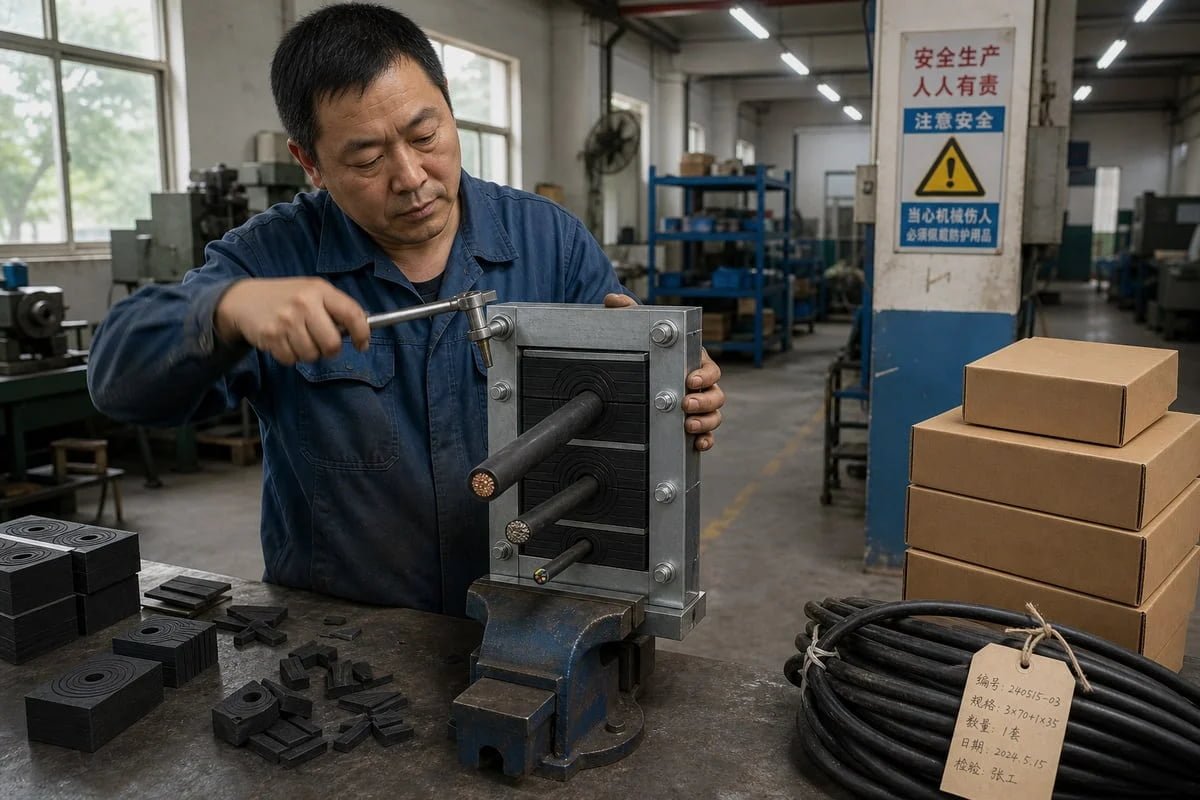
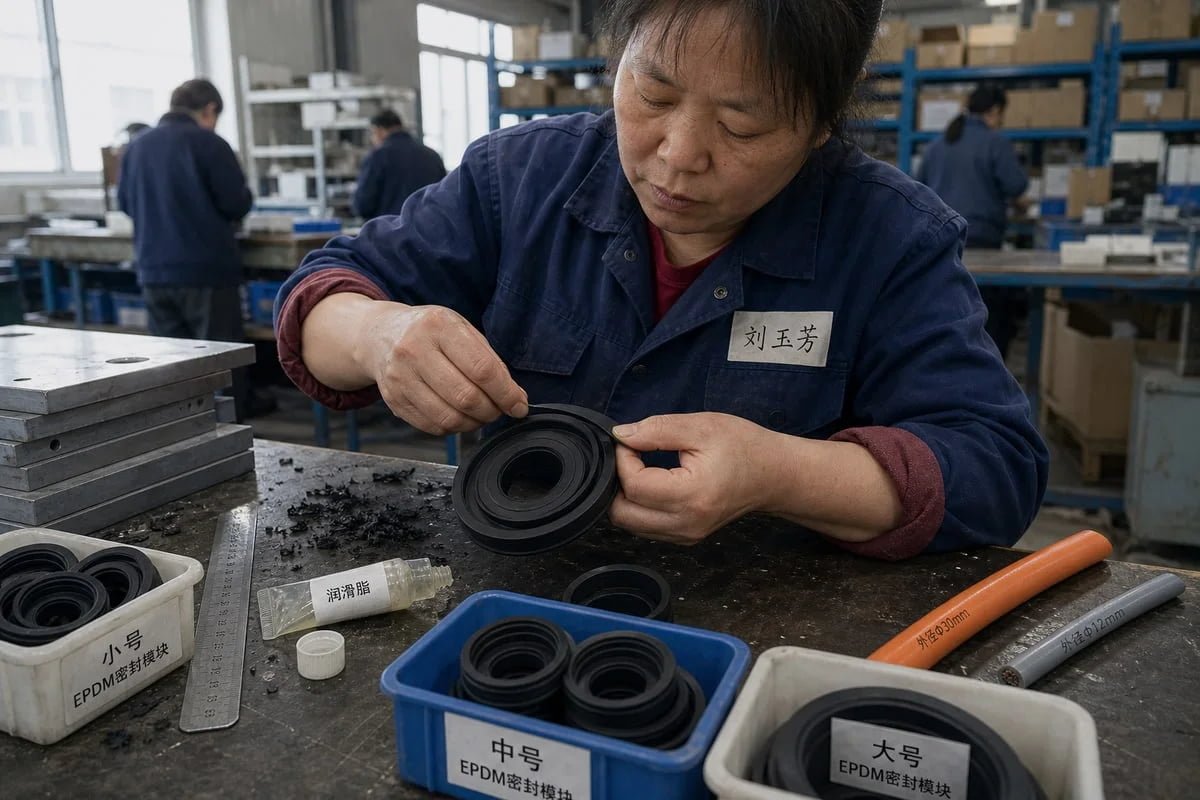
Every batch of EPDM modules 1 on our line gets a compression check before packing. That test exists because the seal only works when the rubber deforms exactly as designed.
Compressed rubber modules seal by mechanical deformation. When the compression wedge unit is tightened, each elastomeric module expands inward against the cable jacket and outward against the frame, eliminating voids and creating continuous contact pressure that blocks water, gas, smoke, and fire.
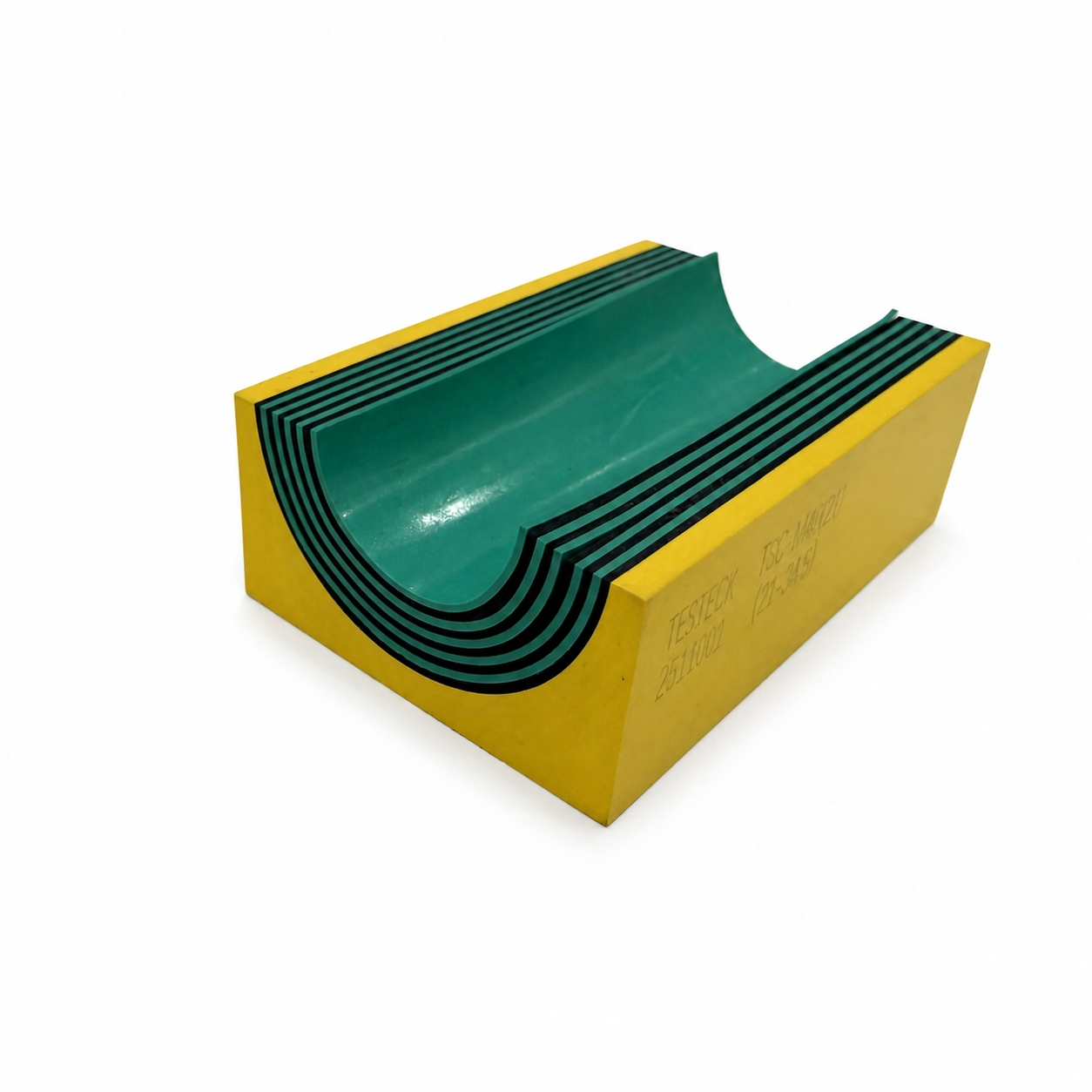
The system is a precision fit problem, not a stuffing job. Four parts work together: a rigid frame welded or bolted into the wall, deck, or panel; elastomeric sealing modules 2; stayplates and frames that hold rows in position during tightening; and the compression unit that generates the sealing force. Get any one of these wrong and the gas-tight integrity of the whole penetration suffers.
The Compression-and-Expansion Mechanism
The process follows a strict sequence. First, the installer peels concentric layers from each half of the module until the inner diameter is 0.5–1.5 mm smaller than the cable’s outer diameter. That slight undersize guarantees grip before final compression. Second, the module faces are lubricated so blocks slide into an air-free fit, but the surfaces that must grip the cable stay clean. Third, modules are stacked row by row with stay plates between them. Fourth, the bolts are tightened progressively and crosswise so pressure spreads evenly. Finally, the penetration should not be pressurized for at least 48 hours, because internal pressure needs time to equalize, especially at low temperatures.
There is a bonus effect worth noting. Because the halogen-free rubber is non-conductive, the transit acts as a dielectric break between cable armor and the steel structure, which reduces galvanic corrosion in marine and offshore installations.
Compression-Based vs Sealant-Assisted Systems
Some suppliers will tell you their modules are only passage guides and a sealant does the real work. That is a legitimate design, but it is not equivalent, and buyers should not treat the two as interchangeable.
| Feature | Compression-based MCT | Sealant-assisted system |
|---|---|---|
| Sealing force | Mechanical, from the compression wedge unit | Chemical adhesion of the sealant |
| Re-entry for new cables | Loosen, add modules, re-tighten | Cut out and re-apply sealant |
| Pull-out and vibration resistance | High, from clamping pressure | Limited |
| Long-term pressure | Managed by re-torque or spring-loaded units | Depends on sealant aging |
| Typical use | Marine, offshore, BESS, hazardous areas | Low-demand building penetrations |
One more engineering detail matters over decades: rubber undergoes viscoelastic relaxation, sometimes called cold flow. Advanced systems counter this with spring-loaded compression units that maintain constant sealing pressure as the material settles. Ask your supplier how their design handles it.
Can I Confirm These Compression Modules Fit My Existing 120-Frame Cutouts Without Redesigning My Panel?
Last quarter, a Dutch switchgear builder sent us a frame drawing and asked one question: will your modules drop into our existing cutouts? We answered with measurements, not promises.
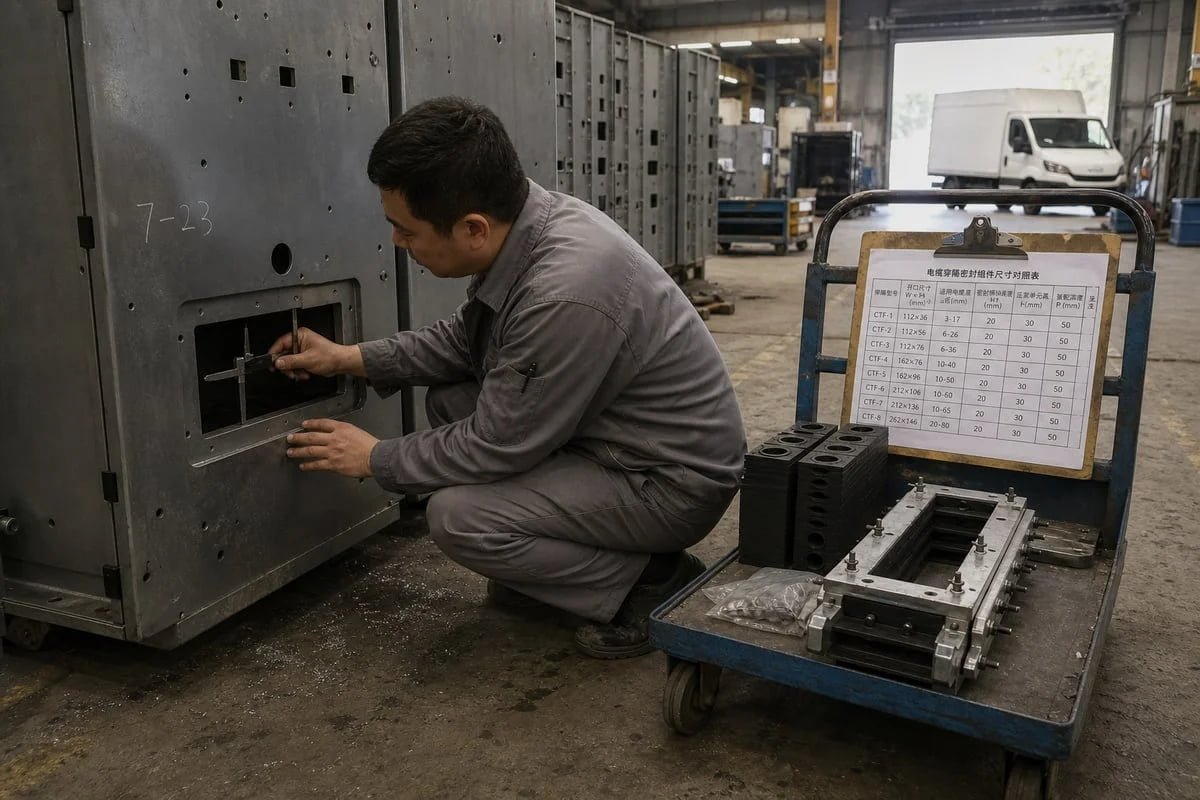
Yes. Modules built to common 120-frame dimensional standards drop directly into existing cutouts. Confirm fit by checking frame opening size, module footprint, packing depth, and compression unit travel against a supplier cross-reference table, then verify with a free validation sample before ordering.
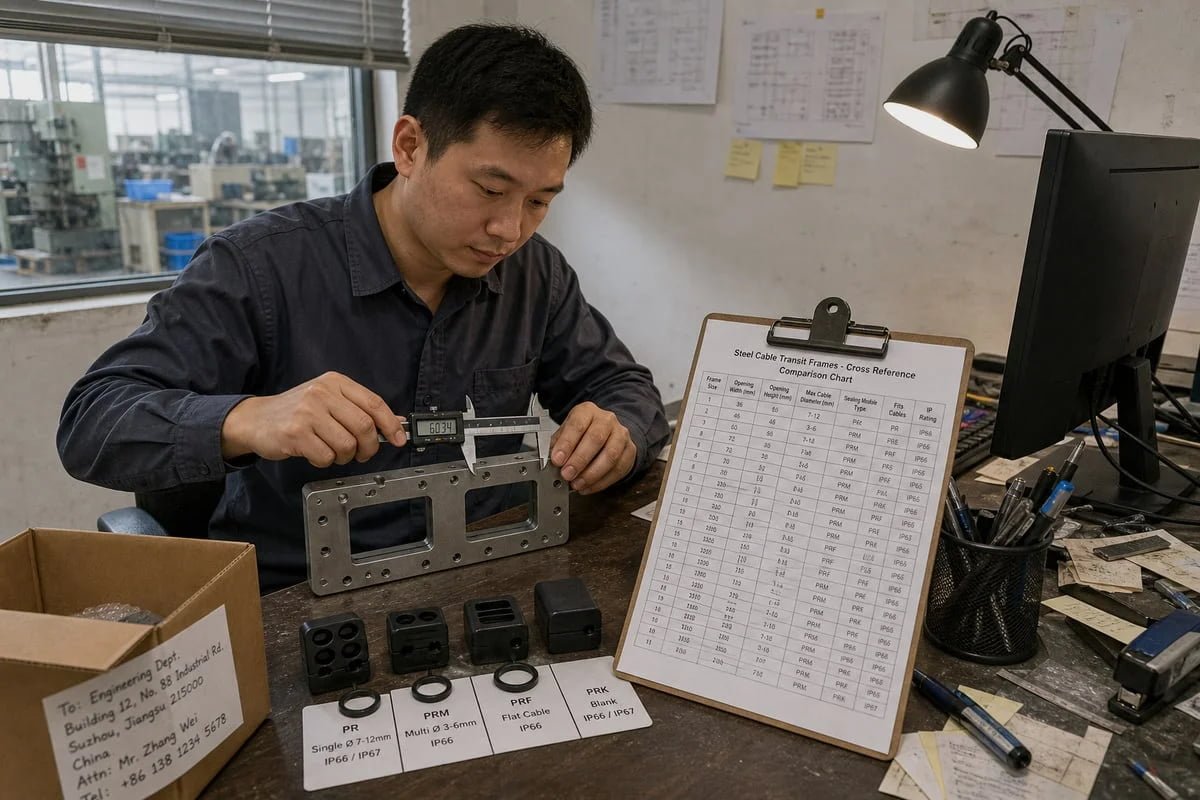
Dimensional compatibility is the whole point of second sourcing a modular cable entry system. If a switch forces you to re-cut panels, re-draw approvals, or re-train installers, most of the cost saving disappears. Our TSC square sealing modules and TSR round sealing assemblies were dimensioned from day one to match the common 120-frame standards, so they install in existing frames without any panel redesign. We support that claim with model cross-reference tables that map each existing module designation to the matching DEWIN model, plus free samples for physical verification.
The Dimensional Checks That Actually Matter
Here is the practical checklist we send buyers. It takes an afternoon with calipers and your current spec sheet.
| Check | What to verify | Why it matters |
|---|---|---|
| Frame opening | Internal width and height of your existing cutout | The stacked module rows must fill it exactly |
| Module footprint | Face dimensions of each module size | Mixed sizes must still complete each row |
| Module depth | Typically 60 mm; deeper modules exist | Depth scales hydrostatic pressure resistance |
| Cable diameter range | Peelable layer coverage per module size | One family can cover roughly 3.0–99.0 mm |
| Compression travel | Space needed by the wedge unit when open | The unit must close fully inside your frame |
Two of these deserve emphasis. Module depth is not cosmetic: a deeper module gives a higher bar-rated watertight cable seal, which is why sub-surface and flood-exposed applications specify deeper blocks. And cable diameter adaptability directly cuts your inventory, because one step-core module size accepts a range of diameters, so you stock fewer SKUs and still keep spare solid modules in the frame for future cables. Those spares can be swapped for cable-carrying modules later without disturbing the rest of the transit.
What Certification and Test Data Should I Request to Verify Fire Rating and IP68 Performance Before I Switch Suppliers?
Early in our export business, we learned a lasting lesson: European buyers never accept a fire rating printed on a datasheet. They want the test report behind it. Rightly so.
Request the full fire test report showing A-0 or A-60 class for the complete assembly, an IP68 ingress test certificate, watertight and gas-tight pressure test data covering 0.01–0.4 MPa, plus ISO 9001, IATF 16949, and classification-society factory approval such as Bureau Veritas.
Certificates only mean something when they describe the exact assembly you will install. A fire-rated cable penetration 3 is tested as a system: frame, modules, stay plates, and compression unit together, in a defined bulkhead or deck construction. So when you review documents, match the tested configuration to your own build. An A60 fire class rating achieved in a 120-frame with 60 mm modules does not automatically transfer to a different frame or module depth.
The Document Checklist We Hand to Sourcing Teams
| Document | What it proves | What to look for |
|---|---|---|
| Fire test report (A-0 / A-60) | Passive fire performance of the full assembly | Tested frame type, module depth, cable loading |
| IP68 test certificate | Sustained immersion protection | Test depth, duration, assembly details |
| Pressure test data | Watertight and gas-tight sealing, 0.01–0.4 MPa | Pressure steps, hold times, pass criteria |
| ISO 9001 / IATF 16949 | Quality system maturity | Current validity, certifying body |
| Classification-society approval | Independent factory audit (we hold BV approval) | Scope covers the product family you buy |
| Material data sheet | Halogen-free rubber compound properties | EPDM chemistry, smoke and toxicity data |
Questions Beyond the Certificates
Ask three follow-up questions. First, what elastomer is used? EPDM is the standard, but environments with aggressive hydrocarbons or solvents 4 may need FKM-based modules, so confirm chemical exposure up front. Second, how is long-term compression maintained? Ask for the supplier’s position on viscoelastic relaxation and whether spring-loaded compression is available. Third, if a supplier quotes extended performance, such as a 4-hour fire-resistant configuration, request the exact tested build, because such claims are configuration-specific. In our experience with multi cable transit sealing projects across Europe, Asia-Pacific, and the Middle East, suppliers who answer these questions with documents within days are the ones worth qualifying.
How Can I Get Validation Samples or CAD/STEP Files to Test Compressed Rubber Module Compatibility Before I Place an Order?
There is a real trade-off in supplier qualification: rigorous testing takes weeks, but skipping it risks a failed penetration in the field. Free samples remove most of that friction.
Contact the supplier’s technical team with your frame drawings and cable schedule. A factory-direct manufacturer should provide free validation samples, model cross-reference tables, and native CAD or STEP files within days, letting you bench-test fit, compression, and sealing before committing to a purchase order.
We built our qualification process around the way European purchasing engineers actually work: spec sheet first, physical evidence second, purchase order last. Since 2013 we have run this as a factory-direct operation, with headquarters in Shaanxi, additional production in Shandong and Hunan, and 38+ granted patents behind our step-core module designs. Because we make our own molds in-house, we can also cut custom sizes and run private-label production when your project needs it. Here is the sequence we recommend.
- Send your current bill of materials. List your existing module model numbers, frame types, and cable schedule. We return a cross-reference table mapping each existing model to the matching DEWIN equivalent, typically with a 40–60% cost reduction against your current pricing.
- Request CAD or STEP files. Drop the 3D models into your panel assembly to check frame opening, module stack height, and compression unit clearance digitally before anything ships. No purchase commitment is required for the files.
- Receive free validation samples. Inspect the halogen-free rubber, peel the layers, and check consistency. Many multidiameter modules use two-colored layers so removal stays visually identical on both halves; use that as a quick QC check.
- Run a bench fit test. Install samples in a spare frame, torque the compression unit crosswise, and hold pressure per your own protocol. Remember the 48-hour equalization window before pressurizing.
- Place a pilot order. Start with one project’s worth of frames and spare sealing modules. We handle export documentation, and our spare-parts line ships fast so replacement modules never hold up your build schedule.
This staged approach costs you a few hours of engineering time and removes almost all switching risk before money changes hands.
Conclusion
Cable penetrations fail at the weakest detail. Compressed rubber modules, correct installation, and verified test data close that gap. Request cross-reference tables and free samples to qualify your second source.
Footnotes
- Provides technical background on the EPDM elastomer used in the manufacturing of sealing modules. ↩︎
- Defines the elastomeric materials that allow for mechanical deformation and sealing in MCT systems. ↩︎
- The IMO sets international standards for fire-rated penetrations and safety in marine and offshore environments. ↩︎
- Authoritative chemical database for verifying the compatibility of elastomers with aggressive hydrocarbons or solvents. ↩︎