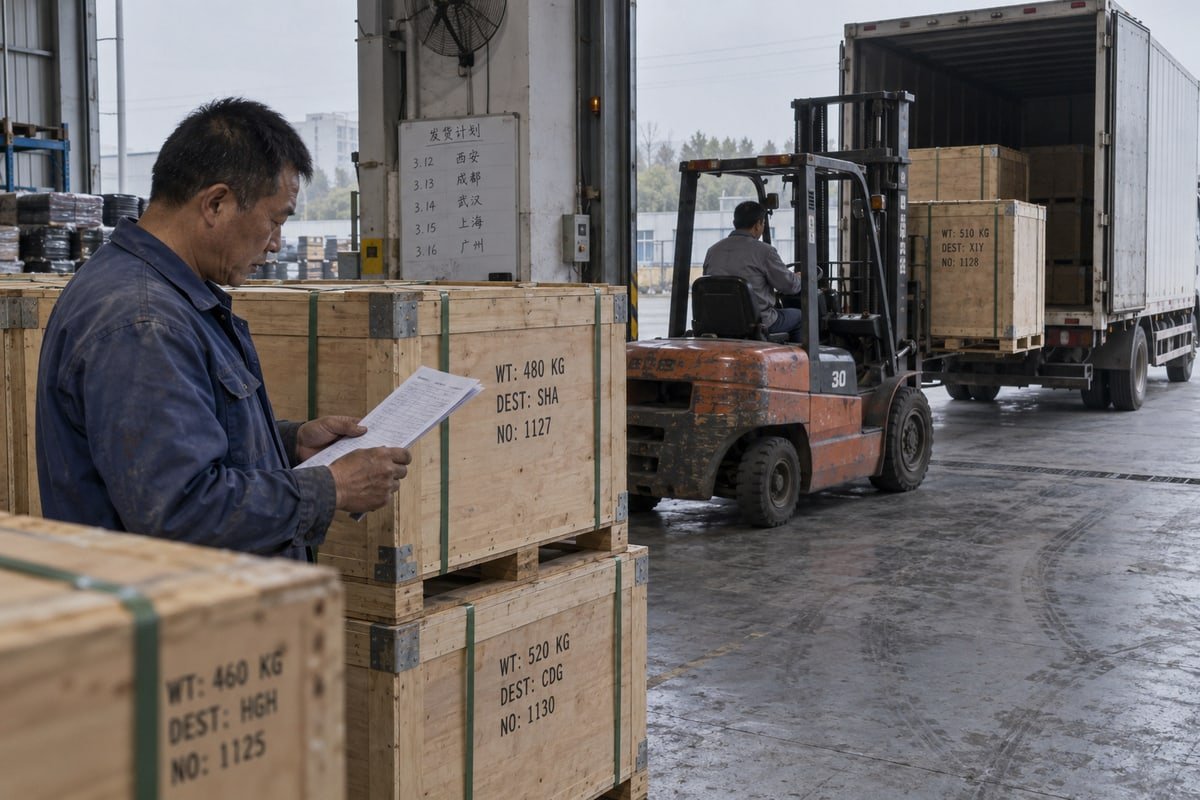
Every multi cable transit quote we send from our Shaanxi factory carries a trade term ingress protection 1. Pick the wrong one, and freight, customs, and transit damage quietly erase your module savings.
The best trade term for a multi cable transit is usually DAP to your project site under Incoterms 2020. You get a predictable landed cost with vendor-managed freight. Choose FCA if you run your own freight forwarder, or DDP if the supplier should also handle import duties.
That is the short answer. The longer answer depends on your project. Below, I break down the terms that matter for MCT buyers, show where the hidden costs sit, and give you a checklist you can paste into your next RFQ.
How do FOB, CIF, and DDP terms affect my landed cost for MCT modules?
A sourcing manager in Europe once sent me two quotes side by side. Ours was FOB Qingdao, the incumbent's was DDP. He asked why the cheaper one cost more.
FOB covers cost to the ship's rail at the export port. CIF adds ocean freight and minimum shipping insurance to the destination port. DDP includes freight, customs clearance, and import duties to your door. The FOB price looks lowest, but DDP gives the truest landed cost for MCT modules.

The confusion in that email is the most common one I see. A unit price is not a landed price. The trade term tells you where the seller's price stops and where your costs start. For a multi cable transit order, those costs can be large because the goods are heavy, odd-shaped, and safety-critical.
What each term actually includes
The table below shows who pays for each cost block. Read it left to right and count how many rows land in your column.
| Cost block | FOB (export port) | CIF (destination port) | DDP (your site) |
|---|---|---|---|
| Factory packing and export clearance | Seller | Seller | Seller |
| Inland haulage to export port | Seller | Seller | Seller |
| Ocean or air freight | Buyer | Seller | Seller |
| Shipping insurance during main carriage | Buyer | Seller (minimum cover) | Seller |
| Destination port handling and demurrage | Buyer | Buyer | Seller |
| Import customs clearance and brokerage | Buyer | Buyer | Seller |
| Import duties and taxes 2 | Buyer | Buyer | Seller |
| Final-mile delivery to site | Buyer | Buyer | Seller |
| Transfer of risk | On board vessel | On board vessel | At named place |
Notice that CIF and FOB share the same transfer of risk point. The goods are your problem the moment they are loaded. CIF only means the seller paid the freight and bought a policy on your behalf.
The insurance gap for fire-rated hardware
This is where I push back on CIF for MCT projects. The insurance a seller must buy under CIF is minimum cover. It often excludes handling damage and inland legs. Our TSC and TSR modules are tested for A-0/A-60 fire rating 3, IP68 ingress protection, and watertight sealing from 0.01 to 0.4 MPa. If a crate is dropped and the compression unit is bent, the module may still look fine but fail at site fit-up. Minimum cover rarely pays for that. If you buy CIF, upgrade the policy yourself or ask for CIP instead. Under CIP, the seller must buy all-risks cover.
Why DDP exposes the real number
DDP forces the seller to quote every cost block. That includes brokerage fees and import duties and taxes that an EXW or FOB quote never shows. When a buyer compares our 40–60% lower module cost against an incumbent, I always ask them to compare on the same term. A drop-in second source only saves money if the landed cost 4, not the unit cost, is lower. DDP makes that comparison honest. FOB makes it flattering.
Which Incoterm gives me the most control over shipping schedules for time-sensitive projects?
Speed and control pull in opposite directions on a BESS container schedule. When we ship TSC modules for a battery enclosure line, the buyer usually wants both.
FCA gives you the most control over shipping schedules. Your freight forwarder books the vessel or truck, so you set the timing. DAP gives less control but fewer tasks. Pair FCA with a forwarder that knows industrial hardware, or use CPT or CIP when the seller has better freight rates.

Control over schedule means one thing. It means you decide when the goods move and on which carrier. Under Incoterms 2020, the buyer arranges main carriage in the E and F groups. The seller arranges it in the C and D groups. So the more control you want, the closer you move toward FCA.
Control level by term
| Term | Who books main carriage | Buyer control over timing | Buyer workload |
|---|---|---|---|
| EXW | Buyer | Highest | Highest, including export clearance |
| FCA | Buyer | High | High, but seller handles export |
| CPT / CIP | Seller | Medium, buyer sets the deadline | Medium |
| CFR / CIF | Seller (ocean only) | Medium, stops at port | Medium |
| DAP / DPU | Seller | Low, buyer sets a delivery date | Low |
| DDP | Seller | Low | Lowest |
A practical sequence for FCA on a tight project
- Fix the ex-factory readiness date in the purchase order. We confirm ours in writing once the frame drawings are approved.
- Have your freight forwarder 6 book space two to three weeks before that date. Modular cable seals travel well by sea, but frames for bulkhead penetration are long and may need flat-rack or oversize handling.
- Send the forwarder our packing list, crate dimensions, and gross weights early. A forwarder who has never moved a stay plate bundle will underestimate the space.
- Agree on the handover point. FCA at our Shandong dock is not the same as FCA at the container yard in Qingdao.
That third point is the trap. Buyer-arranged transport under FCA can slip when the logistics provider is unfamiliar with specialized hardware. I have seen a forwarder book a standard container for frames that needed open-top. The delay was theirs, but the project felt it.
When to let the seller book
CPT and CIP make sense when the manufacturer has better negotiated rates for heavy, high-volume shipments. We consolidate exports from three plants, so our forwarder rates on repeat lanes to Europe and the Middle East are often lower than a one-off booking. Under CPT you still set the delivery deadline, and we carry the booking work. Consolidated shipping also cuts carbon per module, which matters if your project chases LEED or BREEAM points.
Just-in-time and elastomer storage
One more schedule point. Our modules are halogen-free EPDM. EPDM is stable, but I still advise buyers not to leave pallets in open yards for months under UV and ozone. A just-in-time delivery clause tied to the installation window protects the modules and frees site storage. Under DAP, we can phase deliveries against your installation plan. One tender I reviewed asked for DAP site basis, freight by vendor, across a five-month supply window. That structure works well for MCT.
Should I choose EXW or FCA when sourcing cable transit systems from a China-based factory?
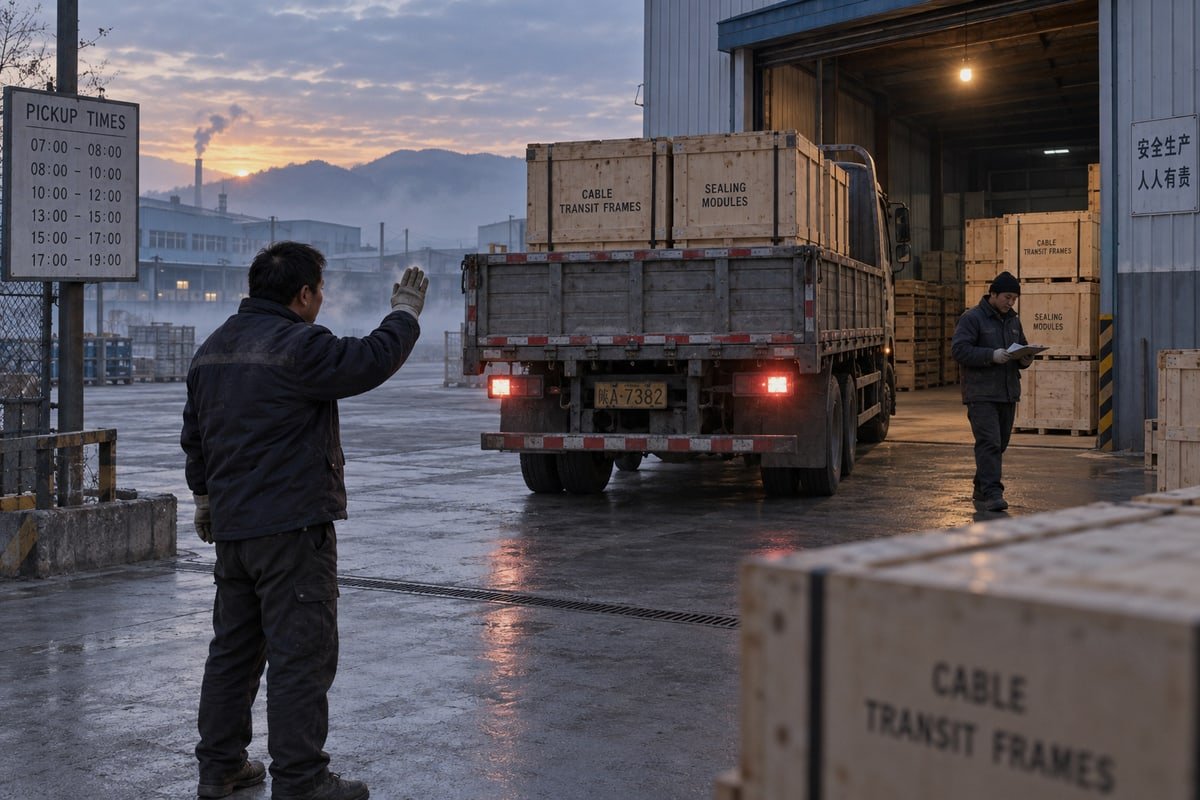
Our Shandong loading bay stamps every crate with a batch and reference before the truck arrives. That habit began after an EXW pickup left a crate of stay plates behind.
Choose FCA over EXW when sourcing cable transit systems from a China-based factory. Under FCA, the seller handles export customs clearance and loads the goods onto your carrier, so transfer of risk happens after loading. EXW leaves export formalities and loading risk with you, which foreign buyers rarely manage well.

EXW is the seller's favorite term. It is also the default in many supplier standard conditions. One major cable supplier's international terms state that all sales are priced EX-Works unless agreed otherwise. That is fine for a domestic buyer with a truck. It is a poor fit for a European integrator buying from Shaanxi.
Where EXW and FCA differ in practice
| Responsibility | EXW | FCA |
|---|---|---|
| Loading onto buyer's truck | Buyer, at buyer's risk | Seller, at seller's risk |
| Export customs clearance | Buyer | Seller |
| Export licence and documentation | Buyer | Seller |
| Chinese VAT export handling | Buyer must arrange via agent | Seller handles |
| Transfer of risk | Goods made available at factory | Goods loaded or handed to carrier |
| Suits a foreign buyer | Rarely | Yes |
Why EXW looks cheaper on paper
The EXW price is lower because it excludes everything. But a foreign company usually cannot act as exporter of record in China. You end up hiring a local agent to do what the seller would have done under FCA. That cost comes back, plus coordination time. Our export documentation is part of the standard service, so the FCA uplift on our quotes is small. The EXW discount is mostly an illusion.
Export documentation for offshore and marine work
If your MCT frames are headed to an offshore platform or a vessel, export documentation matters more. Marine and offshore standards call for traceable material certificates and fire test records. Under FCA, we bundle the BV factory approval, the A-60 firestop certification, and IP68 test reports with the commercial documents. Under EXW, your agent must chase those papers. That is a slow way to prepare a shipment.
FCA and supplier qualification
Most buyers who come to us are qualifying a second source. They have an existing 120-frame installation and want a drop-in module. We send a cross-reference table mapping their current model to the DEWIN equivalent and a free validation sample. That sample usually ships on a courier at our cost. The first production order then goes FCA. The buyer's forwarder collects, our team clears export, and the risk split is clean. It is the simplest term for a first order between two companies that are still building trust.
How do I decide who handles customs clearance and import duties for cross-border MCT orders?
One lesson from a decade of exporting modular cable seals: whoever knows the local customs code should clear the goods. Usually that is not us.
Keep import customs clearance and duties with the buyer under DAP or FCA when the buyer has a registered importer and broker in the destination country. Choose DDP only if the supplier has a local tax registration or partner there. Export clearance should always stay with the China-based seller.
Customs has two sides. Export clearance happens in China. Import clearance happens in your country. The right split is to give each side to the party that lives there. That is why DAP is my default recommendation. We carry the goods to your site, and your broker files the import entry.
Four questions that decide the split
- Do you have an importer of record and a customs broker in the destination country? If yes, DAP or FCA. If no, DDP.
- Does the supplier have a tax registration or a partner who can pay VAT locally? If no, DDP will either be refused or priced with a large safety margin.
- Are the goods going to a free zone, a vessel, or an offshore installation? Then a DAP to port or DPU at a named terminal may fit better than DDP to a site that does not exist in the customs system.
- Who is better placed to claim back import VAT? Usually the buyer. Under DDP, the seller pays it and cannot always recover it, so the cost stays in your price.
Keep payment terms out of the trade term
Buyers often blend the two. They are separate contracts inside one document. Net 30, Net 60, or 5/10 Net 30 define when money moves. DAP or FCA define when goods and risk move. A procurement document I reviewed asked for a firm, FOR store basis with freight included and 100% payment within 45 days after receipt. That is a delivery term plus a payment term, written in one line. Read them separately. Delivery under DAP does not mean you owe the invoice on arrival unless the payment clause says so.
Quantity tolerance and acceptance
Two more clauses ride along with the trade term. First, quantity variance. One supplier's conditions reserve the right to ship plus or minus 10% of the ordered quantity. Another allows plus or minus 3% and invoices the actual delivered quantity. For a project bill of materials, a 10% swing on sealing modules can leave you short at fit-up. Fix the tolerance in the order.
Second, acceptance. Some supplier conditions treat factory acceptance before shipment as final. Tender documents often pay only after site inspection or commissioning. For MCT, site acceptance matters because a compression unit that seals on our test rig may be torqued wrong on site. We supply test documents on request and can attach STEP files, material certificates, and firestop certification to the delivery milestone. Digital handover documents at the delivery point make asset registers and BIM models easier to complete later.
Buyer checklist for the purchase order
| Item to fix in writing | Why it matters for MCT |
|---|---|
| Named delivery point and Incoterms 2020 rule | Removes argument over where risk transfers |
| Freight included or excluded | Prevents surprise surcharges |
| Import clearance and duties responsibility | Aligns with who has a local broker |
| Unloading responsibility | DPU puts it on seller, DAP on buyer |
| Quantity tolerance | 3% versus 10% changes site stock |
| Payment terms stated separately | Stops delivery date becoming due date |
| Factory versus site acceptance | Defines when defects can be claimed |
| Documents due at delivery | Certificates, CAD/STEP, test reports |
Conclusion
Wrong trade term, and your 40–60% module saving leaks into freight and duties. Fix the delivery point, risk transfer, and clearance in writing, and the saving stays yours.
Footnotes
1. Explains the IP68 standard mentioned for the multi cable transit sealing performance. ↩︎
2. Global authority on trade tariffs and the taxes mentioned in the DDP comparison. ↩︎
3. Technical background on the fire resistance standards required for MCT modules. ↩︎
4. Authoritative government guide explaining how trade terms impact the final landed cost. ↩︎
5. Official source for the Incoterms rules discussed throughout the article. ↩︎
6. WCO provides standards for trade facilitation involving the logistics providers mentioned. ↩︎



 English
  Español de México
  Deutsch
  Français
  العربية
  Русский