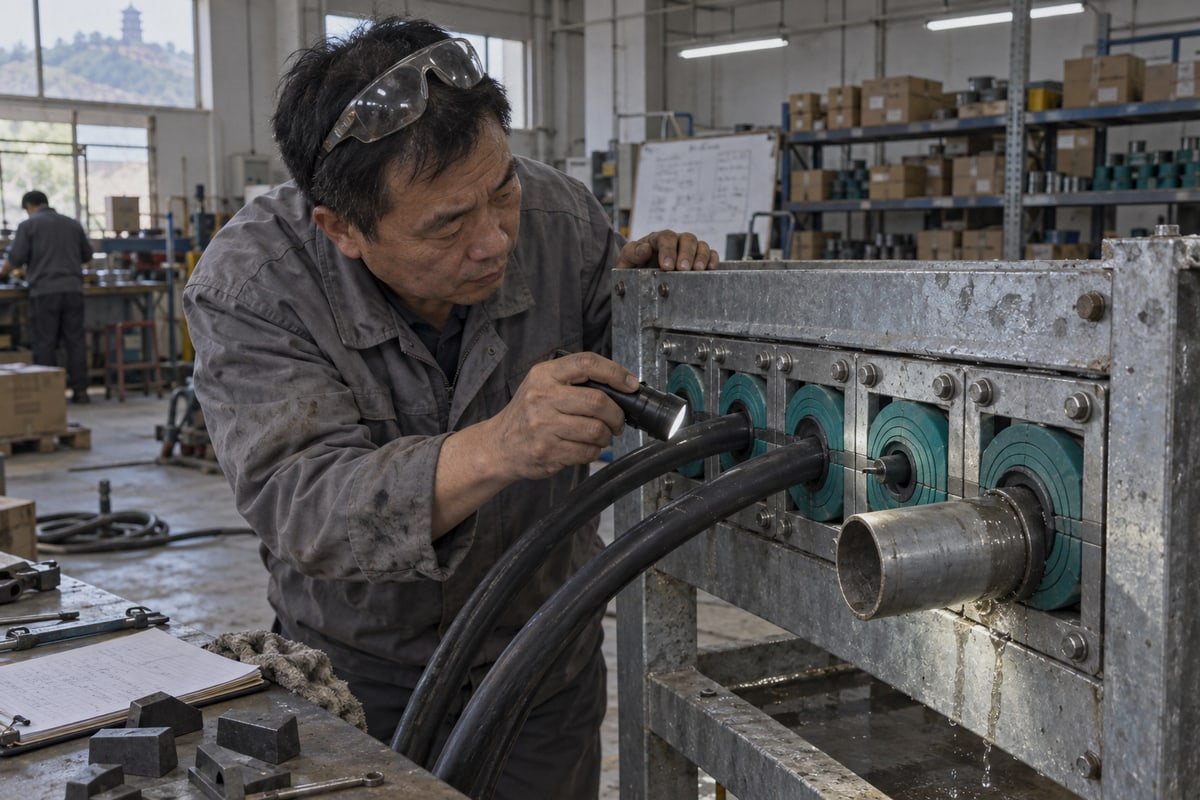
Multi cable transit systems look identical on paper for cables and pipes. That assumption sits behind many failed seals our Shaanxi engineers diagnose. Understanding the difference fixes it.
Multi cable transit systems use the same frames, modular sealing blocks, and compression wedge for both services, but cable penetrations prioritize density, re-entry, and EMC grounding, while pipe penetrations must handle thermal expansion, pipe weight, larger rigid diameters, and dedicated fire and pressure certification.
Below, I walk through the four questions our purchasing contacts ask most often. I cover sealing physics, shared hardware, certification gaps, and a practical selection method for mixed penetrations. Each section ends with what to request from any supplier, including us.
How does sealing performance differ between cable and pipe penetrations in MCT systems?
During pressure testing at our Shandong plant, a TSC module that held 0.4 MPa around cables wept around a steel pipe of the same diameter. Same block, different job.
Cable seals compress flexible jackets, so small diameter variation is absorbed and gas-tight integrity comes easily. Pipe seals press against rigid, hot, or vibrating metal, so watertightness depends on exact OD match, movement allowance, and, for thermoplastic pipes, intumescent modules that close the void in fire.
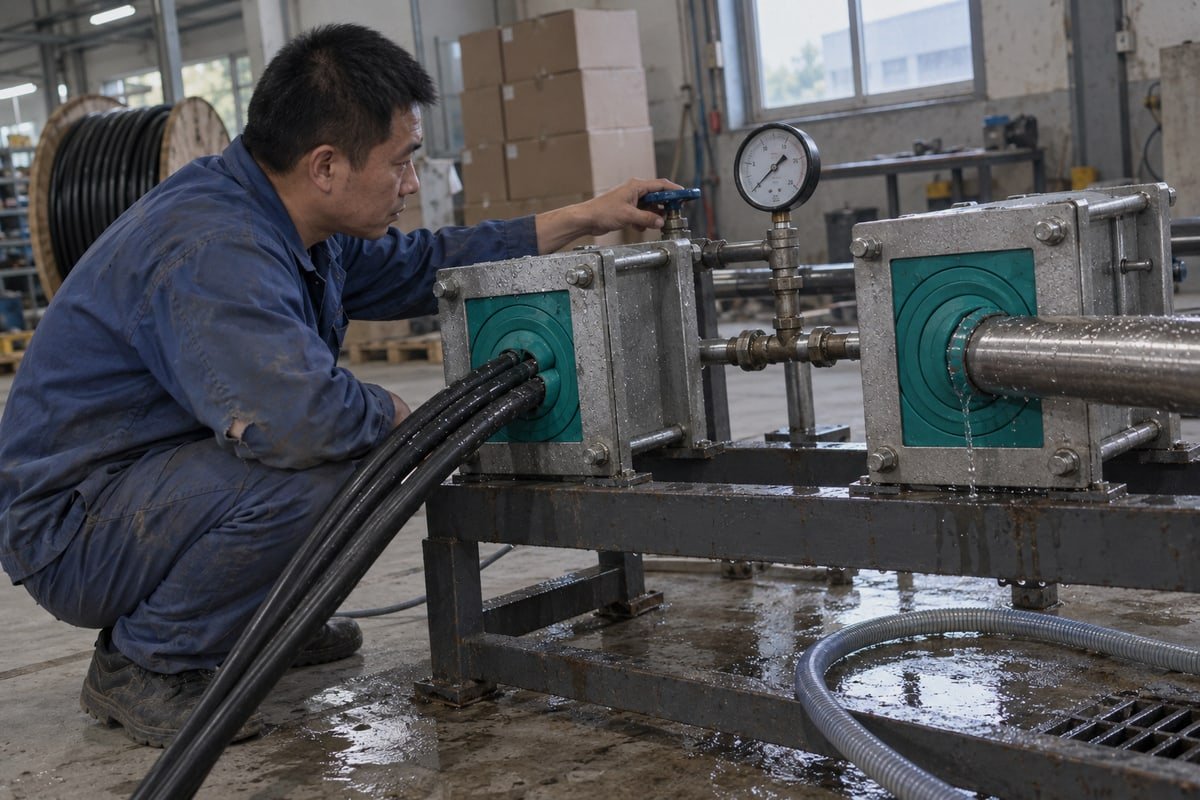
The lesson from that test bench was simple. The rubber was fine. The physics changed. Here is how I explain it to sourcing engineers who read spec sheets before they reply to us.
What the seal actually presses against
A cable has a flexible polymer jacket. When the compression wedge tightens, our halogen-free EPDM module deforms, and the jacket deforms a little too. Two surfaces move toward each other. That is why one TSC step-core block covers a range of cable diameters within a single module size. You peel layers to get close, and compression does the rest.
A pipe does not cooperate. Steel, copper, and stainless walls are rigid. All the deformation must come from the rubber. If the peel step leaves a small gap, the rubber has to fill every bit of it. So pipe blocks need tighter OD tolerance. In our factory we often cut a dedicated bore with an in-house mold instead of relying on peelable layers.
Movement, heat, and weight
Pipe thermal expansion 1 is the second difference. A coolant or hot-water line grows and shrinks along its axis on every cycle. Cables barely move. The seal must keep gas-tight integrity 2 while the pipe slides through it. That is a friction and fatigue problem, not only a static pressure problem.
Pipes also carry weight. Cables usually hang on external trays, so the transit carries almost nothing. A pipe transit often becomes a secondary support for the pipe and its fluid. That load travels through the modules, the stay plates, and the frame weld.
Fire behaviour
For fire-rated seals, a steel pipe conducts heat straight through the barrier, so an A-0 or A60 fire rating test watches the temperature on the cold side. A thermoplastic pipe 3 does the opposite. It softens and disappears. That case needs an intumescent module that expands, crushes the pipe, and seals the hole it leaves behind.
| Sealing factor | Cable penetration | Pipe penetration |
|---|---|---|
| Surface the module presses on | Flexible jacket, shares deformation | Rigid wall, rubber takes all deformation |
| Diameter tolerance | Step-core layers absorb variation | Exact bore or tight peel step needed |
| Axial movement | Negligible | Thermal expansion every cycle |
| Load on transit | Low, cables on trays | Pipe and fluid weight, vibration |
| Fire mode | Jacket burns, module holds | Heat conduction (metal) or collapse (plastic) |
| Water/gas test | 0.01–0.4 MPa, IP68 on our modules | Same range, but must be re-run with the pipe |
Watertight bulkhead penetrations 4 for either service can reach the same numbers. The difference is how hard it is to get there and how the seal ages afterwards.
Can I use the same frame and module design for both cable and pipe transits?
A BESS container builder in Germany asked us last year whether one 120-frame cutout could carry both power cables and a coolant line. The honest answer is yes, with conditions.
Yes. The frame, stay plates, and compression wedge are shared hardware, and 120-frame-compatible modules fit either service. What changes is module selection: EPDM step-core blocks for cables, exact-bore or intumescent blocks for pipes, plus reinforced frame anchorage when the pipe transfers weight or thermal movement.
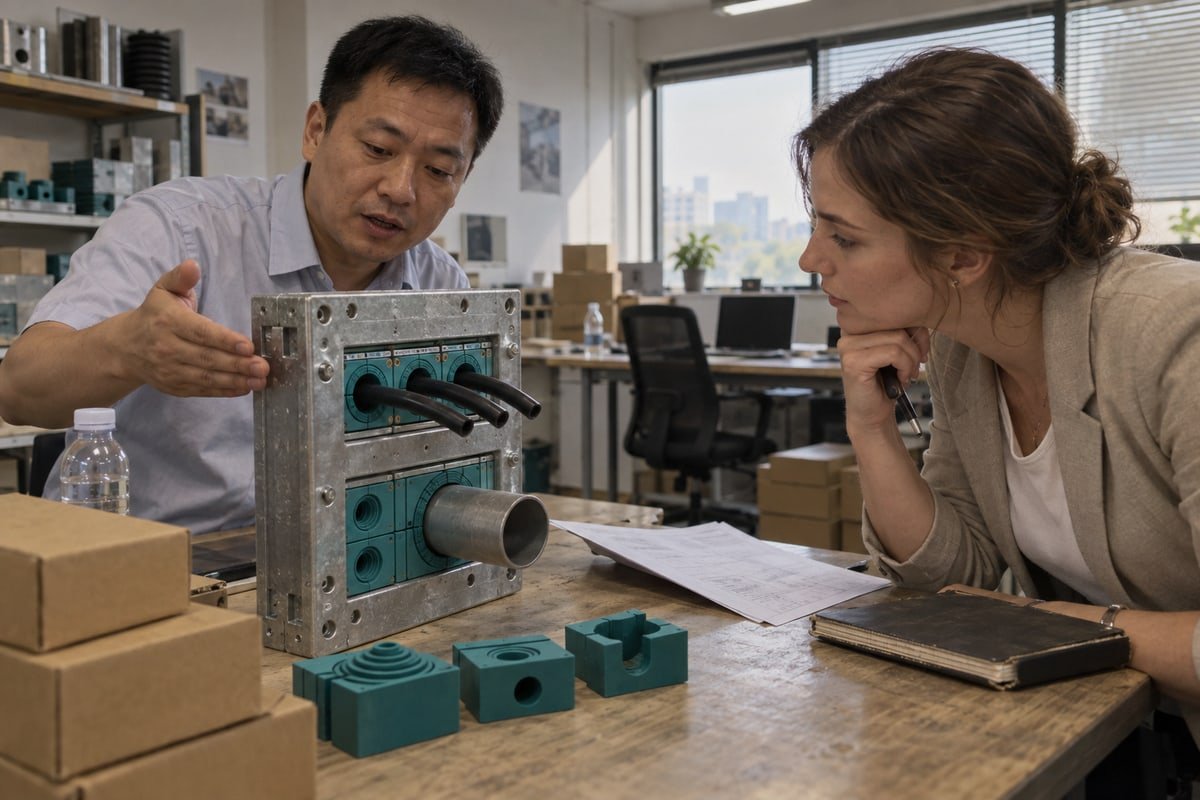
That German enquiry became a useful internal exercise. We laid the cable list and the pipe list side by side and asked which parts truly changed. Fewer than I expected. Here is the process we now follow when a customer asks the same question.
How we specify a shared frame
- Confirm the cutout standard. Our frames are dimensionally compatible with common 120-frame standards. If your existing frame is already in the wall or bulkhead, our modules drop into the same cutout. We supply a cross-reference table from your current model to the DEWIN model so qualification is a paperwork step, not a redesign.
- Choose the mounting method by the barrier, not the service. Welded frames suit steel bulkheads and decks. Bolted frames suit concrete walls, panel enclosures, and container skins where welding is not allowed. Marine and offshore safety rules often decide this for you.
- Split the frame into zones. Cables go in one zone with TSC square modules packed for density. Pipes go in their own row with dedicated bores. Stay plates separate the rows and carry compression evenly.
- Check anchorage against pipe load. If the pipe leans on the transit, the frame weld or bolt pattern must carry it. Cables never trigger this check. Pipes often do.
- Reserve spare capacity. Leave blank modules in the cable zone. Adding a cable later then means peeling a block, not cutting a new hole.
Where the design genuinely diverges
| Component | Cable transit | Pipe transit | Shared? |
|---|---|---|---|
| Transit frame | Welded or bolted | Welded or bolted, heavier anchorage check | Yes |
| Stay plates | Standard | Standard, sometimes thicker for load | Yes |
| Compression wedge | Standard | Standard | Yes |
| Sealing module | TSC step-core EPDM | Exact-bore, TSR round, or intumescent | No |
| Entry geometry | Cables at 90° to the frame face | Pipe axis fixed by pipework, transit adapts | Partly |
| Spare capacity | High priority | Rarely needed | No |
The 90° entry rule matters more than people think. A cable that enters at an angle side-loads the module and opens a leak path. Pipes arrive wherever the pipework puts them, so the frame position must be set from the pipe routing, not the other way around.
One more point for skeptical buyers. Multi cable transit systems seal immediately once the compression wedge is torqued. Compound or mastic methods need curing time. Some suppliers quote installation savings of up to 30% versus single-module approaches. I cannot verify their number, but the mechanism is real, and it applies equally to pipes and cables.
What certifications should I verify for cable versus pipe sealing applications?
Every test report we issue forces one trade-off: a broader certificate costs more test hours, but a narrow one leaves your pipe penetration without valid approval.
For cables, verify the A-0 or A-60 fire rating, IP68 ingress protection, watertight and gas-tight test pressure, halogen-free material data, and EMC grounding claims. For pipes, confirm the fire test used the actual pipe material and diameter, plus movement and load allowances, because cable approvals do not transfer automatically.
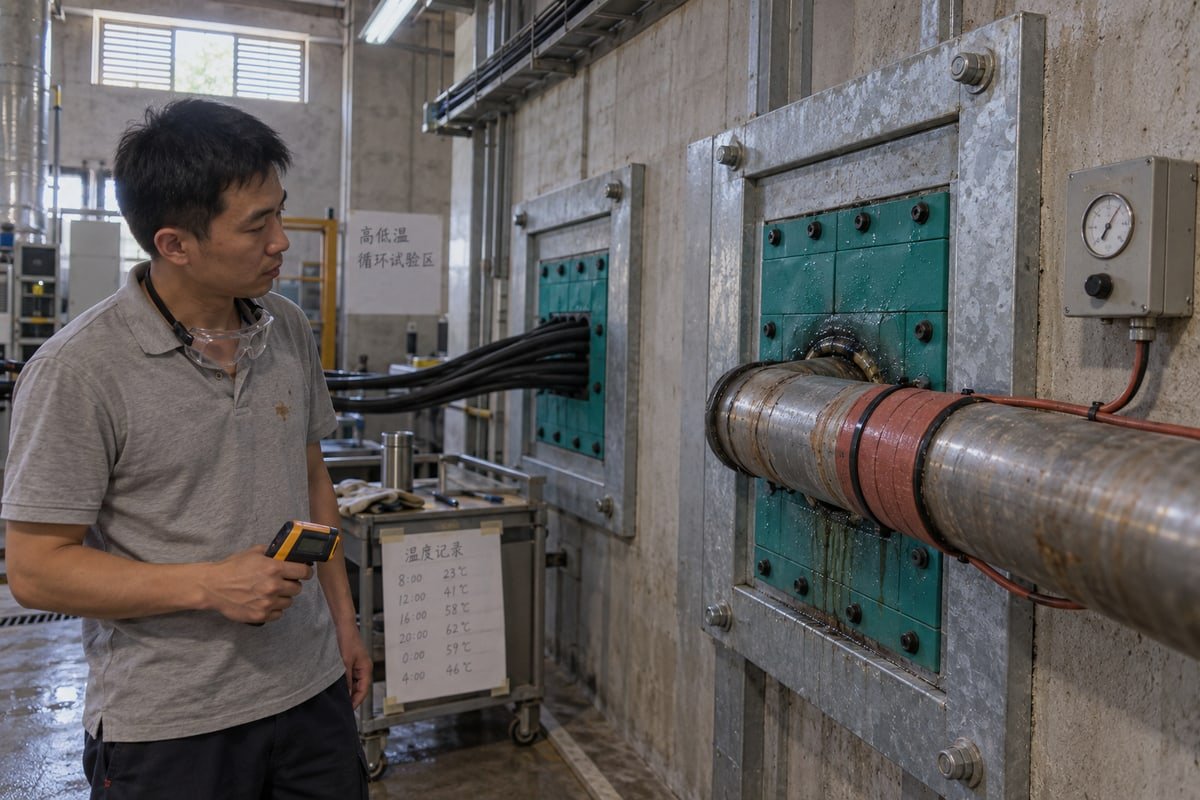
I want to address a fair objection before the checklist. Several buyers have told me that the loudest marketing claims are always tied to one narrow test configuration. They are right. That is exactly why the configuration in the report must match your penetration. The fix is not to distrust certificates. The fix is to read the test setup page, not just the cover page.
Why a cable certificate does not cover a pipe
A fire test with cables measures the seal while the jackets burn away and the module holds. A fire test with a steel pipe measures heat conduction through the pipe wall to the unexposed side. A test with a thermoplastic pipe checks whether the intumescent module closes the void as the pipe collapses. Three different failure modes. Three different reports. Product literature from established brands says the same thing: A-0 cable transits and pipe penetrations need dedicated testing.
Marine and offshore safety versus building projects
Marine and offshore projects usually stack requirements: A-class fire rating plus watertight bulkhead penetrations plus gas-tight integrity, sometimes plus jet fire resistance for process areas. Our factory is BV-approved and our modules carry A-0/A-60 fire ratings 5, IP68, and watertight/gas-tight sealing from 0.01 to 0.4 MPa. We do not claim jet fire performance, and I would advise you to ask any supplier the same direct question rather than assume it.
Building and container projects lean on the quality system behind the certificate. We run ISO 9001 and IATF 16949, which matters to switchgear and modular data center integrators because the same audit discipline applies to every batch of spare sealing modules.
The document request list
| Document | Cable application | Pipe application |
|---|---|---|
| Fire test report | A-0 / A60 fire rating with cable types listed | Same rating, with pipe material and OD listed |
| Ingress protection | IP68 on the sealed module | IP68 with pipe movement noted, if tested |
| Pressure test | Watertight and gas-tight, 0.01–0.4 MPa | Same, on the pipe configuration |
| Material data | Halogen-free EPDM declaration | Plus intumescent data for plastic pipes |
| EMC / grounding | Conductive layer and grounding and bonding method | Usually not applicable |
| Factory approval | BV-approved factory, ISO 9001, IATF 16949 | Same |
| Load and movement | Not required | Axial and lateral movement allowance |
We hold test documents for our configurations and release them on request. If a pipe case sits outside what we have tested, I will say so and quote the test rather than stretch a cable report to cover it.
How do I choose the right module type when my project involves mixed cable and pipe penetrations?
One lesson from a decade of cutting molds: mixed penetrations tend to fail at the boundary between the cable zone and the pipe zone, not inside either one.
Use TSC square step-core modules for the cable bundle, size a separate TSR round assembly or exact-bore block for each pipe, and keep pipes in their own frame row or frame. Then match the whole frame to the strictest requirement present, usually the pipe's fire, load, and movement case.
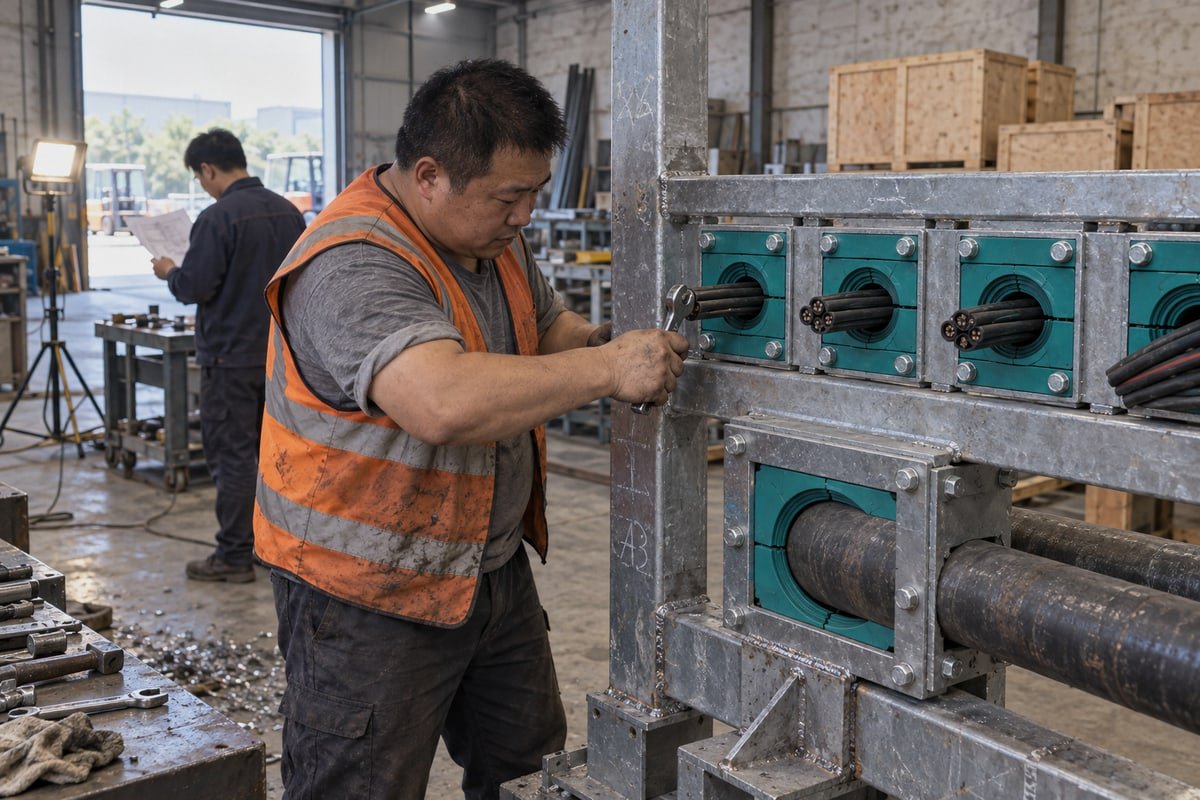
The boundary fails because two different compression behaviours meet at one stay plate. Soft cable blocks keep compressing. A rigid pipe block stops early. The wedge load then goes where it is easiest, and the cable side over-compresses while the pipe side stays loose. Keeping the services in separate rows, or separate frames, removes that problem. Here is the selection method I give to EPC procurement teams.
A five-step selection method
- List every service with OD, material, and temperature. Cables need OD and armour type. Pipes need OD, wall material, fluid, and operating temperature. Digital transit management platforms now track this pipe metadata for compliance reporting, so record it from day one.
- Sort by failure mode. Flexible jacket, rigid metal, or thermoplastic. Each gets its own module family.
- Flag EMC and grounding needs. Armoured cables entering sensitive equipment rooms may need modules with a conductive layer for electromagnetic shielding 6 (EMC) and grounding and bonding. Pipes never need this.
- Set the governing requirement. If one pipe needs A60 and movement allowance, the whole frame is specified to that level.
- Reserve spare capacity in the cable zone only. Pipes rarely change. Cables always do.
Module selection matrix
| Service type | Module family | Key feature | Notes |
|---|---|---|---|
| Power and control cables, mixed OD | TSC square step-core | Peelable halogen-free EPDM, density packing | Leave blank modules for future cables |
| Armoured cables into EMC rooms | TSC with conductive layer | Grounding and bonding path | Confirm bonding method with frame |
| Small metal pipes and conduits | TSR round assembly | Exact bore, immediate seal | Check thermal movement |
| Large steel pipe through bulkhead | Exact-bore block, reinforced frame | Load path through stay plates | Verify anchorage |
| Thermoplastic pipe | Intumescent module | Expands and closes void in fire | Dedicated fire report required |
The cost objection, answered honestly
Some project teams still favour cast-in sleeves or compound fills because the first-cost line looks lower. I understand the instinct. The lifecycle answer is different. A compound seal has to be broken and re-cured every time a cable is added. A modular transit is opened, peeled, and re-torqued. Our drop-in modules also arrive at 40–60% lower cost than the incumbent brands while fitting the same 120-frame cutouts, which usually closes the first-cost gap on its own.
To make qualification easy, we provide free validation samples, CAD and STEP files for every frame and module, and English technical support that answers spec questions rather than sales questions. For custom pipe bores, our in-house mold making covers sizes that catalogue peel steps cannot reach, and spare sealing modules ship fast because we make them ourselves across three plants.
Conclusion
Treating cable and pipe penetrations as identical costs certification and re-work later. Specify the shared frame once, choose modules per service, and demand the matching test documents before ordering.
Footnotes
1. Scientific principle explaining how materials change volume in response to temperature fluctuations. ↩︎
2. IEC standard defining protection levels against gas and moisture ingress for technical enclosures. ↩︎
3. Industry authority providing technical data on thermoplastic materials used in industrial piping systems. ↩︎
4. Bureau Veritas provides classification and certification for watertight sealing systems in marine vessels. ↩︎
5. Official IMO standards for fire protection levels in marine and offshore environments. ↩︎
6. Technical explanation of methods used to protect sensitive electronics from electromagnetic interference. ↩︎



 English
  Español de México
  Deutsch
  Français
  العربية
  Русский