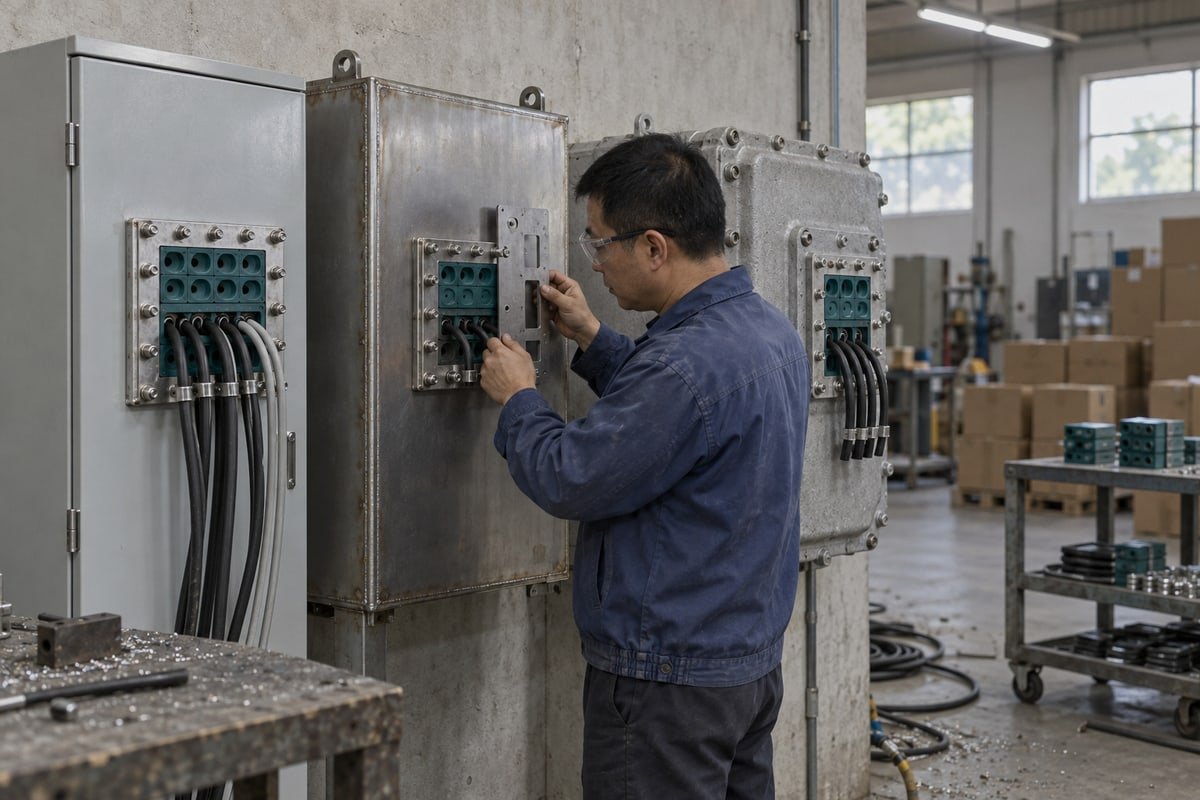
A universal cable entry standard for multi cable transits sounds simple until three E-house box types arrive with three cutouts. Our production line fixed that with one interface.
A universal cable entry standard for multi cable transits works when it fixes the interface, not the product: one 120-frame cutout family, defined panel thickness ranges, tiered IP, fire, and Ex performance classes, and mandatory test documents, so any qualified modular sealing system drops into every E-house box type.
That is the whole idea in one sentence. The rest of this article shows how to apply it. I will walk through dimensional compatibility, the certifications to check, how to test before you commit, and how to bring in a second source without touching your lead times.
How can I ensure MCT modules stay dimensionally compatible across different E-house box designs?
On our QC bench, every TSC square module gets checked against a 120-frame gauge before packing. That gauge exists because one cutout mismatch on site costs more than a batch.
Keep MCT modules compatible by standardizing on the 120-frame interface: fixed frame outer dimensions, a shared bolt pattern, a stated panel thickness range, and step-core modules that adapt to cable diameters. Then verify each supplier with a cross-reference table and physical fit check.

An E-house is never one box. It holds sheet-steel control cabinets, welded switchgear sections, Ex junction boxes 1, and often a BESS rack or data section. Each has a different wall. So the first job is to map the walls, not the cables.
Which E-house box types must share one interface?
| Box type | Wall construction | Common mounting | Main compatibility risk |
|---|---|---|---|
| Sheet-steel control cabinet (Rittal, Eldon class) | Thin folded steel | Bolt-on frame with gasket | Thin wall distorts under compression load |
| Welded switchgear enclosure | Plate steel | Welded frame | Weld heat warps the cutout |
| Ex junction box | Cast or thick plate | Bolted flange | Certification ties the transit to the box |
| Container wall or bulkhead | Corrugated or plate steel | Welded or cast-in frame | Cladding changes the effective thickness |
The table shows the problem. Four walls, four mounting methods, but the cables are the same. The answer is to lock the frame geometry and let the mounting method vary.
Standardize the interface, not the seal
A common objection from European sourcing teams goes like this: "Our enclosures are too different. One standard gives us lowest-common-denominator performance." I understand the worry. But the standard should fix geometry only: the 120-frame family, the bolt pattern, cutout tolerance, and the allowed panel thickness range. Seal technology stays free. That is exactly why our TSC square modules and TSR round assemblies are dimensionally compatible with common 120-frame standards. They drop into cutouts that were designed years ago for another brand.
Inside the frame, our step-core, halogen-free EPDM modules adapt one module size to a range of cable diameters. You peel the core to fit the cable. This is what makes cable density optimization possible without redesigning the frame for every cable schedule. The compression wedge units and stay plates set the packing, and they follow the same frame width on every box type.
Decouple the frame from the wall
Ranking pages now describe a "universal adapter flange" with a standardized bolt pattern. I agree with the concept. The adapter takes the wall variation, and the frame stays identical. Add one more rule to your standard: reserve 20–30% of each opening as blank modules. Spare capacity planning done at the drawing stage avoids hot work on a finished Ex box later.
What certifications should I verify before standardizing MCT sealing systems across my product lines?
One trade-off I weigh every week: a 316L stainless frame for blast-resistant enclosures offshore is right, but the same spec on an indoor switchgear cabinet just burns budget.
Before standardizing, verify five items on documents, not brochures: IP66 or IP68 ingress test reports, fire ratings such as A-0/A-60 or EN 1366-3, gas-tight pressure test records, ATEX and IECEx certificates for any Ex box, and the supplier's ISO 9001 or IATF 16949 quality system with third-party factory approval.

Certification is where a universal cable entry standard either holds together or falls apart. The safety-driven objection is fair: standardization must never weaken the certification path. My answer is to define performance classes by application and to demand the matching document for each class.
The certification map by application class
| Requirement area | Reference standard or rating | Document to request | Where it applies |
|---|---|---|---|
| Ingress protection | IP54 baseline, IP66 ingress protection 2 common, IP68 for washdown and flood risk | Third-party ingress test report | All box types |
| Fire integrity | A-0/A-60 (marine and offshore); H-120 for hydrocarbon fire; BS EN 1366-3, ASTM E-814 / UL 1479 (buildings) | Fire test certificate with the transit named | Bulkheads and fire-rated walls |
| Water and gas tightness | Pressure test, 0.01–0.4 MPa | Pressure test record | Gas-tight seals in BESS containers, transformer rooms |
| Hazardous area | IEC 60079-0 plus IEC 60079-1, 60079-7, 60079-31 | ATEX and IECEx certification for the transit itself | Ex junction boxes and Ex cabinets |
| Strain relief | EN 62444 | Pull-out test | Cabinets with pre-terminated cables |
| North American markets | UL Type 12 / 4X, NEMA 4X compliance | UL listing card | US-bound E-houses |
| Quality system | ISO 9001 3, IATF 16949, BV factory approval | Certificates showing scope and site | Supplier qualification |
What I can and cannot show you
Our factory runs ISO 9001 and IATF 16949 systems and holds BV approval. Our modules are tested to A-0/A-60 fire rating 4, IP68 ingress protection, and watertight and gas-tight sealing between 0.01 and 0.4 MPa. Those test documents are available on request, and I would rather send them than describe them. What I will not do is claim an Ex or EMC rating that is not on paper. If your standard includes an Ex class or an electromagnetic shielding class, ask every supplier for the certificate naming the transit, not the frame material.
Materials and temperature
Pick frame material from the corrosive profile of the site, not from habit. Galvanized steel is right for most indoor switchgear. Marine and petrochemical sites justify 316L. On sealing compounds, remote modular E-houses see rapid temperature swings. Halogen-free EPDM holds its compression set well across cycling, but ask for the supplier's stated temperature range and put that range into your standard as a required field.
Can I get validation samples and CAD/STEP files to test a universal cable entry standard before committing?
A sourcing engineer in Europe once answered our first email with a single line: send STEP files and two samples, then we talk. That reply set our sample policy.
Yes. A qualified second-source MCT supplier should provide free validation samples, STEP and CAD files, and a model cross-reference table before any purchase order, so you can fit-check the 120-frame cutout, run your own compression and ingress checks, and confirm the universal cable entry standard on a real box.

I treat the sample request as the real start of qualification. A datasheet tells you what a supplier says. A sample on your own cabinet wall tells you what is true. Here is the sequence we recommend to buyers, and it is the same one we use to check our own tooling.
A six-step validation sequence
- Request the cross-reference table. Send us your current bill of materials. We return an existing-model-to-DEWIN-model table so your engineers know which TSC or TSR item replaces which part.
- Load the STEP files. Drop the frame, modules, stay plates, and compression wedge units into your enclosure model. Check the cutout, the bolt pattern, and the minimum bend radius of the fanned cables.
- Run a virtual transit mockup. Some integrators now use AR to check routing density before the shell is fabricated. Even a plain 3D clash check catches most interference with busbars and gland plates.
- Fit the physical samples. Mount the frame on a scrap panel of the same thickness as your production wall. Torque the compression unit. Look for panel distortion on thin sheet-steel cabinets.
- Test what matters to your class. For gas-tight seals, a simple pressure hold on a blanked frame is enough to confirm the sample. For IP66 ingress protection, a hose test on the mounted assembly is a reasonable in-house proxy before you rely on the third-party report.
- Record the result. Label each transit point and file the sample report. That documentation later feeds third-party inspection and maintenance audits.
What our samples include
Our free validation samples are production parts, not hand-finished demos. They come off the same molds in Shaanxi, Shandong, or Hunan that run your order. Because we make molds in-house, a non-standard cutout on an older switchgear line can be sampled as a custom size rather than forced into a near fit. If your standard calls for private-label marking on the nameplate, the sample carries it too.
On RFID and digital twins
RFID-embedded modules for digital twin sync are appearing in specifications. I see the value for large EPC projects with hundreds of transits. For most OEM box lines, a clear engraved module label and a documented layout drawing deliver the same audit result at lower cost. Put the requirement in your standard as optional, not mandatory.
How do I switch to a second-source MCT supplier without disrupting my existing E-house production lead times?
The lesson our export team learned: a second source never fails on the spec sheet. It fails at changeover, when the first shipment arrives in the middle of a build.
Switch without disruption by running a four-phase changeover: qualify the second source on samples and documents, start with spare sealing modules only, then dual-source frames on one box type, and finally move full volume while holding safety stock of both suppliers for one production cycle.

The cost case is clear. Drop-in second sourcing of modular sealing systems runs 40–60% below the incumbent price for the same 120-frame interface. But price is not the reason a purchasing engineer in Europe hesitates. Lead time is. So the changeover plan must protect the build schedule at every step.
The four-phase plan
| Phase | What changes | What stays the same | Exit criterion |
|---|---|---|---|
| 1. Qualify | Samples fitted, documents filed, cross-reference approved | All production parts | Sample report signed by engineering |
| 2. Spares first | Spare sealing modules and blank modules from the second source | Frames and compression units | One project closed with mixed modules, no site issues |
| 3. Dual-source one box type | Full transit kit on one cabinet or container line | Other box types untouched | Two consecutive deliveries on schedule |
| 4. Full volume | All box types on the shared standard | Safety stock of both suppliers held | One production cycle without shortage |
Why spares are the safe entry point
Spare modules are where the fire and ingress classes are easiest to keep intact, because the frame and its tested wall condition do not change. Our fast delivery on spare sealing modules is built for this phase. It lets your maintenance and production teams see the halogen-free EPDM in service before a frame ever changes hands.
Answering the "over-specification" objection
Some buyers push back the other way: "A single standard forces the offshore spec onto every indoor cabinet." That would be true if the standard fixed one product. It fixes the interface and offers tiered classes. Your indoor switchgear line stays on a galvanized frame and IP66 class. Your offshore bulkhead sealing solutions use the 316L frame 5 and A-60 class. Both share the cutout, the bolt pattern, and the module family. The procurement spec becomes one document with a class column, not five documents.
Keeping documentation aligned
Export paperwork is part of lead time. We handle export documentation on our side so customs does not become the reason a container waits. Ask any second source to commit to the same. One more practical step: keep a two-supplier stay plate and compression unit kit in stock during phase 3. It removes the fear of a mixed frame on site, and it costs less than one day of delayed commissioning.
Conclusion
Fragmented cable entries waste engineering hours and inflate cost on every E-house. Standardize the 120-frame interface, tier the performance, verify the documents, and qualify a drop-in second source.
Footnotes
1. Official portal for IECEx, the international certification scheme for equipment used in explosive atmospheres. ↩︎
2. Official site for the IEC, the body responsible for international ingress protection (IP) standards. ↩︎
3. Authoritative source for the ISO 9001 quality management standard mentioned in the article. ↩︎
4. International Maritime Organization page detailing fire safety standards and ratings like A-60. ↩︎
5. ISO is the primary authority for international material standards, including stainless steel grades. ↩︎



 English
  Español de México
  Deutsch
  Français
  العربية
  Русский