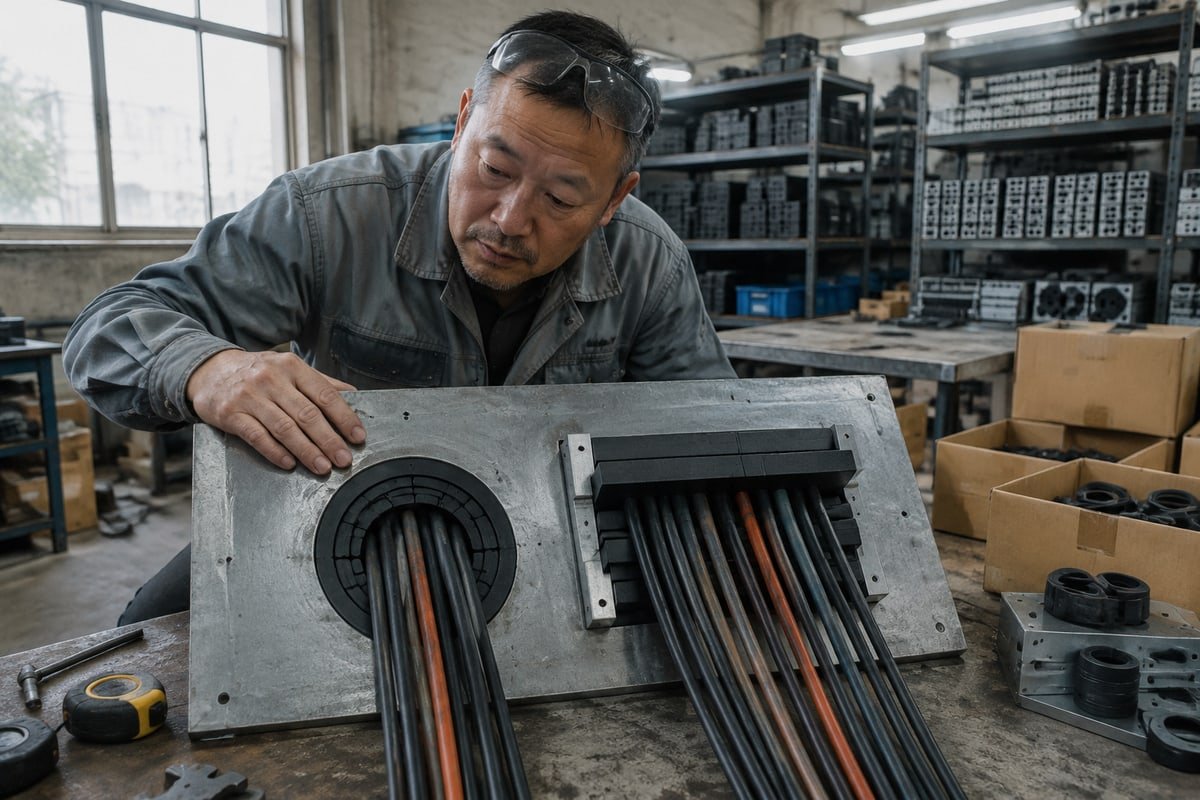
Every week our TSC and TSR production lines 1 see the same costly mistake: a rectangular vs round multi cable transit chosen after the opening was already cut. That order usually ends in rework.
The rectangular vs round multi cable transit decision follows your opening: use round (TSR) frames for core-drilled holes, pipe sleeves, and tight single-bundle penetrations; use rectangular (TSC) frames for panel cutouts, bulkheads, and high-density mixed cable groups. Both reach IP68, A-60, and gas-tight sealing when sized correctly.
Shape is not a style choice. It is a fit question. Below I walk through how we help sourcing engineers match modular cable sealing to the hole they actually have, what switching shapes really costs, and where each geometry seals best.
How do I choose between rectangular and round MCT frames for my project's opening dimensions?
A sourcing engineer in Germany once sent us a drawing of a core-drilled hole and asked for a square frame. We had to talk him out of it.
Match the frame to the opening you have or can cut cheaply: choose round MCT frames for circular core-drilled holes and pipe sleeves; choose rectangular MCT frames for flat panel cutouts and bulkheads needing rows of cables. Measure the clear opening, cable count, and wall thickness before selecting.

The fastest way to decide is to look at three facts: the opening, the cables, and the wall. Here is the shortcut table we send with every quote.
| Your situation | Round MCT (TSR) | Rectangular MCT (TSC) |
|---|---|---|
| Core-drilled hole or existing pipe sleeve | Best fit, no hot work needed | Needs adapter plate or new cutout |
| Laser-cut panel or cabinet wall | Possible, but wastes flat area | Best fit, welded or bolted flange |
| One dense bundle of similar cables | Very good, uniform radial seal | Good |
| Mixed diameters plus pipes, in rows | Limited by circle geometry | Best fit, full cable density optimization |
| Future cable additions likely | Limited spare space | Easy spare capacity planning |
| High-vibration marine deck | Naturally spreads stress | Requires radius corners on cutout |
Start with the opening geometry
If the hole is already round, stop there. A TSR round assembly slides into deck and bulkhead sleeves 2 and expands against the sleeve wall. There is no welding, so it suits retrofits and single-cable penetrations. If the surface is flat and uncut, a TSC frame gives you a rectangular footprint that stacks neatly beside other frames. This matters in BESS containers and modular data centers, where cable trays run in tight service corridors and rectangular frames can be stacked vertically in the BIM model.
Then check cable density
Rectangular frames win on packing efficiency. Our step-core EPDM blocks 3 stack in horizontal rows between stay plates, so an installer can group power, control, and fiber by row. A round frame forces every cable into one circular pattern. That works well up to a point, then wastes space.
The round-first objection
Buyers from marine and offshore backgrounds often tell me round is the standard for a fire-rated bulkhead penetration 4 in high-risk zones. That is true for many ships. But most land-based switchgear and container walls are flat steel plate, and cutting a rectangle there is cheaper than core-drilling a circle. The practical rule holds: redesigning the opening usually costs more than picking the shape that fits it.
Can I switch from round to rectangular sealing modules without redesigning my panel cutout?
During incoming inspection we measure every returned frame. A frequent return reason is not a defect. It is a square module ordered for a round sleeve.
No. Round TSR assemblies seal only inside a circular sleeve, and rectangular TSC modules need a rectangular frame and compression unit. Switching shapes means welding a new rectangular frame or bolting an adapter plate over the round hole. Switching brands within the same shape is the true drop-in case.
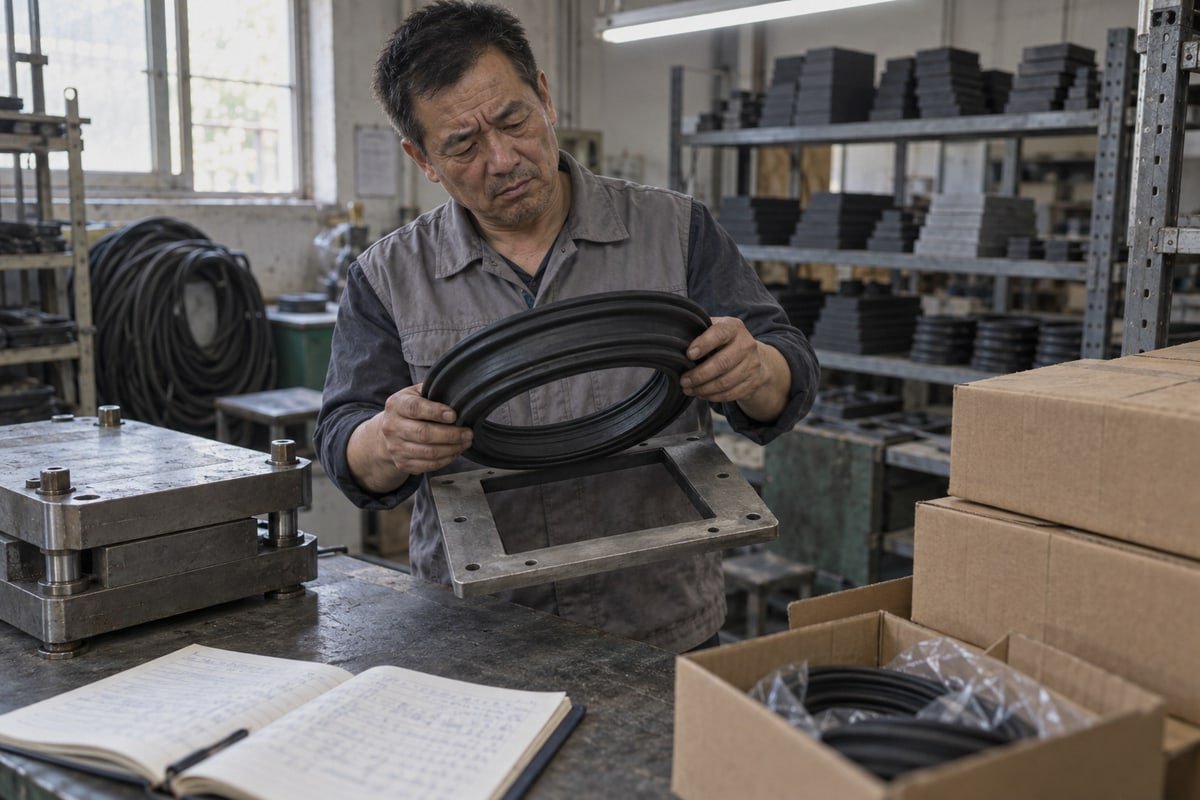
The two shapes seal in different ways. That is why they cannot swap. A TSR round transit uses a rubber assembly that expands outward when you tighten the bolts. A TSC square system uses a compression wedge system that pushes down through stacked rows of modules against stay plates. One is radial. The other is linear. Neither mechanism can be faked inside the wrong geometry.
Why square blocks fail in a round sleeve
Each TSC module is a two-half block with concentric peelable layers, like the teal blocks in our product photos. It needs flat frame walls on all four sides to build pressure. Push it into a circle and the corners have no support. The seal leaks at the gaps, and the IP68 rating is gone before the first water test.
Three retrofit installation solutions
- Keep the round hole, change nothing else. Fit a TSR assembly sized to the sleeve inner diameter. This is the lowest-cost path and needs no hot work.
- Bolt an adapter plate. Cut a flat plate larger than the round hole, weld or bolt a TSC flanged frame to it, then bolt the plate to the panel with a gasket. This works when you need rows of cables and the panel is not a fire barrier.
- Cut a new rectangular opening. Weld a TSC frame directly. This is the right answer for new builds and for a fire-rated wall where the plate itself must carry the rating.
The drop-in case that does work
| Change you want | Drop-in without redesign? | What we provide |
|---|---|---|
| Round brand A to round DewinMCT TSR | Yes, same sleeve diameter | Cross-reference table, validation sample |
| Square brand A to square DewinMCT TSC | Yes, 120-frame compatible | Cross-reference table, STEP files |
| Round to rectangular | No | Adapter plate drawing, new frame |
Our TSC modules are dimensionally compatible with common 120-frame standards. So if your existing rectangular frame is already installed, you can qualify us as a second source, request free validation samples, and swap modules without touching the cutout. That is the switch most European buyers actually need.
What cost and lead-time differences should I expect between TSC square and TSR round transit systems?
Every quote I price for TSC frames weighs welding labor and steel against module count. TSR round quotes weigh sleeve diameter and cable count against stock availability.
Expect TSR round transits to cost less per penetration and ship faster for small cable counts, because standard assemblies are stock items. TSC square frames cost more for welded frames and stay plates but seal more cables per opening, and DewinMCT drop-in modules run 40–60% below premium brands.

Cost is best understood per cable, not per frame. A round transit is cheap for one bundle. A rectangular frame is cheap for thirty cables. Here is how the money splits in a typical quote from our Shaanxi plant.
| Cost driver | TSR round | TSC square | Notes |
|---|---|---|---|
| Frame or sleeve | Low; sleeve often already exists | Higher; welded steel frame with flange | Frame material and finish drive this |
| Sealing modules | One assembly per sleeve | Multiple modules, sized per cable | Step-core blocks cut sizing SKUs |
| Compression hardware | Integrated bolts | Compression unit plus stay plates | Shown by the two hex bolts in our product view |
| Installation labor | Minutes, no hot work | Welding or bolting, then module packing | Retrofits favor round |
| Spare capacity | Limited | Add blank modules now, cables later | Reduces future openings |
| Cost per cable, dense mix | Rises quickly | Falls as count rises | Cross-over point depends on diameters |
Where the savings come from
Our price position is not a discount trick. It comes from in-house mold making, three production sites in Shaanxi, Shandong, and Hunan, and halogen-free EPDM compounded on site. Because one step-core module covers a range of cable diameters, you order fewer sizes. Fewer sizes mean fewer line items, fewer stock-outs, and simpler sealing module sizing during procurement.
Lead-time drivers
Round TSR assemblies in common sleeve diameters and standard TSC modules in the 120-frame family are the fastest items we ship, because we hold them for spare-part orders. Welded rectangular frames take longer. The frame must be cut, welded, and finished, and any custom size passes through our mold shop first. Custom flange plates or non-standard sleeve sizes add the most time. My advice for EPC procurement teams is simple: release the frame order early, and release modules once the final cable schedule is fixed.
The objection I hear most
A skeptical purchasing engineer will ask whether 40–60% lower cost signals lower quality. I answer with documents, not adjectives. We run ISO 9001 5 and IATF 16949 systems, the factory is BV-approved, and we provide fire test reports for A-0 and A-60, IP68 ingress reports, and pressure test data from 0.01 to 0.4 MPa on request. We also handle export documentation, so landed cost stays predictable.
Which frame shape gives me better sealing performance and IP68 rating for my specific cable mix?
The lesson from our pressure test rig is blunt: frame shape rarely fails a seal. Wrong sealing module sizing usually does.
Neither shape is inherently better; both TSR round and TSC square systems achieve IP68, A-0/A-60 fire rating, and gas-tight sealing from 0.01 to 0.4 MPa when modules match cable diameters. Round frames give more uniform radial pressure for dense single bundles; rectangular frames suit mixed diameters needing spare capacity.

Performance lives in the rubber, not the steel outline. Still, the geometry does change how pressure reaches each cable. The table below shows where each shape has a real edge.
| Performance factor | Round (TSR) | Rectangular (TSC) |
|---|---|---|
| Contact pressure pattern | Radial, very uniform | Linear, uniform when rows are packed correctly |
| High external pressure | Slight edge from radial expansion | Meets 0.4 MPa rating with correct torque |
| Mixed cable diameters | Harder; all cables share one pattern | Easier; each module sized per cable |
| Structure-borne noise | Better damping, no flat resonant faces | Flat sides can resonate in thin panels |
| EMC shielding protection | Available with conductive assembly | Available with conductive modules and frame bonding |
| Spare capacity planning | Limited | Blank modules reserved per row |
Radial versus linear compression
In a TSR round assembly, tightening the bolts squeezes the rubber outward against the sleeve and inward against the cables at the same time. Every point on the circle sees the same force. That is why round transits are marketed for demanding high-pressure watertight cable entry. In a TSC frame, the compression unit pushes downward through the stack. Force spreads through the stay plates to each row. Done right, the result is the same gas-tight integrity, and our test documents show both series passing the same water and gas limits.
Sizing modules for your cable mix
This is where I see most failures in a multi cable transit. Our step-core modules are peeled layer by layer until the core hole matches the cable diameter. Peel one layer too many and the cable sits loose. Peel too few and the halves will not close. The concentric rings you see molded on every block are the sizing guide. For a mixed bundle of power, control, and fiber, a rectangular frame lets you size each module on its own. For a single bundle of near-identical cables, a round assembly seals just as well with far fewer parts.
Fire, gas, and hazardous zones
For a fire-rated bulkhead penetration the frame must be welded or bolted to a rated structure, and the module compound must be halogen-free so it does not release corrosive smoke. Both our series use the same EPDM. For hazardous area certification, the frame bonding and any EMC shielding requirement matter more than shape. Ask us for the specific test report for your combination of frame, module, and cable before you sign off the drawing.
Conclusion
Choosing the wrong shape wastes cutouts and schedules. Let the opening decide, size the modules carefully, and we will supply certified, drop-in TSR or TSC parts on time.
Footnotes
1. Government resource for manufacturing excellence and production line optimization. ↩︎
2. Authoritative safety standards for ship structures including deck and bulkhead penetrations. ↩︎
3. Scientific overview of EPDM material properties used for cable sealing modules. ↩︎
4. International Maritime Organization standards for fire protection in marine penetrations. ↩︎
5. Official ISO page for the quality management standard mentioned in the article. ↩︎



 English
  Español de México
  Deutsch
  Français
  العربية
  Русский