
Most first MCT orders reaching our production line are either too big or too small. Both waste money. A safe initial order quantity for multi cable transit 1 prevents that.
A safe initial order quantity for multi cable transit covers your first installation phase, taken from a verified cable schedule, plus 20–30% spare capacity and a small module tolerance buffer. Order one complete frame set per phase-one penetration, not the whole theoretical project.
That answer sounds simple. In practice, four questions decide whether it works. How many samples do you need first? What will the factory actually accept? How do you run the calculation for a 120-frame drop-in? And what goes wrong at each end of the quantity scale? I will take them in order.
How many free validation samples should I request before committing to my first MCT order?
A sourcing manager in Germany once asked us for a carton of free sample modules. We sent a small kit instead. It qualified our TSC series against his existing frames.
Request one free validation sample of every sealing module size in your cable schedule, plus the adjacent size above and below, plus one compression unit and one stay plate. That is usually a dozen pieces or fewer, enough for fit, compression, and certification document checks.

The purpose of a validation sample is not to build a wall. It is to prove three things on a bench. First, the module drops into your existing 120-frame cutout without machining. Second, the step-core rubber closes on your real cable outer diameter, not the nominal one on the drawing. Third, the paperwork behind the sample matches the paperwork you will need for project qualification.
Why adjacent sizes matter more than extra pieces
Real cables are not perfect. A cable listed at 22 mm can measure 21.3 mm on one drum and 23.1 mm on the next. Ranking guidance on this topic recommends a tolerance buffer of modules sized 1–2 mm larger and smaller than the cable specification. Our step-core EPDM modules 2 already cover a band of diameters within one size, but I still tell buyers to sample the neighbouring sizes. If you only sample one size, you only learn about one drum of cable.
The full range for transit systems typically runs from about 3.5 mm to 110 mm cable diameter. That span is why I ask for the cable schedule before I ship anything. Without it, a sample kit is a guess.
What a useful sample kit looks like
| Item in the free sample kit | Quantity | What it proves on your bench |
|---|---|---|
| Module in each scheduled size | 1 per size | Cable diameter tolerance and step-core fit |
| Module one size up and one size down | 1 each | Tolerance buffer for drum-to-drum variance |
| Blank (spare) module | 1 | Spare capacity behaviour under compression |
| Stay plate | 1 | Row geometry inside the 120-frame |
| Compression unit or wedge | 1 | Achievable packing pressure |
| Test documents (A-0/A-60, IP68 3, 0.01–0.4 MPa) | PDF set | Certification match for qualification file |
What to check before you approve
Measure the module footprint against your frame cutout. Compress a scheduled cable and check the seal is water-tight by hand pressure and visual inspection. Then read the test reports and confirm the model cross-reference table maps your old part number to the DEWIN part number you are holding. That last step is the one buyers skip most often. It is also the step that saves the most time later, because the qualification file needs a clean model-to-model trail.
What's the minimum order quantity a factory-direct MCT manufacturer will accept for a trial batch?
Every trial batch forces a trade-off on our side: mold setup time against the buyer's need to stay small. We accept small because qualification wins long-term orders.
A factory-direct MCT manufacturer will usually accept a trial batch of one complete frame set: frame, sealing modules for one penetration, stay plates, and a compression wedge kit. MOQ is a supplier production limit, not a sizing rule; size the trial to one real aperture.
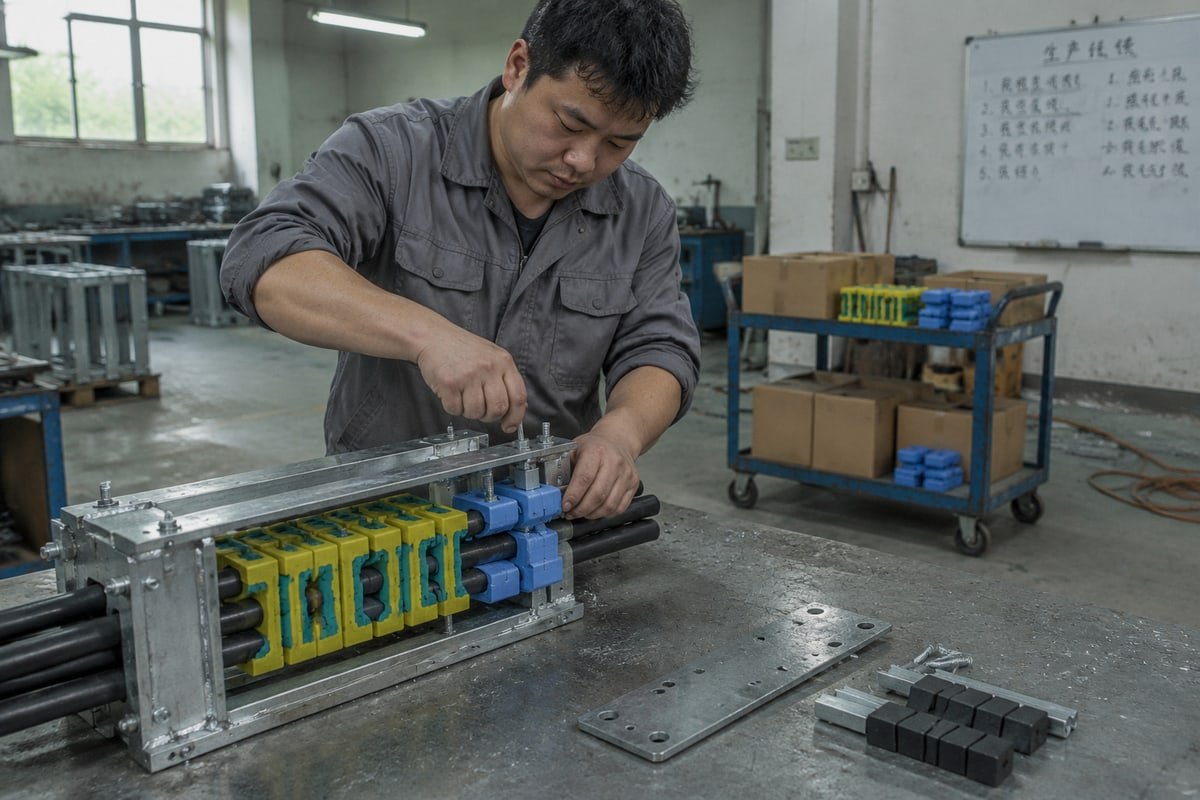
I want to separate two ideas that buyers often merge. The first is MOQ. The second is the right trial quantity. MOQ tells you what a supplier can run through a press without losing money on setup. It does not tell you what your project should buy. When those two numbers collide, a real factory can usually bend, because we control the mold shop and the rubber batch schedule ourselves. A trading company cannot, so its MOQ is often set by the carton or the pallet instead of by production logic.
Why a trial batch should be one real penetration
The trial batch should be the smallest quantity you can install, inspect, and photograph for the qualification file. In my experience that is one complete frame set for one fire-rated cable penetration. Not a bag of loose modules. A loose module tells you about rubber. A complete set tells you about the system: transit frame sizing, stay plate rows, compression travel, and the 15 mm free space some sleeve assemblies need inside the frame at both sides.
What the trial batch must contain
| Component | Why it belongs in a trial batch | Common mistake |
|---|---|---|
| Frame (galvanized or 316L stainless) | Material grade must match site corrosion exposure | Trialling galvanized for an offshore 316L job |
| Sealing modules per cable schedule | Proves module-to-OD mapping | Ordering one size only |
| Stay plates | Locks rows and sets packing geometry | Forgetting them and improvising |
| Compression wedge kit | Creates the pressure-tight assembly | Reusing the old brand's wedge |
| Lubricant | About one tube per 5–7 modules | Under-ordering, causing friction gaps |
| Test documents and CAD/STEP files | Needed for the qualification file | Requesting them after installation |
Standardised frame dimensions matter here too. If your existing system uses a common standard such as Size 6, tell us. Standard sizes ship faster and mount on common hardware. Custom cutouts go to our in-house mold shop, which adds setup time but no MOQ penalty on our side.
The buyer objection I hear most
Buyers sometimes say a bigger first order locks in lead time and price. That is a fair worry when site access is difficult. My answer is a split purchase order: trial batch now, phase-one lot released on qualification, later phases on call-off. You keep the price. You do not lock the wrong configuration.
How do I calculate the right initial quantity when switching to a drop-in second source for my 120-frame system?
During incoming inspection last spring, our QC team checked a customer's 120-frame cutout drawing against our TSC modules. The dimensions matched. The order quantity did not.
Count phase-one penetrations, map each cable OD from the cable schedule to a module size using the cross-reference table, add 10% packing space, 20–30% spare capacity, and a 1–2 mm tolerance buffer per size. Multiply by frames, then round up to full stay-plate rows.

The quantity mismatch I mentioned came from a copied bill of materials. The buyer had taken the old supplier's module count and pasted it into our order. Our modules are dimensionally compatible with common 120-frame standards, so the frame side was fine. But the step-core increments differ between brands, and his old list had no spare capacity at all. Here is the method I now give every buyer switching sources.
A six-step packing space calculation
- Freeze the cable schedule for phase one only. List every cable with measured OD, cable type, and the compartment or wall it passes through. Ignore later phases for now.
- Group cables by penetration. Each penetration becomes one frame set. This is where transit frame sizing starts.
- Map each OD to a DEWIN module size. Use the model cross-reference table. Do not assume the old size code equals ours.
- Add 10% packing space. Cables cross over and never lie perfectly straight. Increase the calculated frame space by roughly 10% for high-density transits.
- Add spare capacity. Ranking guidance says 20–30%. A major transit manufacturer recommends at least 30% and notes many projects choose 100%. Pick the figure your spare capacity requirements actually justify. For BESS containers 4 and modular data centres, I lean toward 30% because retrofits are common.
- Add a tolerance buffer, then round up. Add a few modules one size up and one size down per scheduled size. Round the total to full stay-plate rows so the frame packs correctly.
Worked example for one phase
| Step | Input | Result |
|---|---|---|
| Phase-one penetrations | 4 frames, 120-frame standard | 4 complete frame sets |
| Scheduled cables per frame | 12 cables, 3 OD groups | 12 modules per frame |
| Packing space (+10%) | 12 × 1.10 | 13.2, round to 14 with blanks |
| Spare capacity (+30%) | 14 × 1.30 | 18.2, round to 20 |
| Tolerance buffer | 1 up, 1 down per OD group | +6 modules per frame |
| Total per frame | Rounded to full rows | Fill remaining row with blank modules |
The example is illustrative. The point is the shape of the calculation, not the exact numbers. Free space inside the frame, wedge travel, and stay plate spacing all change with the real module mix, so send us the schedule and we return a frame drawing with the count already rounded.
Turning the safe initial order quantity into a purchase order
Once the count is fixed, split the PO by installation phase. Phase-one sets ship first. Later phases wait until their cable schedule freezes. For a drop-in second source, that also lets you install phase one while the old supplier's stock runs down, which keeps water-tight integrity and fire-rating documentation consistent across the wall.
What risks should I watch for if my first MCT order is too small or too large for project qualification?
The hardest lesson from our early export years came from a BESS container builder who ordered a full project lot before the cable schedule froze. Most modules never fit.
Too small risks commissioning delay, emergency air freight, and rework on prepared apertures. Too large risks obsolete module mixes after design changes, unused EPDM stock, storage burden, and cash tied up. Both can break qualification if test documents and the installed configuration do not match.

That builder had done the conservative thing. He bought early to protect his schedule. Then the battery rack supplier changed cable cross-sections, and half the module sizes became the wrong band. The rubber was fine. The mix was wrong. Multi cable transit can be a meaningful capital item on a complex project, so a wrong mix is not a rounding error.
Too small versus too large
| Risk area | First order too small | First order too large |
|---|---|---|
| Schedule | Commissioning delay waiting for reorder | None directly, but slow to correct |
| Cost | Emergency replenishment, air freight | Cash tied up, unused modules |
| Apertures | Rework on prepared cutouts | Obsolete configuration after redesign |
| Qualification | Installed set differs from sampled set | Certification file covers sizes never installed |
| Storage | None | EPDM stock ageing on shelves |
| Compliance | Missing wedges or lubricant compromises seal | Wrong material grade bought in bulk |
Three viewpoints, and where each one breaks
Buyers push back on the phase-one rule from two directions. The conservative view says buy extra early, because lead time is long and site access is hard. That holds only when the cable design is stable and expansion is likely. The lean view says buy the absolute minimum, because cable routing changes late. That holds only if you accept reorder risk on a fixed commissioning date. The balanced view, which I recommend, is a phase-one order with 20–30% spare capacity and a tolerance buffer. It costs slightly more than lean, but it removes the emergency reorder that lean buyers almost always end up placing.
Qualification risks people miss
- Certification mismatch. A fire-rated cable penetration is only qualified for the tested configuration. If you install a module mix different from the sampled one, your A-0/A-60 evidence may not cover it. For A60 marine certification, that gap is a real audit finding. A-60 marine certification 5
- Incomplete compression. Under-ordering wedges or lubricant causes friction gaps during first compression. The seal then fails IP68 or the 0.01–0.4 MPa gas-tight check.
- Material grade. Bulk-buying galvanized frames for a coastal or offshore site that needs 316L wastes the whole lot.
- Testing separation. Some transit testing guidance requires minimum separation between adjacent transits under simultaneous test. Cramming extra frames to use up stock can void that.
The safe initial order quantity for multi cable transit is the one that avoids both columns of that table. Our role is to make the reorder side painless: fast delivery of spare sealing modules from stock, private-label packaging if you need it, and the same test documents on every batch.
Conclusion
Guessing an MCT quantity costs schedule or cash. Guessing wrong twice costs the qualification. Order for phase one, add spare capacity, validate with free samples, then scale.
Footnotes
1. ISO provides the international standards for manufacturing and quality management systems used in industrial hardware production. ↩︎
2. Provides technical background on the synthetic rubber material used for sealing modules in transit systems. ↩︎
3. The IEC defines the Ingress Protection (IP) ratings used to certify the water-tightness of cable seals. ↩︎
4. The Department of Energy provides authoritative information on battery energy storage systems and infrastructure safety. ↩︎
5. The IMO is the governing body for international marine safety and fire protection standards like A-60. ↩︎



 English
  Español de México
  Deutsch
  Français
  العربية
  Русский