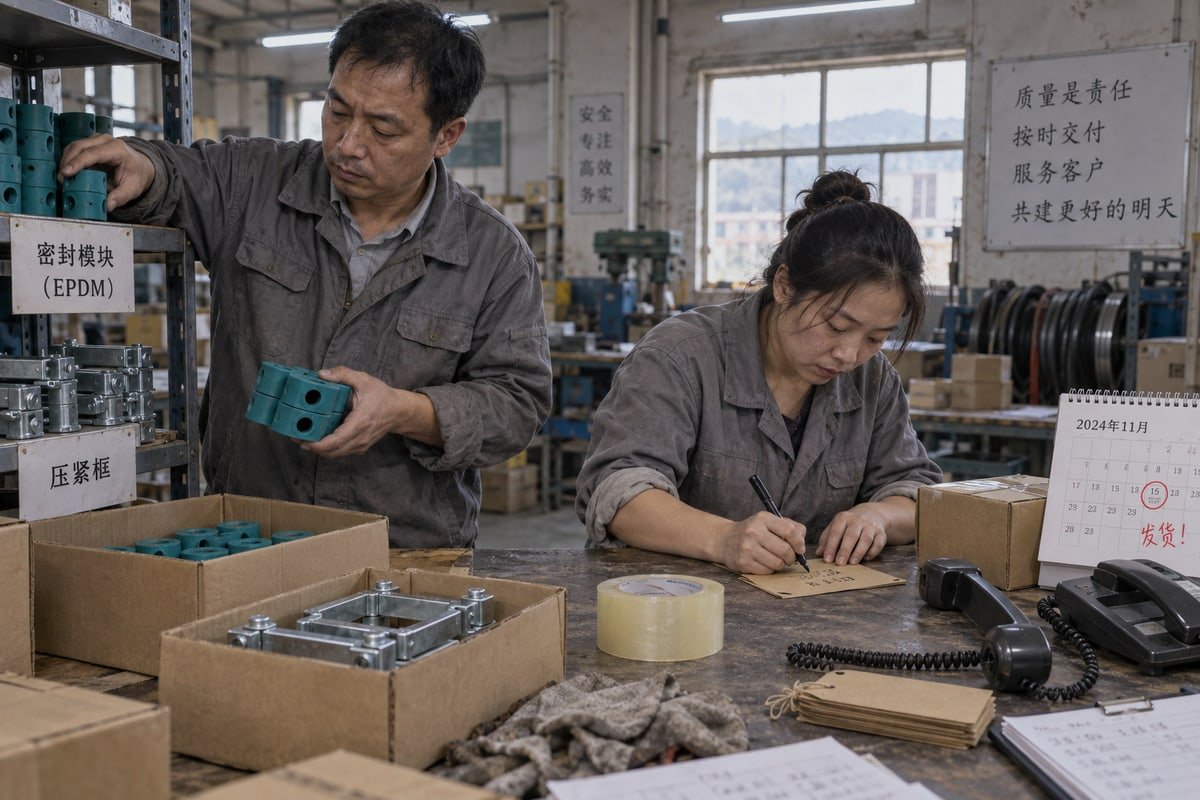
Long-term supplier partnerships for multi cable transits 1 start after a crisis. A buyer’s single source slips a delivery, a container line stalls, and our factory gets an urgent sample request.
Build long-term supplier partnerships for multi cable transits by verifying certifications and test reports first, confirming dimensional compatibility with your existing 120-frame cutouts, qualifying the factory through free samples, then trading forecast visibility and volume commitments for better pricing, priority slots, and documented support.
That order matters. Documents come before samples. Samples come before price talks. Price talks come before any multi-year agreement. Below, I walk through each stage the way our engineering team handles it with sourcing managers in Europe, Asia-Pacific, and the Middle East. I will also raise the objections buyers put to me most often, and answer them directly.
How can I verify a MCT supplier's certifications and test documentation before committing long-term?
Every A-60 fire test on our modules leaves a scorched test frame behind. I keep photos of them, because a certificate alone rarely satisfies a skeptical purchasing engineer.
Verify an MCT supplier by requesting the ISO 9001 and IATF 16949 certificates, the classification society factory approval, and full test reports for fire rating, IP68, and pressure sealing. Check certificate numbers, validity dates, scope, and whether tested module sizes match the ones you will buy.

Certification is the first gate in strategic sourcing 2 for this category. Multi cable transits sit inside firestop sealing systems, watertight bulkheads, and pressurised enclosures. A wrong document is not a paperwork problem. It is a project approval problem. So I recommend a fixed document list and a fixed way to read each one.
Which documents to request, and in what order
| Document | What it proves | What to check |
|---|---|---|
| ISO 9001 certificate | The quality management system exists and is audited | Issuing body, certificate number, expiry date, scope covers cable transit products |
| IATF 16949 certificate | Process control discipline at automotive level | Same site as the production site quoted to you |
| Classification society 3 factory approval (BV in our case) | Production is audited against marine and offshore safety standards | Approval covers the product range, not just the address |
| Fire test report A-0 / A-60 | The sealed penetration holds integrity and insulation | Tested frame size, module layout, cable fill, and test duration |
| IP68 test report | Protection against dust and continuous immersion | Immersion depth and time conditions stated |
| Watertight / gas-tight pressure test, 0.01–0.4 MPa | Sealing under differential pressure | Pressure range, holding time, test medium |
| Halogen-free EPDM material declaration | Low smoke, no halogen acid gas, suitable for BESS containers and data halls | Compound reference matches the module part number |
| Project-specific: ATEX certification, EMC modules | Hazardous-area use or electromagnetic compatibility protection | Request only if your spec requires it; never accept a generic claim |
Read the report, not the cover page
A certificate proves the system. A test report proves the product. I ask buyers to open the report and look at the test configuration. An A-60 result belongs to the frame size, module stack, and cable fill that were burned. If your project uses a different frame, ask whether the report covers it. Ask for test photos too. We keep them for every rating we hold, and I share them on request.
Then verify the certificate number with the issuing body. This takes a few minutes online. It catches self-declarations dressed up as certificates.
The objection I hear most
Some buyers tell me a valid certificate is enough to award a long-term contract. I disagree, and I say so. Certificates expire. Scopes change. Products get revised without a retest. So we recommend adding a scorecard KPI called documentation accuracy. It measures whether every shipment arrives with the correct, current, traceable document set. That single metric tells you more about a partner than a framed certificate on a wall.
What should I look for in dimensional compatibility data to ensure a true drop-in second source?
A fraction of a millimetre decides whether a module drops in or gets returned. When we cut a new mold, we weigh tolerance against EPDM shrinkage, and the drawing records both.
Look for a model cross-reference table mapping your current module to the replacement, dimensioned CAD or STEP files showing outer block size and frame opening, the cable diameter range each step-core module covers, and free validation samples you can fit into an existing 120-frame cutout.
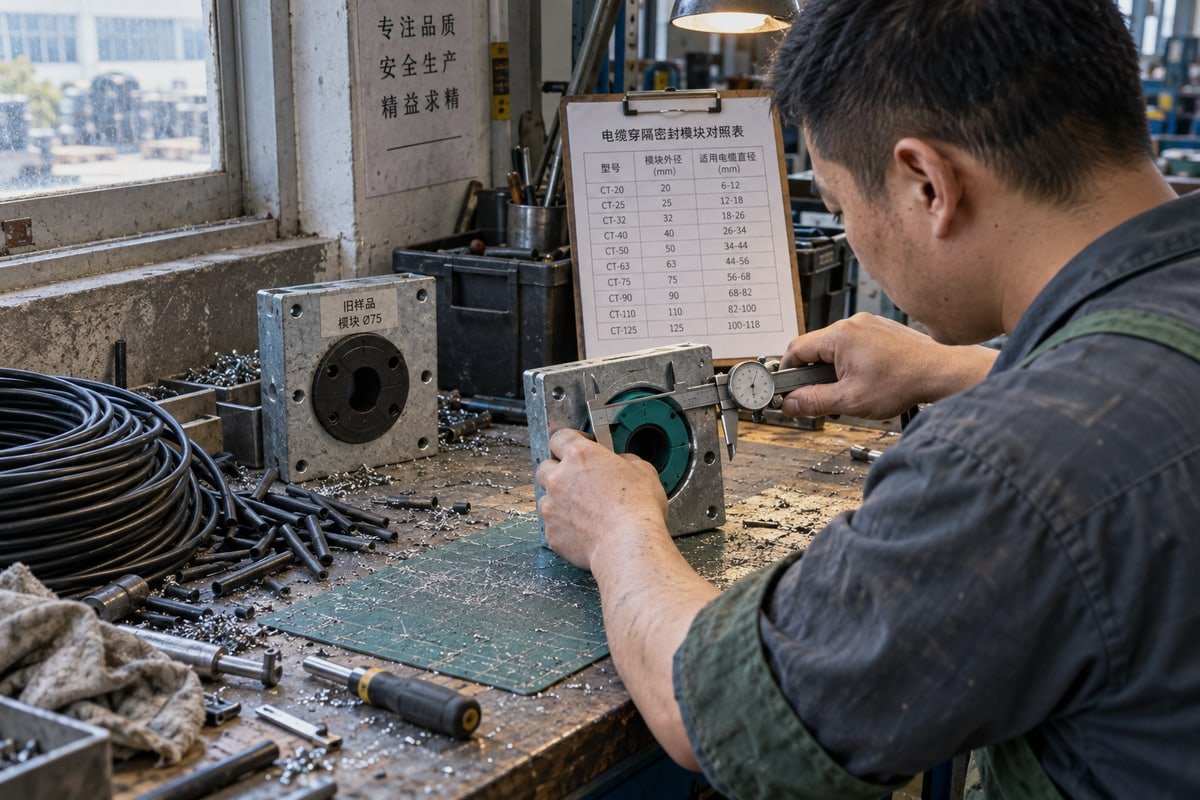
Modular cable seals from different factories look alike in a catalog photo. Blue block, concentric rings, split shell. The photo tells you nothing about fit. Only the data does. Here is the sequence we use with a buyer who wants a qualified second source without touching the installed frame.
A four-step validation process
- Request the cross-reference table. It should map each existing model number to the replacement model number, one line per size. Our TSC square modules and TSR round assemblies are listed this way against common 120-frame standards. If a supplier cannot produce this table, the drop-in claim is untested.
- Import the STEP files. Open them in your own CAD. Measure the outer block dimensions, stack height, and the internal opening of the frame. Compare against the installed frame drawing. Check stay plate thickness and compression unit travel as well, because a module that fits the opening can still fail if the compression stack ends up too tall or too short.
- Check the cable diameter range. Step-core modules cover a range of cable diameters within one block size. The datasheet should state the minimum and maximum diameter per size and how many layers to peel. This range decides how many module sizes you need to stock, which affects both cost and lead time.
- Fit the free samples. Install them in a real frame at your site. Tighten the compression unit. Look for even compression across the stack and no gaps at the frame wall. Photograph the result and keep it in your qualification file.
The data checklist in one place
| Data item | Why it matters | Pass criterion |
|---|---|---|
| Model cross-reference table | Confirms the supplier has mapped sizes deliberately | Every installed model has a listed equivalent |
| Dimensioned STEP/CAD file | Lets your engineers verify fit before samples ship | Block and frame dimensions match your installed drawing |
| Cable diameter range per module | Controls stock complexity and fill planning | Range covers your cable schedule with margin |
| Compression system compatibility | Prevents mixed-stack failure | Stack height and stay plate dimensions align |
| Free validation samples | Proves fit in your frame, not ours | Even compression, no gaps, documented photo record |
An objection worth answering
Buyers sometimes ask whether dimensional compatibility means the product is a copy. The frame dimension standard is open. What sits inside it is not. Our step-core geometry, halogen-free EPDM compound 4, and the test program behind them are ours, backed by 38 or more granted patents. Compatibility is a design decision that protects your installed base. It is not a shortcut.
How do I negotiate better pricing and lead times once I've validated a supplier through free samples?
A sourcing manager in the Netherlands once asked me for our floor price before her samples had even cleared customs. I asked her for a forecast instead.
Negotiate after samples pass by offering a rolling twelve-month forecast, a framework agreement with volume-based pricing tiers, and consolidated shipments. In return, ask for fixed pricing per tier, reserved production slots, spare-module stock, and lead time commitments written into service level agreements.

Better terms are a trade. The buyer offers predictability. The factory returns priority, stability, and flexibility. That exchange is what turns a validated supplier into one of your long-term supplier partnerships for multi cable transits. Here is how I structure the conversation once the qualification file is complete.
What you give and what you can ask for
| Buyer offers | Factory can return |
|---|---|
| Rolling twelve-month forecast, updated monthly | Reserved capacity and shorter confirmed lead times |
| Multi-year framework agreement with volume tiers | Volume-based pricing locked per tier |
| Consolidated orders around standard module sizes | Lower unit cost and fewer partial shipments |
| Early engineering involvement on new frame designs | Custom molds amortised over the agreement, fewer revisions |
| Shared scorecard data on delivery and quality | Faster issue closure and continuous improvement |
| ESG reporting data and audit access | Support for your sustainability targets and green financing files |
The transaction-first objection
Many procurement teams argue that competitive bidding 5 on every order delivers the best savings. For commodity fasteners, I would agree. For certified components, I do not. Every switch of supplier restarts qualification, retests fit, and risks a project approval delay. Total cost of ownership includes those hours, plus rework, plus schedule slippage. Our factory-direct pricing already sits 40 to 60 percent below the incumbent brands. I tell buyers plainly that I will not cut further without forecast visibility. That is not stubbornness. It is how we protect delivery for the customers who do share their plans.
Protect yourself from dependency
The partnership-first view has its own risk. A buyer can grow complacent. Leverage can fade. So I recommend four safeguards, and I put them in writing myself.
- Keep dual sourcing. Hold the incumbent as one approved source and us as the second. Supply chain resilience improves when either can fill an order.
- Add exit clauses tied to scorecard thresholds for on-time delivery, defect rate, and documentation accuracy.
- Benchmark pricing annually against the market, and consider indexing the EPDM raw-material component so both sides share volatility.
- Agree on buffered inventory of spare sealing modules, held at our plant or on consignment near your site. This is the most effective lead time optimization lever we have, because standard TSC and TSR sizes ship from stock rather than from a production slot.
Our three production sites in Shaanxi, Shandong, and Hunan add a further layer. If one site is loaded, another can take the order.
What ongoing support and documentation should I expect from a manufacturing partner versus a trading company?
Our costliest early lesson involved a spare-module order nobody could match to the original frame drawing. Since then, every shipment leaves our plant with its own documentation pack.
Expect a manufacturing partner to supply CAD/STEP files, installation drawings, test reports, material declarations, and export paperwork, plus engineer-to-engineer technical support, custom mold capacity, and fast spare-module delivery. A trading company resells catalog items and usually cannot change a drawing or own a quality issue.

The difference shows up after the purchase order, not before it. Both a factory and a trader can send a quote and a catalog. Only one of them can change a mold, retest a module, or trace a spare part back to the batch it came from. The table below sets out the comparison as I explain it to buyers.
Manufacturing partner versus trading company
| Criterion | Manufacturing partner | Trading company |
|---|---|---|
| Custom sizes and drawing changes | In-house mold making, engineering owns the change | Must relay the request to a factory, if permitted |
| Test documentation | Original reports traceable to production batches | Copies, often generic across brands |
| Spare sealing modules | Produced or stocked on demand | Dependent on third-party stock |
| Quality issue ownership | Root cause found at the production line | Passed through, with delay |
| Technical support | Engineer-to-engineer, in English | Sales-level responses |
| Private-label production | Available | Rare |
| Export documentation | Handled | Handled |
| Pricing | Factory-direct | Margin added |
What ongoing support should look like
Support needs a cadence, or it fades. I recommend agreeing on these elements at signing.
- Governance. Named owners on both sides, a quarterly business review, and a clear escalation path.
- Service level agreements. Written response times for technical queries, RFQ turnaround, and quality complaints.
- Documentation on every shipment. Packing list, certificate of conformity, test report reference, and installation drawing for the frame in question.
- Installation support. Peel-and-fit instructions for step-core modules, installation videos, and on-site training for your install teams where project size justifies it.
- Data integration. STEP files and part numbers loaded into your vendor management system, and where your projects run on BIM, module data that your planners can pull directly into the model for procurement scheduling.
- Joint improvement roadmap. New sizes, new compounds, or retrofit-friendly compression units reviewed together each year.
How to confirm a factory is really a factory
Traders sometimes present themselves as manufacturers. Ask for the business licence and check the registered capital. Ours shows RMB 50 million. Ask for the patent list. Ask to see the production sites on a live video call, not a pre-recorded tour. Ask which classification society has audited the plant. A BV factory approval is hard to fake, because the auditor visits the line.
Some buyers argue that trading companies are more flexible because they can source from several factories. In practice, that flexibility ends the moment a module fails a fit test or a certificate needs updating. Flexibility that cannot change a drawing is not flexibility. It is a longer email chain.
Conclusion
Single-sourcing certified components leaves projects exposed. Verify documents, test drop-in fit, then trade forecast visibility for terms. That is how a qualified second source becomes a long-term partner.
Footnotes
1. Technical overview of multi-cable transit systems used for sealing cable penetrations in hazardous environments. ↩︎
2. Global agency providing resources and methodologies for sustainable and strategic international trade procurement. ↩︎
3. Official site of the UN agency responsible for the safety and security of shipping. ↩︎
4. Authoritative scientific data regarding the chemical properties and engineering applications of EPDM rubber. ↩︎
5. Global financial institution providing economic definitions and frameworks for assessing long-term procurement costs. ↩︎

 English
  Español de México
  Deutsch
  Français
  العربية
  Русский