
Last spring a European buyer sent our engineering team multi cable transit documentation from three Chinese quotes. None matched his class society’s scope. That gap stalls surveys and burns weeks.
Multi cable transit documentation meets classification society requirements when the Type Approval Certificate names the exact society, fire rating, and structure type your vessel needs, when referenced test reports are traceable to recognized labs, and when the installed cable sizes, fill ratio, and frame dimensions match the approved drawing.
That answer has three layers. The certificate scope. The test evidence behind it. The installation limits on the drawing. I will walk through each layer below, in the order a sourcing engineer should check them.
What test documents and certificates should I request from a Chinese MCT manufacturer before ordering?
On our production line in Shaanxi, every batch of TSC modules leaves with a document folder. I learned early that buyers judge us by that folder before the rubber.
Before ordering, request the full Type Approval Certificate, all referenced fire and tightness test reports with lab names and report numbers, ISO 9001 and IATF 16949 certificates, approved installation drawings, technical data sheets with cable diameter and fill-ratio limits, MSDS for halogen-free content, and a Factory Acceptance Test record.

A brochure is not a document. That sounds obvious, but many quotes from China still arrive with a glossy PDF and a line that says "meets class." A surveyor cannot use that line. He needs paper he can trace.
The core document pack
Here is the list I would put in an RFQ. Each item proves a different thing.
| Document | What it proves | Red flag if missing |
|---|---|---|
| Type Approval 1 Certificate (TAC) | The class society examined the design and test evidence | Only a "test certificate" from the factory itself |
| Fire test report (IMO 2010 FTP Code 2, Part 3) | The cable penetration seal survived the A-0 or A-60 furnace exposure | No lab name, no report number, no drawing reference |
| Watertight integrity testing report | Pressure holding at the stated MPa range | A single line "IP68 passed" with no method |
| Approved installation drawing | Sleeve size, cable diameter limits, fill ratio, insulation arrangement | Drawing revision date older than the certificate |
| Technical data sheet | Material, temperature range, module sizes | Model numbers that differ from the TAC |
| ISO 9001 and IATF 16949 certificates | The factory has a controlled quality system | Certificate held by a trading company, not the plant |
| MSDS for the EPDM rubber | Halogen-free, low-smoke composition | No mention of halogen content |
| Statement of Compliance for the project | Traceability to the specific hull number | Generic statement with no project name |
Certificates prove type testing, not site suitability
Here is a tension I hear often. The supplier says a valid type approval is enough. The owner's surveyor says it is not. Both are partly right.
Published DNV examples for Chinese suppliers show how narrow approval language has become. One certificate covers multi-cable penetration systems in A-60 steel bulkheads and decks, tied to SOLAS 74, the IMO 2010 FTP Code, and MSC.1/Circ.1488. Another covers H-120 steel divisions and lists several test reports, drawings, a tightness test report, and a data sheet in the package. Both note that other applications need case-by-case approval.
So the certificate proves the type. The drawing and the installation records prove the site. You need both. I also recommend asking for MCT installation records as a template before ordering. Then you know what the factory expects the yard to record later.
Two more items matter in Europe. Ask for IHM or Green Passport 3 supporting data. The seal materials must not contain substances restricted under the Hong Kong Convention. And ask whether the IEC 60092-350 and IEC 60092-352 cable standards 4 are referenced in the installation guide. Those standards govern the cables, not the transit. But the transit is tested with specific cable types, and the guide should say which.
How do I verify a supplier's BV approval and ISO/IATF certifications are genuine and current?
A German switchgear buyer once asked our sales engineer for the BV certificate number, then checked it himself BV certificate search 5 before replying. I respected that. Skepticism is a good procurement habit.
Verify BV approval by requesting the certificate number and checking it in Bureau Veritas' online certificate database, then confirming the legal entity name and address match the factory. Verify ISO 9001 and IATF 16949 through the IAF CertSearch database and the IATF Global Oversight portal, checking expiry dates and scope.

Counterfeit and expired paper exists in secondary supply chains. I have seen scanned certificates with the date edited. I have also seen genuine certificates held by a trading company that never touched a mold. Both cases fail at survey. So verification is a process, not a glance.
A five-step verification sequence
- Get the certificate number and issue date in writing. Do not accept a screenshot. Ask for the PDF as issued by the society.
- Search the issuer's public database. Bureau Veritas, DNV, LR, ABS, and China Classification Society CCS all run online lookups. CCS uses a certificate online verification system where you scan a QR code or enter the serial number. If the number returns nothing, stop.
- Match the legal entity. The name on the certificate must match the factory's business license and the name on the commercial invoice. Our registration in Shaanxi is the same name on our BV factory approval. If a supplier cannot show that chain, the certificate may belong to someone else.
- Check the certificate type. This is the step most buyers skip. A factory approval, a product type approval, a manufacturer approval, and a service-supplier recognition are not interchangeable. Each covers a different thing.
- Check the expiry date and the scope line. A certificate issued five years ago may have lapsed. A scope that says "rubber seals" does not automatically include frames and compression units.
Certificate types are not interchangeable
| Certificate type | Issued by | What it covers | Verify through |
|---|---|---|---|
| Product Type Approval Certificate | Class society (IACS member 6) | A specific product range and its approved applications | Society's public certificate database |
| Factory or Manufacturer Approval | Class society | The plant's process capability for a product family | Society's database plus site audit report |
| ISO 9001 | Accredited certification body | Quality management system | IAF CertSearch |
| IATF 16949 | IATF-recognized body | Automotive-grade process control | IATF Global Oversight portal |
| Service-Supplier Recognition | Class society | The installer, not the product | Society's service supplier list |
One practical note on IACS member standards. BV, DNV, LR, ABS, and CCS are all IACS members. That means their fire test acceptance follows the same IMO FTP Code basis. It does not mean a BV approval is automatically accepted by DNV. If your vessel is under another society, ask that society about cross-recognition or case-by-case acceptance early. I tell buyers this on the first call because it saves months later.
Can I get fire rating and IP68 sealing test reports that satisfy my classification society's specific requirements?
Every time we schedule a fire test on our TSC modules, we weigh scope against cost. A wider approval envelope costs more furnace hours but saves buyers from case-by-case submissions.
Yes. Chinese MCT factories can supply A-0 and A-60 fire test reports based on IMO 2010 FTP Code Part 3, IP68 ingress reports per IEC 60529, and watertight or gas-tight pressure reports up to 0.4 MPa. Satisfaction depends on whether tested division, structure, and cable envelope match your society's rule.

The word "satisfy" is doing a lot of work in that question. A test report satisfies a class society only when the tested arrangement matches the arrangement on your vessel. I want to break down what "matches" means in practice.
What each test report must show
| Test | Standard basis | What the report must state | Where scope usually breaks |
|---|---|---|---|
| A-0 / A-60 fire | IMO 2010 FTP Code, Part 3 | Division type (bulkhead or deck), steel thickness, insulation side, cable types loaded | Approved for bulkhead only, deck not tested |
| H-120 hydrocarbon fire | Class society offshore rules | Hydrocarbon curve exposure, jet fire if claimed | Applied to a cellulosic-rated A-60 report by mistake |
| IP68 ingress | IEC 60529 | Immersion depth, duration, cable fill used | Report covers empty frame, not loaded modules |
| Watertight integrity testing | Class pressure test procedure | Pressure held, duration, direction of pressure | Only one direction tested, deck penetration needs both |
| Gas-tight seal | Class or project specification | Test gas, pressure, leak rate | No leak rate stated, only "pass" |
Our own published range covers A-0 and A-60 fire resistance, IP68, and watertight or gas-tight sealing from 0.01 to 0.4 MPa. When a buyer asks for H-120, I say so directly. That rating needs a separate hydrocarbon exposure test, and I would rather lose an order than send a mismatched report.
The A60 fire resistance scope trap
Here is the objection I hear from owners and their surveyors. "Your A-60 report is for a steel bulkhead. My penetration is through a deck with insulation on the underside." They are right to raise it. The FTP Code treats bulkheads and decks differently. Heat flows differently through a horizontal division. Insulation placement changes the result.
The resolution is simple but often skipped. Compare the fire zone on the vessel's general arrangement plan against the division type on the test report. If the report covers both bulkheads and decks, as the published DNV A-60 examples for Chinese suppliers do, you are covered. If it covers one only, you need either a second report or a case-by-case submission to your society.
IMO FTP Code compliance versus MED
For EU-flagged vessels there is one more layer. The Marine Equipment Directive MED requires the wheelmark for A-class penetrations. A class society Type Approval Certificate and a MED certificate are different documents, even when the same lab test supports both. Ask your supplier which one you are looking at. Then ask the flag administration which one they need.
I also suggest asking for the Factory Acceptance Test FAT record on the actual shipped batch. The type test proves the design. The FAT proves the batch was built to that design. Together they close the loop a surveyor wants to see.
What should I check in a model cross-reference table to confirm dimensional compatibility before requesting documentation?
One lesson from years of second-source qualification: a certificate for the wrong module height is worthless. So we now send the cross-reference table before the certificate pack, not after.
Check that the cross-reference table lists your existing model beside the second-source equivalent with matching module height, width, depth, cable diameter range, frame cutout size, stay plate thickness, and compression unit stroke. Then confirm the listed model number appears verbatim on the Type Approval Certificate and test reports.
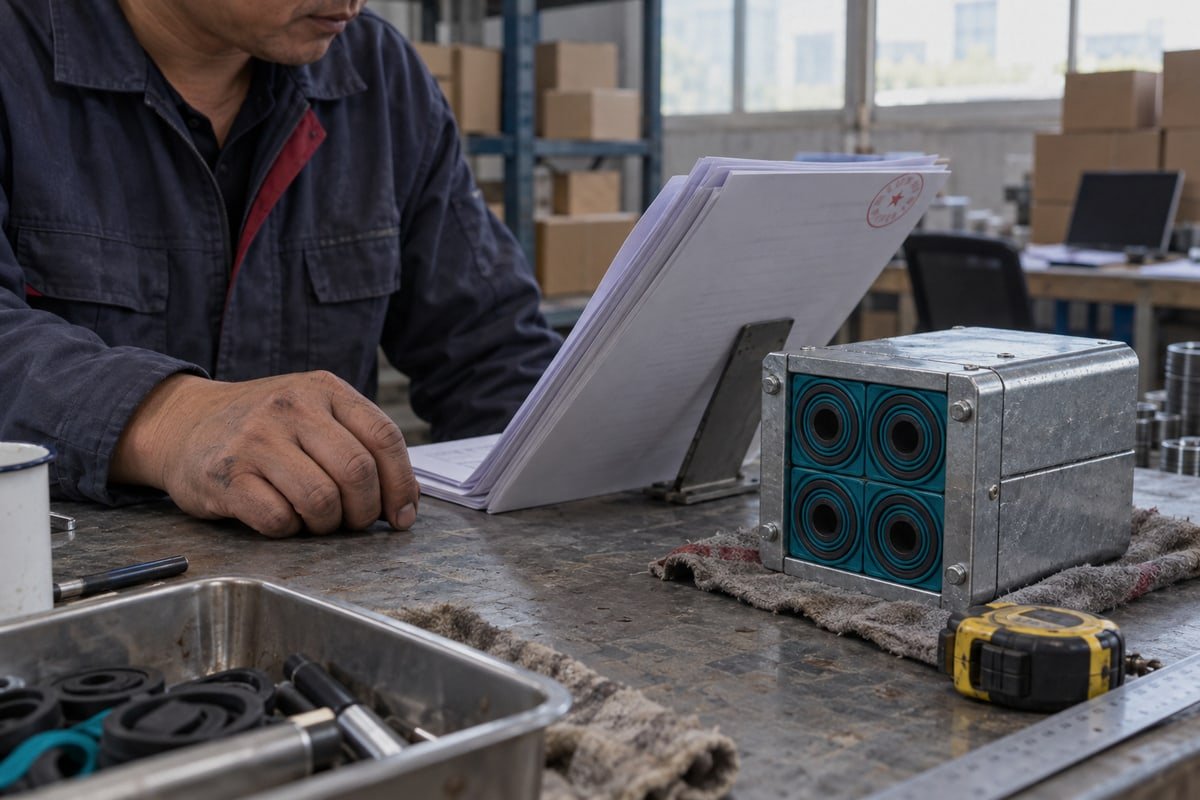
Documentation is only useful for a product that fits. That is why I put dimensional compatibility ahead of the certificate request in the workflow. If the module does not drop into the existing frame cutout, you will not install it, and the paperwork is moot.
Fields that must match
Our cross-reference tables map an existing model to a DEWIN TSC or TSR model. The table is dimensionally built around the common 120-frame standard. But a table is only as good as the fields it contains. Here is what I would look for, and what goes wrong when a field is missing.
- Module height and width. The stacked layers in a frame must add up to the frame opening with the stay plates and compression unit included. A few millimeters of mismatch means the compression unit cannot close.
- Module depth. In the 120-frame family, depth is fixed by the frame. A shallower module leaves an unsealed edge. A deeper one protrudes and defeats the fire insulation arrangement.
- Cable diameter range per module. Our step-core EPDM modules accept a range of diameters in one size. The table must state the range so you can compare it against the cable list from IEC 60092-352 selection.
- Fill ratio and minimum cable spacing. CCS-approved installation drawings often set limits here. The cross-reference table should point to the same limits.
- Stay plate thickness and position. Chinese surveyors increasingly ask for photographic evidence of stay plate positioning. The table should tell you how many plates each frame size needs.
- Compression unit stroke and bolt torque. The documented bolt torque values must appear in the class-stamped manual. Temperature swings in a shipyard change how the rubber behaves, so the torque value on the drawing is not optional.
- Spare insert blocks. LR-linked design criteria note that spare blocks may be required. Check the table lists the blank module for each frame size.
From table to drawing to certificate
The final check is consistency. The model number in the cross-reference table must appear on the installation drawing, the technical data sheet, the Type Approval Certificate, and the test report. Revision dates should line up. If the table says one thing and the drawing says another, ask which is current before you order.
This is also where a free validation sample earns its place. I would rather ship a sample module and a STEP file than argue about a spreadsheet. Fit the sample into your existing frame. Photograph it. Then request the full multi cable transit documentation for that exact model. In my experience, this order of steps cuts qualification time and avoids the survey-day surprise where the paperwork is perfect and the module is wrong.
Conclusion
Documentation gaps, not rubber quality, sink Chinese MCT submissions. Verify scope, trace test reports, match dimensions first. Do that and a qualified second source clears survey.
Footnotes
1. Authoritative overview of the maritime type approval process by a leading classification society. ↩︎
2. Official IMO resource for fire safety standards, including the FTP Code for marine equipment testing. ↩︎
3. IMO guidance on ship recycling and the Inventory of Hazardous Materials (IHM) requirements. ↩︎
4. International standard for electrical cable selection and installation on board marine vessels. ↩︎
5. Official Bureau Veritas Approval Explorer tool for verifying marine equipment and manufacturer certificates. ↩︎
6. Official site of the International Association of Classification Societies governing global maritime safety standards. ↩︎



 English
  Español de México
  Deutsch
  Français
  العربية
  Русский