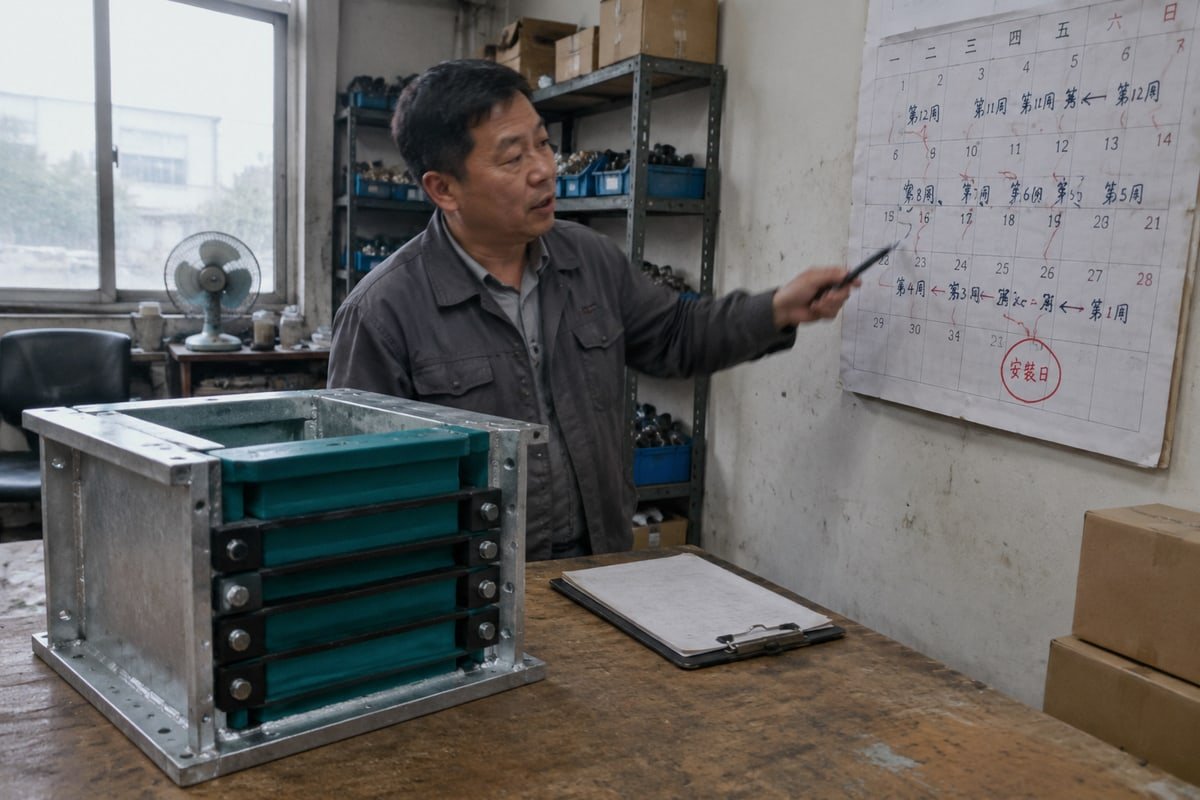
Every autumn our order desk sees the same problem: multi cable transit systems requested for installation dates that are already impossible IATF 16949 1. Late orders stall cable pulling. Early back-planning fixes this.
Order multi cable transit systems 16 to 24 weeks before the on-site date for peak season. Count back from installation, adding time for drawing approval, production, testing, freight, customs, and site acceptance. Custom or certified modules need the longer end of that range.
That answer is short. The reasoning behind it is not. Below I break the timeline into its real steps, show where peak season stretches each one, and give you a practical plan for second sourcing, samples, [custom size](https://dewinmct.com/?p=653)s, and spare module reorders.
How much lead time do I need to budget when switching to a second-source MCT supplier during peak season?
A sourcing manager in Germany once asked us to qualify our TSC modules in three weeks, mid-October. We told him the honest number instead of the one he wanted.
Budget 16 to 24 weeks when switching to a second-source MCT supplier in peak season. Reserve 2 to 4 weeks for sample validation and drawing approval, then production, inspection, and 1 to 6 weeks for freight and customs release. Start qualification before the peak, not during it.

The number that matters is not the one on a product page. A stock page shows factory dispatch time for a certain quantity under normal conditions. It does not show your project cycle. When you switch suppliers, the cycle gets longer, because qualification steps are added in front of production.
The full lead-time chain, counted backward from site
I always ask buyers to start with the date cables must pass through the wall or bulkhead. Then we count backward. Here is the chain we use in our own supply chain planning with EPC and OEM customers.
| Step | What happens | Peak-season effect | Planning note |
|---|---|---|---|
| Site acceptance | Goods checked, frames released to installers | Site teams stretched thin | Add several days, more for offshore sites |
| Freight and customs | Sea or air transit, destination release | Q3/Q4 capacity crunch, booking delays | 1 to 6 weeks depending on mode and paperwork |
| Inspection and packing | Final QC, test documents, export documents | Inspectors booked out | Pre-agree the document list |
| Production | Modules molded, frames welded and galvanized | Slots fill early | Reserve a slot at PO release |
| Drawing approval | Submittals, cross-reference sign-off | Engineers busy with other packages | 2 to 4 weeks of "white space" |
| Sample validation | Fit check in your 120-frame cutout, compression test | Courier delays | Request samples before the peak |
| PO release | Internal approval, vendor set-up | Finance cycles slow down | Set up the vendor early |
Add these up and 16 to 24 weeks stops looking conservative. It looks normal.
Why a second source adds steps, and how we shorten them
Switching suppliers means your engineers must confirm three things. First, that the module is dimensionally compatible with the existing frame cutout. Second, that the sealing performance matches the spec. Third, that the paperwork satisfies the client.
Our step-core, halogen-free EPDM 2 modules are built to common 120-frame standards. So the first check is usually fast. We provide a model cross-reference table that maps the existing module to the DEWIN equivalent. We send free validation samples so your team can fit them, compress them, and inspect them. Test documents for A-0/A-60 fire rating 3, IP68, and watertight sealing from 0.01 to 0.4 MPa are available on request. None of that removes the approval step. It just removes the argument inside the approval step.
The objection: "the quoted lead time is enough"
I hear this often. A buyer takes the quoted production time, adds a week, and sets the PO date. Then peak season arrives. Freight bookings slip. A drawing sits in an inbox for three weeks. The module arrives after switchgear is already energised. The quoted lead time was accurate. It was just one link in a longer chain.
Procurement-focused teams do it differently. They back-plan from site and treat the quoted lead time as one input. They also watch sector micro-peaks. A large data center build-out or an offshore wind campaign 4 can drain regional stock months before the traditional peak. If your project sits near one of those, move your PO date earlier still.
A final tactic works well for EPC teams. Negotiate a manufacturing slot reservation at the Pre-FEED stage, before the cable schedule is final. You lock capacity. You fix sizes later. We accept these for integrators we have already qualified, because it lets us plan compound and steel purchasing ahead of the crunch.
Can I still get free validation samples and CAD/STEP files quickly even during high-demand periods?
Last peak season our sample bench in Shaanxi stayed busy late into the evening. Sample requests do not stop when production slots fill up, so we separated the two flows.
Yes. Free validation samples and CAD/STEP files come from a separate engineering flow, not the production queue, so high demand rarely delays them. Standard TSC and TSR module files ship digitally on request; physical samples follow by courier. Custom sizes need mold and drawing time first.

The reason samples stay fast is structural. Our engineering team owns drawings, cross-reference data, and sample picking. Our production planners own the molding and welding schedule. When the production queue is full, engineering is not. That separation is deliberate. It exists because European sourcing managers qualify suppliers on evidence, and evidence must arrive before the PO, not after it.
What arrives quickly and what does not
Not every request moves at the same speed. This table shows how we sort them.
| Request | Source | Peak-season speed | Why |
|---|---|---|---|
| CAD/STEP files for standard TSC square modules and TSR round assemblies | Engineering library | Same or next working day | Files already exist |
| Model cross-reference table (existing model to DEWIN model) | Engineering library | Immediate | Standard document |
| Free validation samples of standard sizes | Sample stock | Courier time only | Picked from sample shelf |
| Test documents for A-0/A-60, IP68, 0.01 to 0.4 MPa sealing | Quality department | Days | Issued on request from existing reports |
| CAD/STEP files for a custom size | New drawing | Longer | Must be modelled and checked |
| Samples of a custom or private-label size | New mold | Longest | Tooling must exist first |
| ESG or material-origin documentation per module | Quality and purchasing | Up to 3 weeks | Data must be collected from compound and steel suppliers |
The last row surprises buyers. Emerging sustainability rules in Europe ask for carbon footprint and material origin data per module. Gathering that from upstream suppliers takes time. If your client requires it, ask on day one. It is a document lead time, not a manufacturing one, but it delays verification all the same.
Using the files to prevent the biggest peak-season delay
Here is a point I want to stress. The leading cause of peak-season shipping delay is not the factory. It is a bad bill of materials. Manual entry errors on module sizes, stay plate counts, or frame types create rework at the worst possible moment.
Digital transit design software solves most of this. Import our STEP files. Lay out the frame against your actual cable schedule. Let the software generate the BOM. Then send us that BOM, not a retyped list. Our step-core modules help here too. Each module size covers a range of cable diameters, so fewer sizes are needed and there is less room for error.
What to include in a sample request
Give us the existing frame standard and the module models you use today. Tell us which cable diameters run through each module. State the required fire rating and ingress class. Mention any offshore engineering requirements or maritime safety certifications 5 your client demands. With that, we pick the correct samples, attach the cross-reference sheet, and send the matching test documents in one package. That saves a full round of email during a period when every week counts.
What factors cause MCT lead times to vary between standard modules and custom private-label sizes?
Every custom mold we cut is a trade-off. It gives an integrator the exact size they need, but it pulls a toolmaker away from spare-part tooling for weeks.
Standard modules ship from existing molds and stocked EPDM compound, so lead time tracks the production queue. Custom private-label sizes add mold design, tooling, first-article inspection, drawing approval of 2 to 4 weeks, and extra certification or ESG paperwork. Raw material allocation and freight mode widen the gap.

The gap between standard and custom is not one factor. It is a stack of them. Some are inside our factory. Some are in the material market. Some are in the shipping lane. I will take them in order.
Factor stack: standard versus custom private-label
| Factor | Standard TSC/TSR module | Custom or private-label size |
|---|---|---|
| Tooling | Existing mold | New mold, made in-house |
| Compound | Stocked halogen-free EPDM | Same compound, but volume must be planned |
| Drawings | Existing CAD/STEP | New drawing, customer approval loop |
| First-article inspection | Not needed | Required before series run |
| Fire-rated cable seal documentation | Existing A-0/A-60 reports | May need review against the new geometry |
| Private-label marking | Not applicable | Label artwork, nameplate, packaging approval |
| ESG and origin data | Standard file | May need re-issue per module |
| Freight | Consolidated with other orders | Often ships alone |
Inside the factory
Standard modules move fastest for a simple reason. The mold exists, the process is validated under our ISO 9001 6 and IATF 16949 systems, and the compound is on the shelf. A custom size starts from zero. Our in-house mold shop shortens that path because we do not wait on an outside toolmaker. But we still design, cut, trial, and inspect before the first series run. Private-label work adds a second loop for nameplate and packaging artwork. Each loop needs a customer signature, and signatures slow down in peak season.
Outside the factory
Two outside factors move lead times more than buyers expect. The first is raw material volatility. Steel and polymer prices can spike. When they do, some manufacturers move to allocation-only status and serve existing contracts first. Being a qualified, active second source before that point matters more than any quote. The second factor is freight mode. Galvanized frames are heavy and suit sea freight. Elastomeric modules are light. A multi-modal plan, frames by sea and modules by air, lets you bypass port congestion for the part that is easiest to move.
The objection: "standard kits are always faster, so avoid custom"
That is often true, but not always right. Sometimes a custom layout is the only way to meet sealing performance, an approval body's requirement, or a tight installation space. The better approach is to reduce custom content, not eliminate it. Our step-core modules cover a diameter range within one size, so a cable schedule that once needed many special sizes may need only a few standard ones. Where a custom size is still required, we reserve the tooling slot early and run the standard modules in parallel, so the custom part is never the last item on the truck.
How do I plan reorders for spare sealing modules so I avoid stockouts during peak project rollout?
We learned a hard lesson years ago when a BESS builder called for spare modules during a commissioning week. Their stock count was fine. Their size mix was not.
Plan spare module reorders from the cable schedule, not from last year's usage. Set a reorder point per module size, trigger it one full lead time plus a peak buffer before projected use, and consolidate spares into frame shipments. Blanket orders with call-offs protect slots.

Spare modules are small, cheap, and easy to forget. They are also the part that stops a commissioning team when the wrong size is missing. Good reorder planning is a bulk procurement strategy question, not a stockroom question.
A five-step reorder process
- Build the size profile from the cable schedule. List every cable diameter passing through each frame. Map each to a module size. Step-core modules keep this list short.
- Set a reorder point per size, not per total. A hundred spare modules of the wrong size are zero spares. Track each size separately.
- Trigger the reorder one full lead time before projected use, plus a peak buffer. Use the end-to-end chain from the first section, not the factory quote alone.
- Consolidate spares into planned frame shipments. Add spares to the frame order for the same project. It removes a separate freight booking during the Q3/Q4 crunch.
- Cover the gap with a blanket order and call-offs. Agree annual volume, then release monthly. This holds a production slot and stabilises price if compound costs move.
Timing by project type
| Project type | Spare trigger point | Reason |
|---|---|---|
| Traditional on-site construction | One full lead time plus peak buffer before cable pulling | Standard chain applies |
| Modular off-site integration (BESS containers, modular data centers) | 20% to 30% earlier than the on-site case | Factory assembly windows close before the site date |
| Shutdown or commissioning window | Spares on site before the window opens | No recovery time inside the window |
| Offshore or marine installation | Add transit to vessel or platform | Freight to the final location is slow and fixed |
The objection: "just-in-time keeps cash free and avoids design-change waste"
This is a fair concern. Early ordering ties up cash and storage. If the scope shifts, early stock can become the wrong stock. For spare sealing modules, though, the numbers favour early ordering. Modules are compact and light. Storage cost is low. Because our step-core modules cover a diameter range, a design change on cable size often stays inside the same module. And the cost of a stockout, a delayed commissioning day for a switchgear room or a BESS container, is far higher than the carrying cost of a box of spares.
The blanket order also answers the cash concern. You commit to volume, not to early delivery of everything. We commit to a slot. Both sides gain lead-time reliability.
Align spares with primary asset lead times
One more point from our work with switchgear and control panel builders. Synchronise MCT procurement with the lead times of the switchgear and transformers themselves. Cable sealing solutions must be on site before cable pulling starts, and cable pulling starts when the primary assets land. If your transformer date moves, your module date should move with it. That single link in project scheduling prevents most of the emergency spare calls we receive.
Conclusion
Late MCT orders turn a routine sealing item into a schedule risk. Back-plan 16 to 24 weeks, qualify your second source early, and let us hold the slot.
Footnotes
1. Global automotive quality standard applicable to high-performance manufacturing and molding systems. ↩︎
2. Technical overview of the synthetic rubber compound used in cable sealing modules. ↩︎
3. Explanation of fire resistance ratings required for maritime and offshore installations. ↩︎
4. Authoritative source for renewable energy trends affecting global supply chain demand. ↩︎
5. International standards for safety at sea, relevant to offshore cable transit requirements. ↩︎
6. Official standard for quality management systems used to validate manufacturing processes. ↩︎



 English
  Español de México
  Deutsch
  Français
  العربية
  Русский