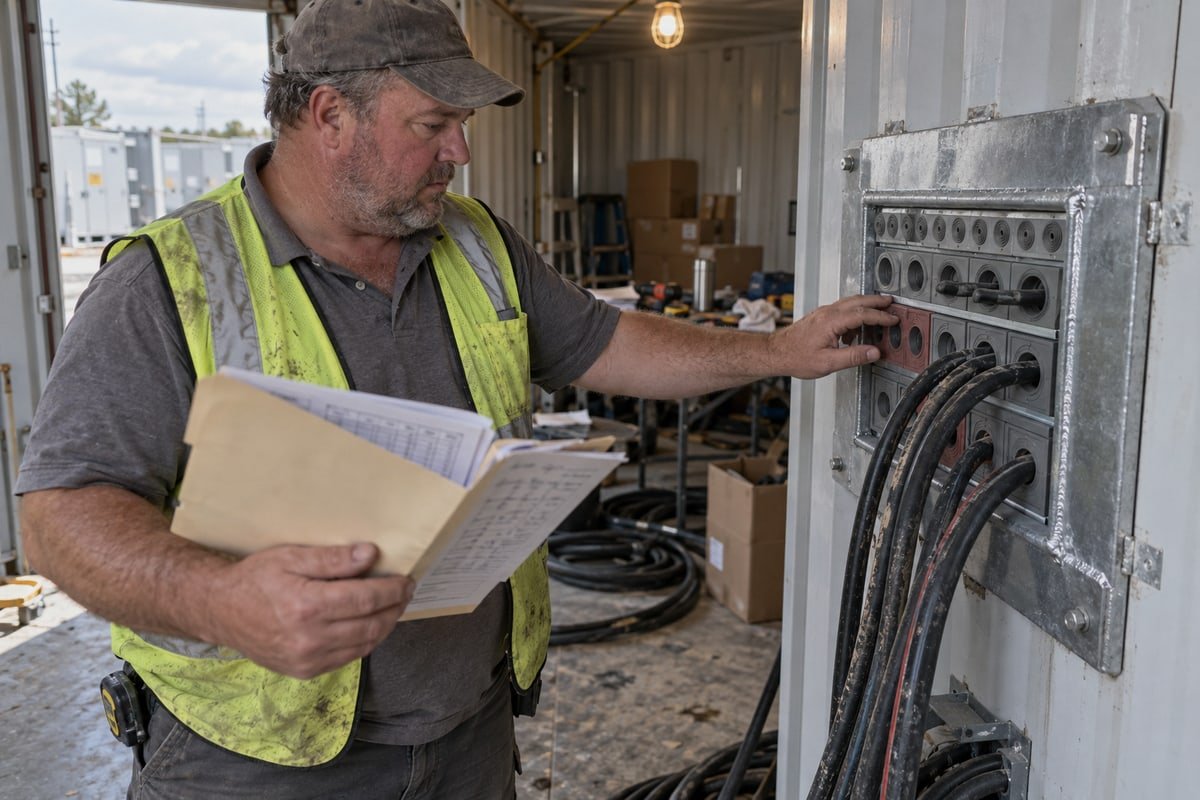
Our export team sees it every quarter: a container builder installs our TSC modules correctly, then fails inspection because installation records for multi cable transit systems are missing.
Keep installation records for multi cable transit systems as a per-transit dossier: unique transit ID, location, manufacturer and model, type approval and fire/IP68 certificates, cable schedule, as-built drawing, compression torque, test reports, dated photos, installer sign-off, and a modification log updated after every re-opening.
That sounds like a lot of paper. It is not. It is one folder per frame, kept current. Below I walk through what goes in that folder, section by section, using the same structure our customers use when a class surveyor or fire inspector walks onto their site.
What Documentation Do I Need to Prove My MCT Installation Meets Fire and IP68 Standards?
Last year a BESS integrator in Germany sent our BV factory approval 1 to a surveyor before we had even shipped. That was the right instinct.
To prove fire and IP68 compliance you need the type approval certificate, A-0/A-60 fire test report, IP68 ingress test report, watertight/gas-tight pressure test data (0.01–0.4 MPa), the manufacturer installation manual, and an as-built drawing showing the exact modules, fillers, stay plates, and compression unit installed.

The inspector is not judging the product. The product was judged in a test lab years ago. The inspector is judging whether the thing on the wall matches the thing in the test report. So your firestop compliance documentation has two halves. The first half is what the manufacturer proves. The second half is what you prove on site.
The manufacturer half
Marine and offshore survey guidance asks for a register that holds identification, manufacturer manuals, type approval certificates 2, and installation drawings. These come from us. For our TSC and TSR modules, the file includes the BV factory approval, the A-0/A-60 fire rating report, the IP68 ingress report 3, and the pressure test data for watertight and gas-tight sealing across 0.01–0.4 MPa. If a customer builds for a vessel or offshore unit, the surveyor will read these against SOLAS fire safety standards 4 and DNV classification standards. The certificate must name the same module series that sits in the frame. A certificate for a different module size does not count.
The site half
This is where most files are thin. The as-built record, made after final inspection, must show the frame type, module layout row by row, filler blocks, stay plate positions, and the compression unit used. Passive fire protection depends on the assembly, not on the rubber alone. A frame with one missing filler is not A-60, no matter what the certificate says.
| Document | What it proves | Who issues it | Linked to |
|---|---|---|---|
| Type approval certificate | Product family is qualified | Class society / third party | Module series, frame series |
| A-0/A-60 fire test report | Fire integrity and insulation | Test lab via manufacturer | Module series |
| IP68 ingress report | Dust and water immersion resistance | Test lab via manufacturer | Module series |
| Pressure test report (0.01–0.4 MPa) | Watertight / gas-tight sealing | Manufacturer | Module series, compression unit |
| Installation manual (revision noted) | Correct assembly method | Manufacturer | Transit ID |
| As-built drawing with photos | Actual installed state | Installer, signed by inspector | Transit ID |
Some buyers push back here. They say the handover package only needs the certificate and a signature. That passes a basic check on a good day. It does not pass when a surveyor opens a random frame and finds a module size that is not on any drawing. Richer records cost an hour per frame. A failed survey costs a week.
How Do I Record Cable Diameter and Module Configuration Data for Future Audits?
When we size a step-core module, we trade wider diameter range against fewer removable layers. That choice must be written down, not remembered.
Record cable diameter and module configuration in a per-transit cable schedule: cable tag, measured outer diameter, module size and part number, layers peeled, row and position in the frame, filler blocks, stay plate placement, spare capacity, and the drawing revision. Update it after any cable change.

An audit two years after handover has one question: does the frame still match the schedule? If nobody measured the cables at installation, nobody can answer. Here is the process our technical support team sends with every validation sample.
Step-by-step data capture
- Measure, do not read. Measure the cable outer diameter with calipers at the point where it enters the module. Datasheet diameters vary by batch. Write the measured value.
- Assign the module. Sealing module sizing follows the manufacturer's diameter range table. Our step-core EPDM modules cover a range of diameters within one module size, so record which layers were peeled. Peeling too many layers is the most common hidden defect.
- Map the position. Give each cable a row number and a slot number from the bottom of the frame. Note the module part number in each slot, including blind filler modules.
- Run the packing space calculation. Total module height per row plus stay plates plus the compression unit must fit the frame opening. Record the calculated fill and the remaining spare space. Overfill is the reason compression wedge installation fails.
- Record stay plate placement. Note which rows are separated by stay plates. Missing stay plates let modules shift under pressure.
- Note torque or compression depth. Log the value achieved when the compression unit was tightened, as specified in the installation manual.
- Photograph before compression and after. Link each photo to the transit ID and drawing revision.
Example cable schedule layout
| Transit ID | Row / Slot | Cable tag | Measured OD (mm) | Module part no. | Layers peeled | Batch no. | Stay plate below |
|---|---|---|---|---|---|---|---|
| MCT-A1-014 | 1 / 1 | PC-201 | 22.4 | TSC-30 | 2 | 2024-11-B | No |
| MCT-A1-014 | 1 / 2 | PC-202 | 22.6 | TSC-30 | 2 | 2024-11-B | No |
| MCT-A1-014 | 2 / 1 | (spare) | – | TSC-30 blank | 0 | 2024-11-B | Yes |
Batch numbers matter more than buyers expect. Elastomeric parts age. Tracking the EPDM batch and installation date lets you plan replacement by exposure, not by guesswork.
A common objection: "The crew knows the frames, we don't need this much detail." The crew changes. Cables get added on a night shift. Cable schedule verification during an audit fails when site practice drifts from the manufacturer's method and nobody logged the drift. The schedule is what makes the drift visible before the inspector sees it.
What Test Certificates Should I Keep on File When Using a Second-Source MCT Supplier Like DewinMCT?
A sourcing manager in the Netherlands once asked me a blunt question: "If your module is 40% cheaper, which certificate proves it isn't 40% worse?"
For a second-source MCT supplier, keep the BV factory approval, ISO 9001 and IATF 16949 certificates, A-0/A-60 fire test report, IP68 report, 0.01–0.4 MPa pressure test report, halogen-free EPDM material data, the model cross-reference table to the original frame standard, and your own validation sample test record.

That question deserves a documented answer, not a sales answer. A second source adds one extra layer to the record: proof of equivalence. Your file has to show that the replacement module fits the existing frame cutout and performs to the same rating as the module it replaces.
The supplier qualification file
Our TSC modules are dimensionally compatible with common 120-frame standards. That claim goes in the file as a cross-reference table, existing model to DEWIN model, with the drawing or STEP file for each. Buyers then check it with a free validation sample in their own frame. Keep the result of that check. A dated note that says "sample fitted frame type X, compressed to manual value, no gap" is the first document an auditor asks for when they see a second brand in a frame.
| Certificate or report | Purpose in the file | Retention note |
|---|---|---|
| BV factory approval | Third-party proof of factory control | Check expiry date at each survey |
| ISO 9001 / IATF 16949 | Quality system evidence | Store current revision only |
| A-0/A-60 fire report | Fire rating equivalence to original | Must match module series installed |
| IP68 ingress report | Immersion sealing equivalence | Must match module series installed |
| Pressure test report (0.01–0.4 MPa) | Watertight / gas-tight equivalence | Note test pressure vs. site requirement |
| Halogen-free EPDM material data | Material and aging evidence | Link to batch numbers in schedule |
| Model cross-reference table | Dimensional drop-in proof | Attach CAD/STEP references |
| Validation sample record | Your own fit and compression check | Signed by your engineer |
Site tests you still owe
Factory certificates never replace watertight integrity testing on site. NAVSEA requirements call for a local air hose test 5 after installation of cables for each new and disturbed multi-cable transit device. Marine surveyors expect similar evidence. For each test, record who ran it, the equipment used, the gauge calibration date, and the result. Ultrasonic or acoustic leak test reports give non-destructive proof of gas-tight integrity and belong in the same folder. Test reports filed separately from the register are a classic nonconformance finding.
Some buyers assume a second source raises audit risk. In practice, the risk comes from a missing equivalence file, not from the brand. With the table above complete, the surveyor reads the same evidence they would read for the original supplier.
How Do I Organize Installation Records to Speed Up Inspection Approval on Site?
The lesson we learned shipping spare modules to a Middle East EPC site: the inspector never asked for more paper, only for faster answers.
Organize installation records around one cable transit register with a unique ID per frame. Tag each frame with a QR or RFID label, link certificates, drawings, photos, and test reports to that ID, keep a visual inspection checklist per transit, and log every modification before the surveyor arrives.
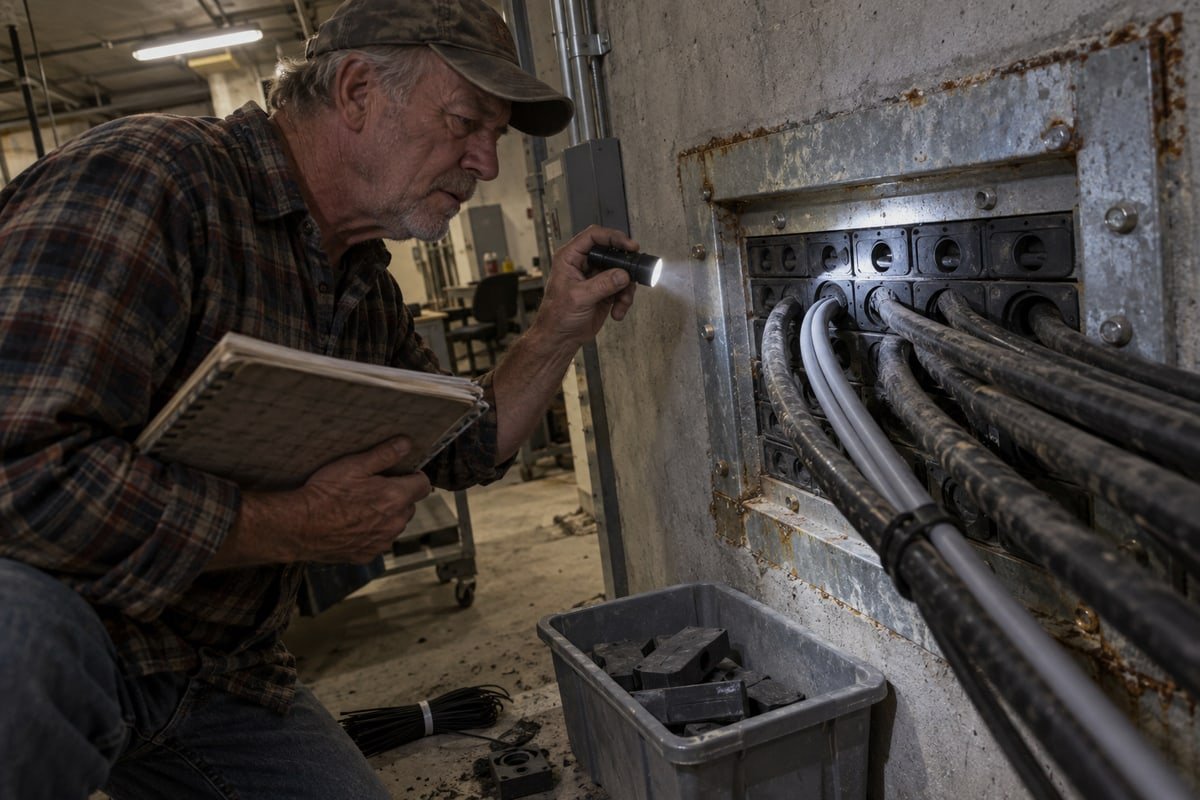
Speed on inspection day comes from one thing: the inspector points at a frame and you show its full history in under a minute. Installation records for multi cable transit systems only do that when they are organized by transit, not by document type.
The register as single source of truth
Survey guidance describes a cable transit seal systems register that the owner maintains and the surveyor reviews at periodic surveys. It has sections for inspection, modification, repair, and maintenance. Every transit gets one line, one ID, and one folder. The nameplate on the frame carries the same ID. A QR or RFID tag on the frame opens the folder on a phone. That is the whole system.
Paper versus digital
| Aspect | Paper binder | Digital register |
|---|---|---|
| Works with fewer than 50 transits | Yes, if disciplined | Yes |
| Works with 500+ transits | Rarely; pages go missing | Yes, searchable by ID |
| Links photos to the right transit | Manual, error-prone | Automatic via tag |
| Revision control on drawings | Weak | Built in |
| Dependency risk | Fire, loss, one copy | Software access, data governance |
| Surveyor access on site | Carry the binder | Scan the frame |
Paper is not wrong. It is fragile at scale. Management guidance notes that facilities may have up to and exceeding 500 MCTs. At that count, an accurate register only survives in digital form, ideally with spatial data pushed into a BIM or digital twin model so future cable routes avoid barrier overfill. For a single switchgear room, a well-kept binder still passes.
Mistakes that stop approval
- No unique ID on the frame or in the register
- Type approval or manual missing from the folder
- As-built drawing not updated after a cable addition
- Photos stored, but not linked to a transit ID
- Repairs done without a register entry
- Disturbed transits never re-tested
- Inspection entries without date, signature, or acceptance status
- No named owner for the register
Fix these before the visit and the visual inspection checklist becomes a formality. The inspector confirms block layering and compression plate position against your photos, signs, and moves on.
Conclusion
Missing records turn a sound MCT installation into a nonconformance. Build one cable transit register per frame, log every change, and inspection becomes a file check, not a fight.
Footnotes
1. Bureau Veritas is a global leader in testing, inspection, and certification for industrial and maritime sectors. ↩︎
2. DNV provides type approval to certify that maritime components meet rigorous safety and performance requirements. ↩︎
3. The IEC provides international standards for IP ratings, defining protection levels against dust and water ingress. ↩︎
4. SOLAS establishes international safety standards for fire protection and life safety on maritime vessels. ↩︎
5. NAVSEA establishes technical standards and testing requirements for systems used by the United States Navy. ↩︎



 English
  Español de México
  Deutsch
  Français
  العربية
  Русский