
Every month our Shaanxi line gets a request for a discontinued multi cable transit insert; without a [long-term spare parts list for older vessels](https://dewinmct.com/?p=971), that ship waits at the quay.
A long-term spare parts list for older vessels should record every multi cable transit by location, maker, model, and revision, map its wear parts, assign criticality tiers, set reorder triggers tied to lead time, and pre-qualify a class-accepted second source before the original supplier discontinues the model.
That sentence is the whole method. The rest of this article shows how to do each step IATF 16949 1. I will use the questions our European buyers ask most often, and I will point to the documents and numbers that make each answer stick.
How can I future-proof a spare parts list when original MCT suppliers discontinue older models?
A sourcing manager in Europe once sent us a 1998 transit drawing and asked one question: could we still make this in five years? Yes, and here is how.
Future-proof the list by recording each transit's frame standard and cutout dimensions rather than only the OEM part number, holding drawings and sizing charts onboard, standardizing on multi-diameter step-core modules, and validating a dimensionally compatible second source while the original parts are still available for comparison.

The reason a part becomes impossible to buy is rarely the rubber. It is the interface. When a supplier retires a model, the part number dies with it, but the frame cutout on your bulkhead stays exactly the same size. So the first move is to describe every deck and bulkhead penetration by its physical interface.
Record the interface, not just the part number
Start with a physical audit, ideally during a scheduled drydock. For each transit, note the frame type, the internal opening height and width, the frame material, the fire rating stamped on the nameplate (A-60 for most ship bulkheads, H-120 on some offshore units), and the module stack inside it. Link each record to the location on the general arrangement plan and to the original installation date. Many operators now fix a weather-resistant QR code or RFID tag on the frame so crew can pull the last seal configuration on a phone. This is cable transit frame maintenance done as data, not as memory.
In our experience, most older frames follow the common 120-frame standard. That is good news. Our TSC square modules and TSR round assemblies are dimensionally compatible with that standard, so the audit alone often tells you a drop-in path already exists.
Standardize on modules that cover a range
The second lever is to reduce unique SKUs. A step-core module accepts a range of cable diameters within one module size, because the crew peels layers to fit the cable. One box of such modules replaces several fixed-bore inserts. Keep a sealing module sizing chart with the list so nobody guesses which layer to peel. Add roughly 20 percent surplus filler blocks per transit, so a future fiber or sensor cable does not force a structural change.
Vessel-specific list or fleet-generic list?
Buyers often ask for one generic list to cover sister ships. That is simpler, and it works for consumables like lubricant. But it fails for modules and stay plates, because refits change revisions ship by ship. My advice is a fleet-level catalog for naming, and a vessel-specific list for quantities and revisions.
| Tier | Example MCT items | Where to hold |
|---|---|---|
| Vessel-critical | Compression units, stay plates, modules for engine room watertight bulkhead seals | Onboard, sealed kit |
| Operationally important | Spare modules for accommodation and deck penetrations, blanking blocks | Shore depot near trading route |
| Routine consumables | Assembly lubricant, labels, bolts and washers | Onboard, replenish per port call |
What documentation should I request to verify drop-in compatibility with my vessel's existing 120-frame cutouts?
During final inspection our QC team rejected a batch of TSC modules that measured slightly over nominal width. That tolerance matters when a frame is thirty years old.
Request a dimensioned drawing of the module and frame opening, a model cross-reference table mapping the legacy part to the new one, a fit-check report or free validation sample, the type approval certificate, and a material data sheet confirming halogen-free EPDM and the tested pressure range.

A skeptical purchasing engineer does not need a brochure. He needs a file he can hand to the superintendent and, later, to the class surveyor. So I will describe the documents in the order we send them, and I will explain what each one proves.
The document pack that proves drop-in fit
| Document | What it proves | What to check |
|---|---|---|
| Dimensioned drawing (PDF, plus CAD or STEP) | Module and frame geometry | Nominal size, tolerance band, step-core layer diameters |
| Model cross-reference table | Legacy model → replacement model | Every item on your list appears, including blanking blocks and stay plates |
| Type approval certification | Acceptance under marine classification society standards | Fire class, IP rating, pressure range, expiry date |
| Material data sheet | Rubber compound and ageing behavior | Halogen-free EPDM 2, hardness, shelf-life guidance |
| Fit-check report or free validation sample | Real assembly in your frame size | Compression height after torque, no gaps at the seam |
The cross-reference table is the document buyers underestimate. Our tables map an existing model to a DEWIN model line by line, so the spares list does not need rewriting. It only gains a second column.
How to run the fit check yourself
- Pick one representative frame from the audit, preferably a worn one.
- Ask for free validation samples of the module sizes on that frame's list.
- Fit the samples with the existing compression wedge kit and stay plates. Do not swap the frame.
- Torque the compression unit to the value on the drawing and measure the stack height.
- Photograph the result and file it with the drawing and certificate.
If the frame is badly corroded or has undocumented shipyard modifications, a 3D scan during drydock creates a digital twin of the opening. With that file, our in-house mold shop can cut a custom adapter insert, which is faster than waiting for a discontinued original.
Why the material sheet matters for older ships
SOLAS fire safety requirements 3 do not care who made the module. They care that the firestop cable penetration performs as tested. A halogen-free compound also matters for cable compatibility, because some legacy sheath materials react badly with plasticizers migrating from cheap rubber. Ask for the sheet, and ask for the test documents behind it. We provide ours on request, and a BV-approved factory 4 should have no trouble doing the same.
How do I balance inventory holding costs against long lead times when stocking spare sealing modules for aging fleets?
Every quotation we prepare for aging fleets forces the same choice: ship a full pallet of modules now, or a smaller batch with a fixed repeat lead time.
Balance the two by tiering spares into vessel-critical, operationally important, and routine consumables, holding only tier-one items onboard, pre-positioning the rest in a shore depot, setting minimum stock from consumption per port call and replenishment lead time, and using a second source to shorten that lead time.
Two camps argue about this every year. The first says older vessels are unpredictable, transit spares are hard to find, and a stockout can immobilize the ship. The second says dead stock ties up capital and most items can be sourced ashore. Both are right, and a good list resolves the argument by item, not by policy.
Tie minimum stock to port calls, not the calendar
A practical rule from spare parts research is simple. Minimum onboard stock equals expected consumption per port call, multiplied by the number of port calls needed to get a replacement delivered. For a legacy OEM part with a lead time of weeks to months, that multiplier can be large. For a second-source module shipped from stock, it drops sharply. That is the real financial argument for qualifying an alternative supplier before you need it.
| Item | Consumption per port call | Port calls to replenish | Minimum onboard stock |
|---|---|---|---|
| Discontinued OEM module | 2 | 6 | 12 |
| Compatible step-core module from stock | 2 | 2 | 4 |
| Assembly lubricant (tubes) | 1 | 1 | 1 |
The numbers above are illustrative, but the structure is the point. Same seal, same frame, one third of the capital sitting in a locker.
Where the stock should sit
Keep a dedicated critical onboard spares kit per vessel. Ours typically covers compression wedge kits, stay plates, a mixed box of modules covering the common cable diameters, blanking blocks, and lubricant. Everything else belongs in a shore depot near the trading route, so an urgent drydock window does not become an emergency air freight bill.
Shelf life is a holding cost too
Elastomer parts age. Heat, UV, and ozone all harden EPDM, and a hardened module will not compress correctly. Store modules in sealed bags, in the dark, away from electrical equipment that produces ozone. Record batch number, storage location, condition, and owner in the inventory system. Then link the list to the planned maintenance system, so replenishment triggers before the next drydock rather than after a defect report.
Can I qualify a second-source MCT supplier without compromising fire, IP68, and gas-tight certification requirements?
The hardest lesson from our early export years was simple: a lower price means nothing to a class surveyor. Only the test file speaks.
Yes. Qualify a second-source MCT supplier by matching its type approval certification to the same fire rating, IP68, and gas-tight pressure range as the original, confirming dimensional compatibility with a free sample, and recording the substitution in the PMS so class surveyors can trace it.
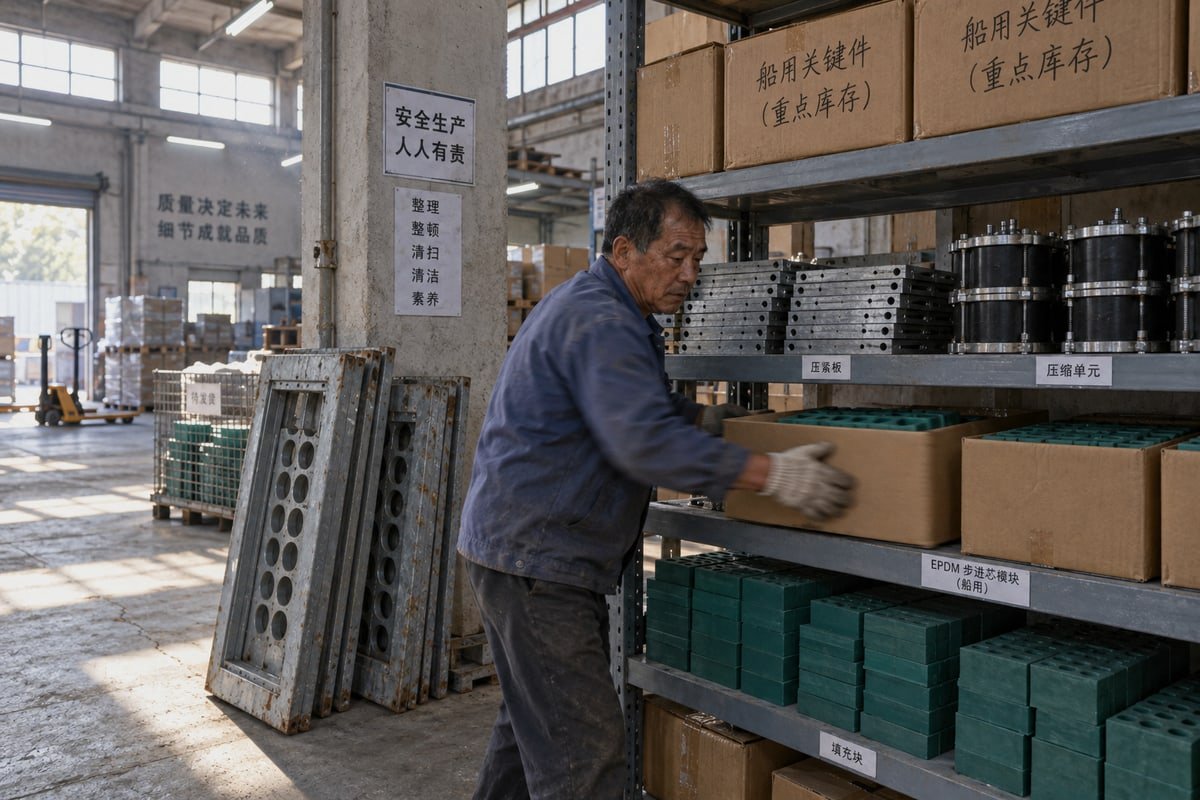
The strongest objection I hear is the OEM-only argument. It says the original maker guarantees compatibility, holds the certificates, and removes installation risk. That was true when the model was in production. Once it is discontinued, OEM-only becomes a policy with no supplier behind it. The mixed-sourcing view is more honest about aging tonnage, but it only works when the alternative is approved and traceable. So the question is not OEM or not. It is which alternatives pass.
Compare the options on evidence, not price
| Source | Certification status | Traceability | Best use on older vessels |
|---|---|---|---|
| OEM current model | Full type approval | Full | While still in production |
| Certified drop-in second source | Own type approval, matching fire, IP68, and pressure class | Full, with cross-reference table | Long-term replenishment after discontinuation |
| Reconditioned stock | Original approval, unknown ageing | Partial | Emergency only, with inspection |
| Surplus market | Often no certificate copy | Weak | Avoid for firestop and watertight positions |
The qualification file we hand over
For our own line, the file contains the type approval, the A-0 and A-60 fire test documents, the IP68 ingress report, and the watertight and gas-tight test covering 0.01 to 0.4 MPa. It also contains the ISO 9001 5 and IATF 16949 system certificates and the BV factory approval. A buyer compares each figure with the original nameplate. If the original frame is rated A-60 and the replacement module is tested A-60 in a compatible frame, the retrofit sealing solution holds its class status.
Keep the surveyor's trail intact
Spare part obsolescence management is really a documentation discipline. Enter the substitute model in the PMS against the same transit location. Attach the certificate, the drawing, and the fit-check photos. Note the date and the batch. When the surveyor opens the file at the next survey, the history reads as one continuous, approved chain, from the original watertight bulkhead seals to the module fitted last month. That is what separates a qualified second source from a cheap part.
Conclusion
Older vessels punish reactive buying. Record every transit, tier the spares, verify drop-in fit with documents and samples, and qualify a certified second source before obsolescence forces your hand.
Footnotes
1. Official site for the IATF 16949 manufacturing quality standard required for technical certification. ↩︎
2. Authoritative overview of EPDM rubber properties, relevant to the sealing module material discussion. ↩︎
3. Official IMO page for the SOLAS convention, the primary treaty for maritime safety and fire protection. ↩︎
4. Homepage for Bureau Veritas Marine & Offshore, the classification society referenced for factory approvals. ↩︎
5. Official ISO page for the 9001 quality management standard mentioned in the article. ↩︎



 English
  Español de México
  Deutsch
  Français
  العربية
  Русский