
EMC-shielded sealing modules for VFD E-House multi cable transit fix a failure our engineers see often: shielded cables, an unshielded penetration, random instrument trips, and nobody checking the wall.
Select EMC-shielded sealing modules by matching four things: the shielding level (ES full-shield or PE conducted-disturbance), 360-degree contact with the cable screen, verified IP68 and A-0/A-60 fire ratings, and dimensional compatibility with your existing 120-frame cutouts, backed by test documents.
Each of those four decisions has its own traps. I will take them one at a time. I will also show you what to ask for, so you can check the answers yourself instead of trusting a datasheet.
What Shielding Performance Do I Need to Suppress VFD-Generated EMI in My E-House?
The trade-off we weigh most often on the shop floor is simple: full ES shielding costs more per module, while PE-type modules cover only conducted disturbances.
You need modules that provide 360-degree contact with the cable screen, a low-impedance path to the frame and earth, and shielding effectiveness tested across the VFD noise band, roughly 30 MHz to 10 GHz. Choose ES modules for radiated EMI, PE modules for conducted disturbances only.
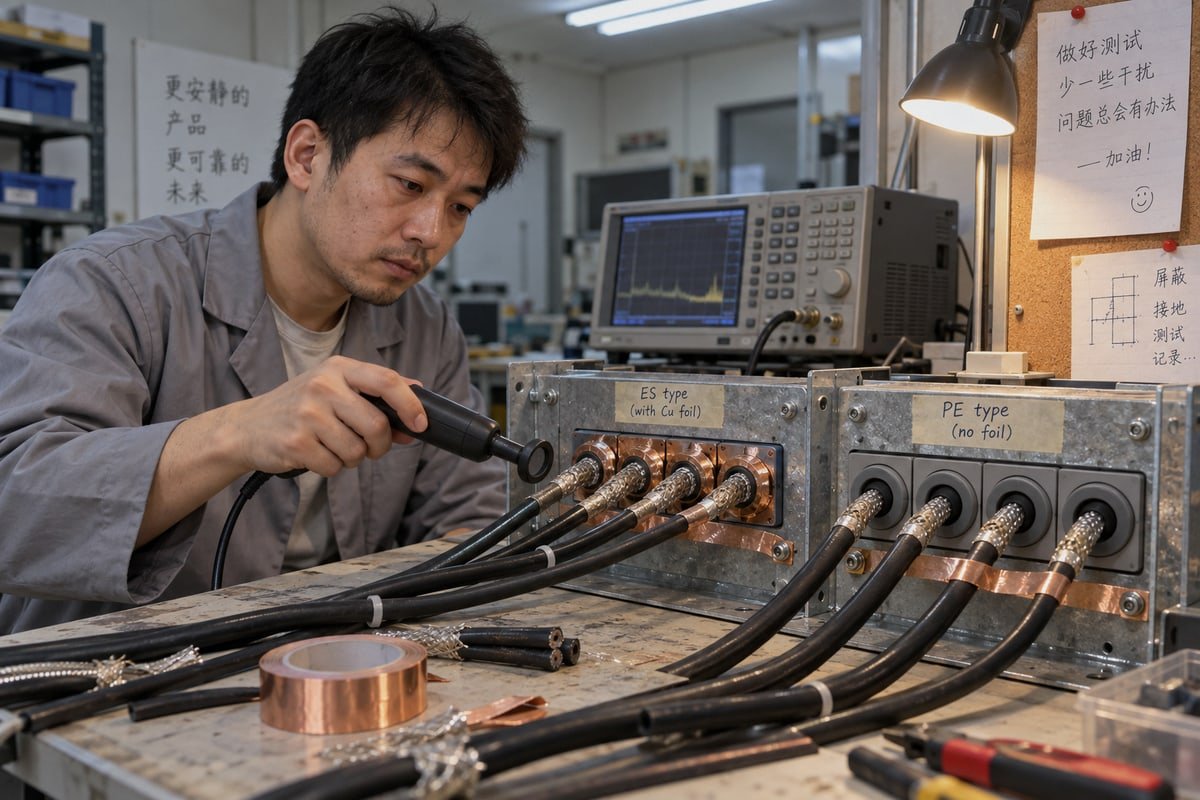
Before we get into frequencies and grounding, here is the comparison that decides most VFD E-House projects. The industry splits EMC modules into two families. The names come from the largest vendors, but the concept applies to any modular cable entry system.
| Module type | What it protects against | Construction | Best use in a VFD E-House |
|---|---|---|---|
| ES (full shielding) | Radiated electromagnetic energy and shield currents | Conductive rubber, conductive foil, copper contact strips bonded to the frame | Walls between VFD rooms and control, automation, or instrument spaces |
| PE (conducted disturbance) | Currents carried on the cable screen | Conductive contact to the screen, less emphasis on airborne shielding | Penetrations where airborne EMI is already contained and only screen bonding is needed |
| Standard non-EMC module | Fire, water, gas, dust, rodents | Halogen-free EPDM, no conductive path | Penetrations carrying unshielded power or non-sensitive cables |
ES versus PE: which one do you actually need?
Some buyers push back here. They tell us a PE-type module is enough because the cable is already shielded. Sometimes that is correct. If the disturbance is mainly conducted on the screen, and the wall itself is a solid grounded steel plate, PE contact may do the job. But a VFD E-House usually has a different problem. The drive room is a strong radiated source. The wall opening is a hole in your Faraday cage 1. A PE module bonds the screen but does not close the hole. Once the opening is large enough to pass thirty cables, that hole matters. In that case we recommend ES modules for every penetration into a control or instrument room.
Frequency matters more than the datasheet suggests
Variable speed drive harmonics sit at low frequency, but the switching edges create high-frequency noise. Bonding and grounding tests for some transit systems are described only up to about 100 MHz. That is a warning sign, not a spec. Newer Silicon Carbide (SiC) drives switch with faster dv/dt, which pushes common-mode current energy higher. So ask for shielding effectiveness data 2 with the frequency range stated. If a supplier only shows a single number with no frequency, ask again. High-frequency noise mitigation depends on that curve.
The grounding chain has five links
Think of the earth path as a chain. Every link must be conductive and must stay conductive for twenty years.
- Cable screen to module: this needs 360-degree grounding contact, not a pigtail. Match the module core to the screen diameter, not just the jacket.
- Module to adjacent modules: conductive rubber or foil surfaces touching under compression.
- Modules to frame: copper contact tips or tapes. One well-known system uses copper tapes around 0.2 mm and 0.1 mm thick for this bond.
- Frame to wall or sleeve: zinc-plated steel 3, stainless, or nickel-plated aluminum. The sleeve may need to be conductive and grounded.
- Wall to equipotential bonding bar of the E-House.
Galvanic compatibility between the copper contact elements 4 and the enclosure steel also matters. A bond that reads fine at commissioning can oxidize and rise in impedance over years in a coastal or offshore plant. Tinned copper contacts help here.
How Do I Verify a Sealing Module's IP68 and Fire Rating Meet My E-House Spec?
Every batch that leaves our Shaanxi line goes through a pressure check before packing. That habit started after we saw how many spec sheets list ratings without evidence.
Verify ratings by requesting the actual test reports, not the datasheet. Check IP68 test depth and duration, the fire class (A-0 or A-60 to fire test procedures), the pressure range tested (0.01–0.4 MPa), and confirm the tested assembly matches your frame, module, and wall type.

An E-House wall usually separates a high-energy switchgear or drive room from a clean control room. So the same penetration must stop fire, water, gas, and dust as well as EMI. Our approach when we review a spec is to separate the marketing rating from the test condition behind it. The table below shows what we look for.
| Rating on the datasheet | What the report must show | Common gap we find |
|---|---|---|
| IP68 | Immersion depth, duration, and the exact module and frame tested | Report covers a small round transit, but the buyer installs a large rectangular frame |
| IP66/67 ingress protection | Jet or short immersion conditions | Sold as equal to IP68 for outdoor E-House use; it is not |
| A-0 / A-60 fire class | Fire test procedure, insulation time, cable fill used in the test | Fire-rated cable seals tested with steel bulkhead 5, but installed in sandwich panel |
| Watertight / gas-tight | Pressure range, for our modules 0.01–0.4 MPa, and leak criteria | Only one pressure point tested, not a range |
| Halogen-free | Material declaration for the EPDM compound | Claimed on the rubber only, not the lubricant or filler parts |
Step-by-step verification
- Ask for the report number and issuing body. A datasheet line that says "IP68" without a report is a claim, not a rating.
- Check the tested configuration. The frame material, the module sizes, the stay plates, and the compression unit all affect the result. If your assembly differs, the rating may not transfer.
- Check the wall type. Fire performance on a steel bulkhead is not the same as on a sandwich panel or concrete. Some transit families are specifically presented for steel or sandwich walls and floors.
- Match the environment. An outdoor E-House in the Middle East sees dust, heat, and washing. A container BESS unit may sit in standing water. IP68 with a stated pressure range is safer than IP66/67 for these cases.
- Ask about the factory system. ISO 9001 and IATF 16949 systems and a BV-approved factory tell you the test result can be repeated batch to batch.
One more check that many specs miss
VFD power cables at high load run warm. The transit point is where insulation, rubber, and steel meet, so it can become a local hotspot. Ask what temperature the module compound is rated for, and check that the fire test used a realistic cable fill. Step-core EPDM helps here because the module wraps the cable jacket fully, which spreads heat rather than trapping it in an air gap.
Can I Cross-Reference EMC-Shielded Modules to Fit My Existing 120-Frame Cutouts?
A sourcing manager in Germany once sent us a photo of a wall full of installed frames and asked one question: will your modules go in without cutting new holes?
Yes. Modules built to common 120-frame dimensions drop into existing cutouts as a second source. Confirm three things: module outer dimensions and step-core range, compression unit height, and that the conductive elements bond to your existing frame material. Use a model cross-reference table and a free sample.

The answer above is short. The work behind it is not. When we qualified our TSC square modules and TSR round assemblies against the common 120-frame standard, the goal was simple: an integrator should be able to remove one module and insert ours without touching the frame, the stay plates, or the compression unit. For EMC-shielded sealing modules, one more condition joins that list. The conductive surfaces must land on the frame the way the original module did.
Dimensional points to confirm
| Check | Why it matters | How we support it |
|---|---|---|
| Module outer size (width, height, depth) | Fits the 120 mm frame depth and the packing pattern | CAD/STEP files and a cross-reference table, existing model to DEWIN model |
| Step-core diameter range | Each module must grip the cable screen, not just the jacket | Step-core EPDM adapts across a range within one size |
| Stay plate thickness and pitch | Rows must line up for compression to work | Dimensionally matched to common frame standards |
| Compression unit height | Wrong height means no compression or over-compression | Compression units and spare parts supplied to matching dimensions |
| Conductive contact position | Copper contacts must meet the frame surface for 360-degree grounding | Verified on a free validation sample in your frame |
A qualification process that takes weeks, not months
We suggest this sequence to our European customers.
- Send us the existing module model numbers. We return the cross-reference table.
- We ship free validation samples in the sizes on your drawing.
- Your team fits them into one existing frame and checks compression and continuity to earth.
- You request the test documents for the rating you need and compare them with the incumbent report.
- You place a pilot order for spare sealing modules, then move to project volume.
The vendor lock-in objection
Some buyers prefer one integrated system. The argument is that mixing brands creates compatibility risk. That is a fair concern. Our answer is not to argue. It is to prove compatibility on a sample in your frame, with drawings you can measure. On cost, the second-source route usually lands 40–60% below the original brand for equivalent modules. For an EPC team ordering hundreds of modules across several E-Houses, that changes the budget without changing the frame.
Frame material and bonding
Frames come in zinc-plated steel, stainless steel, and nickel-plated aluminum. Steel frames are cheaper and easier to weld into a bulkhead. Stainless resists corrosion in coastal plants. Nickel-plated aluminum is lighter but costs more. None of these is better in every case. What matters for cross-referencing is that our copper contact elements bond to whichever frame you already have. That is one reason we ask for the frame material, not just the cutout size, before quoting.
What Test Documentation Should I Request Before Qualifying a New MCT Supplier?
One lesson from more than a decade of exporting: buyers who ask for documents on day one qualify us faster than buyers who ask for price first.
Request the ISO 9001 and IATF 16949 certificates, the third-party factory approval (for example BV), fire test reports for A-0/A-60, IP68 and pressure test reports, shielding effectiveness test data with the frequency range, material declarations for halogen-free EPDM, and CAD/STEP drawings.

A document request is the fastest way to separate a real factory from a trading company. A trader forwards whatever the upstream plant gives them. A factory can explain the report, show the test rig, and re-run the test on your configuration. We have three production sites and in-house mold making, so custom sizes and private-label runs come with their own drawings and their own test data.
The document pack we recommend
| Document | What it proves | Red flag if missing |
|---|---|---|
| ISO 9001 and IATF 16949 certificates | Repeatable quality system, automotive-grade process control | Only a supplier declaration, no certificate number |
| BV factory approval | An independent body has inspected the plant | "Marine grade" claimed without an approval body |
| Fire test report (A-0 / A-60) | Fire class on a defined wall type and cable fill | Report belongs to another brand or another product |
| IP68 and pressure test report | Watertight and gas-tight across 0.01–0.4 MPa | Single-point test or no report at all |
| Shielding effectiveness test data | EMI attenuation stated per frequency, ideally covering 30 MHz to 10 GHz | A single dB value with no frequency |
| Material declaration | Halogen-free EPDM, no regulated substances | Rubber compound not named |
| CAD/STEP files and cross-reference table | Dimensional fit into existing 120-frame cutouts | Only PDF sketches, no 3D models |
How to read a shielding report
Shielding effectiveness reports are the hardest to compare between suppliers. Look for three things. First, the frequency sweep. Second, whether the test used the full assembly, including frame, stay plates, and compression, or just a single module. Third, whether the cable screens 6 were bonded during the test. Some published data covers bonding only up to about 100 MHz. That is useful for equipotential bonding checks but says little about radiated EMI at the frequencies a SiC drive generates. If the data stops early, ask the supplier to state that clearly rather than imply full coverage.
Documents that help after installation
Newer sealing solutions add digital identification such as RFID tags or QR codes on the module or nameplate. That lets an owner audit EMC integrity and spare module history across the E-House lifecycle without opening the transit. It is not a certification. But if your maintenance team plans periodic bonding checks, it is worth asking whether the supplier can add it during private-label production.
Cable gland alternatives and the documentation gap
The last objection we hear is about cost. A standard gland is cheaper than a transit and comes with an IP rating. For a single unshielded cable that is fine. But a gland rarely carries a fire test on an E-House wall, and it does not offer the density or spare capacity of modular cable entry systems. Cable counts on E-House projects change late. Modules with spare capacity absorb that. Glands do not.
Conclusion
The wall penetration is where VFD EMI leaks and where qualification stalls. Specify shielding, sealing, and fit together, demand the documents, and test a sample before you commit.
Footnotes
1. A Faraday cage is the fundamental physical principle used to block electromagnetic fields in cable transits. ↩︎
2. IEEE is the leading technical authority for electromagnetic compatibility and shielding effectiveness testing standards. ↩︎
3. The International Trade Administration provides authoritative data on global metal manufacturing and material standards. ↩︎
4. ISO provides international standards for material compatibility and metallic coatings in industrial applications. ↩︎
5. The IMO sets the global fire safety standards for steel bulkheads in marine and offshore environments. ↩︎
6. Cable screens are the conductive layers required to protect sensitive signals from electromagnetic interference. ↩︎



 English
  Español de México
  Deutsch
  Français
  العربية
  Русский