
MCT brochures prove nothing at survey time. Our factory opened in 2013, and I have watched buyers burned by unverified supplier past cases for multi cable transits. Verification fixes that.
To verify a supplier’s past cases and feedback for multi cable transits, request a sector-matched reference project list, confirm Type Approval Certificates by number with the issuing body, call two references directly, and cross-check fire and pressure test reports against the exact module you plan to buy.
That sounds like a lot of work. It is not. Most of it is email. The sections below give you the documents to ask for, the questions to send, the warning signs to watch, and the cross-checks that close the loop before you approve a new source for cable sealing systems.
What Documentation Should I Request to Confirm a Supplier's Real Project History?
Last quarter our QC team re-tested a batch of TSC modules before shipping, and every report went into the customer's file. I expect the same file from any supplier.
Request a reference project list sorted by sector, Type Approval Certificates with certificate numbers, fire and pressure test reports for the exact module series, business registration and factory ownership proof, and installation records such as nameplates, photos, or digital verification logs from at least two comparable projects.
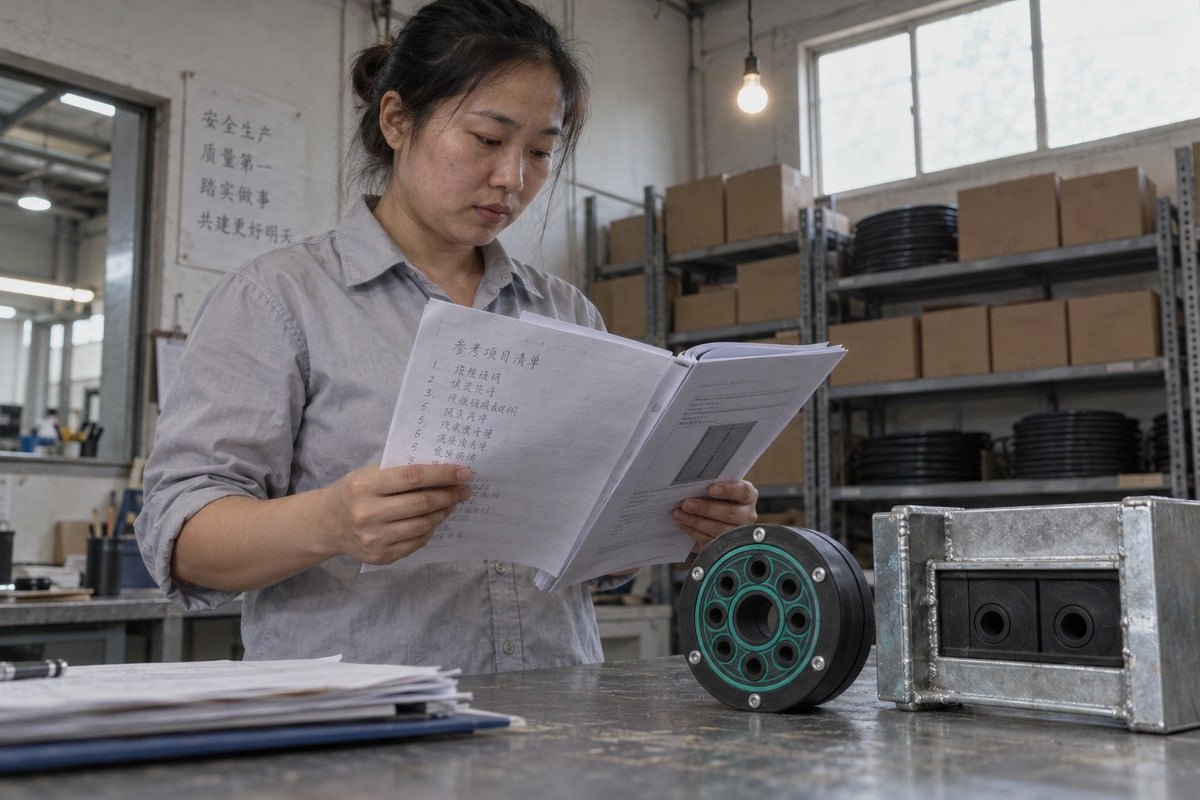
A project history is only useful when it matches your environment. A tunnel job proves fire behavior. An offshore platform proves weather and pressure behavior. A BESS container proves gas-tightness and vibration behavior. So the first document I ask for, and the first one we hand over, is a reference project list broken down by application. Volume of logos means nothing. Relevance means everything.
The core document pack
Here is the pack I recommend a sourcing engineer request before the first sample ships.
| Document | What it proves | What to check |
|---|---|---|
| Reference project list by sector | Relevant experience in marine and offshore applications, rail, tunnels, substations, BESS, data centers | Project year, cable density, retrofit or new build, end-user type |
| Type Approval Certificates | Third-party review by DNV, Lloyd's Register, Bureau Veritas, ABS, or UL | Certificate number, product scope, expiry date |
| Fire test report | Fire rating compliance for the stated class, such as A-0 or A-60 | Test standard, lab name, module size tested |
| Pressure test report | Watertight and gastight integrity | Pressure range, duration, pass criteria |
| Hazardous area evidence | ATEX or IECEx where hazardous area classification applies | Zone and gas group named, not implied |
| Factory ownership proof | Real production, not trading | Business license, registered capital 1, plant addresses |
| Installation records | Field reality | Nameplate photos, digital verification logs, BIM or drawing sign-offs |
Why factory proof belongs in the pack
Many "suppliers" in this market are trading companies. They cannot answer a mold question. They cannot control a rubber batch. In our case, the proof is simple: headquarters in Shaanxi, additional production in Shandong and Hunan, RMB 50M registered capital, and 38+ granted patents. A serious buyer should ask any supplier for the same level of detail and then check it against public registries.
Digital records are becoming the norm
Some suppliers now offer digital installation verification platforms 2 and cloud-based record keeping. This matters because class surveys in offshore contexts 3 run on periodic cycles and are documentation-heavy. Traceability is not a one-time check. If a supplier can show inspection labels, digital certificate references, or BIM integration logs from a past project, you get a preview of how easy your own audits will be.
Do not skip market longevity
Elastomer modules age. A supplier with a decade of installations can show how their compound behaves after years of compression. We use halogen-free EPDM with a step-core design, and I would expect any competitor to explain their compound and its aging data with equal clarity.
How Can I Validate Customer References Without Wasting My Engineering Team's Time?
A German sourcing engineer once asked me for three reference contacts and a free validation sample in one email. That was smart. Twenty minutes of her time saved weeks.
Validate references efficiently by asking the supplier for contacts in your own sector, sending a fixed five-question email before any call, letting procurement handle the outreach, and reserving engineers only for one fifteen-minute call with the reference's lead engineer about lead times and field support.

Case studies and customer feedback are not the same thing. A case study is a curated success story. It shows what the supplier wants you to see. Feedback from a third-party owner, contractor, or operator tells you why the supplier was chosen, how responsive they were, and whether support continued after the invoice was paid. You need both, but you should weigh feedback more heavily.
A four-step process that protects engineering hours
- Ask for sector-matched contacts. If you build modular data centers, ask for two data center or switchgear references. Do not accept an offshore reference as a substitute. The demands differ.
- Send the questions by email first. Written answers are faster to compare across suppliers. They also give the reference time to check facts.
- Let procurement run the outreach. Procurement can confirm lead times, invoicing behavior, and documentation quality. Engineers are not needed for that.
- Book one short engineering call. Fifteen minutes with the reference's lead engineer, focused only on installation and field support.
The five questions that matter
| Question | Who answers | Why it matters |
|---|---|---|
| Why did you select this supplier over the incumbent? | Procurement | Reveals whether certification, cost, or lead time drove the decision |
| Did the modules drop into your existing frame cutouts? | Engineering | Confirms dimensional compatibility for cable sealing systems |
| Did stated lead times hold on repeat orders? | Procurement | Tests supply stability, not just the first shipment |
| Was installation quality control supported on site or remotely? | Engineering | Shows post-sale depth |
| Did any module require field modification or replacement? | Engineering | Surfaces problems a case study would hide |
The objection I hear most often
Some buyers tell me certifications and case studies are enough if the supplier holds recognized approvals and serves the right industry. I understand the logic. It saves time. But a published case study can omit a failed project, a subcontractor who did the real work, or an after-sales dispute. A certificate confirms a product passed a test. It does not confirm the supplier answered the phone when a bulkhead leaked. Direct references close that gap. That is why we offer free validation samples alongside contact introductions. The sample lets your own team test fit and compression in your frame, and the reference tells you what happens after month six.
Which Red Flags Suggest a Supplier's Case Studies or Certificates Might Be Misleading?
I often weigh how much of our reference project list to publish. Naming end users builds trust, but some BESS integrators 4 forbid it. Silence is not always a red flag.
Red flags include certificates without numbers or issuing-body links, logos of end users with no project details, fire ratings quoted without a test standard, identical stock photos across suppliers, no failure or recall history, refusal of live factory video, and a case-study portfolio that never names a sector.

The goal here is not to distrust everyone. The goal is to separate a confidentiality constraint from a fabrication. A supplier who cannot name an end user because of an NDA can still tell you the sector, the cable count, the frame standard, and the year. A supplier who cannot tell you any of that has probably not done the job.
The warning signs, ranked by severity
| Red flag | Severity | What it usually means |
|---|---|---|
| Certificate PDF with no number or scope | High | Possibly copied, expired, or issued for a different product |
| "DNV GL certification" claimed but no DNV database record | High | Marketing claim, not a verified approval |
| Fire rating stated with no test standard or module size | High | Rating may be borrowed from another product family |
| Same project photos appear on several supplier websites | High | Shared trading source or lifted imagery |
| No documented field modifications or corrective actions ever | Medium | Real factories keep nonconformance records; zero history is unrealistic |
| Refusal of a live video walkthrough of the plant | Medium | Common with trading companies or ghost portfolios |
| Case studies with logos but no application details | Medium | Emphasis on brand association over proven performance |
| End users unnamed but sector and specs given | Low | Usually an NDA, not a problem |
Failure rate transparency is a credibility test
Ask for documented instances of field modifications, product recalls, or customer complaints, and ask how the supplier responded. Under ISO 9001 5 and IATF 16949, we are required to log nonconformances and corrective actions, and we share relevant ones on request. A supplier who claims a perfect record over many years is either very small or not being honest.
Video beats photos
A live video walkthrough of the production floor, the mold shop, and the warehouse stock is hard to fake. Geo-tagged photos with metadata intact also help. When a buyer asks us for this, I take it as a good sign about the buyer, not an insult. It means they will also hold our competitors to the same bar.
How Do I Cross-Check Test Reports and Field Feedback Before Approving a New MCT Source?
The hardest lesson from our early exports was simple. A test report for one module size says nothing about another. Smart buyers ask for the report matching their exact part.
Cross-check by matching each test report's product code, standard, and lab to the module you specify, confirming the certificate on the classification society's database, comparing claimed fire and pressure values with field feedback from references, and running a free validation sample through your own installation quality control.

This is where the three layers of verification come together: project relevance, compliance evidence, and real customer experience. Each layer should confirm the other two. When they disagree, stop and ask why.
Match the claim to the evidence to the field
| Supplier claim | Document to request | Field cross-check with a reference |
|---|---|---|
| Fire rating A-0 or A-60 | Fire test report naming the standard, lab, and module size | Did the class surveyor accept the report without a repeat test? |
| IP68 ingress protection | Ingress test report with duration and depth | Any water ingress after the first season outdoors? |
| Watertight and gastight integrity from 0.01 to 0.4 MPa | Pressure test report with pass criteria | Any gas alarms or leak findings at commissioning? |
| Halogen-free EPDM | Material durability testing data and compound declaration | Any hardening or cracking after years of compression? |
| Compatible with 120-frame standards | Cross-reference table and CAD or STEP files | Did modules drop into the existing frame without machining? |
| Hazardous area suitability | ATEX or IECEx documentation tied to the product code | Was the hazardous area classification accepted by the site authority? |
Read the report, not the summary
A one-page summary that says "A-60 tested" is not a test report. The full report names the standard, the lab, the sample size, the frame configuration, and the cable fill. If the tested module is TSC 60 and you are buying TSC 20, ask whether the approval scope covers the whole series. Our test documents are available on request for exactly this reason. A skeptical engineer reading them before replying is the customer we want.
Ask for long-term field data
Post-occupancy evaluation data is rare but valuable. Ask whether any reference has seals in service for 15 years or more and whether maintenance records show seal integrity holding. Even qualitative answers help. A reference saying "we have never re-torqued the compression unit" tells you something about material stability.
Close with your own validation
The final cross-check is in your hands. Request a free validation sample, install it in your existing frame cutout, torque the compression unit, and pressure test it under your own installation quality control. Compare the result to the supplier's report. If the numbers line up and the references confirm the service history, you have a qualified second source, not just a cheaper one.
Conclusion
Unverified MCT suppliers cost you survey rejections and rework. Verify project relevance, compliance evidence, and real customer experience. Ask us for the documents, cross-reference table, and a free validation sample.
Footnotes
1. Global trade organization relevant to the business registration and capital requirements of international manufacturing suppliers. ↩︎
2. Authoritative source for technical standards in digital verification and electronic record-keeping systems. ↩︎
3. Provides general context on the offshore environments where multi cable transit systems are frequently utilized. ↩︎
4. The primary international standards body for electrotechnical systems relevant to battery energy storage system integrators. ↩︎
5. Official page for the quality management standard governing supplier nonconformance and corrective action logging. ↩︎



 English
  Español de México
  Deutsch
  Français
  العربية
  Русский