
A Dutch buyer once sent me a rival’s “USCG approved” MCT datasheet IATF 16949 1. Its number was a BV certificate. That gap defines USCG Type Approval for multi cable transits from China.
To verify USCG Type Approval for multi cable transits from China, request the Certificate of Approval, match its approval number, product designation, and manufacturer entity against the CGMIX database under Approval Series 164.138, confirm the five-year validity date, and check the independent laboratory and installation limits.
The country of origin is not the real risk. The real risk is a claim that cannot be traced to a live certificate for the exact module you will install. This article walks through the documents, the dimensional match, the test reports, and the samples you should ask for. Each step is something our own export team handles every month, so I will show you what a clean file looks like and what a weak one looks like.
What documents should I request to confirm a Chinese manufacturer's USCG Type Approval is genuine and current?
The hardest lesson from our export desk: a certificate that names only the company proves nothing about the module in your hand. So we tell buyers to demand six documents.
Request the USCG Certificate of Approval (COA) with approval number and expiry, the independent laboratory test report, the manufacturer's Chinese business license with Unified Social Credit Code, the latest follow-up service audit report, the approved installation manual, and photos of the permanent approval marking on production parts.

The six documents work as a chain. Break one link and the claim is not verified. Here is what each one must show.
| Document | What to check | Why it matters |
|---|---|---|
| USCG Certificate of Approval (COA) | Approval number in Series 164.138, exact type designation, issue and expiry dates | This is the only document that proves USCG approval. Class or MED numbers do not count. |
| Independent laboratory test report | Lab name, report number, test standard, tested configuration | Confirms the test basis behind the COA. The lab must be one the Coast Guard accepts, such as DNV, UL, or the Shanghai Marine Auxiliary Electromechanical Equipment Testing Center. |
| Chinese business license | Unified Social Credit Code (USCC) and legal entity name | Lets you match the certificate holder to the real factory. |
| Follow-up service or production quality control audit | Date, auditor, findings, scope | Proves the current production line still matches the tested prototype. |
| Installation manual | Approved division type, sealant or module thickness, cable range, mounting method | The COA is only valid inside these limits. |
| Marking photos | Approval number stamped or cast on frame and modules | 46 CFR Subchapter Q requires permanent marking for traceability during inspection. |
Read the COA line by line
The Certificate of Approval is issued through the Marine Safety Center (MSC), not a class society. It names a product type, a series, and a validity window. USCG Type Approvals run for five years. The certificate must be active on the day the equipment goes onto the vessel, not just on the day you place the order. If the expiry date falls inside your build schedule, ask how the renewal is progressing.
Run the dual-entity check
Many "factories" in China are trading intermediaries. Compare the legal entity on the COA with the entity on the business license. The USCC is a unique eighteen-character code, so a mismatch is easy to spot. Our own licenses list our Shaanxi headquarters and our Shandong and Hunan plants. A serious supplier will give you these without being chased.
Validate in CGMIX and with the Coast Guard
Search the Coast Guard Maritime Information Exchange (CGMIX) using the Coast Guard EQAL equipment listing. Enter the manufacturer name and the approval number. If nothing appears, email TypeApproval@uscg.mil and ask them to confirm. This costs nothing and settles most disputes.
How can I check if a USCG-approved MCT model matches the frame dimensions and cable range I already use?
On our Shaanxi line, every TSC module is checked against the 120-frame cutout gauge before it is packed. That habit exists because approval and frame must both fit.
Compare the type designations and frame sizes listed on the COA against your existing frame's inside opening, packing space, and module height, then map each module size's cable diameter range to your cable schedule using the supplier's cross-reference table. Any variant not named on the certificate is not approved.

Approval and compatibility are two different questions. A module can be approved and still not fit. A module can fit and still not be approved for your division. You need both answers before you qualify a second source.
Match the frame first
Most European integrators use frames built to the common 120-frame standard. Our TSC square modules and TSR round assemblies are dimensionally compatible with that standard, so they drop into existing cutouts. Still, check these points on a drawing, not a brochure:
| Check point | What to measure | Where to confirm on the certificate |
|---|---|---|
| Frame inside opening | Width and height of the cutout | Frame type listed on the COA |
| Packing space depth | Module height plus stay plates plus compression unit | Approved assembly drawing in the installation manual |
| Module widths | Each size in the stack, for example 20, 30, 40, 60 mm classes | Type designations named on the COA |
| Stay plates and compression unit | Thread, torque, and compression height | Installation manual limits |
| Division type | A-60 fire rated, A-0, or watertight bulkhead | Approval scope line on the COA |
Map the cable range with a cross-reference table
Our modules use step-core, halogen-free EPDM rubber. Each layer is peeled to match the cable diameter, so one module size covers a range rather than a single value. That flexibility is useful, but it must be documented. Ask the supplier for a cross-reference table in the form of existing model → replacement model → approved cable diameter range. Then lay it next to your cable schedule. Every cable on the schedule must land inside an approved range for a module that appears on the certificate.
Watch the approved configuration
Certificates for fire-stop penetration seals often carry limits. Typical examples are minimum sealant or module thickness, approved sleeve materials, and the type of division. A module approved for an A-class steel bulkhead may not be approved for a B-class lining. If your installation sits outside those limits, the COA does not protect you in practice, even though the number is genuine.
What test reports and certification numbers should I cross-reference to confirm fire, IP68, and watertight ratings are covered under USCG approval?
One trade-off we weigh on every quote: a single broad certificate is cheaper to maintain, but separate fire, IP68, and pressure reports are easier for buyers to verify.
Cross-reference the USCG approval number under Series 164.138 for A-class fire integrity, the IMO FTP Code test report number for the A-60 fire rating, an IEC 60529 report for IP68, and a hydrostatic pressure report for watertightness. USCG approval covers fire; IP68 and pressure need separate third-party reports.

Buyers often expect one certificate to cover everything. It does not. Marine equipment certification for cable transits is layered, and each layer has its own paper trail.
| Rating | Test basis | Evidence to request | Who issues it | What to cross-check |
|---|---|---|---|---|
| A-0 / A-60 fire | IMO FTP Code 3, Part 3, under SOLAS requirements | COA under Series 164.138 plus lab fire test report | USCG via MSC, based on an accepted independent laboratory | Approval number in CGMIX, report number on the COA |
| IP68 ingress | IEC 60529 4 | Third-party test report with immersion depth and duration | Accredited lab or class society | Report number quoted on the datasheet and manual |
| Watertight / gas-tight | Hydrostatic and pneumatic pressure test | Pressure report, typically 0.01–0.4 MPa for our modules | Class society such as ABS Type Approval, BV, or DNV | Scope line of the class certificate |
Fire is the only rating USCG actually approves
Approval Series 164.138 covers penetrations through A-class divisions. It is the fire and structural integrity approval. The COA will not mention IP68 or pressure. So if a supplier tells you "our USCG approval covers IP68," that statement is wrong on its face.
IP68 and watertight evidence comes from elsewhere
Watertight cable seals for bulkheads and decks are usually covered by class-society type approval and by third-party test reports. Our own test documents cover A-0/A-60 fire, IP68 ingress protection, and watertight and gas-tight sealing from 0.01 to 0.4 MPa, backed by a BV-approved factory and ISO 9001 5 and IATF 16949 systems. I tell buyers plainly that these are class and laboratory documents. They support 46 CFR compliance discussions, but they are not a USCG COA. Any USCG claim, from us or anyone else, must be traced separately.
Beware the MRA shortcut
Some suppliers claim USCG status through the EU-US Mutual Recognition Agreement. That route applies to products certified under the EU marine equipment regime by a notified body for a European manufacturer. Chinese-made MCTs do not qualify for reciprocal MRA status. They need a direct USCG COA. If the only number you are shown is an EC or MED wheel-mark number, the USCG claim is not verified.
A common objection is that a valid class certificate is enough because the product is used worldwide. For a vessel under a non-US flag, that view often holds. For a US-flag vessel or a US-regulated project, it does not. Read the contract and the flag requirements before you decide, and never assume equivalence without written confirmation.
Can I request free validation samples and CAD/STEP files before qualifying a USCG-approved MCT supplier from China?
A German switchgear buyer once asked me for STEP files before he would even read our price list. That order matters. Geometry first, then paperwork, then commercial terms.
Yes. A credible USCG-approved MCT supplier from China should provide free validation samples of the exact certified module and frame, plus native CAD or STEP files, before qualification. Use the samples for PMI alloy checks and fit tests, and compare the STEP geometry against the certified drawings.
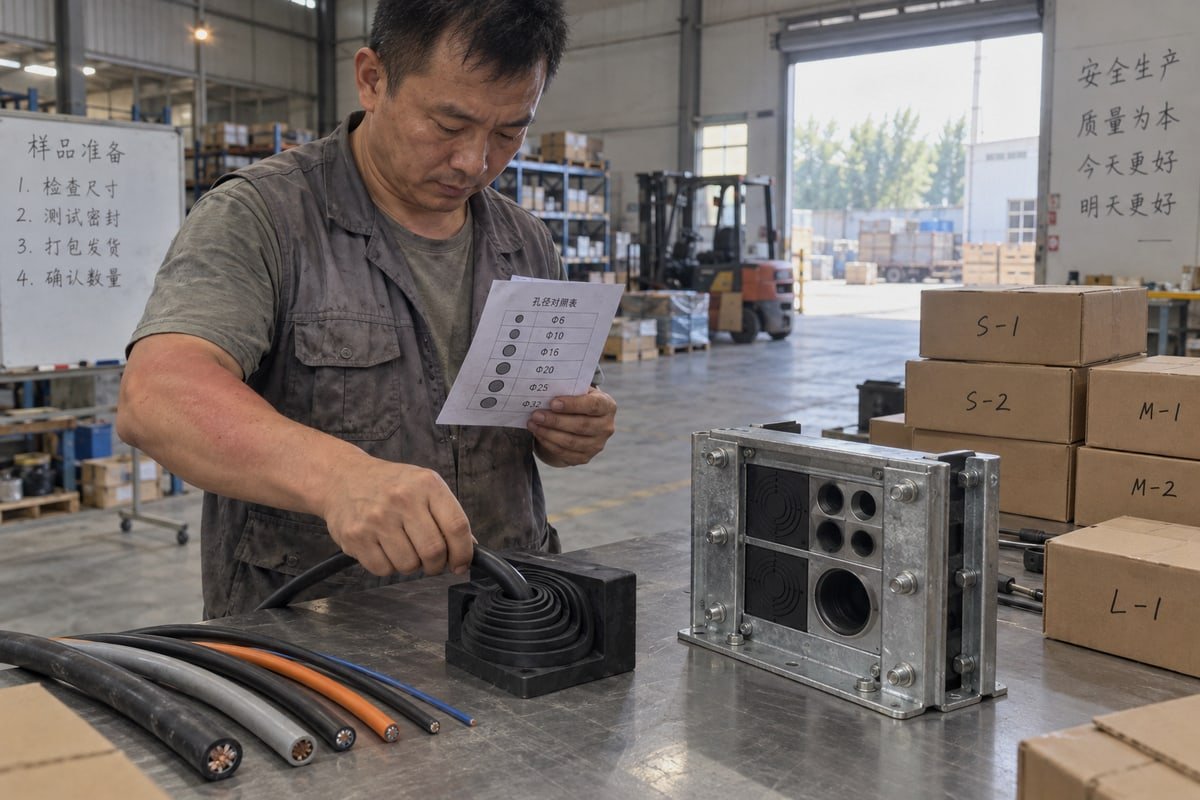
Samples and files turn a paper claim into something you can measure. We ship free validation samples and CAD/STEP files as standard because that is how a skeptical engineer decides. Here is the sequence I recommend.
- Request the STEP file for the frame, the compression unit, and each module size you plan to use. Ask for the revision number and date.
- Overlay the STEP geometry on your existing frame cutout in your CAD system. Check the inside opening, packing depth, and bolt pattern.
- Compare the STEP dimensions with the assembly drawing referenced in the installation manual. The drawing on the certificate file and the file on your screen must agree.
- Request physical samples of the same part numbers. Insist they come from the production line, not a prototype shelf.
- Inspect the samples. Look for the permanent USCG approval marking on the frame and modules.
- Fit the samples into a spare frame and compress them to the manual's torque. Confirm the stack closes within the stated compression height.
What to do with the sample
Positive Material Identification is the test that catches the most substitutions. If the certificate lists 316L stainless steel for the frame, a handheld PMI gun will tell you within seconds whether you received 316L or a cheaper 304 grade. Batches that fail PMI are a sign the production quality control is not under the follow-up service audit. Also cut one EPDM module and check the step-core layers. They should peel cleanly and the halogen-free rubber should carry a batch mark you can trace.
What to do with the file
The STEP file also feeds your onboard records. IACS Unified Requirements Z23 and Z28 ask for a Cable Transit Seal Systems Register with valid type approval documentation for each transit. A clean STEP file, a drawing revision, and the COA number give the yard everything it needs for that register. If a supplier hesitates on either the sample or the file, that hesitation is the answer.
Conclusion
Unverified claims cost more than any cheap module saves. Match the exact SKU to a live COA, validate it in CGMIX, and keep the evidence in the vessel file.
Footnotes
1. Global quality management system standard for manufacturing industries. ↩︎
2. Official USCG database for verifying equipment type approvals and certificates. ↩︎
3. International standard for fire test procedures required for marine equipment approval. ↩︎
4. International standard for degrees of protection provided by enclosures (IP Code). ↩︎
5. International standard for quality management systems used by manufacturers. ↩︎



 English
  Español de México
  Deutsch
  Français
  العربية
  Русский