
A multi cable transit that fails its smoke test costs far more than the frame. We learned this on our production line: the fix starts with documents, not just rubber.
For a multi cable transit, data center buyers should request firestop test reports for the exact partition, smoke and gas-tightness data, ingress protection reports, and re-entry drawings. Offshore buyers add marine Type Approval Certificates, hydrocarbon or jet fire reports, pressure test results, salt spray reports, and material traceability.
Both environments use the same family of modular cable seals. They do not carry the same risk. Below I separate the two document stacks, then show how to qualify a second source without guessing about fit or paperwork.
What certification documents do I need for data center MCT systems versus offshore installations?
A European modular data center builder once sent us a spec that demanded DNV type approval 1 for an indoor raised floor. Nobody on their side could explain why.
Data center MCT systems need a firestop test report for the exact wall or floor type, a Declaration of Performance, smoke and gas-tightness data, and installation drawings. Offshore installations need a marine Type Approval Certificate, IMO FTP Code fire testing, pressure and salt spray reports, and ATEX documentation where relevant.

Start with the table. It maps each document to the environment that actually requires it.
| Document | Data center MCT system | Offshore installation |
|---|---|---|
| Fire test report | UL 1479 certification (North America) or EN 1366-3 (Europe), for the exact partition; NFPA 75 2 sets the context | A-0/A-60 per IMO FTP Code 3 for steel bulkheads; H-120 where hydrocarbon fire is specified |
| Product listing or approval | UL or FM Global listing; Declaration of Performance and CE documents in Europe | Type Approval Certificate from ABS, DNV, or Lloyd's Register |
| Factory quality evidence | ISO 9001 4, IATF 16949 for OEM integrators | ISO 9001 plus classification society factory approval |
| Environmental and material data | Halogen-free compound statement; REACH/RoHS; EPD for Scope 3 embodied carbon | Salt spray test report; Mill Test Reports for frames and fasteners |
| Hazardous area | Usually not required | ATEX/Ex documentation for zoned areas |
| Special requirements | EMI/RFI shielding report; HEMP verification for high-security sites | Blast resistance rating; HEMP for naval-adjacent assets |
Why the configuration matters more than the certificate
A generic fire rating tells you the module compound survived a furnace. It does not tell you the module survived in your wall. A firestop sealing system is only rated for the tested assembly: partition type, frame size, cable fill, and module arrangement. So for a data center I ask buyers to request the report page that shows the exact configuration. Concrete wall, steel wall, raised floor, and insulated sandwich panel each need their own evidence. Containerized builds use sandwich panels far more than concrete, and many older reports never covered them.
Offshore, the same logic applies with heavier weight. A Type Approval Certificate ties the product to marine rules. But the certificate still lists the tested deck and bulkhead types and the fire class. If your spec says A-60, check that the certificate says A-60 for a steel bulkhead of your thickness, not just A-0. And if the platform fire scenario is hydrocarbon, the report must show H-class testing, not cellulosic.
The objection: too much paper slows the project
Some procurement teams push back here. They say a full submittal package delays award and installation. I understand that. But I have watched a data center penetration get rejected at commissioning because the submittal only had a brochure. The rework cost more than the whole transit order. Offshore, the consequence is worse. A rejected penetration can hold up a class survey.
The practical fix is not less paper. It is the right paper, sent once. From our side, we keep ISO 9001 and IATF 16949 5 system certificates, our BV factory approval, and A-0/A-60 fire test documents ready as one package. A buyer receives them on request, reviews once, and files them for the whole project.
How do I verify dimensional compatibility before switching to a second-source MCT supplier?
Every TSC module that leaves our Shaanxi plant gets checked against a 120-frame gauge before packing. That habit started after an early batch sat slightly proud of the frame.
Verify compatibility by comparing frame cutout dimensions, module footprint, stay plate thickness, and compression unit stroke against the incumbent's drawings, using the supplier's model cross-reference table. Then fit a free validation sample into an existing frame, check compression, and confirm the cable diameter range per module before switching.

Dimensional compatibility is a measurement job, not a trust job. Here is the sequence I recommend before any second-source switch.
- Pull the incumbent frame drawing. You need the cutout width, height, and the internal clear opening, because modules fill the clear opening, not the cutout.
- Match model numbers. We publish a cross-reference table, existing model to DEWIN model, for the TSR round series and the TSC square series. Use it to pick candidates, not to approve them.
- Compare module geometry. Check outer width, height, and depth. Modules built to the common 120-frame standard share these, but confirm on paper anyway.
- Compare stay plates and the compression unit. Stay plate thickness and compression unit stroke set the total stack height. If either differs, the last row will not compress correctly.
- Confirm the cable diameter range. Our modules use a step-core design, so one module size accepts a range of diameters. Check that the range covers your smallest and largest cable.
- Fit a sample. Install it in a real frame and follow your installation quality control sheet, including the torque or tolerance value from the manual.
| Check item | Compare against | Accept when |
|---|---|---|
| Frame clear opening | Incumbent frame drawing | Module rows fill the opening with the specified compression margin |
| Module footprint | Incumbent module datasheet | Width and depth match; height stack equals frame height minus compression unit |
| Stay plate thickness | Incumbent stay plate | Same thickness, or supplier provides matching plates |
| Compression unit stroke | Incumbent unit | Full compression reached inside the tightening range in the manual |
| Cable diameter range | Your cable schedule | Every cable falls inside one step-core range |
| Spare capacity | Project fill plan | Blank modules and filler blocks are listed in the parts list |
The lock-in objection
Buyers sometimes tell me a single-vendor ecosystem is simpler. Design support is bundled, and every drawing already exists. That is true at the design stage. The problem appears at the spare parts stage, when a container builder needs spare modules urgently and the sole vendor quotes a long lead time. Open-spec procurement, backed by a verified drop-in second source, keeps that leverage. In our export work to Europe and the Middle East, the cost gap is typically 40–60 percent below the incumbent brand for the same frame footprint. That saving is only real if the module fits without frame rework. The six steps above are what protect the saving.
Which fire rating and ingress protection test reports should I request for each project environment?
There is a trade-off we weigh in every compound review: a softer EPDM seals cables more forgivingly, but a harder one holds pressure better.
Data center buyers should request firestop reports for each partition (UL 1479 or EN 1366-3), air leakage rate data for gas suppression retention, and IP67 or IP68 ingress reports for exterior enclosures. Offshore buyers should request A-60 or H-120 reports, hydrostatic pressure tests, gas-tight seal data, and blast resistance ratings.
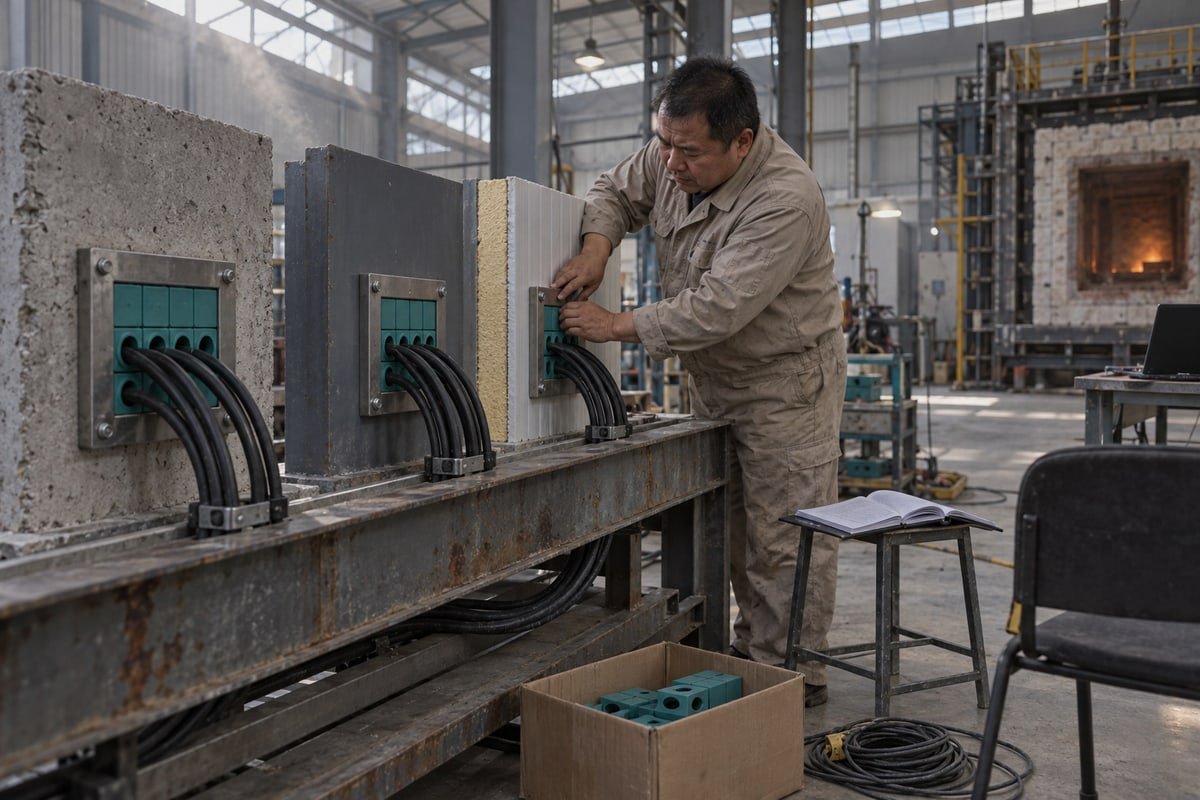
Every test report answers one question: did the seal hold under one specific load? Your job is to line the loads up with your environment.
| Test | The report must show | Data center use | Offshore use |
|---|---|---|---|
| Fire integrity and insulation | Partition type, duration, unexposed-face temperature | Hourly rating for the actual wall or floor | A-0, A-60, or H-120 on steel bulkhead and deck |
| Air leakage rate | Pressure differential and leakage volume | Clean-agent hold time in data halls | Smoke control between compartments |
| Gas-tight seal | Test pressure and duration | Suppression gas retention | Hydrocarbon gas migration control |
| Water and hydrostatic | Pressure in MPa or bar, direction, duration | Rooftop or exterior wall penetrations | Deck and bulkhead penetrations under wave load |
| IP67 ingress protection or IP68 | Dust and immersion depth and time | Outdoor enclosures and containers | Weather deck equipment housings |
| Salt spray test report | Hours of exposure, corrosion grade | Coastal sites only | Mandatory for frames, bolts, stay plates |
| Blast resistance rating | Overpressure and duration | Rarely required | Required near process areas |
| Electromagnetic shielding | Shielding effectiveness across frequency | Sensitive data hall equipment; HEMP for high-security sites | Control rooms; naval-adjacent assets |
| Chemical compatibility | Fluid list and swelling or hardness change | Immersion cooling dielectric oils | Hydraulic oil and drilling fluids |
Reading a fire report properly
Look for two curves, integrity and insulation. Integrity means no flame passed. Insulation means the cold face stayed under the temperature limit. A-60 means both held for 60 minutes on a steel bulkhead under the IMO FTP Code furnace. In a data center, the NFPA 75 context makes the hourly rating the key number, but the smoke behavior matters just as much. That is why I also ask buyers to request a halogen-free compound statement. Our modules use halogen-free EPDM for exactly this reason.
Pressure, ingress, and corrosion
Offshore buyers should not accept "watertight" as a word. They should accept it as a number. Our modules are tested watertight and gas-tight from 0.01 to 0.4 MPa, and the frames carry IP68 ingress protection. The difference between IP67 and IP68 is immersion depth and duration, so check which one your deck-level equipment actually needs. For salt-laden air, request a salt spray test report for the frame, the bolts, and the washers, not only the rubber.
Flexibility against integrity
Data center operations teams want easy re-entry for cable adds. Safety teams want the compartment untouched. The document that reconciles both is a fire report that includes spare modules and filler blocks in the tested configuration. If the tested fill plan already has spare capacity, a later cable add stays inside the rating. Ask for that page specifically.
Can I get free validation samples and CAD/STEP files before committing to a bulk order?
The lesson that shaped our sampling policy came from a BESS container builder who qualified us on paper but never fitted a module before the first order.
Yes. Serious MCT suppliers provide free validation samples of sealing modules and stay plates plus native CAD, STEP, and DXF files before a bulk order. Request samples matched to your cross-referenced model numbers, fit them in your existing frame, and confirm the 3D files match the physical parts.

A sample is not a gift. It is the last document in the stack, and it is the only one you can measure with calipers. So I treat the sample kit and the file package as one deliverable.
What a validation kit should contain
- Two or three module sizes from the cross-reference table, covering your smallest and largest cable.
- One blank module and one filler block, so you can test the spare-capacity fill plan.
- A stay plate and, where relevant, a compression unit, so the stack height can be checked.
- The installation manual with the torque or tolerance value, for a real installation quality control run.
- A parts list that matches the sample labels to the quotation line items.
The file package
| File type | Format | What to check | Who uses it |
|---|---|---|---|
| 3D model | STEP | Overall dimensions match the physical sample | Mechanical design, enclosure integration |
| 2D drawing | DXF or DWG | Cutout, bolt pattern, and frame weld detail | Fabrication, cutting |
| Filling plan | Module arrangement per transit with spare capacity | Site installer, inspector | |
| Frame schedule | PDF or spreadsheet | Every transit, frame, and part number on the project | Procurement, commissioning |
| BIM object | IFC or Revit family | Attribute data for as-built cable density | Data center infrastructure management, digital twin |
For modular data centers, the BIM object matters more each year. Operators want as-built cable counts and spare capacity inside their automated infrastructure management tools. A multi cable transit with no digital object becomes a blind spot in that model.
The minimal-paperwork objection
Some buyers say a simple product needs only a datasheet and a price. For a non-critical penetration in a temporary building, that may be fine. For a fire-rated data hall wall or an offshore bulkhead, the penetration is part of the envelope, and the file package is what proves it. We keep the burden light on the buyer. Our in-house mold shop makes custom sizes when a frame is not standard, our private-label line can print your part numbers on the module face, and spare sealing modules ship quickly with export documentation handled. English-language technical support reviews the STEP files with your engineer before the sample ships. That is what makes second sourcing a low-risk decision rather than a leap.
Conclusion
Match documents to hazard, verify fit with samples and files, then save cost. Undocumented transits create rework; documented drop-in second sourcing removes that risk. Ask us for the package.
Footnotes
1. DNV official page for maritime type approval certification services. ↩︎
2. Official NFPA landing page for Standard 75; replaces the broken legacy URL path. ↩︎
3. IMO fire protection page covering the FTP Code for marine safety. ↩︎
4. Official ISO 9001 page for quality management system certification standards. ↩︎
5. Official IATF 16949 page for automotive and OEM quality standards. ↩︎



 English
  Español de México
  Deutsch
  Français
  العربية
  Русский