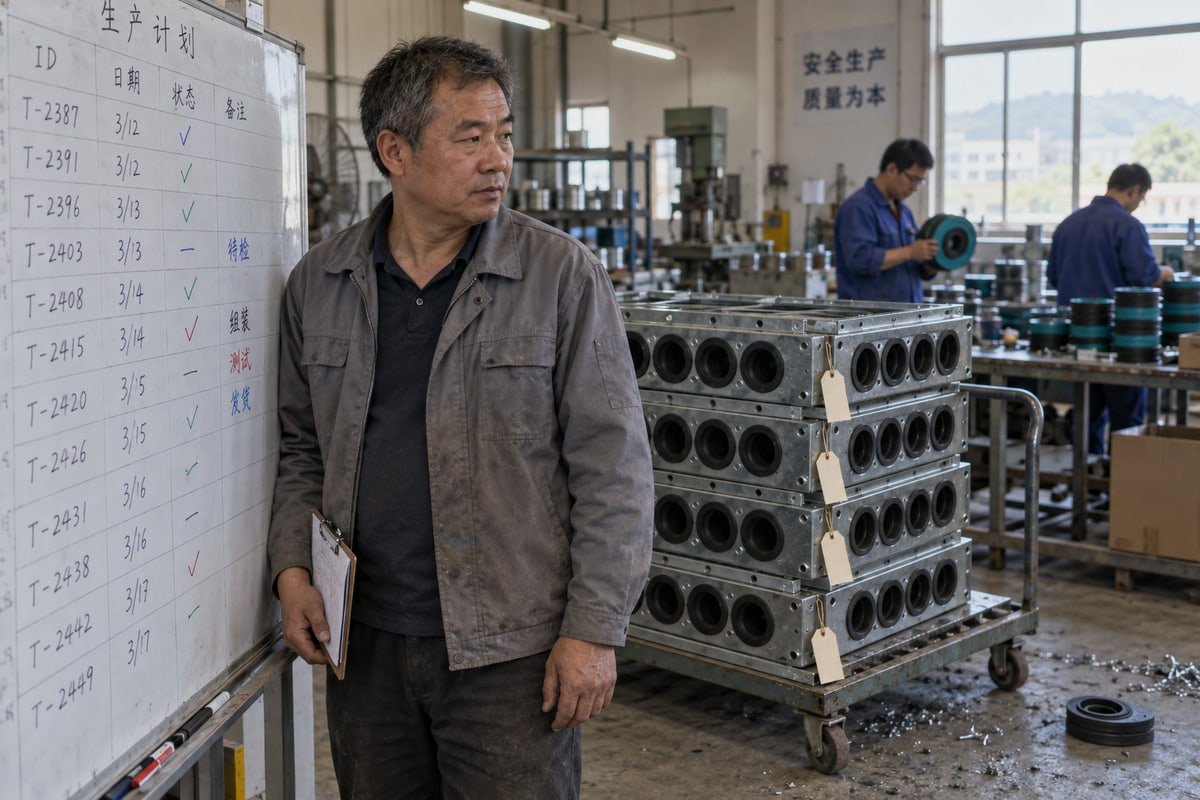
Late multi cable transits production can stall an entire BESS container line. I have seen it hit buyers before they reached our factory floor. It is avoidable.
To track multi cable transits production, give every transit a unique ID, request a dated production schedule with milestones, collect photo and test evidence at each stage, and check material readiness weekly. Live status reporting exposes slips early, so you can act before the deadline.
Cable sealing systems look simple on a drawing. In practice, a transit is a small work package that touches engineering, molding, steel fabrication, inspection, export paperwork 1, and freight. Any one of those can slip. The sections below walk through what to ask before ordering, what documents prove progress, how to judge a drop-in replacement, and which warning signs matter most.
How can I verify my MCT supplier's production schedule before placing an order?
A sourcing engineer in Germany asked for our schedule before sending a purchase order. We sent a milestone plan tied to his frame drawings. That is the right ask.
Verify an MCT supplier's production schedule by requesting a dated milestone plan covering material arrival, molding, compression unit assembly, quality control inspections, and shipment. Ask which plants run the order, confirm mold availability for your module sizes, and demand a named contact who updates status weekly.

A single ship date is not a schedule. It is a promise. A real schedule shows the steps behind that promise and the dates each step should close. When we prepare one for a TSC or TSR order, we split it into the stages that can actually fail. That gives the buyer something to check against, not just something to hope for.
Ask for milestones, not a ship date
The table below shows the milestone plan we recommend buyers request from any MCT supplier, including us.
| Milestone | What to verify | Evidence to request |
|---|---|---|
| Order acknowledgment | Frame size, module count, compression unit type, stay plate quantity | Signed order confirmation with Bill of Materials |
| Raw material arrival | Halogen-free EPDM compound lot and galvanized steel 2 in stock | Material receiving record or photo of stock |
| Mold readiness | Mold exists for each module size ordered | Mold number list; custom sizes show tooling status |
| Molding and curing | Modules produced in the right quantities | Dated production photos with batch labels |
| Frame fabrication | Weld seams, cutout dimensions, surface finish | Dimensional check sheet |
| Assembly and inspection | Compression units, plates, lubricant packed as kits | In-process inspection record |
| Pre-shipment | Cartons, marking, export documents | Packing list, commercial invoice, photos of pallets |
Check capacity behind the plan
Material lead times drive most upstream risk. EPDM compound and galvanized steel are not exotic, but a supplier that buys per order will always be later than one that holds stock. So I suggest asking two direct questions. First, do you run more than one production site? We run our headquarters plant in Shaanxi plus lines in Shandong and Hunan, which lets us shift capacity if one site is loaded. Second, do you make your own molds? In-house mold making means a custom module size does not wait behind a third-party toolmaker.
Supply chain visibility also depends on how the supplier plans. Our production planning runs under ISO 9001 3 and IATF 16949 systems. That does not make a schedule immune to problems, but it does mean every order has a routing, a planned start, and a planned finish that someone owns. Ask to see that routing. A factory with a real quality system will show it. A trading company usually cannot, because it does not control the line.
What documentation should I request to confirm my cable transit modules are on track?
Every batch of TSC modules leaving our Shaanxi line carries a batch card. It records compound lot, mold number, and inspection result. Buyers who ask for it rarely get surprised.
Request a confirmed order acknowledgment with the Bill of Materials, a production milestone report with dated photos, material certificates for EPDM and frame steel, in-process quality control inspection records, fire and IP68 test reports on request, and pre-shipment packing lists with export documents.

Documents fall into two groups. Progress documents prove the order is moving. Compliance documents prove the product will pass inspection on site. Buyers often chase one group and forget the other. Both cause delays if missing. A late packing list holds up freight. A missing fire test report holds up handover.
Progress documents by stage
| Stage | Document | Why it matters for your deadline |
|---|---|---|
| Order entry | Order acknowledgment with full Bill of Materials | Confirms module sizes, frame codes, and spare parts before production starts |
| Engineering | CAD or STEP files and cross-reference table | Lets your team check the 120-frame cutout fit before steel is cut |
| Production | Dated photos with batch labels | Shows real modules, not a rendering |
| Inspection | In-process check sheets | Catches dimensional or compression faults before packing |
| Shipping | Packing list, invoice, certificate of origin | Prevents customs holds that eat installation days |
Bill of Materials management is where most document gaps start. A transit for a switchgear panel might need a frame, twelve modules in three sizes, a compression unit, two stay plates, and lubricant. If any line item is missing from the acknowledgment, it will be missing from the crate. Match the BOM against your cable schedule before you approve it. Good cable schedule integration means each transit ID lists the exact cable diameters passing through it, and the module sizes in the BOM cover those diameters. Our step-core EPDM modules accept a range of cable diameters per size, which keeps the BOM short and easier to audit.
Compliance documents you should hold before shipment
Firestop compliance standards are usually checked at handover, when a delay hurts most. So ask for the compliance set early. For our modules that set includes fire rating documentation 4 for A-0 and A-60, IP68 ingress protection 5, and watertight and gas-tight test records across 0.01 to 0.4 MPa. Our factory is BV-approved, and we provide these test documents on request. Ask your supplier to put them in one shared folder with the progress documents. A centralized digital repository for certifications and inspection logs is one point where the industry advice is right. It stops the last-week scramble for a PDF someone emailed months ago.
One objection I hear often: photos by email are good enough. They are better than nothing. But emails do not give you a timeline you can scan. A shared folder or portal with dated entries lets you see whether the last update was yesterday or three weeks ago. That gap is itself information.
How do I know if a drop-in replacement will actually arrive on time for my project deadline?
Speed and fit pull against each other in second sourcing. A fast module that does not match the 120-frame cutout is worthless. We qualify fit first, then lock the date.
A drop-in replacement arrives on time when three things are settled before the order: a validated cross-reference from your existing model to the new one, an approved free sample fitted in your frame, and a written lead time that separates production, export paperwork, and freight days.
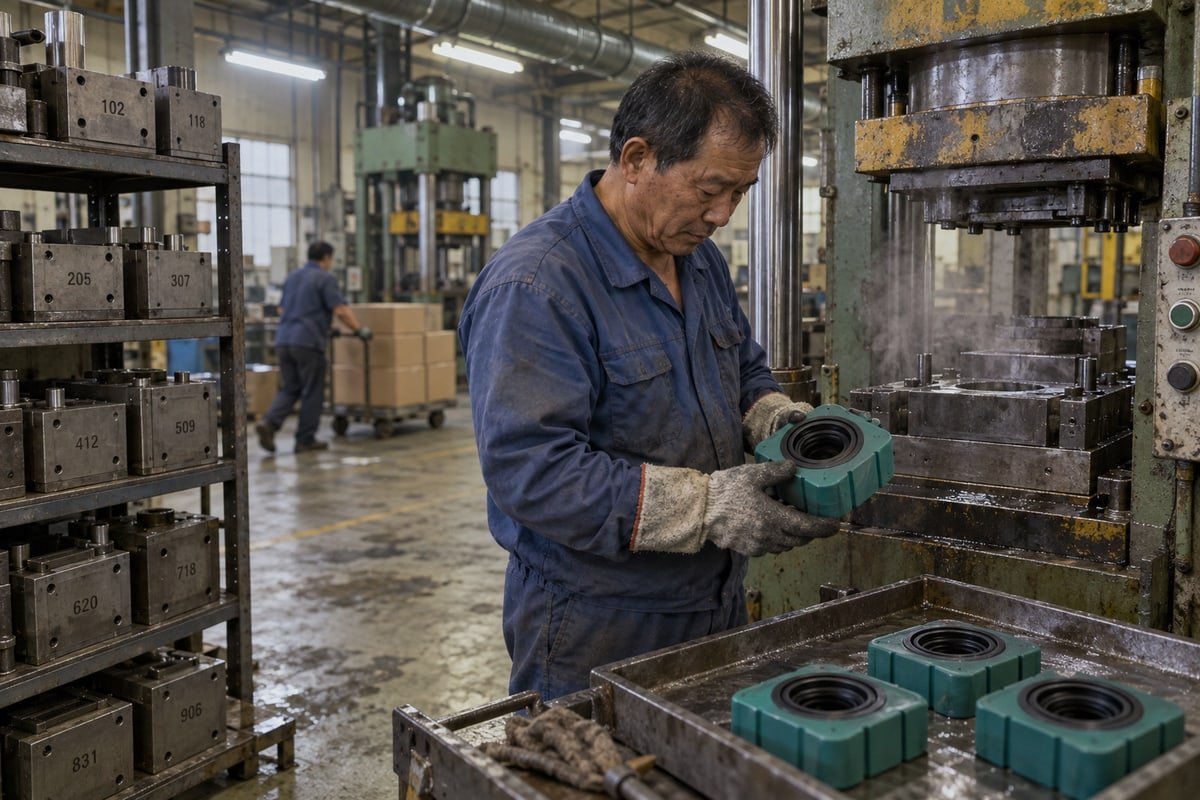
A drop-in replacement is only a time saver if the drop-in part is real. The 40 to 60 percent cost saving that draws buyers to a second source disappears if the modules arrive and do not seat in the frame. So the delivery question and the fit question are the same question. I recommend working through both in a fixed order.
A five-step qualification sequence
- Cross-reference the model. Send your current module and frame codes. We return a table mapping each existing model to the matching DEWIN TSC or TSR model, with dimensions side by side. Any mismatch shows up here, on paper, before money moves.
- Check the CAD or STEP file. Your engineer drops our model into the frame assembly. This catches cutout tolerance issues that a spec sheet hides.
- Fit a free validation sample. We ship samples at no charge. Your team installs them in a real frame with real cables and compresses the unit. Fit, compression travel, and seal contact are confirmed by hand.
- Approve and freeze the BOM. Once the sample passes, the module sizes, quantities, and modular seal components are fixed. Changes after this point restart the clock.
- Get the lead time in writing, split by stage. Production days, documentation days, and freight days are different risks owned by different people.
Break the lead time into parts you can check
| Lead-time component | Who controls it | How you verify it |
|---|---|---|
| Sample shipment and validation | Buyer and supplier together | Sample tracking number; your own fit report |
| Production of modules and frames | Supplier factory | Dated milestone photos against the plan |
| Quality control and packing | Supplier factory | Inspection sheet and packing photos |
| Export documentation | Supplier logistics team | Draft invoice and packing list before cargo leaves |
| Freight and customs | Forwarder and customs | Booking confirmation, bill of lading, arrival notice |
The most common trap is adding these parts in your head instead of on paper. A supplier who quotes production time only is not lying, but the number is not your arrival date. Ask for the full chain. Also ask what happens if one component slips. For spare sealing modules, we hold standard sizes in stock, so a repeat order can skip the molding stage entirely. For custom sizes, in-house mold making shortens the tooling step, but it is still a step. Knowing which path your order takes tells you how much buffer to keep.
Some industry articles suggest simulating cable density and thermal load in a digital twin before installation. That advice belongs to the design phase. For a second-source module, the physical validation sample does the same job faster and with less setup. Use the sample.
What early warning signs indicate a supplier might miss my cable transit delivery date?
One lesson stuck with us after a rushed spare-module order: silence is a signal. When updates slow down, production usually has too. We now report even when nothing changes.
Early warning signs include vague or shifting ship dates, missing dated photos, unanswered questions about raw material stock, a change in the named contact, requests to alter module specifications late, unexplained deposit changes, and no mention of export paperwork close to the promised departure.

Most delays announce themselves early. The problem is that the announcement is quiet. Nobody sends an email saying production is behind. Instead, replies get shorter, dates get softer, and photos stop arriving. If you know the pattern, you can act while there is still time to recover.
Signals and what to do about them
| Warning sign | What it usually means | Your next move |
|---|---|---|
| Ship date moves without a reason | A milestone slipped and nobody wants to explain which one | Ask which stage is late and request the current photo |
| No dated production photo for over a week | Modules may not be in production yet | Request a photo of your batch label on the line |
| Questions about EPDM or steel stock go unanswered | Materials not purchased or not received | Ask for the receiving record |
| Your contact changes suddenly | Internal handoff; order knowledge may be lost | Ask the new contact to restate the milestone plan |
| Supplier asks to change module size or compound late | Mold or material not available as promised | Refuse changes that affect fit; ask for the root cause |
| No draft export documents near departure | Logistics team not yet engaged | Request draft invoice and packing list now |
| Supplier cannot say which factory is producing | Likely a trading company reselling | Ask for factory address and quality system certificate |
Digital tracking helps, but only with discipline
The industry is moving toward digital tracking software for transits. Web-based transit management systems give each transit a unique ID, a status, a location, and photo history, and let engineers see live confirmation from site that the final design is in use. QR or barcode scanning updates status in seconds instead of waiting for a weekly log. Automated notification triggers can flag a missing component or a failed inspection the moment it is recorded. Installation status reporting on the downstream side has clearly improved because of this.
Here is the objection I take seriously: a dashboard is only as good as the person updating it. If the factory scans a batch as complete before inspection, the dashboard lies. So I do not treat software as a substitute for the checks above. We combine our digital records with a manual short-interval review on the floor, and we send buyers the underlying photo, not just a green status bar. Predictive analytics and computer vision are promising for large yards. For an OEM integrator buying frames and modules, a dated photo and a named person still catch more problems than any algorithm.
One more note. Buyers sometimes ask about blockchain provenance for fire-rated components. The simpler control works today: material certificates tied to batch numbers, held in your shared folder, checked against the BOM.
Conclusion
Delays hide where visibility is weakest. Demand milestones, documents, validated samples, and honest signals, and multi cable transits production stops being the risk on your schedule.
Footnotes
1. Authoritative guide to common export documents from the International Trade Administration. ↩︎
2. Official trade resource regarding steel, a primary material used in the fabrication of cable transit frames. ↩︎
3. Official ISO page for the quality management standard used in the supplier’s production planning processes. ↩︎
4. IMO fire protection page relevant to the fire rating standards required for marine and offshore cable transits. ↩︎
5. Official IEC resource explaining IP ratings for ingress protection against solids and liquids. ↩︎


 English
  Español de México
  Deutsch
  Français
  العربية
  Русский