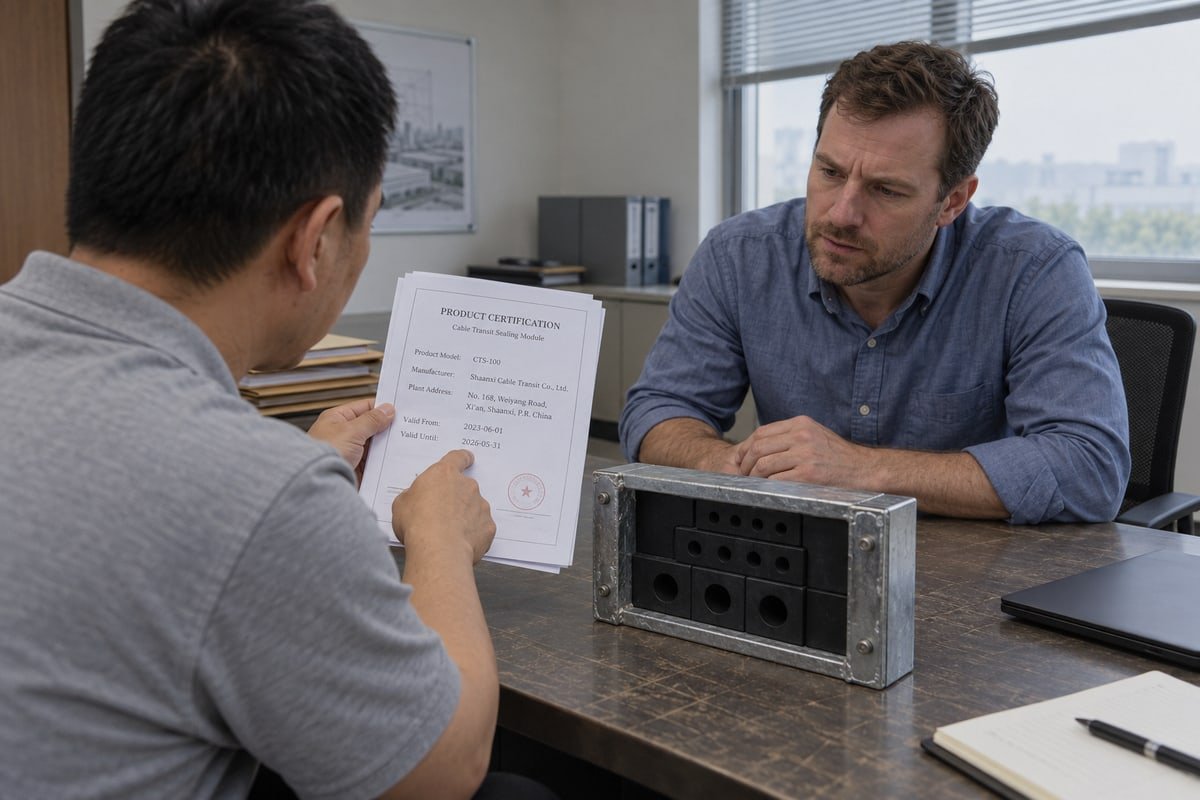
A buyer emailed our factory a competitor’s ABS logo as proof of ABS design and manufacturing certification for Chinese MCT suppliers. It proved nothing, and that gap stalls projects.
Chinese MCT suppliers need ABS design and manufacturing certification only when the transit goes on an ABS-classed vessel or the project specification demands it. Verify by checking the full certificate for product model, plant address, and validity dates, then confirming it in the ABS Type Approval database.
The rest of this article breaks that answer into four parts. I explain what ABS actually certifies. I show how to check a certificate line by line. I compare ABS with BV, DNV, LR, and CCS. Then I list the test documents you should demand before you qualify any new cable transit source, including ours.
What Does ABS Design and Manufacturing Certification Actually Cover for MCT Systems?
During our last BV factory audit, the surveyor spent more time on compression-test records than on drawings. That split between design and production is exactly how ABS structures its approvals.
ABS design and manufacturing certification for MCT systems covers two checks. The Product Design Assessment verifies the cable transit design against ABS rules and fire, watertight, and gas-tight standards. The Manufacturing Assessment verifies that a specific factory can build that approved design. Both must be valid for Type Approval.

An MCT, or Multi Cable Transit, is a modular cable sealing system 1. A steel frame is welded or bolted into a bulkhead or deck. Rubber modules fill the frame around each cable. A compression unit squeezes the stack so the opening stays fire-tight, watertight, and gas-tight. On a ship or an offshore platform 2, that opening is a weak point in a fire boundary. This is why a classification society 3 cares about it.
Design approval versus manufacturing approval
ABS treats these as separate questions. The Product Design Assessment (PDA) asks whether the design works. The Manufacturing Assessment (MA) asks whether a named plant can repeat that design. ABS Type Approval guidance is clear that a product must hold both a current design approval and a valid manufacturing assessment certificate. One without the other is not full Type Approval.
| Approval component | What it checks | Tied to | Typical evidence |
|---|---|---|---|
| Product Design Assessment (PDA) | Drawings, materials, fire and pressure test results against ABS rules | The product model and its scope limits | Fire test report, pressure test report, material certificates |
| Manufacturing Assessment (MA) | Quality system, process control, traceability at the factory | A specific legal entity and plant address | Audit report, ISO 9001 records, batch inspection data |
| ABS Type Approval | PDA plus MA, both valid at the same time | Model and plant together | Certificate listed in the ABS database |
What the scope line must say
A real certificate does not just say "MCT." It lists the frame types, the module sizes, the approved cable diameter range 4, and the bulkhead or deck materials. It states the fire class, such as an A-60 fire rating 5 tested under the IMO FTP Code, or H-120 for hydrocarbon fire zones on offshore units. It may state the pressure limit for watertight integrity. When I read a rival's certificate, I compare those numbers with the buyer's drawing. Our own modules are rated A-0/A-60, IP68, and 0.01–0.4 MPa watertight and gas-tight. Those are the kinds of figures a scope line should carry.
Required versus preferred
ABS Type Approval is mandatory when the MCT will be installed on an ABS-classed vessel or offshore asset. It is only preferred when a buyer or shipyard writes it into a specification for convenience. For land-based BESS containers, modular data centers, and switchgear panels, ABS is rarely required at all. The end use decides the answer, not the supplier's country.
How Can I Verify a Chinese MCT Supplier's ABS Certificate Is Genuine and Current?
A sourcing manager once forwarded us a rival's translated certificate PDF. The English company name did not match the registered Chinese entity. That mismatch is now my first check.
Verify a Chinese MCT supplier's ABS certificate by searching the ABS Type Approval database by company name or certificate number, then matching the legal entity, factory address, product model, scope limits, and expiry date. If any detail differs, or the record is missing, contact ABS before qualifying the supplier.

Logos and screenshots are not evidence. A translated PDF is not evidence either. Only the full original certificate, cross-checked against the ABS record, counts. Here is the sequence I follow when a buyer asks me to help review a competitor's claim.
A seven-step verification process
- Request the complete certificate, every page, in its original form. Do not accept a summary or a cropped image.
- Search the public ABS Type Approval database. You can reach it through the ABS Eagle portal. Search by supplier name, certificate number, or the cable transit product category.
- Match the legal name on the certificate to the registered Chinese company name. Trading companies often reuse a factory's certificate under their own brand.
- Match the factory address on the certificate to the physical production site. Ask for a plant photo with the address sign, or arrange a video walk-through.
- Read the certificate type. Is it a PDA, an MA, or full ABS Type Approval? Each covers something different.
- Check the issue date and expiry date. Type approvals typically run for five years, and some frameworks require annual endorsement. An expired or un-endorsed certificate is not current.
- Compare the scope limits with your drawing. Cable diameter range, module size, frame type, fire class, and pressure rating must all match your application.
Red flags I have seen in the market
| Red flag | Why it matters | What to do |
|---|---|---|
| Logo on brochure but no certificate number | Cannot be traced in any database | Request the number or reject the claim |
| Certificate holder is a trading company | Manufacturing Assessment is plant-specific | Ask for the actual factory's certificate |
| Different plant address from the shipping origin | Approval does not transfer between sites | Confirm which site will produce your order |
| Scope lists a different model family | A similar product is not the approved product | Match model codes line by line |
| Expiry date passed or endorsement missing | Certificate is no longer valid | Ask for the renewed certificate |
Why a group certificate does not cover every plant
Our company runs production in Shaanxi, Shandong, and Hunan. If we ever sought ABS approval, each site would need its own Manufacturing Assessment. The same rule applies to any supplier you review. A certificate for one plant covers that plant only. When the supplier is a group with several factories, ask which plant will actually ship your modules, and verify that plant.
Do I Need ABS Certification Specifically, or Will IACS/BV/DNV Approval Meet My Project Requirements?
Our own factory approval is from Bureau Veritas, so I face this trade-off with buyers often: pay for a second class approval, or ask the project what it truly needs.
You need ABS certification when the vessel or offshore unit is classed by ABS, or when the specification names ABS. BV, DNV, LR, and CCS approvals are not interchangeable with ABS, despite shared IACS standards. For land-based BESS and data center projects, a BV-approved factory with test reports usually suffices.
Let me lay out the comparison first, then deal with the objections I hear most.
| Classification Society | Where it is common | Accepted in place of ABS? | Notes for China-based sourcing |
|---|---|---|---|
| ABS (American Bureau of Shipping) | US-flagged vessels, Gulf of Mexico offshore, many FPSOs | Yes, when the asset is ABS-classed | Separate PDA and MA; verify in ABS database |
| BV (Bureau Veritas) | European yards, energy infrastructure, many EPC specs | No, unless the spec allows any IACS member | Our factory holds BV approval; widely accepted in Europe and the Middle East |
| DNV | North Sea, Norwegian and offshore wind projects | No, unless allowed | Frequently specified for offshore wind substations |
| LR (Lloyd's Register) | UK and Commonwealth fleets | No, unless allowed | Often paired with DNV in tender documents |
| CCS (China Classification Society) | Chinese domestic fleet and yards | Rarely for export projects | Common on Chinese supplier brochures; check whether your buyer accepts it |
Objection one: "CCS is enough"
Many Chinese MCT suppliers hold CCS first because it is closest to home. That is fine for domestic hulls. It is not fine when your end client's vessel is classed by ABS. The surveyor who attends the yard works for ABS, and ABS rules apply. CCS membership in IACS does not make its certificates equivalent.
Objection two: "All IACS members recognize each other"
IACS standards create common technical requirements, but each classification society issues its own approvals. Mutual recognition exists for some materials and components, but Type Approval of a cable sealing system is generally society-specific. Do not assume transfer. Ask the yard or the project engineer which society holds class, and read the specification for wording like "ABS or equivalent." If that phrase is present, a BV or DNV certificate may be accepted. If it is absent, it will not be.
When ABS is the wrong question
Most of our customers build BESS containers, modular data centers, and switchgear enclosures on land. For them, no marine classification society governs the installation. What matters is the A-60 fire rating test report, the IP68 result, and the watertight integrity data. In those cases I tell buyers plainly: do not pay a premium for an ABS mark you will never need. Spend the money on validation samples and a proper test package instead.
What Test Documents Should I Request Alongside ABS Certification Before Qualifying a New MCT Supplier?
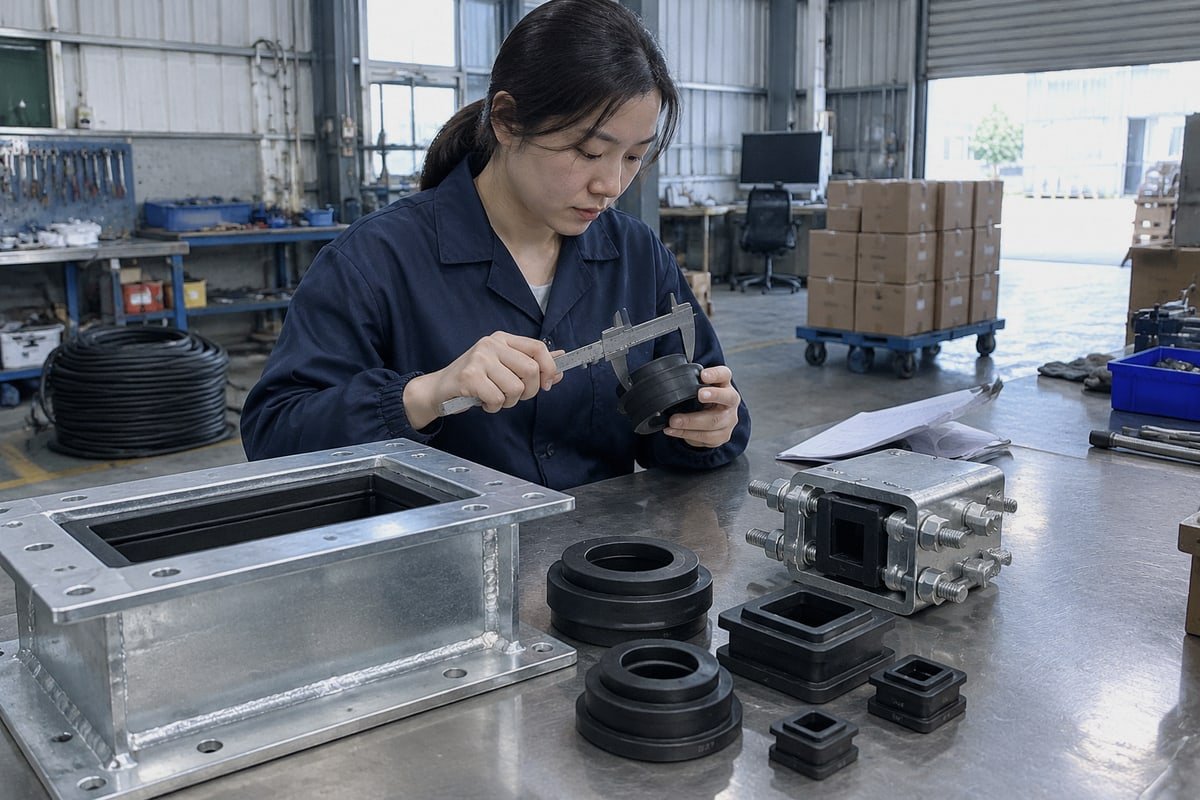
The lesson I learned early in export work: a certificate shows a design passed once, while test reports and batch records show the modules shipping to you still pass.
Request the fire test report showing the A-60 fire rating under the IMO FTP Code, watertight and gas-tight pressure test reports, IP68 ingress test data, EPDM material and halogen-free certificates, ISO 9001 and IATF 16949 certificates, batch inspection records, installation instructions, and any surveyor-witnessed third-party inspection reports for safety-critical applications.

Certificates prove a moment in time. Documents prove a process. When a European purchasing engineer qualifies our factory, I send the package below before anyone asks for it. Use it as a template for any Chinese MCT supplier, ABS-approved or not.
The document package I recommend
| Document | What it proves | Ask for |
|---|---|---|
| Fire test report (IMO FTP Code) | A-0 or A-60 fire rating on the actual frame and module configuration | Lab name, test date, tested cable fill, pass/fail record |
| Watertight and gas-tight pressure test | Sealing performance, for us 0.01–0.4 MPa | Test pressure, hold time, leak criteria |
| IP68 ingress test | Immersion resistance for outdoor and deck use | Depth, duration, sample identity |
| EPDM material and halogen-free certificate | Rubber compound identity and smoke toxicity behavior | Compound reference, supplier certificate |
| ISO 9001 and IATF 16949 certificates | Quality system maturity beyond the marine scope | Certificate numbers and current dates |
| Batch inspection records | The shipped lot matches the tested design | Hardness, dimension, and compression checks per batch |
| Third-party inspection report | Surveyor witnessed production or testing | Society or inspector name, scope, date |
| CAD/STEP files and cross-reference table | Drop-in fit against your existing 120-frame cutout | Model mapping from existing brand to replacement model |
Emerging items worth adding
Three newer points come up in tenders now. First, service provider approval. On some fire-protection installations the validity of the approved seal depends on installation by recognized technicians, so ask whether the supplier or the yard holds that recognition. Second, EMI shielding. ABS cyber resilience guidance for smart vessels is pushing buyers to ask whether the cable transit affects electromagnetic shielding of the enclosure. Third, IHM or Green Passport data. Modern ship recycling rules require an Inventory of Hazardous Materials, so the module compound declaration should confirm it is halogen-free and free of listed substances.
How we make qualification easy
I keep the qualification loop short. We send a free validation sample from the exact mold that will produce your order. We include the model cross-reference table so your engineer can confirm the drop-in fit into the existing frame cutout. We send STEP files the same day. That lets your team check the physical seal, the dimensional fit, and the paperwork in one round, which is where a 40–60% cost reduction becomes real rather than theoretical.
Conclusion
Unverified ABS claims stall projects and expose you to rejection. Verify model, plant, and dates, then request test evidence. Our factory supplies test documents and validation samples on request.
Footnotes
1. ABS provides specific Type Approval for modular cable sealing systems used on vessels and offshore assets. ↩︎
2. Authoritative US government agency regulating safety and environmental standards for offshore platform infrastructure. ↩︎
3. IACS establishes the technical standards followed by major classification societies for marine safety and component certification. ↩︎
4. Bureau Veritas audits MCT manufacturers to verify technical specifications like approved cable diameter ranges. ↩︎
5. The IMO sets the international fire test procedures required for A-60 rated marine cable transits. ↩︎



 English
  Español de México
  Deutsch
  Français
  العربية
  Русский