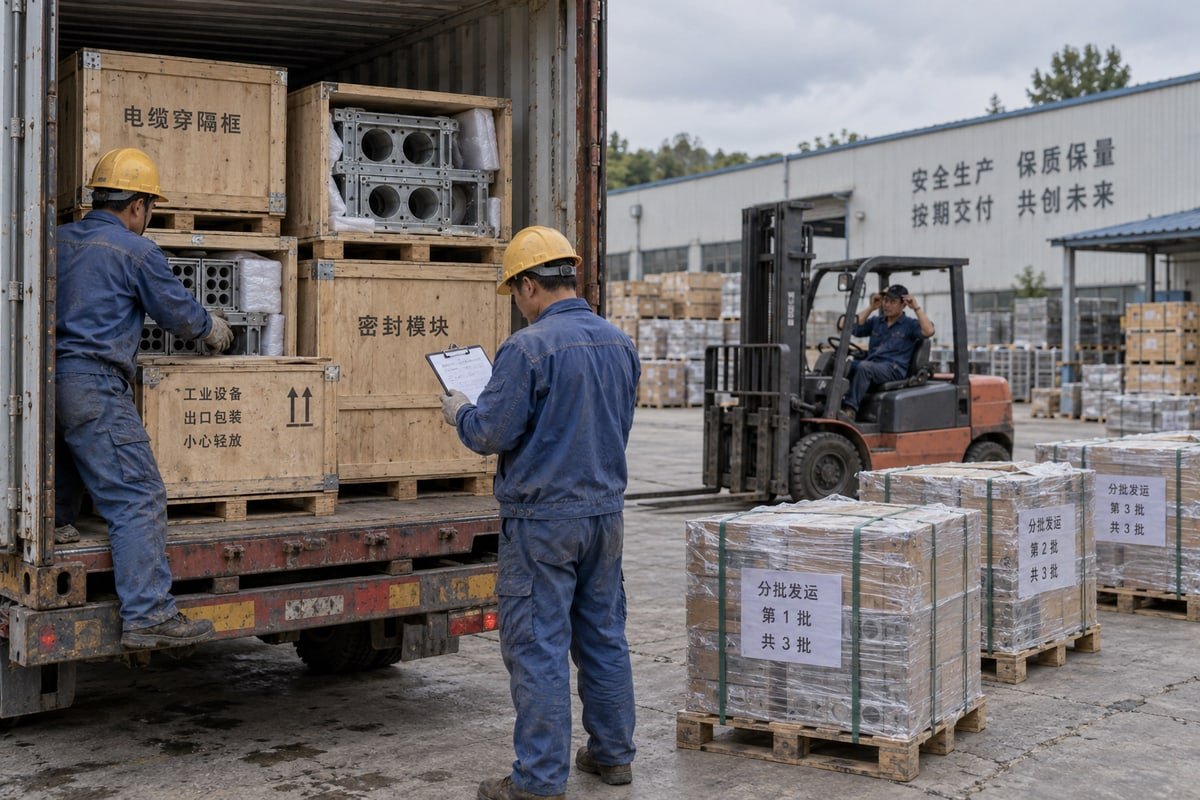
Full container consolidation vs batch shipping 1 decides whether MCT frames leaving our factory arrive when crews need them. Pick wrong and labor idles. Pick right and your critical path holds.
Full container consolidation suits MCT projects with a stable scope and predictable installation dates, because it cuts freight cost per unit and handling. Batch shipping suits phased builds with fragile critical paths, because partial releases keep crews working when one supplier slips.
Multi-cable transit sealing is a small package inside a large build. That is exactly why its delivery timing matters so much. Below, I walk through the decision, the cost and lead-time trade-offs, mixed TSR and TSC loads, and the customs paperwork that ties phased deliveries together.
How do I decide between full container consolidation and batch shipping for my MCT system delivery schedule?
A sourcing manager in Rotterdam asked me to ship the frames early and the modules later. That request taught me the decision starts with the installation sequence, not the container.
Decide by mapping each MCT component to its installation milestone. If frames, modules, and compression units are all needed within one window and suppliers are synchronized, consolidate into a full container. If installation is phased or supplier readiness varies, ship in batches tied to milestones.

Here is the comparison I put in front of buyers before we talk about freight rates at all.
| Factor | Full Container Consolidation | Batch Shipping |
|---|---|---|
| Freight cost per unit | Lower; one flat container rate | Higher; paid per cubic meter |
| Transit time | Shorter; bypasses port consolidation stations | Longer; extra consolidation and deconsolidation |
| Schedule flexibility | Low; waits for the last item | High; each wave moves when ready |
| Site arrivals to receive | One or few | Many |
| Site storage constraints | Needs staging area and unloading equipment | Fits smaller laydown areas |
| Exposure to one late supplier | Holds the whole container | Holds only that batch |
| Cargo security | Sealed from factory to site | More handling in shared loads |
Start from the installation sequence, not the port
MCT hardware installs in two distinct phases. Cable transit frames get fixed into wall or bulkhead openings during structural or shell work. TSC and TSR sealing modules, stay plates, and compression units go in only after cables are pulled. In our experience shipping to BESS container builders, those two phases can sit weeks apart. So a single full container often means modules sit on site while frames are still being welded in. That ties up cash and takes space. In modular construction logistics, space is rarely free.
The objection I hear most
Buyers sometimes tell me consolidation is simply superior because it cuts handoffs and freight cost. That is true when the scope is fixed and every supplier ships on the same calendar. It is not true when your site date is uncertain or when a third-party item in the same container is late. Then the whole load waits, and the ripple effect reaches your electrical crew. I treat batch shipping as a risk tool in that case, not a compromise.
Five questions I ask before quoting freight
- Is the first installation date fixed, or is it still moving?
- How many weeks separate frame installation from module installation?
- Does the site have a forklift and a covered laydown area?
- Are other suppliers sharing this container, and are they synchronized?
- Have we started planning at least 8–12 weeks before the first material need?
If the answers point to a fixed date, one window, and a ready site, I consolidate. If two or more answers are uncertain, I recommend batches.
What lead-time and cost trade-offs should I expect when switching from batch shipments to full container loads?
Every quote we prepare weighs two numbers against each other: the flat container rate and the calendar days lost while modules wait for the last frame to finish.
Switching from batch shipments to full container loads lowers freight cost per unit and transit time, since sealed containers bypass port consolidation stations. The trade-off is a longer front-end lead time, roughly eight weeks of staging and inspection, plus storage fees if arrivals miss a 5–7 day window.

The freight cost optimization 2 case for consolidation is real, but it only shows the sea leg. The full picture includes time before the port and cost after the port.
| Cost or Time Item | Full Container Load | Batch Shipment |
|---|---|---|
| Ocean freight basis | Fixed container cost, shared across all cargo | Charged per cubic meter occupied |
| Front-end staging | About 8 weeks across manufacturing, warehouse staging, inspection, dispatch | Each wave ships as it finishes |
| Port handling | No CFS consolidation or deconsolidation | Added days at both ends |
| Damage risk | Low; sealed door to door | Higher; more touches in shared loads |
| Inventory carrying costs | Higher; all material arrives at once | Lower; supports just-in-time delivery |
| Receiving events on site | One | Several, each needing checks and staging |
Where the savings come from
Fixed container costs reward filling the box. When our TSC modules, frames, and compression units from three production sites all go into one container, the freight per frame 3 drops sharply. For small volumes, however, paying per cubic meter in a batch is cheaper than paying for empty container space. There is a crossover point. I ask buyers to send the bill of materials so we can measure CBM and weight before anyone books space.
Where the time goes
A consolidated load follows a staged timeline. Manufacturing finishes first. Goods then move to a consolidation warehouse near the port for staging, re-palletizing, and pre-shipment inspection. Then the container is packed and dispatched. Spread across multiple suppliers, that sequence takes about eight weeks. Project lead times therefore grow at the front, even though the sea leg gets shorter. The staging warehouse also charges storage. Keeping all arrivals inside a 5–7 day window avoids most of those fees. Miss the window and the savings shrink.
The objection from the other side
Some project teams argue batch shipping protects the schedule, so cost does not matter. I push back gently. Each batch is one more truck at the gate, one more count against the packing list 4, and one more crate to store. Material handling efficiency drops with every extra arrival. My honest answer is that batches cost more in total logistics spend. They buy flexibility, and you should decide whether you actually need it.
Can I mix TSR and TSC modules in one consolidated shipment without risking installation delays on site?
Our Shaanxi packing team labels every carton with its frame ID before crating. The habit started after one mixed load arrived sorted by product type, not by wall opening.
Yes. TSR round modules and TSC square modules can share one consolidated container without installation delays, provided the load is packed by penetration location, each crate carries a frame ID and phase code, weight is distributed evenly, and the packing list matches the site's installation sequence.
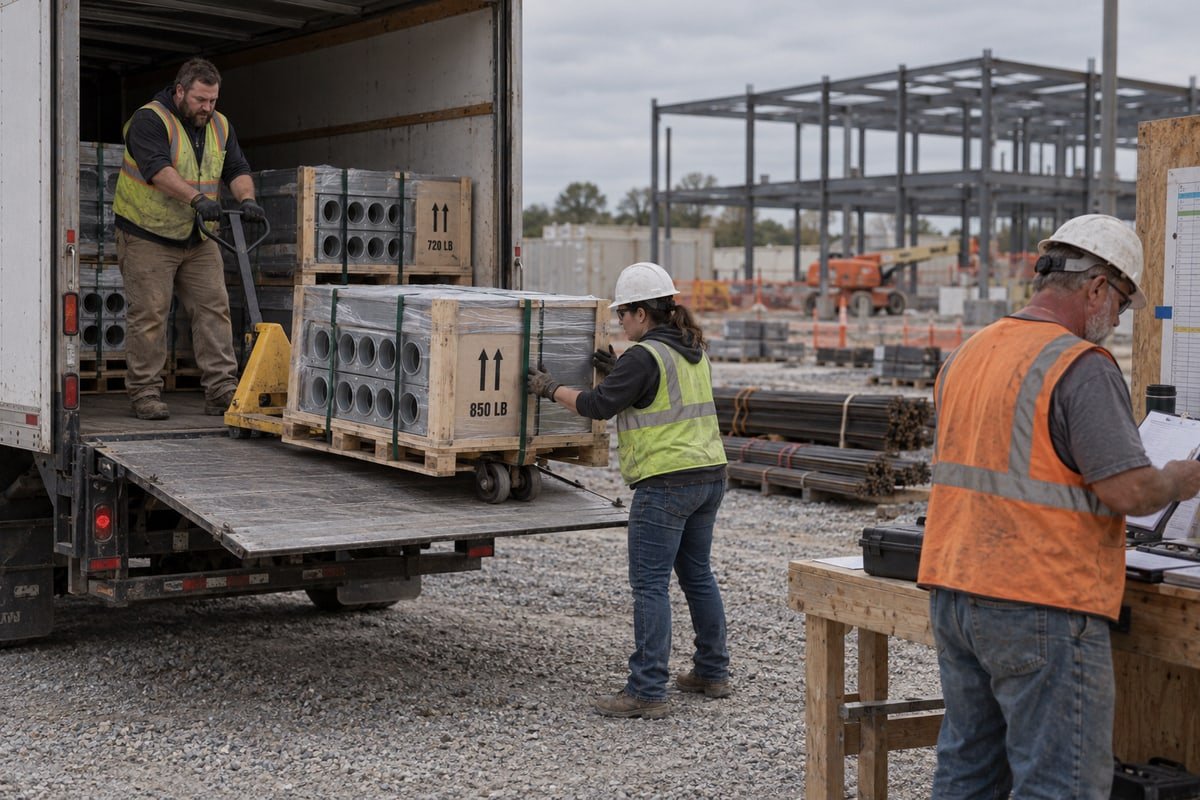
Mixing product lines is not the risk. Mixing them without a plan is the risk. A container packed by product family forces the site crew to open every crate and sort by opening. A container packed by penetration location lets them pull one crate per wall and install straight from it.
Pack by opening, not by product line
The just-in-sequence idea from automotive logistics applies well here. Frames and stay plates are foundational. They install first. TSC square modules and TSR round assemblies install after cable pulling. So a mixed load should be layered in reverse installation order. Frames sit at the door end for early unloading. Modules sit deeper. When we build a load like this, we mark each crate with the frame ID, the phase code, and the module count for that opening.
Our load-plan checklist
- Confirm the penetration schedule from the customer's drawings or STEP files.
- Group modules, stay plates, and compression units per frame.
- Measure CBM and gross weight per crate before sealing.
- Place galvanized steel frames low and central for weight distribution.
- Reinforce crates holding compression units, because the bolts and plates are dense.
- Photograph each crate open and closed for the packing file.
| Component | Typical Packaging | Load-Plan Note |
|---|---|---|
| Cable transit frames | Bolted timber crate | Heaviest item; floor level, spread across the container |
| TSC square modules | Cartons on pallets | Stack by frame ID; label module size and count |
| TSR round assemblies | Individual boxes on pallets | Keep with matching sleeve or opening reference |
| Compression units and stay plates | Reinforced crate | Dense hardware; brace to stop shifting |
| Spare sealing modules | Separate carton set | Mark as spares so site does not install them by mistake |
Why fewer sizes make mixed loads easier
Our modules use step-core, halogen-free EPDM. One module size covers a range of cable diameters. That cuts the number of SKUs in a load and cuts the chance of the wrong size arriving at the wrong opening. Because our modules are dimensionally compatible with common 120-frame standards, a site that already has frames from another supplier can receive our modules as a drop-in second source without changing the load logic. The EPDM itself is stable in transit, so a sealed container gives all the environmental protection the modules need.
How do I coordinate customs documentation and delivery windows when phasing MCT deliveries across multiple construction stages?
The hardest lesson from exporting to the Middle East was simple: a perfect packing list is useless if the phase codes on it don't match the commercial invoice.
Coordinate phased MCT deliveries by issuing one master packing list with a phase code per shipment, matching each commercial invoice and certificate of origin to that code, confirming partial-shipment terms in the purchase order, and fixing delivery windows backward from each stage's first installation date.
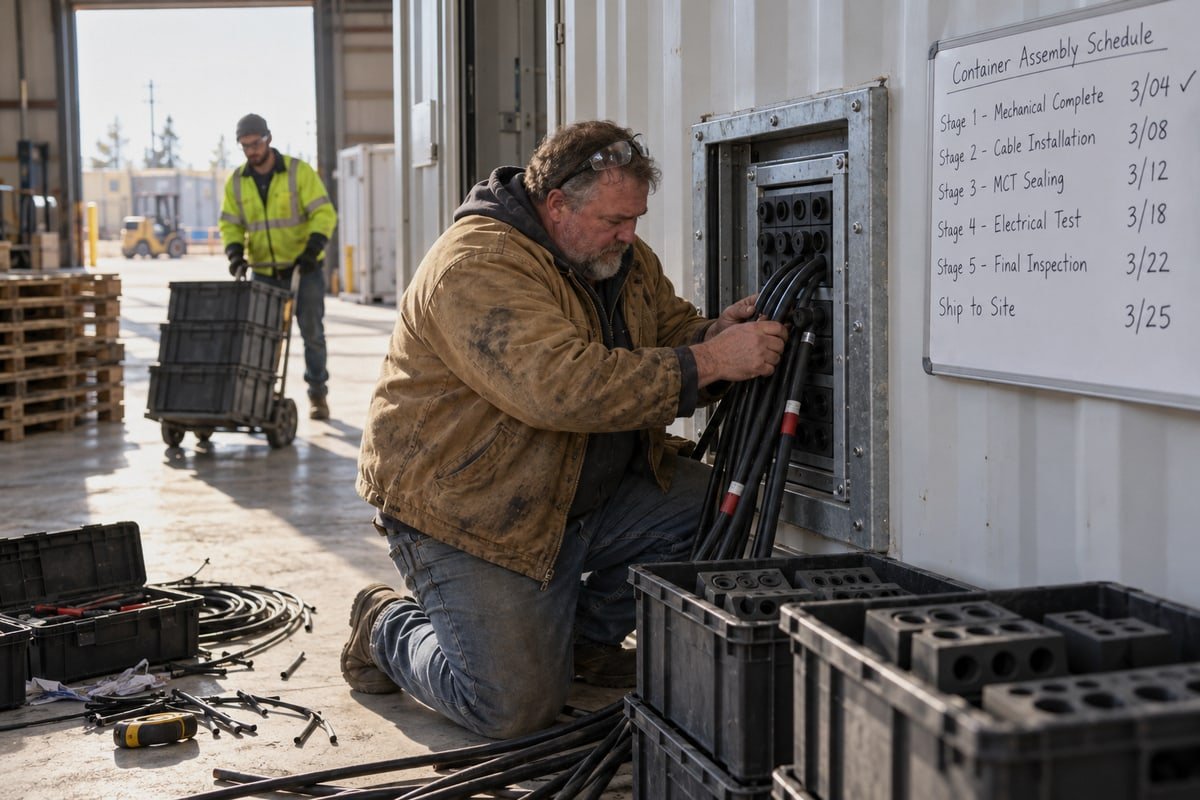
Phased delivery multiplies paperwork. Each batch clears customs on its own. Supply chain reliability then depends on documents that agree with each other, batch after batch. Here is how we structure it.
Backward planning from the first installation date
I start with the date the first frame must be in the wall. I subtract inland transit, customs clearance, ocean transit, port handling, and staging. That gives the factory dispatch date for phase one. I repeat for each stage. The result is a shared production calendar that the buyer, our three plants, and the freight forwarder all see. Release triggers then sit on that calendar. A trigger can be a floor range, a block of BESS containers, or a milestone handover signed by the site manager. When the trigger fires, that phase ships. Nothing ships early to sit in a yard.
One document set per phase
| Document | Issued Once or Per Phase | What Must Match |
|---|---|---|
| Master packing list 5 | Once, updated per phase | Phase codes, crate IDs, CBM and weight |
| Commercial invoice | Per phase | Line items and values tied to that phase code |
| Certificate of origin | Per phase | Product descriptions identical to invoice |
| Bill of lading | Per phase | Consignee, notify party, container or LCL reference |
| Test and certification documents | Once, with phase one | ISO 9001, IATF 16949, BV approval, A-0/A-60 fire, IP68, 0.01–0.4 MPa sealing tests |
| Partial-shipment authorization | Once, in the purchase order | Number of phases and allowed windows |
Our export desk handles this document set for every shipment. I still recommend the buyer's procurement cycle include one review of the master packing list before phase one leaves. That single check prevents most customs holds later.
Delivery windows and dense sites
Delivery windows should be narrow but realistic. I aim for a window that gives the site two working days of slack. For urban data center builds with strict vehicle size limits, we have used smaller container formats that keep the load sealed while staying road legal. That gives the security of a full container with the maneuverability of a batch. Keeping arrivals to the port staging warehouse within the 5–7 day window applies here too, because storage fees at the staging point follow the same rules whether the load is large or small.
Conclusion
Idle crews cost more than freight. Consolidate when scope is stable; batch when the critical path is fragile. Either way, plan 8–12 weeks ahead and we ship to your sequence.
Footnotes
1. Provides a comprehensive overview of container consolidation and the differences between FCL and LCL shipping methods. ↩︎
2. United Nations body providing authoritative analysis on maritime transport and global freight cost optimization strategies. ↩︎
3. Authoritative source for global logistics and freight cost data used in industrial business decision-making. ↩︎
4. Official U.S. government resource detailing essential export documentation requirements for international trade compliance. ↩︎
5. Global intergovernmental organization that defines international standards for customs documentation and trade facilitation. ↩︎



 English
  Español de México
  Deutsch
  Français
  العربية
  Русский