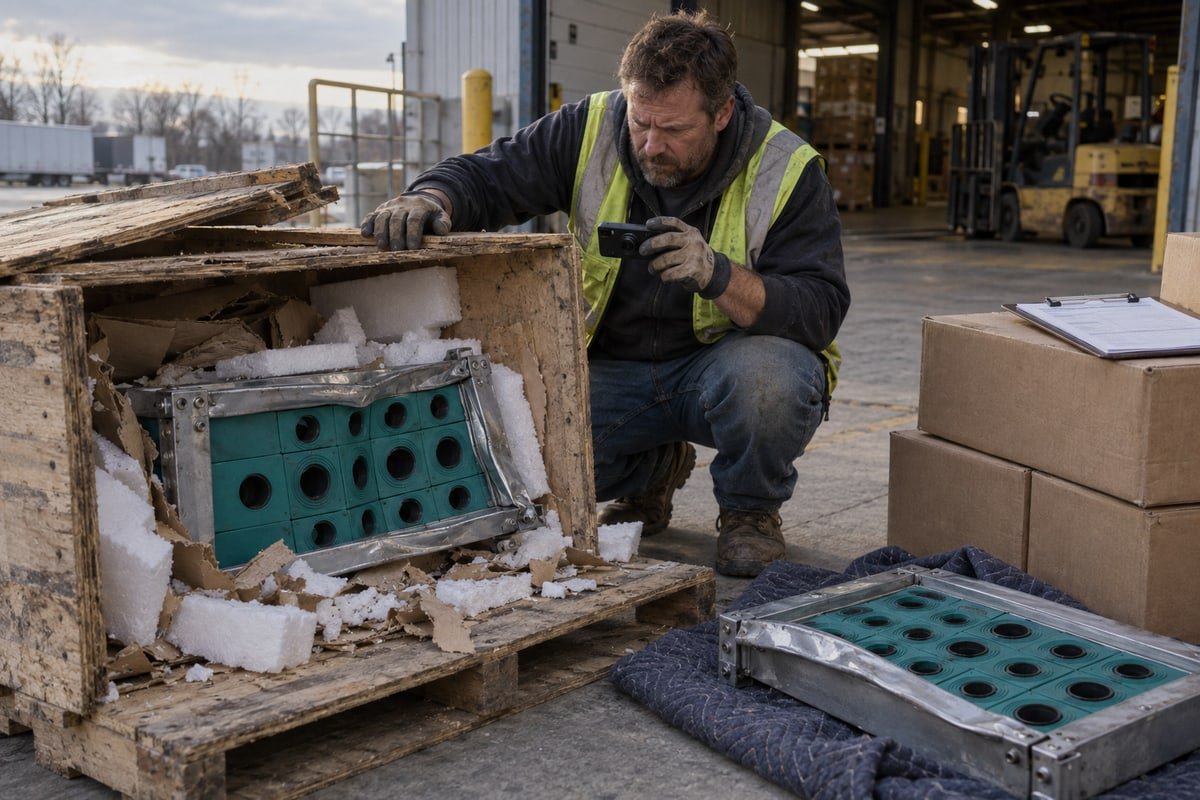
A crate of Multi Cable Transit modules 1 lands on your dock, two frames are warped, and nobody knows who pays. Our factory in Shaanxi takes this call often.
To file a quality claim for Multi Cable Transit, inspect on delivery, note damage on the delivery receipt, quarantine defective modules, then send the supplier a written non-conformance report with order number, photos, batch numbers, and a retained sample. Wait for verification and an RMA before returning anything.
That is the short version. The long version is where claims are won or lost. Below, I walk through the paperwork, the deadlines, the test evidence, and what happens on our side once a claim is approved.
What documentation do I need to submit when filing a quality claim for a defective MCT module?
Last year our QC team reopened a claim file that had only one blurry photo and no batch number. We could not verify anything. That claim stalled for weeks.
Submit the purchase order or invoice, the signed delivery receipt with damage notations, dated photos of packaging and modules, batch and nameplate numbers, a written non-conformance report describing the defect and quantity, all carrier correspondence, and a short physical sample kept for examination.
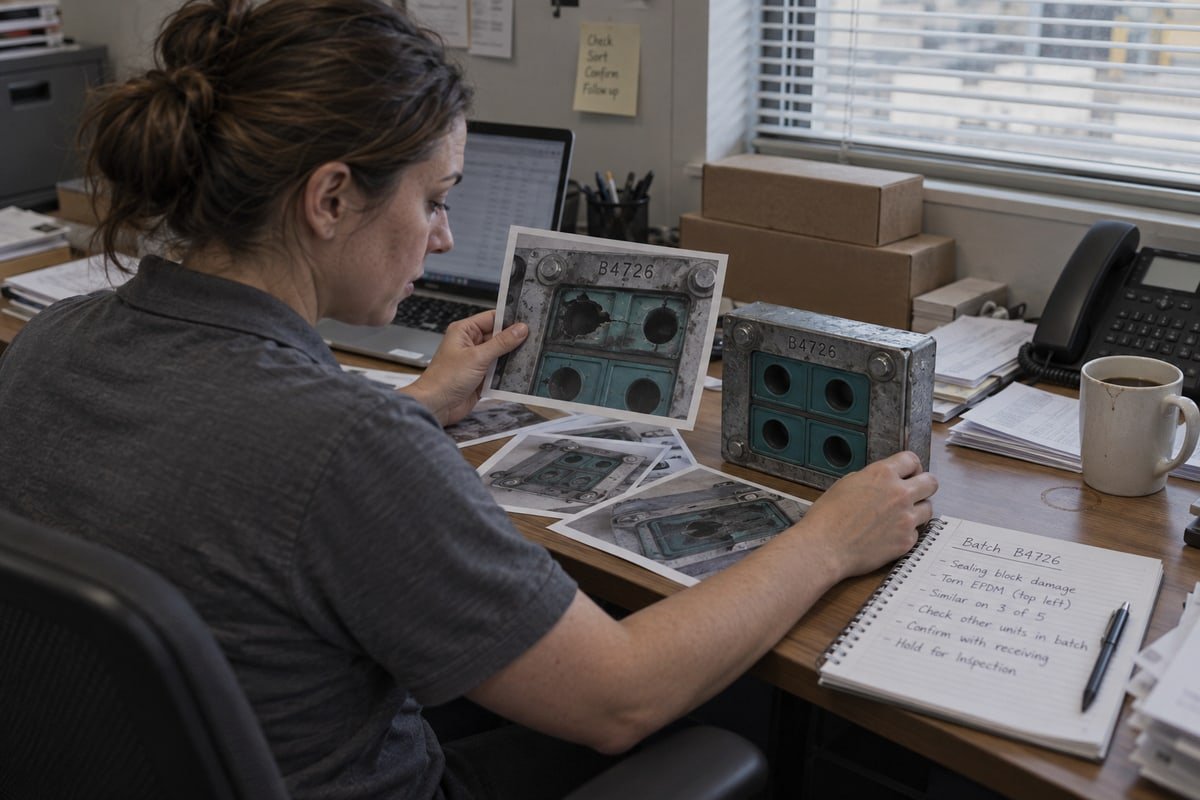
A claim is only as strong as its file. I say this to every new buyer who qualifies us as a second source. Our engineers can trace any TSR or TSC module back to a mold, a rubber batch, and an outgoing inspection sheet 2. But we can only do that if you give us the numbers stamped on the module and the nameplate. Without them, the claim becomes a guess.
Build the claim file in the order it happened
Start with the commercial record. Then add the delivery record. Then add the technical evidence. That order matches how a claims reviewer reads the file, and it makes fault allocation clear.
| Document | What it proves | Common mistake |
|---|---|---|
| Purchase order and invoice | The spec, quantity, and frame standard you ordered | Ordering by description only, with no model cross-reference |
| Signed delivery receipt with notations | Condition at handover from the carrier | Signing clean, then discovering crushed crates later |
| Dated photos or video | Outer crate, inner packing, each defective module | One wide shot, no close-ups of the defect |
| Batch, lot, and nameplate numbers | Links the delivery to our QC records | Photographing the box but not the module stamp |
| Non-conformance report | Defect type, quantity, and impact on watertight integrity | Vague wording like "modules look bad" |
| Carrier and supplier emails | Timeline of who was told what, and when | Relying on phone calls with no written follow-up |
| Retained physical sample | Allows examination for compression set or delamination | Installing or discarding the suspect part |
Describe the defect in technical terms
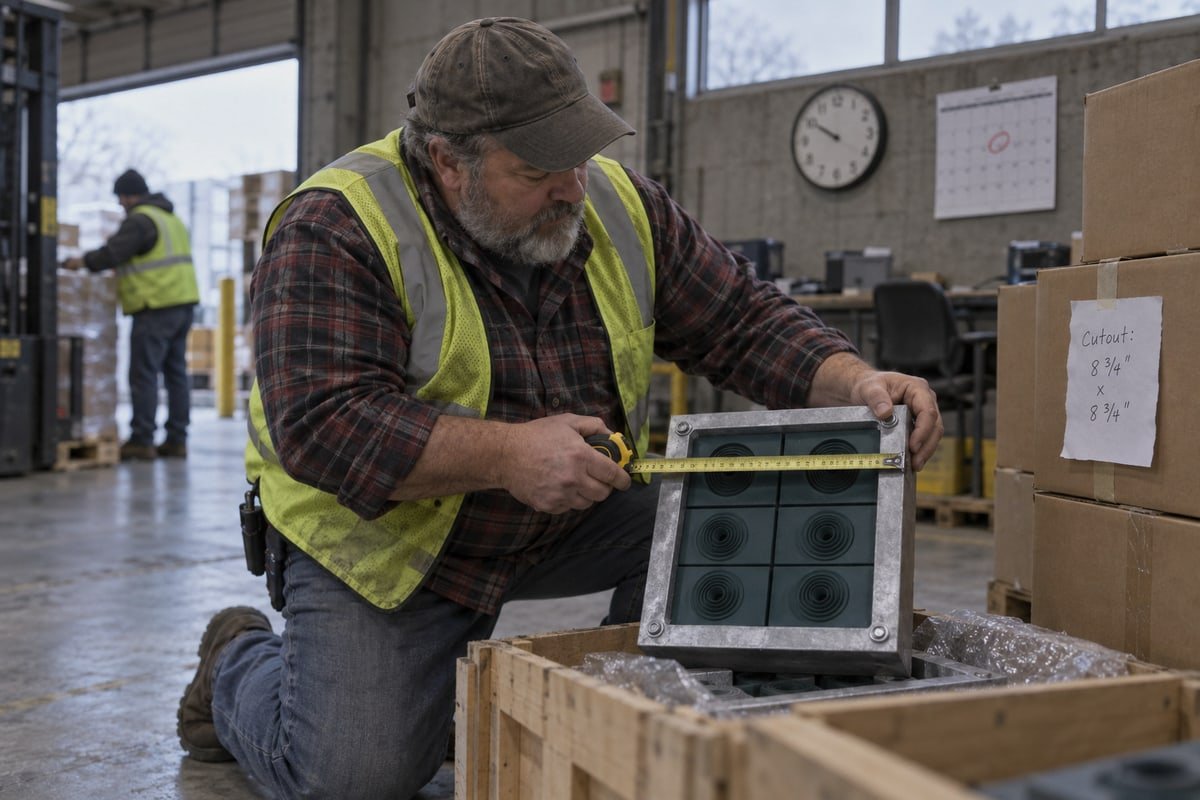
"Defective" is not a defect description. Tell us what you measured. A dimensional variance on a square module should come with the measured width against the 120-frame cutout. Packing block defects should be named: surface cracking, delamination between step-core layers, or a compression set that leaves the block permanently deformed. A compression wedge failure should note whether the bolts reached torque before the wedge slipped.
Keep the sample, quarantine the rest
Segregate every suspect module and frame. Tag them. Do not install any of them. The sample you keep is the single most persuasive piece of evidence, because it lets us, or an independent surveyor, test the actual rubber rather than argue over photos.
How long do I have to report dimensional or sealing performance issues after receiving my cable transit shipment?
We weigh two things when we set reporting windows: buyers need time to run incoming inspection, and we need evidence collected before storage conditions change the facts.
Report visible transit damage on the delivery receipt at once and notify the supplier within the contract window, typically 48 to 72 hours. Dimensional variance should be reported after incoming inspection. Sealing failures found during pressure testing fall under latent defect clauses, which extend the claim period.
There is no single deadline. There are three, and each one belongs to a different type of defect. This is the part of the topic that causes the most three-way disputes among buyer, seller, and carrier. So I will break it down.
Three windows, three defect types
| Defect type | When it is found | Reporting window | Who is usually responsible |
|---|---|---|---|
| Visible transit damage (crushed crates, bent frames) | At the dock, before signing | Note on the delivery receipt at handover; formal notice usually within 48 to 72 hours | Carrier, if noted; disputed if signed clean |
| Dimensional variance, wrong grade, missing certificates | During incoming inspection | Within the inspection period stated in the purchase contract | Manufacturer, if batch records confirm the error |
| Sealing failure under pressure or airtightness test | After installation, during commissioning | Latent defect clause; extends past the delivery window | Manufacturer, subject to sample verification |
Why the carrier window is unforgiving
Here is the buyer objection I hear most: "We accepted the shipment, then found damage two days later, and the carrier refused the claim." That refusal is common. A clean signature 3 is treated as acceptance in good condition. The fix is simple but strict. Open the outer crates before signing. If you cannot open them, write "subject to inspection" and list any crate damage on the receipt. Take photos with a timestamp. That one habit moves a transit damage dispute from your desk to the carrier's.
Why dimensional issues need an inspection period, not a rush
Transit frame inspection takes time. You need to check the cutout against the frame flange, measure the module stack height, and confirm the stay plate fits. In our experience exporting to Europe, purchasing contracts usually define an incoming inspection period. Use it fully. But report inside it. A dimensional claim raised after the modules are installed is much harder to separate from installation error.
Latent defects and the pressure test
Some sealing problems only appear when the modular sealing system is compressed and tested. A block with internal delamination may look perfect on the shelf. It fails at 0.4 MPa. If your contract includes a latent defect clause, invoke it in writing and include the test record. Our own modules are tested for watertight and gas-tight sealing 4 between 0.01 and 0.4 MPa, and those test documents are available on request. That gives you a factory baseline to compare against your site result.
What test reports or certifications should I request to verify whether a claimed defect is a manufacturing fault?
A sourcing engineer in Germany asked me why our A-60 certificate mattered if her modules had delaminated. Good question. The certificate proves the design; the batch records prove her delivery.
Request the batch Certificate of Conformity, the material test report for the EPDM compound, fire rating certification covering A-0/A-60 under the IMO FTP Code, IP68 and pressure test records, and the factory's outgoing QC inspection sheet. Compare each against your delivered batch numbers.

A manufacturing fault is a claim that the product left the factory already wrong. A handling fault is a claim that it became wrong later. Documents are how you tell the two apart. I split them into two groups: design-level documents and batch-level documents. Both matter, but they answer different questions.
Design-level documents
These prove the product family meets the standard. They do not prove your specific carton does.
- Fire rating certification for A-0 and A-60 bulkhead and deck penetrations, with IMO FTP Code compliance stated on the certificate.
- IP68 ingress protection test report for the assembled frame and module stack.
- Watertight and gas-tight test results across the 0.01 to 0.4 MPa range.
- Third-party approval of the factory, such as our BV approval, and the quality system certificates, ISO 9001 and IATF 16949.
Batch-level documents
These prove the units in your delivery match the certified design.
| Document | Question it answers | What to check against |
|---|---|---|
| Certificate of Conformity (CoC) | Was this batch released against the certified spec? | Batch numbers on your modules and nameplates |
| Material test report for the rubber compound | Was the halogen-free EPDM the correct grade? | Hardness, density, and halogen-free declaration on the PO |
| Outgoing QC inspection sheet | Were dimensions and visual checks passed before packing? | Your incoming inspection measurements |
| Mold and tooling record | Was the correct step-core mold used for this size? | Model cross-reference from the original part number |
How to use the documents in a dispute
Put the batch CoC next to your incoming inspection sheet. If the CoC says the module width was checked and passed, and you measured it out of tolerance, one of two things happened. Either the QC record is wrong, or the module changed shape after leaving the factory. That is where a Shore A hardness test on the retained sample helps. Improper transit storage, such as heat or chemical common export documents 5 exposure, can shift hardness even when the block looks intact. A hardness reading far from the material test report value points toward storage or handling. A reading that matches, combined with a dimensional error, points toward tooling or process.
Independent verification
For large industrial orders, ask a third-party inspector or a classification society surveyor to witness the test. Their report carries weight that neither side can easily dismiss. We welcome this. It usually shortens the dispute rather than lengthening it.
How does DewinMCT handle replacement or refund timelines once my quality claim is approved?
The hardest lesson from our early export years was simple: an approved claim without a written date is still an open dispute. So we changed how we close them.
Once DewinMCT approves a claim, it issues a written RMA with a confirmed resolution: replacement modules shipped from stock, a new production run with a committed date, or a credit note against the invoice. The approval letter states the timeline, freight terms, and export documents.

I will not quote a fixed number of days here, because the honest answer depends on what you ordered and what we have on the shelf. What I can describe is the sequence. Every step produces a document. That is the point.
The RMA procedure, step by step
- Acknowledgement. Your non-conformance report is logged with a claim number. You receive it in writing the same working day it is registered.
- Verification. Our QC team pulls the batch records: CoC, material test report, outgoing inspection sheet. If a retained sample is needed, we ask for it, and we cover the shipping method in the request.
- Decision letter. The claim is approved, partially approved, or declined. A declined claim always states the basis. You are entitled to that, and it is what you would escalate with.
- RMA issued. The RMA number, the return scope, and the resolution type are fixed in one document. Nothing ships back until this exists.
- Resolution. Standard spare sealing modules are usually held in stock, so replacements ship fast. Custom sizes from our in-house mold shop go into a scheduled run with a committed date. Credit notes are issued against the original invoice.
- Close-out. Export documentation for the replacement is handled on our side, including the commercial invoice, packing list, and any certificate copies you need for customs.
Replacement or refund: how we decide
This is where the buyer objection comes in. Many teams expect an immediate refund the moment a defect appears. I understand why. But a refund before verification means neither side learns what went wrong, and the root cause stays in the process. So we verify first, then resolve fast. For an OEM integrator building BESS containers or modular data centers, a replacement is usually the better outcome anyway. Your frame cutouts are already in the enclosure. A drop-in replacement keeps the build moving. A credit does not.
Carrier damage is handled separately
If verification shows the damage came from transit, the resolution changes. We still help: we provide the packing records and the as-shipped photos so you can support the carrier claim. But the financial claim goes to the transportation provider. This is why the notation on the delivery receipt matters so much. It is the difference between a supported carrier claim and an argument.
If you disagree with a decision
Ask for the written basis. Preserve everything. Escalate to our export manager, and if needed, bring in an independent surveyor. We would rather resolve it with evidence than lose a second-source partner over one batch.
Conclusion
A defective delivery costs you schedule and money. Undocumented claims cost more. Inspect early, report on time, demand batch evidence, and get every approval in writing.
Footnotes
1. Wikipedia provides a technical overview of multi-cable transit systems used in hazardous environments. ↩︎
2. ISO 9001:2015 specifies requirements for quality management systems and production inspection records. ↩︎
3. A bill of lading explains the legal implications of a clean signature in shipping. ↩︎
4. The IMO oversees international maritime safety standards, including fire and watertight integrity for vessels. ↩︎
5. Updated working URL from Trade.gov for official export documentation. ↩︎



 English
  Español de México
  Deutsch
  Français
  العربية
  Русский