
Matching multi cable transit ATEX/IECEx certification to offshore zones trips up buyers I talk to IECEx online database 1. A wrong certificate scope stalls a class survey. Our factory answers with documents, not claims.
Multi cable transit ATEX/IECEx certification must match the zone (1, 2, 21, 22), gas group (IIA–IIC), temperature class, and equipment protection level of each penetration. Read the certificate scope, confirm the frame, modules, and compression unit are certified as one system, and install per IEC 60079-14.
That sounds simple. In practice it needs four checks. I will walk through each one below, using the same logic we use when a buyer sends us a deck drawing.
How do I determine which ATEX/IECEx zone classification my offshore MCT system actually needs?
Last year a Middle East EPC buyer sent our engineers a deck layout with every penetration marked Ex. Half of them crossed safe-area bulkheads. That drawing started this section.
Determine the zone from the project's hazardous area classification drawing, not from the vessel type. Zone 1 needs EPL Gb, Zone 2 needs Gc, and dust areas use Zone 21/22. Then check whether the transit enters Ex equipment, crosses a hazardous/safe boundary, or only a general compartment wall.

Reading hazardous area zones and equipment protection levels
The hazardous area classification drawing is your starting point. A process engineer produces it under the IEC 60079 standards 2, specifically IEC 60079-10-1 for gas and 60079-10-2 for dust. The drawing tells you where an explosive atmosphere 3 can exist and how often. Equipment protection levels then follow from the zone. I keep this table on my desk.
| Zone | Explosive atmosphere | Required EPL | What this means for the transit |
|---|---|---|---|
| Zone 0 / Zone 20 | Present continuously or for long periods | Ga / Da | Rare for MCTs; usually outside standard Ex transit scope |
| Zone 1 / Zone 21 | Likely during normal operation | Gb / Db | Ex-certified transit required where it enters Ex equipment |
| Zone 2 / Zone 22 | Unlikely, short duration only | Gc / Dc | Ex-certified transit required at Ex equipment; lighter protection concepts allowed |
| Non-hazardous | Not expected | None | Standard gas tight cable seals with fire and water ratings |
Most Ex-rated transit ranges on the market, Roxtec's included, are approved for Zone 1 and 2 for gas and Zone 21 and 22 for dust. Zone 0 and Zone 20 demand stricter assumptions. If your drawing shows Zone 0, stop and talk to the project's Ex authority before you buy anything.
Gas group and temperature class
Two more values sit on the certificate. Gas group IIC covers hydrogen and acetylene. IIB covers ethylene. IIA covers methane and propane. The transit's group must be at least as strict as the most volatile gas present. Temperature class T6 means the surface stays at or below 85 °C. That figure must be lower than the auto-ignition temperature of the surrounding atmosphere. On FPSO topsides with mixed streams, buyers often specify IIC and T6 to close the argument early. Platforms moving toward hydrogen production should also ask about hydrogen permeation resistance of the sealing material, since IIC alone does not answer that question.
Three boundary cases
Here is the decision tree I use.
- The transit enters an Ex enclosure, such as a junction box, motor terminal box, or switchgear cabinet. An Ex-certified transit is mandatory. The certificate must cover the enclosure type and mounting arrangement, and the marking must follow IEC 60079-0.
- The transit crosses a bulkhead or deck between a hazardous and a safe area. The boundary must be gas tight. Some projects accept a certified gas-tight transit here. Others require Ex-rated units for consistency.
- The transit crosses a wall between two safe compartments. A standard fire-rated, watertight cable penetration seal system is enough.
Some engineers push back and say Ex everywhere is safer. I understand the instinct. But the certificate adds no compliance value on a safe-area boundary, and it can raise cost on dozens of penetrations. Specify by boundary, not by habit.
Can I verify a supplier's ATEX/IECEx certification documents before I commit to an order?
A lesson we learned early in exporting to Europe: a certificate number a buyer cannot look up is worth nothing. We now attach our test documents before quoting.
Yes. Ask for the full certificate PDF, then check the certificate number on the IECEx online database or with the ATEX notified body listed on it. Confirm the holder name, product model, Ex marking, zones, gas group, temperature class, special conditions, and expiry date match your quotation.

Buyers sometimes treat ATEX and IECEx as the same thing. They are not. The table below shows why a project may ask for one, the other, or both.
| Item | ATEX | IECEx |
|---|---|---|
| Legal basis | EU Directive 2014/34/EU | International scheme built on IEC 60079 standards |
| Who issues it | EU notified body (EU-type examination certificate) | IECEx Certification Body (Certificate of Conformity) |
| Where it is required | Legally required in the EU/EEA | Common in global client specs, Australia, and many Asia-Pacific and Middle East projects |
| Public lookup | Through the notified body named on the certificate | IECEx online certificate database |
| Typical marking | CE, Ex hexagon, category such as II 2 G | Ex marking per IEC 60079-0 |
IECEx states clearly that applications for Certificates of Conformity go through IECEx Certification Bodies. A supplier cannot self-declare it. That makes it the easiest document to verify.
Line-by-line checks before you sign
Open the certificate PDF and go through it slowly. I do it in this order.
- Certificate holder. Does it match the company on your quotation, or is it a distributor?
- Product designation. Does the model code on the certificate match the frame, module, and compression unit you are buying?
- Ex marking. Read the gas group, temperature class, and EPL. Compare with the zone table from the previous section.
- Special conditions of use. This section often limits mounting orientation, cable fill, or enclosure type. Many buyers skip it. Do not.
- Issue and expiry dates, plus any supplements. An expired or superseded certificate is a stalled survey.
Red flags I see in supplier files
A brochure that says "Ex approved" with no number. A certificate that names a single component, not the complete system. A scan with the holder name cropped. Each of these deserves a direct question. Also ask whether the manufacturer's quality system is audited. Our own ISO 9001 4 and IATF 16949 certificates and BV factory approval are documents a buyer can check with the issuing body. We ask buyers to apply that same test to every supplier, including us. If your specification calls for an Ex-certified transit, verifying multi cable transit ATEX/IECEx certification this way takes an hour and avoids months of rework.
What certification and test evidence should I request to confirm fire, IP68, and gas-tight ratings for hazardous zones?
On our test line, every gas-tight batch check runs at pressure with the compression unit torqued to spec. If a module weeps, the batch stops. That habit shapes our evidence.
Request the fire test report showing A-0 or A-60 on a fire rated bulkhead, an IP68 ingress protection test report with depth and duration, a gas-tight pressure test report stating the tested pressure range, plus the Ex certificate, marine class approval, and installation manual for the frame and module combination.
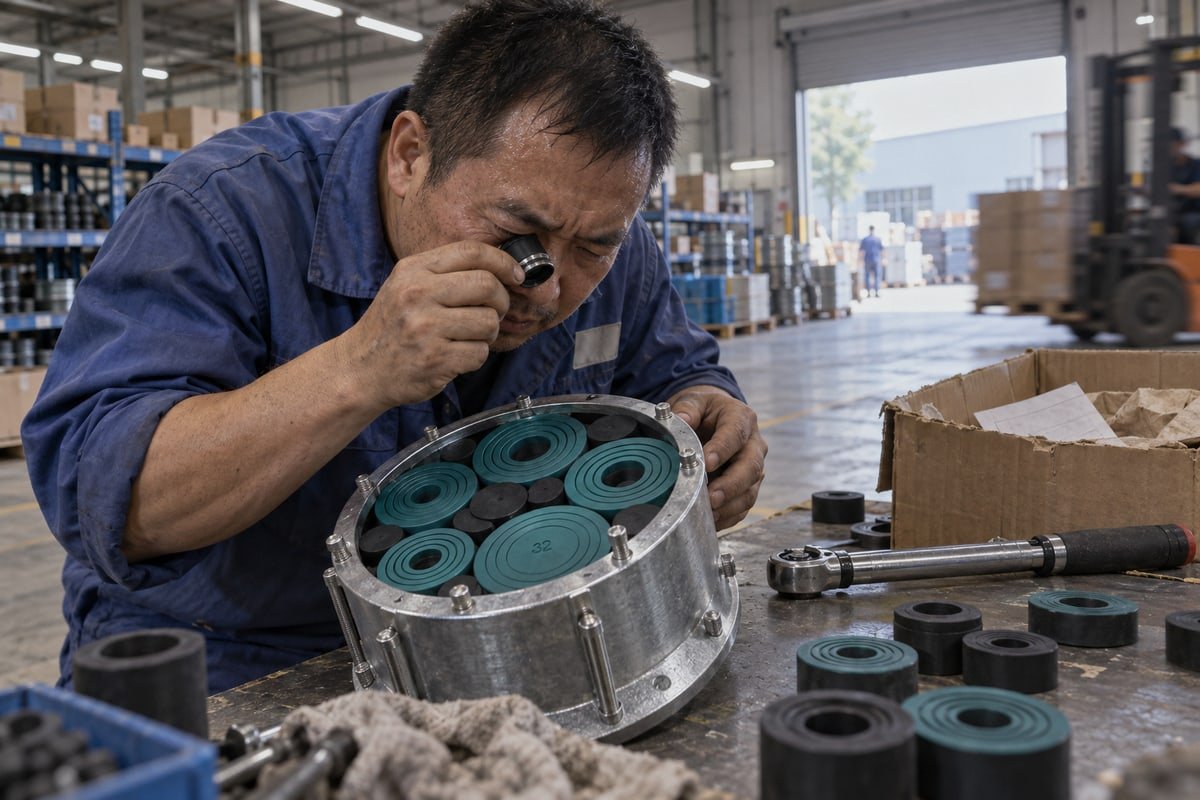
Explosion protection is only one part of the picture offshore. The same transit must hold back fire, seawater, and pressure at the same time. Here is what I ask each report to show, and where reports usually fall short.
| Rating | Evidence to request | What must appear in it | Common gap |
|---|---|---|---|
| Fire A-0 / A-60 | Fire test report and class approval | Bulkhead type, test standard, frame size, cable fill | Report covers a different frame size |
| Ingress protection rating IP68 | Ingress test report | Water depth, duration, module configuration | "IP68" stated with no parameters |
| Gas tight cable seals | Pressure test report | Test pressure, hold time, leakage criterion | Marketing claim with no number |
| Ex | ATEX/IECEx certificate | Zones, gas group, T-class, EPL, special conditions | Component certificate only, not the system |
| Blast resistance rating | Blast or overpressure test | Peak pressure and duration | Assumed from the gas-tight figure |
Numbers matter here. Our sealing assemblies are tested for watertight and gas-tight performance across 0.01 to 0.4 MPa. Roxtec quotes certified gas tightness up to a catastrophic pressure of 2.5 bar for some MCTs. Neither figure is useful unless the report ties it to the frame and fill you will install. Ask for that link every time.
One system, one certificate
The frame, modules, stay plates, and compression unit must be certified together as a single cable penetration seal system. Mixing a frame from one manufacturer with modules from another voids the certificate. This is the rule that surprises buyers most. It also drives the second-sourcing logic in the next section.
Aging, thermal stress, and cold flow
Cable insulation creeps over time. Engineers call this cold flow. As cables age, a fixed compression unit can lose contact and open a gas leak path. Some designs use active compression that follows the cable as it settles. Thermal expansion during a fire adds a second stress. A transit that holds A-60 alone, and Ex gas tightness alone, may not hold both at once. Ask whether the fire and gas-tight tests were run on the same configuration.
Class approval and the transit register
For marine installations, class societies matter as much as Ex bodies. DNV type approval, BV approval, and similar documents show the design was reviewed for the marine environment. Our factory is BV-approved, and we send the test documents behind our fire, IP68, and gas-tight ratings on request. Finally, IACS UR Z23 5 requires a Cable Transit Seal Systems Register on board. Every penetration must be recorded, with its certification and fill status, for class surveys. Build that register from day one. It becomes the backbone of FPSO electrical safety audits later.
How do I cross-reference my existing certified MCT model to a drop-in ATEX/IECEx-compliant second source?
There is a trade-off I weigh on every cross-reference request: dimensional fit is easy to prove with a sample, while certificate equivalence takes paperwork. We refuse to blur the two.
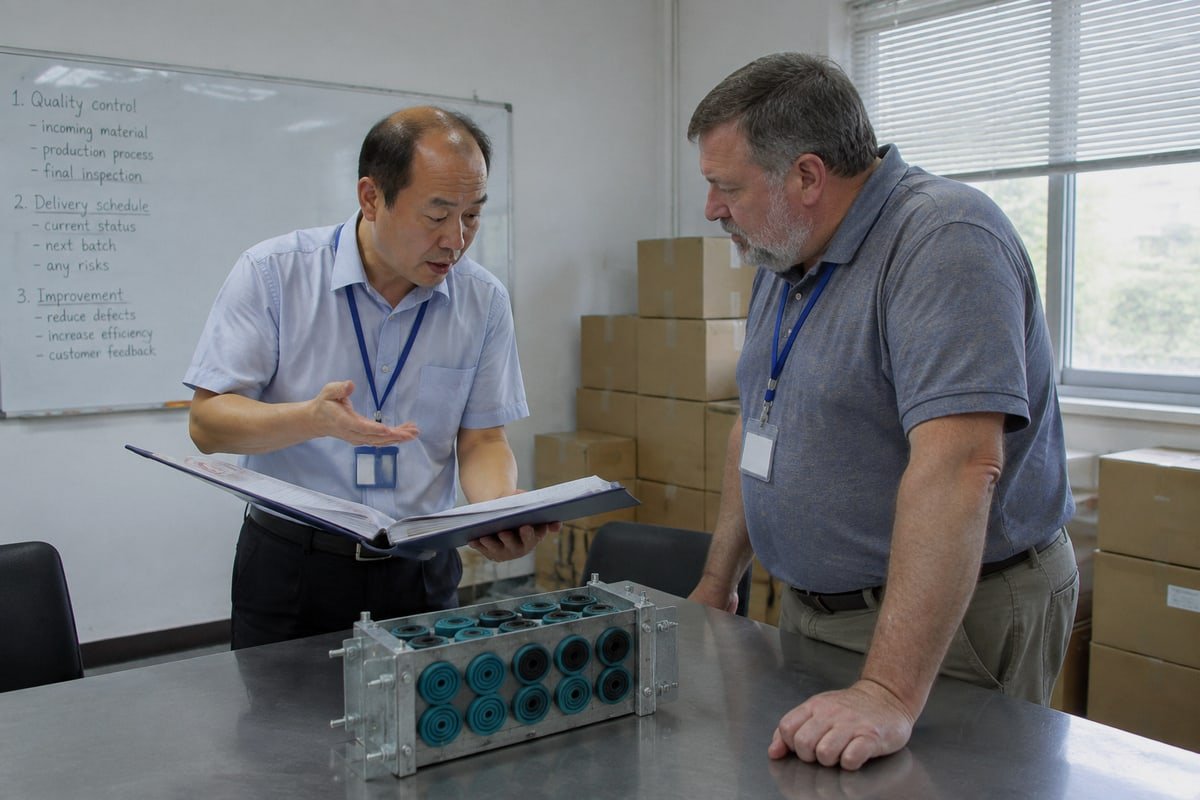
Cross-reference in two layers. First, match frame cutout, module size, cable diameter range, and compression unit to a 120-frame compatible equivalent using a model cross-reference table and a validation sample. Second, compare the second source's Ex certificate scope, zone, gas group, and temperature class line by line against the original.
Layer one: dimensional fit
Our TSR round assemblies and TSC square modules are dimensionally compatible with common 120-frame standards. They drop into existing frame cutouts. We publish a cross-reference table that maps existing model codes to DEWIN model codes, and we send free validation samples so your engineer can check fit before any purchase order.
| Existing component | DEWIN equivalent | Verified by sample | Verified by document |
|---|---|---|---|
| Square sealing module | TSC series, step-core halogen-free EPDM | Module size, cable diameter range | Fire, IP68, gas-tight test reports |
| Round sealing assembly | TSR series | Bore, thread, cable range | Pressure test report |
| Cable transit frame | 120-frame compatible frame | Cutout, bolt or weld pattern via CAD/STEP file | Class approval |
| Compression unit and stay plates | DEWIN compression unit and stay plates | Fit inside frame, torque | Torque and pressure records |
The step-core design lets one module size cover a range of cable diameters. That reduces spare part lines, which matters when you are populating a transit register across an entire platform.
Layer two: certificate equivalence
This is where I am blunt with buyers. A drop-in fit does not transfer the original manufacturer's Ex certificate. On an Ex penetration, the full frame, modules, and compression unit must come from one certificate holder, and that holder's own certificate must cover your zone, gas group, and temperature class. So the practical approach is:
- Split your penetration list into Ex and non-Ex boundaries using the zone logic from the first section.
- For non-Ex boundaries, qualify the second source on fire, ingress protection rating, and gas-tight test reports. This is where the 40–60% cost saving lands first.
- For Ex boundaries, evaluate the second source's complete system and its own Ex documentation, verified as described earlier.
- Update the IACS UR Z23 register after every swap. RFID-enabled modules can automate this and feed a digital twin, but a spreadsheet works if it is kept current.
The objection I hear most is that a lower-cost source must be cutting corners on certification. I answer with documents. Our factory has been building these systems since 2013, holds ISO 9001 and IATF 16949 systems and BV factory approval, and makes its own molds in-house for custom sizes. Cost falls because we are factory-direct, not because a test was skipped. Multi cable transit ATEX/IECEx certification is checked the same way for any supplier. The right second source is the one that passes that check and still fits your cutout.
Conclusion
Zone mismatch stalls surveys and wastes budget. The fix: read the certificate scope, verify it, demand test reports, and cross-reference in two layers. Our documents are ready when you are.
Footnotes
1. Official international database for verifying IECEx certificates of conformity for explosive atmosphere equipment. ↩︎
2. Official homepage of the commission that develops the international 60079 series standards for explosive atmospheres. ↩︎
3. Official European Commission page for the ATEX directive governing equipment used in explosive atmospheres. ↩︎
4. Official ISO page for the 9001 quality management system standard for manufacturing and service providers. ↩︎
5. Official site for the International Association of Classification Societies regarding marine safety and transit registers. ↩︎



 English
  Español de México
  Deutsch
  Français
  العربية
  Русский