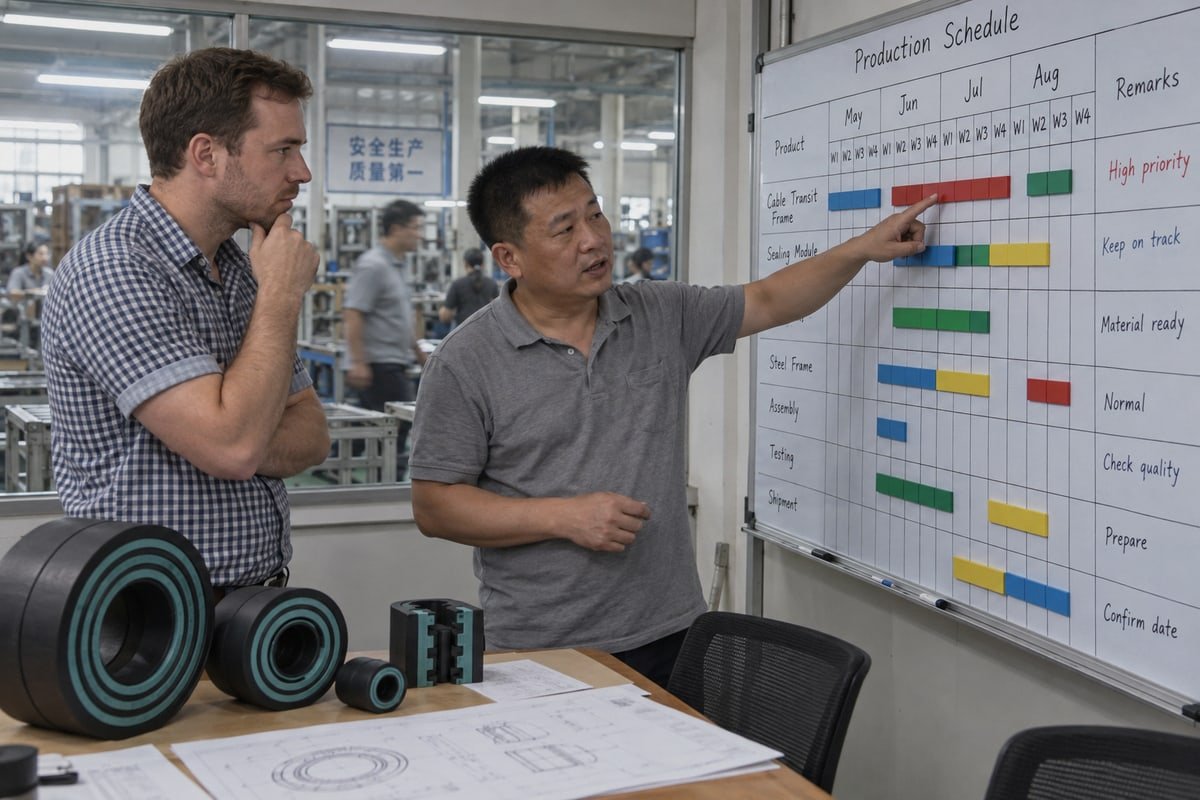
Late cable penetration seals can idle a whole BESS container line. Securing production capacity for multi cable transit systems 1 early is the fix, and our Shaanxi factory sees why weekly.
To secure production capacity for multi cable transit systems, freeze specifications early, share a 12–18 month pipeline, verify test slots and certification status, sign a 3–5 year framework agreement with slot reservations, and qualify a drop-in second source before the project reaches its critical path.
That answer is short. The details are not. Below I walk through the four questions our purchasing contacts in Europe ask most, and I show what evidence to demand at each step.
How can I verify a supplier's production capacity before placing a bulk order?
Last quarter our Shandong line ran two shifts on TSC modules while our IP68 test bench backed up for a day. Molding was never the bottleneck. Testing was.
Verify production capacity by requesting a written, dated production plan for your order, an audit of molding, testing, and certification throughput, proof of multi-plant or surge capability, raw-material stock levels for EPDM and steel, and references from recent bulk deliveries of similar size.

Capacity is more than units per month
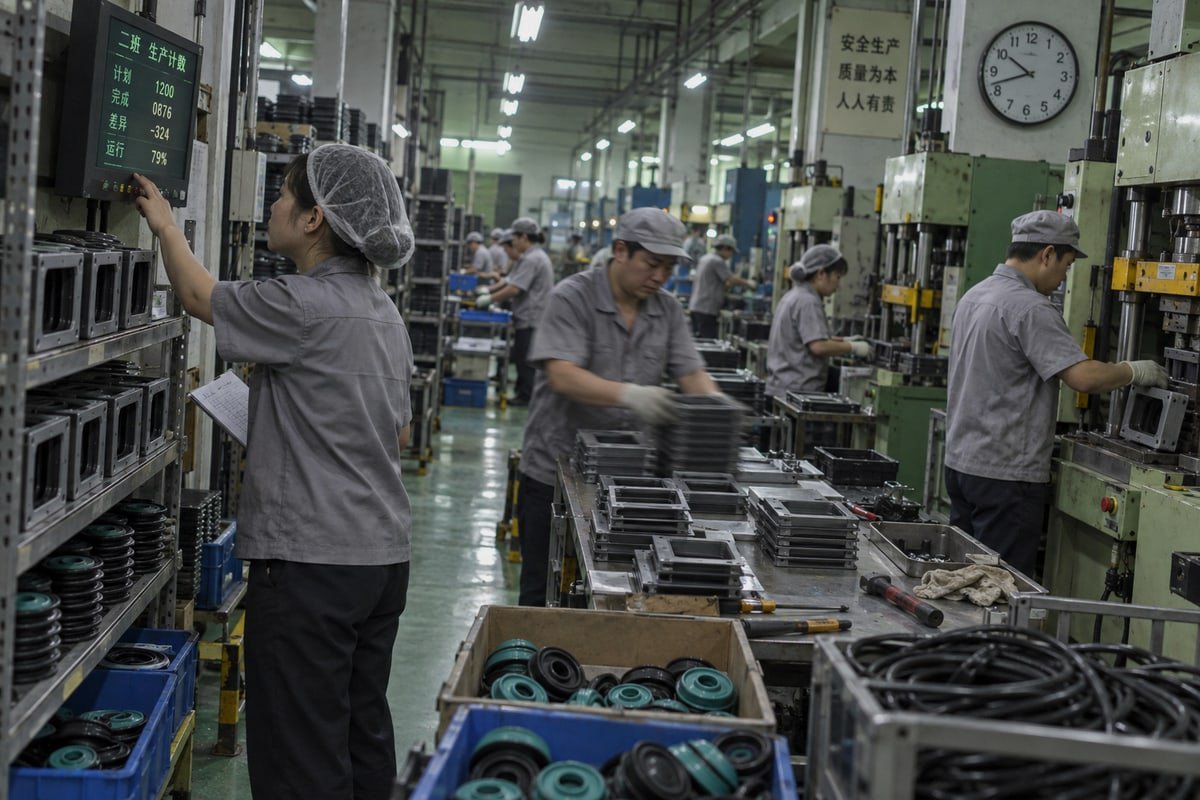
Most buyers ask one question: how many frames can you make per month? That number is easy to inflate. It also misses the real constraints. For modular sealing systems, capacity includes five things. Molding output. Test bench slots for fire, IP68, and pressure checks. Engineering hours for custom sizes. Certification throughput. And raw-material availability, especially halogen-free EPDM compound and galvanized steel for frames.
The market context makes this urgent. Sector estimates put multi cable transit systems at about USD 1.8 billion in 2025, growing to roughly USD 3.2 billion by 2034. Offshore energy, shipbuilding, BESS, and data center builds all draw from the same supplier pool. A supplier with a large nominal factory can still be stuck if type approvals are pending or if elastomer supply tightens.
| Capacity dimension | What to ask for | Red flag |
|---|---|---|
| Molding output | Shift pattern, number of presses, output per shift | Only a total monthly figure, no breakdown |
| Test bench slots | Weekly capacity for fire-rated transits, IP68, and 0.01–0.4 MPa pressure tests | Testing outsourced with no booked dates |
| Engineering bandwidth | In-house mold making, CAD/STEP turnaround | Custom sizes quoted with open-ended timing |
| Certification status | BV factory approval, ISO 9001, IATF 16949 certificates with dates | Marine and offshore certifications "in progress" |
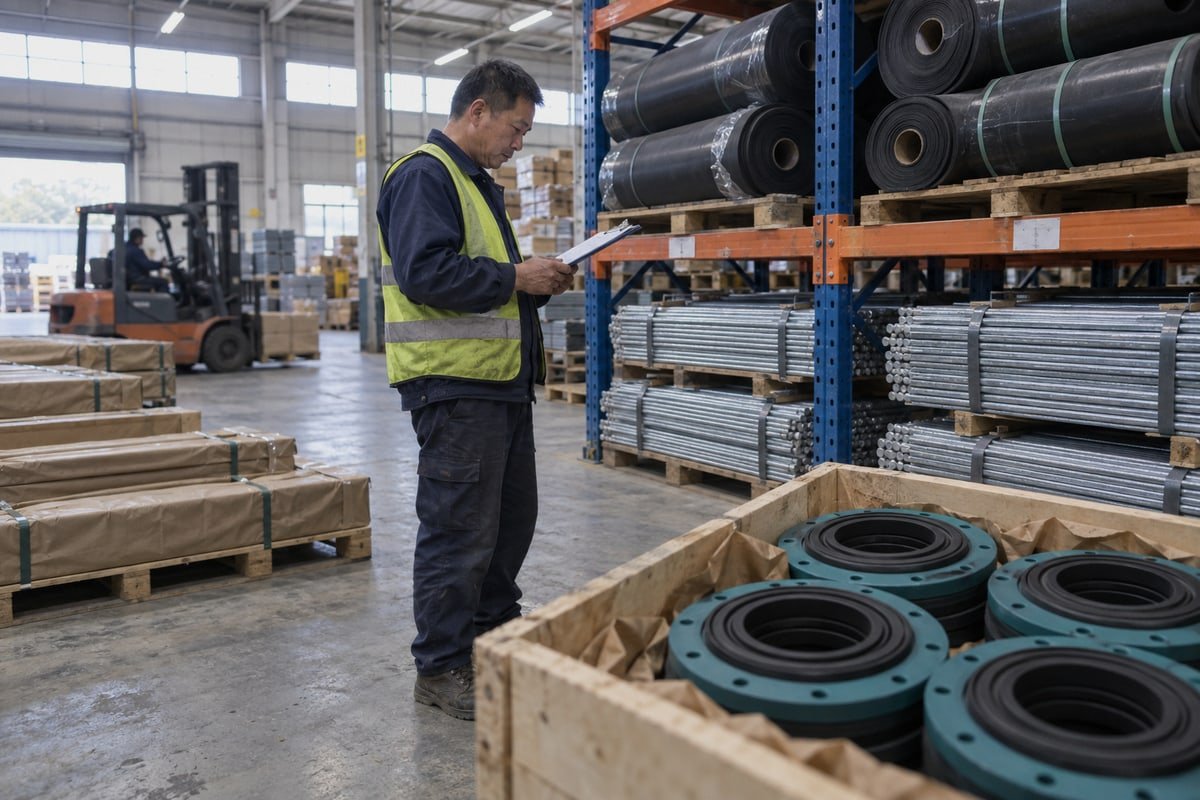
| Raw materials | EPDM and steel stock on hand, weeks of cover | Single elastomer source with no buffer |
| Multi-plant support | Which plant backs up which product line | One site, one line, no alternate |
Questions I would ask in an audit
I run three plants: Shaanxi, Shandong, and Hunan. When a European sourcing manager audits us, I expect them to ask which plant would absorb a surge on TSR round assemblies if Shaanxi is full. I expect them to ask how many of our 38+ patents cover the step-core module, because that tells them our design is not borrowed. And I expect them to ask for last month's test log for bulkhead sealing modules, not a brochure.
Market concentration is moderate. One analysis puts CR3 near 45.5% and CR5 near 58.2%. That means large players hold scale, but specialists still supply a large share. The lesson for you: do not assume brand size equals free capacity. Verify it the same way for every bidder.
What lead time guarantees should I expect from an MCT manufacturer during peak demand?
A sourcing manager at a European BESS integrator once asked me for one fixed lead time in writing. I told him a number alone means nothing without a dated plan.
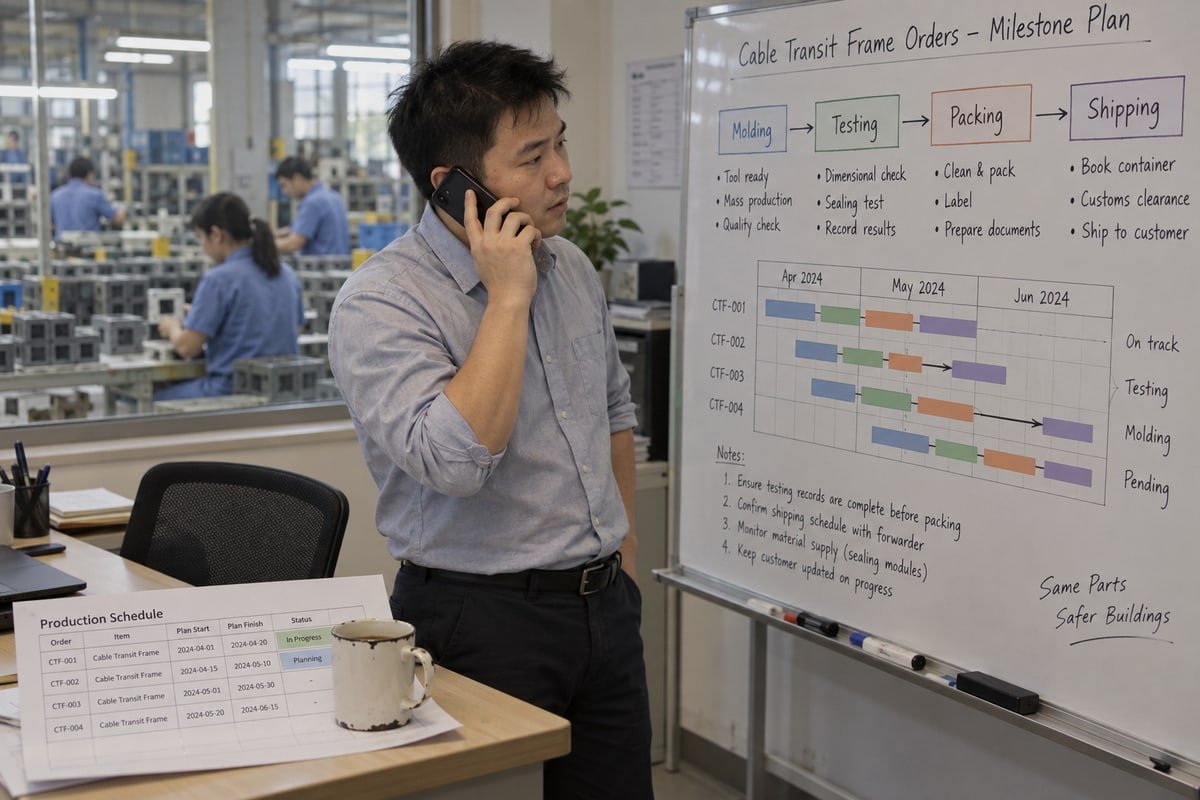
Expect a manufacturer to commit to a dated production plan with milestones, not a generic lead time; a documented surge option such as a second plant or extra shift; delivery remedies tied to those milestones; and early notice of raw-material or test-slot constraints during peak demand.
Why peak demand hits MCT lead times harder
Recent forecasts for this sector range from about 5.2% to 7.8% annual growth, and one report projects 9.12% CAGR for 2026–2033. Growth like that does not arrive evenly. It comes in waves tied to offshore wind rounds 2, shipyard cycles, and BESS deployment targets. When a wave hits, every supplier's production scheduling tightens at once.
Certification is the hidden lead-time killer. Many projects now treat approval timing 3 as a gating item. If a supplier ships frames before the fire-rated test report is in your hands, your EPC or shipyard cannot install them. So a manufacturing lead time quote that ignores documentation is not a real quote.
What a real guarantee looks like
I use a simple five-part structure with our framework customers.
- Dated plan. Mold start, compression unit assembly, test week, packing, and ship date for each batch.
- Milestone visibility. A shared tracker, updated weekly, that you can check without emailing us.
- Surge clause. Which plant or extra shift covers an overrun, and the trigger for using it.
- Remedies and incentives. Delay remedies tied to the milestones above, plus early-delivery incentives where your site can accept them.
- Change control. Your engineering freeze date aligned with our release date. A late drawing change can erase a reserved slot.
| Clause | Weak version | Strong version |
|---|---|---|
| Lead time | "8–10 weeks, subject to load" | Dated batch plan with named test week |
| Surge | "We will do our best" | Named alternate plant and shift trigger |
| Documentation | "Certificates on delivery" | Test reports issued before packing, sent for review |
| Materials | Not mentioned | EPDM and steel reserved for the order at award |
| Changes | Not mentioned | Freeze date; changes after it reset the slot |
The lowest-bid objection
Some buyers still pick the lowest unit price and accept a vague lead time. I understand the pressure. But a stalled container line costs far more than the saving on cable penetration seals. Best-value selection weighs the documented plan, the surge option, and the test readiness alongside price. When I quote 40–60% below incumbent brands, I attach the dated plan anyway. Price without predictability is not a saving.
How do I qualify a second source to avoid production bottlenecks with a single supplier?
The hardest lesson I learned building our cross-reference tables was simple. Buyers do not fear a second source. They fear the paperwork and re-testing that come with it.
Qualify a second source by confirming dimensional compatibility with your existing 120-frame cutouts, testing free validation samples on site, reviewing fire, IP68, and pressure test documents, auditing ISO 9001 or IATF 16949 systems, and running a small pilot order before a 70/30 split.
The objection: multi-sourcing adds complexity
Here is the pushback I hear most. Two suppliers mean two sets of drawings, two certificate files, and a risk of batch-to-batch variation. That is true if the second source is not a true drop-in. It is much less true when the second supplier matches the frame standard you already cut.
Our TSC square modules and TSR round assemblies are dimensionally compatible with common 120-frame standards. They fit existing cutouts without rework. Our step-core, halogen-free EPDM covers a range of cable diameters within one module size, so your BOM does not grow. The cross-reference table maps each incumbent model number to a DEWIN model number. That collapses most of the paperwork burden into one lookup.
A five-step vendor qualification path
| Step | What you check | Evidence to request |
|---|---|---|
| 1. Dimensional fit | Module and frame dimensions against your cutouts | Cross-reference table, CAD/STEP files |
| 2. Physical validation | Fit, compression, and seal behavior on your cables | Free validation samples, install feedback loop |
| 3. Performance documents | A-0/A-60 fire rating, IP68, 0.01–0.4 MPa watertight and gas-tight tests | Test reports, BV factory approval |
| 4. System audit | Quality management, traceability, ESG documentation | ISO 9001 and IATF 16949 certificates, batch records |
| 5. Pilot order | Small production batch through your normal receiving | Batch test log, packing list, export documents |
Moving to a 70/30 model
Once the pilot passes, most of our OEM customers move to a hybrid split. The incumbent keeps about 70% of volume. The qualified second source takes about 30%. That share is large enough to keep our slots warm and our documentation current. It is small enough to limit disruption. When the incumbent's backlog spikes, the split can flex without a new qualification round.
Standardize your specifications early to make this work. If your control panel 4 or BESS design uses a fixed set of frame sizes and module heights, both suppliers can hold stock and both can run repeat batches. Custom-molded parts break that. Where you truly need a custom size, our in-house mold making handles it, but I always ask whether a standard step-core module already covers the diameter range first. Supply chain resilience starts with fewer unique parts.
Can I secure priority production slots without committing to excessive minimum order quantities?
Every quarter I weigh one trade-off on our Hunan line: hold finished TSR modules for a customer who may not call them off, or release that slot.
Yes. Secure priority slots by paying a modest slot reservation fee, sharing a 12–18 month forecast, splitting orders into firm base scope plus options, signing a buffer stock contract for universal modules, or co-funding critical EPDM stock instead of accepting a large minimum order quantity.
Five ways to buy time without buying a warehouse
MOQ is a blunt tool. It exists because a factory needs certainty before it reserves presses, benches, and compound. But certainty can come in other forms. Here are the mechanisms I use, ranked from lightest to heaviest commitment.
| Mechanism | What you commit | What we commit | Best for |
|---|---|---|---|
| Shared 12–18 month pipeline | Forecast, updated quarterly | Labor and machine schedule aligned to it | Recurring OEM programs |
| Slot reservation fee | Small fee per reserved week | Named production and test week held | Peak-season projects |
| Base scope plus options | Firm base order, priced options | Capacity held for options until a cutoff date | Uncertain project scope |
| Buffer stock contract | Agreed call-off window | Dedicated inventory of universal modules | Fast call-offs, spares |
| Raw material co-investment | Pre-purchase of EPDM compound | Insulated pricing and reserved material | Multi-year framework agreements |
The working-capital objection
Buffer stock improves schedule confidence. It also ties up cash and can strand inventory if your design changes. That is a fair concern. Two things reduce it. First, keep the buffer in universal parts. Step-core modules cover a diameter range, so a few sizes serve many cable schedules. Stay plates, compression units, and spare sealing parts are stable across projects. Second, let the supplier hold the stock under contract rather than buying it outright. Inventory management then sits on our floor, and you pay on call-off.
Modular designs make this practical. One market breakdown gives modular multi cable transit systems 5 around 45.3% share, and I see why. Modular sealing systems reduce SKU count and simplify spares. They are the reason a buffer stock contract can stay small.
Using data to trigger orders earlier
Some of our data center and BESS customers now share cable schedules from their design tools. Digital twin simulations predict cable density changes before site finalization. That lets an automated capacity request reach us weeks earlier than a manual PO would. Even a simple shared tracker helps. Real-time visibility into our backlog and your logistics milestones removes the surprise that turns a slot request into an expedite fee.
The pattern holds across all five mechanisms. You trade a little information or a small deposit for a reserved place in our production scheduling. That is a far better deal than a large MOQ you may never consume.
Conclusion
Late cable transits stall whole projects. The fix is buying predictability: freeze specs, verify real capacity, contract for slots, and qualify a certified second source before your critical path arrives.
Footnotes
1. Technical overview of the design and application of multi-cable transit systems for industrial and maritime safety. ↩︎
2. International agency providing data on offshore wind energy development, a primary driver for cable transit system demand. ↩︎
3. Bureau Veritas provides the type approvals and certification services required for multi cable transit systems in marine environments. ↩︎
4. IEEE standards govern the design and safety of electrical control panels where cable transit systems are commonly installed. ↩︎
5. Statista is a leading provider of market and consumer data, including industrial sector growth and market share analysis. ↩︎



 English
  Español de México
  Deutsch
  Français
  العربية
  Русский